

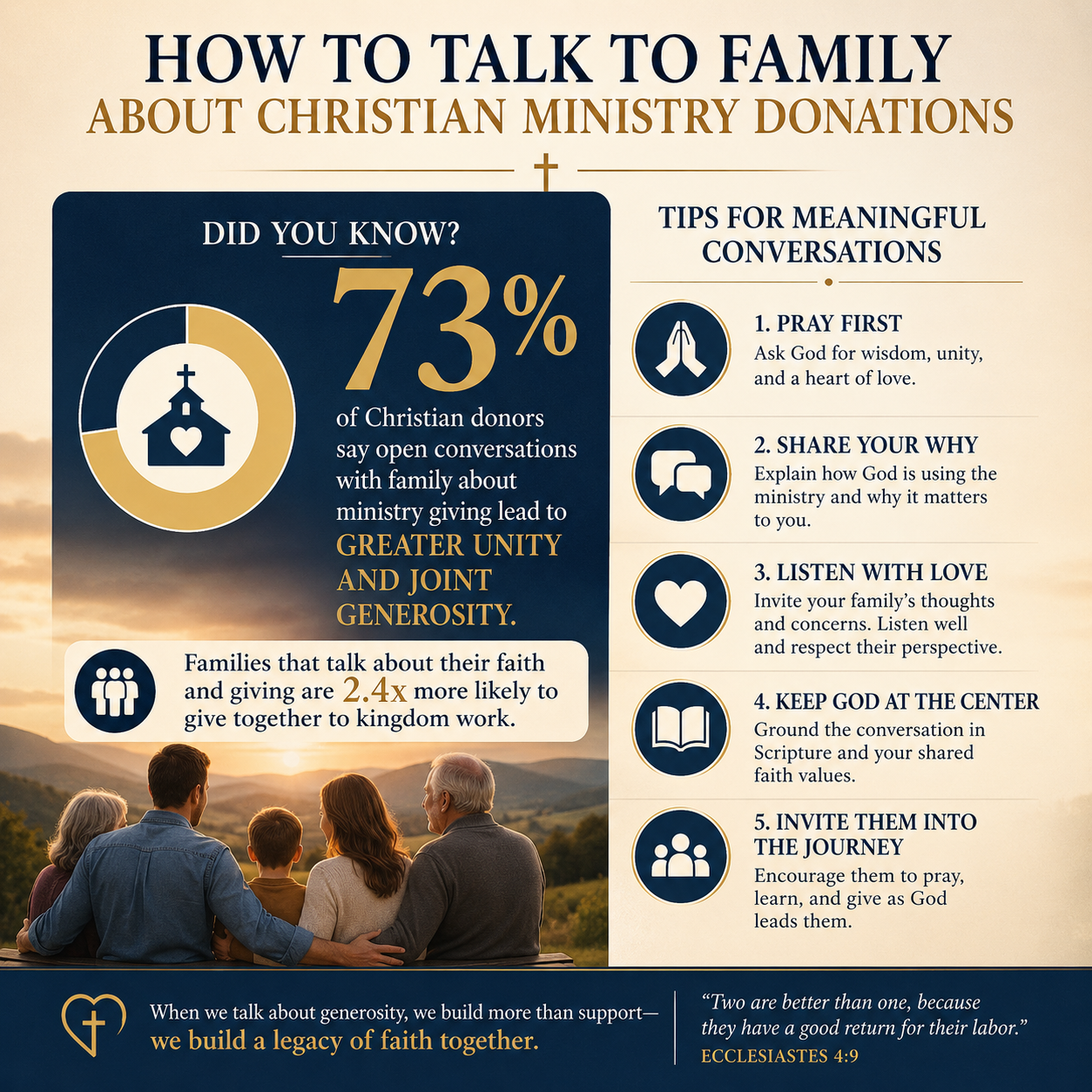
How to talk to family about Christian ministry donations is rarely a simple question of budget lines. It is a question of authority, trust, theological priorities, and the relational weight that money carries in families.
Many Christian donors already feel that weight. Some are trying to be faithful without appearing self-righteous. Others have watched a loved one give impulsively, or have lived through a ministry scandal that made the whole topic feel unsafe. Families also differ in conviction: some emphasize the local church first, others prioritize global relief, and others are cautious about any giving beyond immediate obligations. A mature conversation does not pretend those tensions are trivial; it disciplines them under Scripture and brings them into the light with patience.
Begin with shared theological ground rather than institutional loyalties
Anchor the conversation in worship, not in preference
Christian giving is not primarily a philanthropic hobby. It is an act of worship and a practice of discipleship under the lordship of Christ. Scripture consistently connects money to the heart: “Where your treasure is, there your heart will be also” (Matthew 6:21). When families disagree about which ministries to support, the underlying question is often what each person believes faithfulness looks like in the real world.
Shared ground usually exists even when giving patterns diverge: the authority of Scripture, the call to love neighbor, the priority of the gospel, and the conviction that resources are entrusted, not owned. We have found that conversations go better when donors name these commitments explicitly before discussing specific organizations or allocations. It changes the tone from “our family’s brand of generosity” to “our family’s obedience and joy.”
Distinguish convictions from preferences with care
Families can clarify what is biblically required, what is prudential wisdom, and what is personal calling. Christians genuinely disagree about some applications: the balance of local versus global giving, the place of explicitly evangelistic work within relief efforts, and whether designated giving should track measurable outcomes or be more open-handed. The New Testament offers both principled instruction and freedom within those principles, including differing callings within one body (1 Corinthians 12).
What this means in practice is that “faithful giving” can legitimately look different across siblings, spouses, and generations. A conversation becomes healthier when it aims for clarity and unity of love, not uniformity of strategy.

Make the relational goal explicit and refuse to weaponize giving
Speak about generosity as formation, not as superiority
Within families, giving can become a proxy battle for moral standing. Some use donations to signal that they are more serious Christians. Others respond by framing any giving as naive or performative. Both patterns deform stewardship.
Set a different aim: “We want our giving to be faithful, wise, and peaceable.” Peaceable does not mean conflict-free; it means governed by the wisdom “first pure, then peaceable, gentle, open to reason” (James 3:17). A donor can be firm about convictions without using money to win arguments or to punish relatives who do not share them.
Agree on boundaries before discussing amounts
Some family discussions require explicit boundaries, particularly where power dynamics exist. For example, adult children may need to state that their giving decisions are not subject to parental approval. Married couples may need to clarify that one spouse will not make significant gifts without joint consent. Older parents may need to hear that pressure or guilt will end the conversation rather than resolve it.
A short, shared boundary statement can preserve relationship while still allowing honest disagreement. If the family cannot agree on anything else, it is still possible to agree that conscience should be honored and that manipulation has no place in Christian decision-making.
Replace vague confidence with verifiable trust
Explain why verification matters without cynicism
Many donors hesitate to discuss ministry donations with family because they anticipate the same objection: “How do you know the money is handled well?” That question is not hostile; it is stewardship. The apostle Paul took pains to avoid any suspicion regarding the collection for Jerusalem, arranging accountable handling of funds “to avoid any criticism” (2 Corinthians 8:20–21).
Modern nonprofit realities make this more, not less, important. The Internal Revenue Service recognizes more than a million tax-exempt organizations in the United States, though not all are active charities; the scale alone creates wide variation in governance and practice IRS. Families do not need to become investigators, but they should not treat trust as a feeling. Trust should have reasons.
This is where Most Trusted’s work can serve a family conversation without turning it into a debate club. We verify Christian nonprofits against The Most Trusted Standard, a 15-criteria framework that examines faith foundation, financial integrity, governance and leadership, and transparency and effectiveness. When a donor can say, “We give here because it meets a defined standard,” the conversation shifts from personal taste to accountable stewardship.
Use a simple set of questions that respects both mission and method
Families often talk past each other because one side talks mission (“they serve widows”) and the other talks risk (“their board is weak”). Both matter. A brief set of shared questions can keep the discussion constructive:
- Is the ministry’s Christian identity and theological posture clear and consistent?
- Are financial statements available, understandable, and responsibly governed?
- Is leadership accountable through an active, independent board?
- Does the ministry describe outcomes candidly, including limits and setbacks?
- Are stories and images used with dignity, especially regarding children and the poor?
These questions do not guarantee agreement, but they raise the conversation above slogans. They also help families avoid the common mistake of treating “low overhead” as the primary measure of faithfulness. The nonprofit sector itself has warned donors against simplistic overhead ratios; Charity Navigator, GuideStar, and the BBB Wise Giving Alliance jointly argued that overhead alone is a poor indicator of effectiveness Charity Navigator.
Address the contested questions in relief and development directly
Discuss harm risks without shaming compassion
Christian relief and development is morally urgent and operationally complex. The needs are real. So are the unintended consequences of poorly designed help. The When Helping Hurts framework, articulated by Steve Corbett and Brian Fikkert, has reshaped how many Christian organizations think about dignity, dependency, and local agency. Families will not always agree on how to apply that framework, but it is a useful shared language for distinguishing compassion from effectiveness.
In family conversations, the most fruitful move is often to acknowledge both truths at once: “We should care deeply” and “we should learn how help can harm.” That posture resists two temptations: sentimental giving that demands no evidence, and cynical giving that refuses to act because perfect solutions do not exist.
Clarify what kind of impact claims the ministry can responsibly make
Some ministries operate in environments where rigorous measurement is difficult: conflict zones, closed countries, or complex community development contexts. Others have programs where outcomes can be tracked more directly: clean water systems, deworming campaigns, disaster response distributions, or locally-led agriculture training. Families should ask what kind of claims are appropriate to the work.
The harder question is whether the ministry is honest about what it can and cannot know. Overconfident impact claims often signal weak internal learning. Under-reporting can also be a red flag, especially when a ministry has years of operations but provides only generalities. Mature transparency names both fruit and limits, and it usually includes some description of external partnerships, local church involvement, and safeguards against paternalism.
For donors who want to explore organizations working in this space with greater confidence, our coverage of Christian Relief and Development Ministries is designed to keep theological commitments and operational accountability together rather than separating them.
Choose a practical plan for family giving decisions
Decide what unity means in your specific family system
Not every family needs a single giving plan. A married couple generally should have shared priorities and shared limits, because “the two become one flesh” is not sentimental language; it is a covenant reality that includes money. Extended families, however, may be better served by clarity about separate stewardship rather than forced consensus.
Some families do well with a “common fund plus personal calling” approach: a portion given together to mutually affirmed causes, and a portion left to individual conviction. This can preserve unity while honoring different burdens, including different local church commitments or different levels of interest in international development work.
Prepare for moments when the conversation must slow down
If a family member is suspicious of all ministries because of a past scandal, pressing for quick agreement often backfires. The more faithful path may be to rebuild trust incrementally: review a ministry’s public disclosures, ask for documentation rather than assurances, and take time to evaluate governance. The goal is not to force comfort, but to pursue wisdom.
Our team has observed that donors who have a defined evaluation framework tend to feel less relational pressure. They can say, without drama, “We will not support an organization that will not provide basic transparency,” and then keep the conversation focused on verifiable practices rather than personalities. For readers who want to strengthen those practices across their broader giving, Biblical Stewardship in Christian Relief and Development Giving is a natural place to continue that work.
FAQs for How to talk to family about Christian ministry donations
What if a family member thinks all Christian nonprofits are untrustworthy?
It is reasonable to acknowledge the reality of misconduct without accepting the premise that faithful ministry is impossible. A constructive response is to shift from reassurance to evidence: ask what disclosures and governance practices would be persuasive, and evaluate specific ministries against those criteria. Paul’s concern for handling funds above reproach (2 Corinthians 8:20–21) supports the legitimacy of due diligence as an act of stewardship rather than suspicion.
How do we handle disagreement about giving to relief versus evangelism?
Many Christians hold strong convictions here, and the New Testament does not reduce mission to a single activity. Scripture calls believers to proclaim Christ and to practice tangible mercy. A family can move forward by naming shared commitments, then clarifying whether the dispute is about theology, strategy, or trust in a specific organization. Where consensus is not possible, a shared portion of giving plus individually directed giving can preserve unity without forcing an artificial agreement.
A faithful conversation aims for truth, peace, and accountable love
Family conversations about Christian ministry donations succeed when they treat giving as discipleship, refuse manipulation, and pursue verifiable trust. The goal is not to win a debate over budgets; it is to honor Christ with resources that belong to him, in ways that protect both the vulnerable served and the relationships God has placed under our care.



