

How churches partner with Christian counseling ministries effectively is not a tactical question alone. It is a pastoral and stewardship question, because the care of souls is always entrusted care, and entrusted care requires both compassion and discernment.
Many donors have watched churches respond to mental health needs with sincere urgency and uneven judgment. The opportunity is significant: a faithful partnership can expand access to wise, Christ-centered care. The risk is also significant: mishandled referrals, unclear theology, or weak governance can harm vulnerable people and expose the church to preventable failures of accountability.
Begin with a pastoral theology of care
Distinguish between pastoral care and clinical care without separating them
Churches have a biblical mandate to bear one another’s burdens (Galatians 6:2) and to shepherd the flock with vigilance (Acts 20:28). That mandate does not require pastors to practice outside their competence. It requires churches to provide faithful care pathways, including competent counseling when suffering, trauma, addiction, or severe relational breakdown are present.
Christian counseling ministries occupy a space where discipleship, wisdom, and clinical skill intersect. Some operate as licensed mental health clinics with explicit doctrinal commitments; others function more as pastoral counseling centers. Christians genuinely disagree about the appropriate boundaries between spiritual formation and clinical practice, and those disagreements are not merely academic. What a church believes about sin, suffering, sanctification, and spiritual warfare will shape what it expects counseling to address and how it measures fruit.
Set expectations about Scripture, sanctification, and common grace
Effective partnerships begin with clarity. Churches should ask counseling ministries to articulate how Scripture functions in their counseling model, how they understand the relationship between spiritual and physiological factors, and how they approach medication, trauma treatment, and psychiatric referral when needed. Common grace does not threaten biblical authority; it can be received with discernment. At the same time, a counseling approach that evacuates sin, repentance, and hope in Christ will not serve the church’s people well.
For donors, this is an early indicator of whether a partnership is built on a shared account of what human beings are and what restoration requires. That clarity is also protective. Vague spiritual language can conceal incompatible assumptions.

Define partnership models that protect counselees
Choose a model aligned with risk, capacity, and access
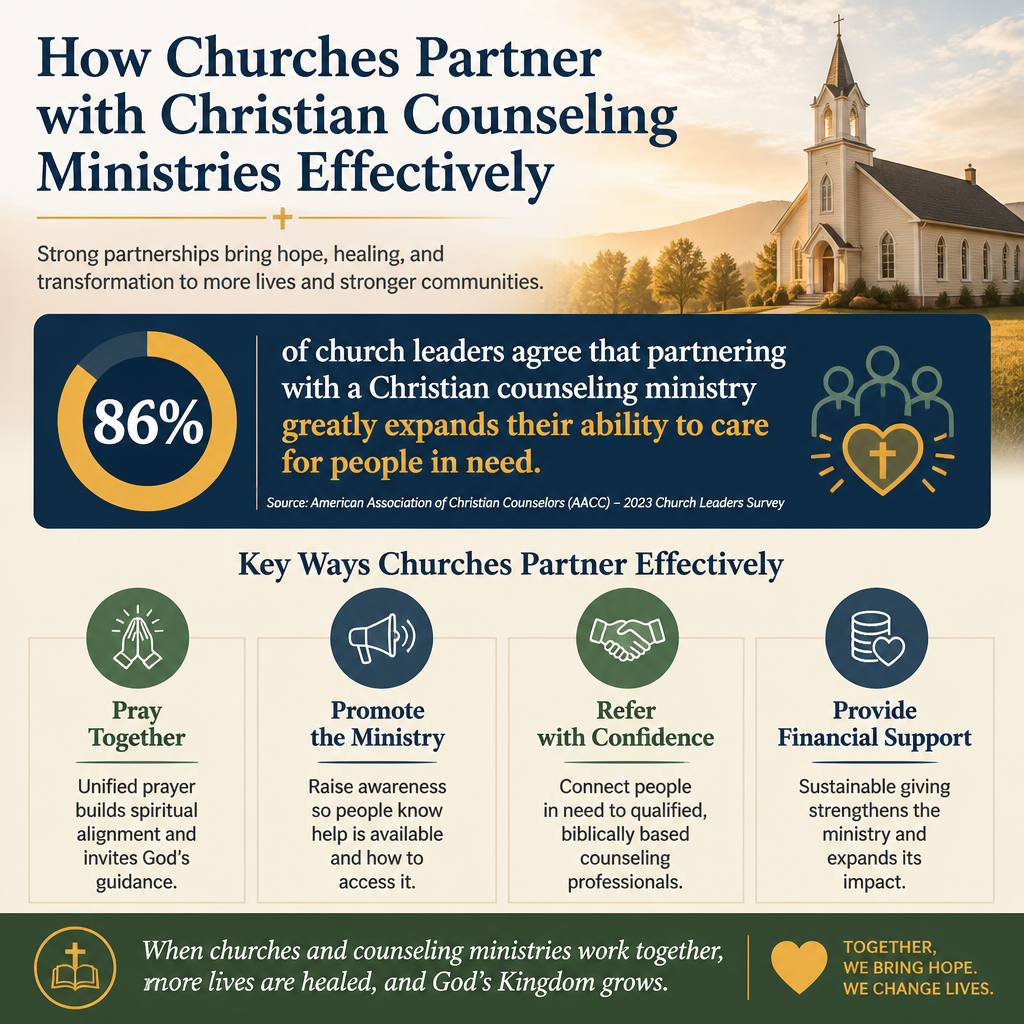
Churches generally partner with Christian counseling ministries in one of three ways: (1) referral relationships, (2) subsidized counseling for members or the community, or (3) integrated services such as on-site counseling or co-located clinics. Each model has trade-offs. A referral list is low-cost but can become careless if it is not curated. Subsidies expand access but require disciplined oversight. Integrated services improve continuity of care but raise the stakes for policy, supervision, and liability.
Access pressures are real. In recent years, many communities have faced long waits for therapy, and churches often become the place where people ask first. The U.S. Health Resources and Services Administration designates extensive “Mental Health Professional Shortage Areas,” a structural reality that affects rural and urban communities alike HRSA.
Build safeguards around referral and confidentiality
Counselees often arrive with layers of vulnerability: marital crisis, suicidal ideation, abuse histories, or addiction. A partnership must be designed to protect them. Churches should insist on written policies for informed consent, confidentiality, recordkeeping, mandated reporting, and emergency protocols. If a ministry is not licensed, churches should be candid about what that means for clinical scope, supervision, and reporting standards in their jurisdiction.
Effective partnerships also clarify what the church will and will not ask of the counseling ministry. Pastors may desire feedback to shepherd well; clinicians must protect confidentiality. A mature partnership establishes consent-based communication channels and avoids informal “backchannel” updates that erode trust.
Evaluate counseling ministries with the same rigor used for any ministry
Faith commitments should be explicit and operational
Donors understand that “Christian” can signal anything from a historical affiliation to a robust doctrinal framework. Churches should evaluate whether faith commitments shape practice: hiring, supervision, counseling approach, and ethical boundaries. A clear statement of faith matters, but so does evidence that leaders enforce it with consistency and charity.
This is one reason our team at Most Trusted emphasizes verification rather than sentiment. A ministry’s public language may be sincere and still fail basic standards of governance, financial integrity, or transparency. Donors have learned that character claims require corroboration.
Governance and accountability are not secondary in soul care
Christian counseling can involve profound influence over a person’s choices, beliefs, marriages, and sense of safety. That influence demands accountable leadership. Churches should examine board independence, conflict-of-interest policies, complaint pathways, professional supervision structures, and safeguarding practices for minors and vulnerable adults. Where licensure applies, churches should confirm that counselors hold current credentials and that the ministry has appropriate clinical oversight.
We recommend donors and church leaders look for evidence consistent with The Most Trusted Standard: clear doctrinal grounding, transparent finances, accountable leadership, and verifiable outcomes. These are not bureaucratic preferences. They are forms of neighbor-love expressed through responsible stewardship.
For donors who want broader context on the field, the directory of Christian Counseling Ministries can be a useful starting point for understanding the landscape churches are navigating.
Fund partnerships in ways that strengthen care rather than distort it
Avoid the hidden incentives that drive shallow counseling
Funding structures shape ministry behavior. If a church funds counseling only when a crisis is visible, leaders may unintentionally reward emergency-only care rather than steady discipleship and relapse prevention. If a church reimburses only for high caseload volume, a counseling ministry may be pushed toward short sessions, limited follow-up, and burnout among clinicians.
The field has also had to reckon with the “overhead” debate in nonprofits. Donors often want to fund direct services and avoid administration, but counseling ministries require supervision, training, secure record systems, and safeguarding infrastructure. The Overhead Myth letter—signed by leading nonprofit evaluators—argues that overhead ratios are poor measures of performance and can incentivize unhealthy underinvestment in capacity Candid GuideStar.
Use targeted subsidies and clear eligibility standards
Many churches rightly want counseling to be accessible to those with limited means. The most effective models tend to pair generosity with clarity: a defined number of subsidized sessions, documented financial need criteria, and a plan for continuity of care when the subsidy ends. Churches can also fund group therapy, marriage intensives, or trauma-informed classes when those services are clinically appropriate and responsibly led.
A short set of practices often improves both stewardship and care quality:
- Require a written memorandum of understanding defining scope, referral protocol, and crisis procedures
- Fund supervision, training, and safeguarding systems alongside counseling sessions
- Set clear subsidy limits and review processes to prevent inequity or favoritism
- Ensure a documented process for complaints and adverse incidents
- Review annual reporting that includes finances, service volume, and client feedback mechanisms
Measure fruit with honesty about what counseling can and cannot prove
Respect the limits of outcomes in confidential care
Donors often ask for metrics, and they should. Yet counseling is not a program where outcomes are easily reduced to a dashboard. Confidentiality rightly constrains what can be reported. Human change is also complex: progress may include setbacks, and the most significant outcomes may be spiritual resilience, repaired relationships, or sustained sobriety that is not captured by a simple count.
Still, ministries can offer meaningful evidence without violating privacy: utilization rates, retention patterns, average wait times, clinical supervision ratios, client satisfaction methodologies, and aggregate improvement measures when validated tools are used appropriately. Churches can also assess whether the counseling ministry has clear processes for risk management, including suicide assessment protocols and referral pathways for higher levels of care.
Do not ignore the pastoral integration question
One of the most common failure points is the gap between counseling and the life of the church. If counseling becomes detached from worship, community, confession, and ordinary discipleship, it can become a parallel institution rather than a supportive service. Conversely, if the church pressures counseling into premature “spiritual fixes,” counselees may learn to hide pain rather than bring it into the light.
Effective partnerships address integration with consent and care: optional coordination with pastors, thoughtful recommendations for community support, and clear boundaries that honor both spiritual authority and clinical ethics. Donors who care about long-term spiritual fruit should ask churches not merely whether counseling exists, but whether it is wisely situated within the church’s discipleship ecosystem.
For donors seeking to understand how churches structure these relationships across different models, Church Partnerships with Christian Counseling Ministries provides a window into the patterns we see across the sector.
FAQs for How churches partner with Christian counseling ministries effectively
Should a church only partner with licensed counselors?
Licensure is a meaningful protection because it signals formal training, ethical standards, and accountability mechanisms. Yet some churches also work with pastoral counselors or biblical counselors who are not licensed. The responsible question is not merely licensure, but scope and safeguards: what kinds of cases are accepted, what supervision exists, what referral pathways are in place for severe mental illness, suicidality, abuse, or complex trauma, and whether counselees give informed consent about the nature of care.
What should donors ask before funding a church counseling partnership?
Donors can ask for the partnership agreement, the counseling ministry’s statement of faith and counseling model, evidence of governance and conflict-of-interest controls, safeguarding and crisis protocols, and a clear description of how subsidies are administered. Donors can also ask how the church will prevent perverse incentives, fund supervision and training, and report aggregate evidence of service quality without compromising confidentiality. These questions align naturally with the kind of verification Most Trusted applies through The Most Trusted Standard.
A partnership worth funding is a partnership built for trust
Churches partner with Christian counseling ministries effectively when they treat counseling as entrusted care: theologically serious, clinically competent, and accountable in governance and finances. Donors should not be asked to choose between compassion and rigor. The church’s calling to heal the brokenhearted does not weaken the case for careful verification; it strengthens it.



