

Hosting a Christian anti-trafficking awareness event is not primarily an exercise in publicity. It is a moment of moral formation for a congregation and a test of whether our compassion will be governed by truth. The cause is urgent, but the field has learned that urgency can produce careless claims, misplaced confidence, and even harm to survivors.
The question is not whether Christians should care. Scripture is unambiguous about God’s opposition to oppression and exploitation, and the church’s obligation to seek justice for the vulnerable (Isaiah 1:17). The harder question is how to convene donors, pastors, and volunteers in a way that deepens discernment, honors those who have been exploited, and directs resources to work that is demonstrably faithful and effective.
1. Begin with theological clarity and moral restraint
Make the imago Dei your first principle
Anti-trafficking communication often fails at the first doctrine. If every person bears the image of God, survivors must never be treated as illustrations for a cause, and perpetrators must never be reduced to caricatures that make us feel righteous. A Christian event should frame trafficking as an assault on the dignity of persons made for communion with God and neighbor, and therefore as a concern that touches evangelism, discipleship, family life, and public witness.
This theological framing also guards against a familiar temptation: to treat “awareness” as a substitute for costly love. Awareness can be necessary, but Scripture presses beyond sentiment into action shaped by wisdom. Christians can agree on the mandate to resist oppression while disagreeing about tactics, policy approaches, or the best models of survivor care. An awareness event that admits these tensions tends to mature a congregation rather than inflame it.
Refuse sensationalism and the false certainty it brings
Trafficking is real, but it is not helped by inflated numbers, conspiracy-driven narratives, or lurid stories that collapse complex realities into a single storyline. Donors should hear sober definitions: the difference between sex trafficking, labor trafficking, exploitation that does not meet legal thresholds, and commercial sexual exploitation of children. Clear language builds trust and prevents a congregation from being manipulated by fear.
When Christian communities repeat doubtful claims, we risk both reputational damage and misdirected funding. The better posture is moral restraint: we will not say more than we can responsibly substantiate, and we will not use trauma as a fundraising tool.

2. Set the purpose of the event before choosing the format
Choose one primary outcome and design around it
Many events fail because they try to do everything at once: raise money, recruit volunteers, educate teenagers, influence local policy, and showcase a ministry partner. A more disciplined approach is to choose one primary outcome. For donor audiences, the strongest outcomes are typically (1) informed giving to vetted work, (2) long-term prayer and pastoral engagement, and (3) concrete prevention practices in the local church.
Across our verification work at Most Trusted, we observe that healthy ministries can describe their outcomes in plain terms and can name what their work does not attempt. The ministries that meet The Most Trusted Standard tend to resist inflated promises, especially in a field where “rescue” language can create unrealistic expectations about speed, scale, and certainty.
Select a format that fits the outcome and protects people
For awareness and donor discernment, a moderated conversation often serves better than a dramatic presentation. Consider a panel with a clinician, a local service provider, and a ministry leader with clear safeguarding practices. If the event includes testimony, the standard should be higher than “moving.” It should be voluntary, trauma-informed, and structured so that no one is pressured to disclose details to satisfy an audience’s curiosity.
What this means in practice is that “story” must serve truth and neighbor-love, not the emotional arc of an evening.
3. Build your content around evidence and lived realities, not headlines
Use credible sources and define terms in public
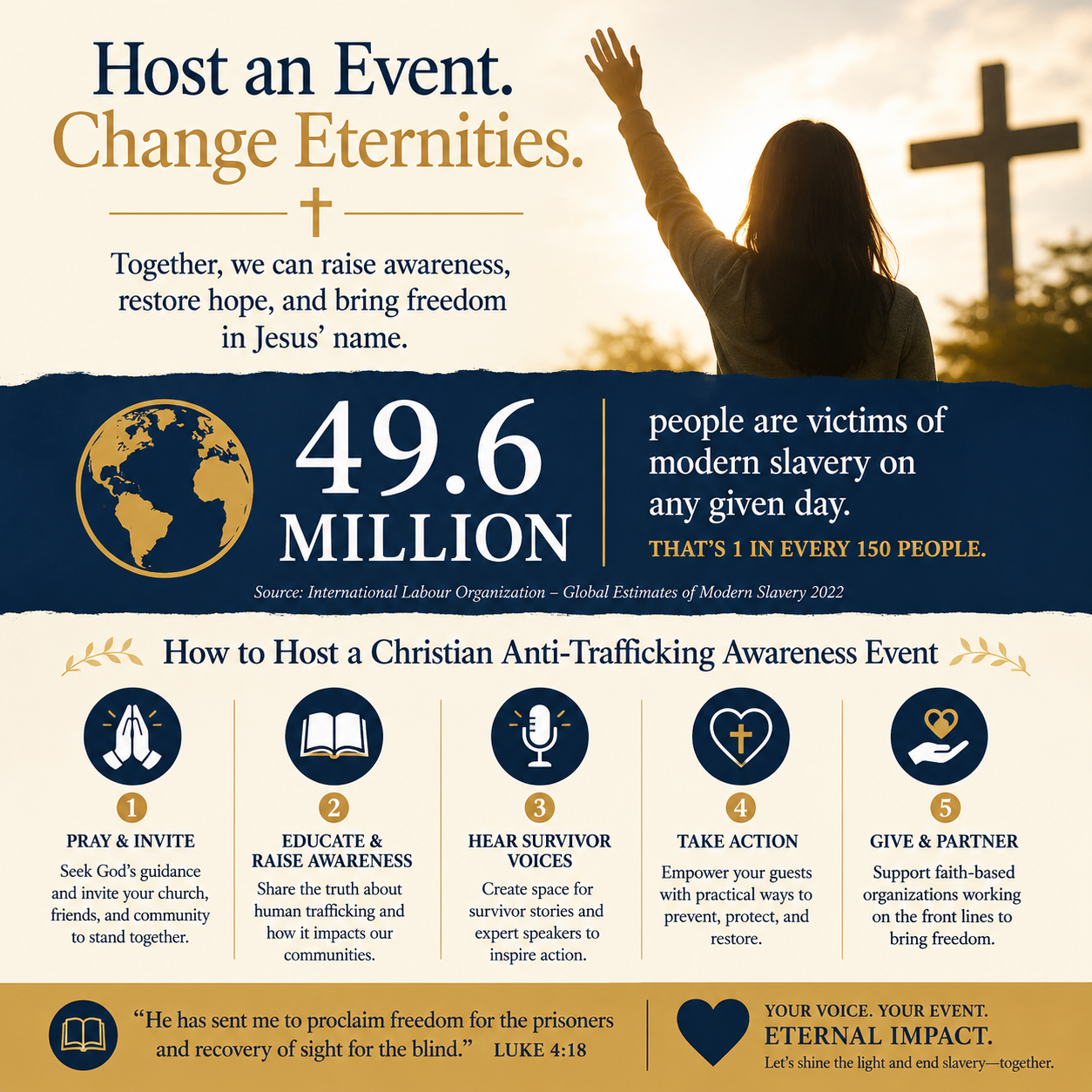
Anti-trafficking work requires precision because the public conversation is often imprecise. If the event includes a short “what we know” segment, keep it limited to claims you can responsibly cite and explain. For example, the International Labour Organization estimates that 27.6 million people are in forced labor globally, a figure that includes forced sexual exploitation and forced labor in other sectors; that estimate should be used with clarity about what it does and does not measure International Labour Organization.
In the United States, the National Human Trafficking Hotline provides aggregated data on contacts and signals rather than comprehensive prevalence. That distinction matters: hotline data can illuminate patterns and needs, but it does not tell us the total number of trafficking cases in a community National Human Trafficking Hotline.
Donors generally appreciate this candor. A congregation does not need dramatic certainty; it needs truthful confidence, paired with humility about what we cannot quantify.
Address prevention without sliding into suspicion culture
Some awareness events unintentionally cultivate paranoia: every child’s photo becomes suspect, every unfamiliar adult becomes a threat, and parents are left afraid rather than equipped. Prevention can be taught without fear. Emphasize healthy boundaries, digital literacy, and the role of stable relationships. In many contexts, the most faithful prevention work looks like ordinary discipleship: parents who know their children, churches that are safe to disclose in, and leaders trained to respond wisely.
This is also the place to connect the event to the broader work of Prevention and Education in Christian Anti-Trafficking Ministries, because prevention is not an add-on to “real ministry.” It is a central expression of Christian love for neighbor when practiced with competence.
4. Choose partners with governance, safeguarding, and financial integrity
Vet the ministry partner before giving them the microphone
A Christian anti-trafficking event implicitly commends the people on stage. For donors, the question is not merely whether a ministry is passionate, but whether it is accountable. Basic due diligence should include governing board independence, transparent financial reporting, clear child and adult safeguarding policies, and a realistic explanation of programs and outcomes.
At Most Trusted, our role is to help donors give with confidence by evaluating Christian nonprofits against The Most Trusted Standard, a 15-criteria framework spanning Faith Foundation, Financial Integrity, Governance and Leadership, and Transparency and Effectiveness. Even when a church does not use a third-party verifier, the logic holds: the more emotionally charged the cause, the more disciplined the verification should be.
Ask questions that reveal maturity rather than marketing
Before inviting a partner, ask questions that surface how they think, not merely what they claim. A short list can guide an initial conversation:
- How do you define trafficking, and how do you distinguish it from other forms of exploitation?
- What safeguarding policies govern your staff, volunteers, and partners?
- How do you avoid retraumatizing survivors in storytelling and fundraising?
- What outcomes do you track, and what outcomes do you refuse to promise?
- What is your relationship with local authorities and service providers, and how do you handle disagreements?
These questions protect the church and, more importantly, protect survivors. They also help donors avoid a common error: funding work that looks heroic but is structurally unaccountable.
5. Design the evening for discipleship, not just donations
Plan the pastoral and ethical details that are easy to overlook
If the event includes prayer, make it intercessory rather than performative: prayer for survivors’ healing, for repentance where the church has been complicit, for courage to address demand, and for integrity in institutions. If the event includes an offering, communicate the terms clearly: whether funds are restricted, how they will be distributed, and how follow-up reporting will occur.
Churches should also decide ahead of time how disclosures will be handled. Awareness events sometimes prompt attendees to disclose abuse or exploitation. A mature plan includes trained responders, clear mandatory reporting guidance where applicable, and a pathway to professional care. This is a place where a church’s internal safeguarding culture matters as much as any external partnership.
Create a follow-up pathway that honors donor stewardship
Donors who attend an anti-trafficking event are often looking for a way to give that is both compassionate and responsible. The event should therefore include a follow-up mechanism that does not rely on lingering emotion: a written list of vetted partners, a recommended reading list grounded in credible research, and a timeline for hearing back about impact.
It can also be appropriate to situate the event in the wider landscape of Christian Anti-Trafficking Ministries, because donors rarely want to fund a moment. They want to fund a sustained strategy: prevention, survivor care, and institutional accountability, pursued with patience and courage.
FAQs for How to host a Christian anti-trafficking awareness event
Should a church use survivor testimony at an awareness event?
Sometimes, but not by default. Testimony should be voluntary, trauma-informed, and structured so the survivor retains control over what is shared. Churches should avoid details that satisfy curiosity or intensify emotion without increasing understanding. A moderated conversation with clear boundaries is often safer than an open-ended narrative, and written testimony can sometimes reduce pressure while still honoring a person’s voice.
How should donors evaluate an anti-trafficking ministry presented at the event?
Donors should look for governance and transparency as carefully as they look for compassion. Practical indicators include accessible financial statements, an accountable board, clear safeguarding policies, and a realistic description of outcomes. Ministries that communicate with restraint, acknowledge limitations, and avoid sensational claims tend to be safer partners for long-term Christian stewardship.
A faithful awareness event is measured by truth, not volume
Christian anti-trafficking awareness is not faithful because it is large, loud, or emotionally intense. It is faithful when it is truthful, when it protects the vulnerable from further harm, and when it forms donors and congregations into wiser stewards. The goal is not to win a news cycle; it is to love our neighbors with integrity, guided by Scripture and disciplined by evidence.



