

Knowing how to spot fundraising red flags in Bible distribution ministries is not cynicism; it is Christian stewardship under pressure. Bible distribution carries a moral weight because the object in view is not a generic good, but the Word of God entrusted to the church for faithful transmission.
Scripture holds two truths together. We are warned against hardened suspicion that refuses to believe good (1 Corinthians 13:7). We are also commanded to test what claims spiritual authority and to handle resources in ways that withstand light (1 Thessalonians 5:21; 2 Corinthians 8:20–21). Mature donors learn to live in that tension: generosity that moves promptly, and diligence that refuses manipulation.
Fundraising appeals should sound like Christian truth, not spiritual coercion
When urgency becomes a substitute for evidence
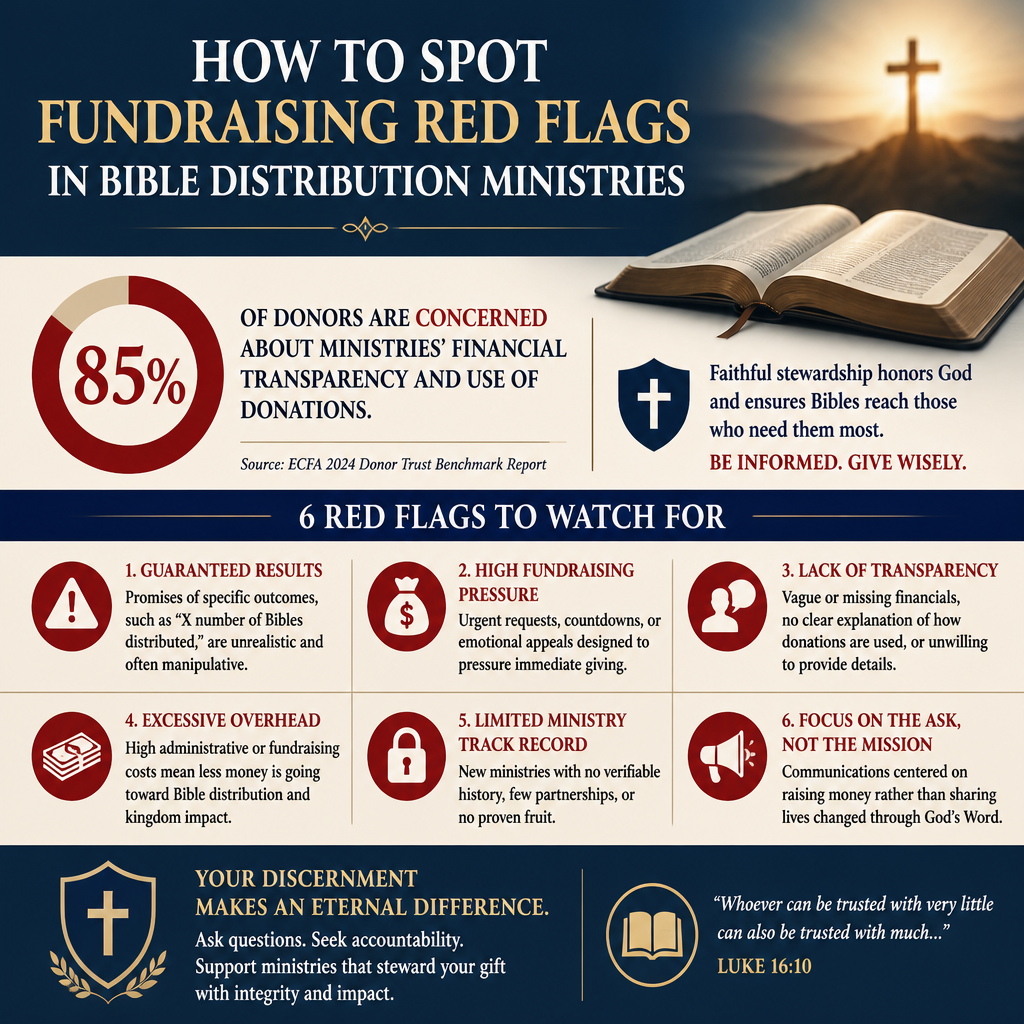
Bible distribution is often conducted in contexts where urgency is real: conflict zones, refugee flows, closed countries, and fragile local churches. The presence of urgency is not a red flag. The red flag appears when urgency is used to bypass ordinary accountability: “We cannot disclose details,” “We cannot share partners,” “We cannot provide receipts,” “We cannot report outcomes,” and yet donors are expected to give immediately and repeatedly.
Healthy ministries can protect sensitive field information while still providing verifiable assurance: audited financials, a clear description of in-country controls, a credible risk policy, and reporting that can be checked by a third party. Christians genuinely disagree about how much operational secrecy is warranted in hostile environments; what cannot be justified is secrecy that becomes a shield against any scrutiny at all.
When Scripture is deployed as a fundraising weapon
Another red flag is the spiritualization of giving in ways that flatten Scripture’s own pastoral wisdom. Appeals that imply a donor’s hesitancy proves unbelief, that questions are rebellion, or that God’s blessing is mechanically tied to a gift are borrowing more from manipulation than from the New Testament’s vision of generous freedom (2 Corinthians 9:7).
We have observed across verification work at Most Trusted that ministries aligned with The Most Trusted Standard tend to invite donor questions without moralizing them. They can say, “Here is what we know; here is what we cannot disclose; here is how oversight works; here is what an independent auditor and board see.” That posture is not merely good practice; it is consistent with the apostolic concern to avoid any appearance of mishandling funds.

Financial signals often reveal whether a ministry is built for trust or for extraction
What to ask for before you evaluate ratios
Donors are often trained to look for a single “good” overhead percentage. That instinct is understandable, but it is not sufficient. The nonprofit sector has repeatedly warned that overhead fixation can distort behavior and penalize necessary investments in systems, controls, and evaluation. Charity Navigator, Candid, and BBB Wise Giving Alliance made this case publicly in their joint “Overhead Myth” letter, urging donors to look beyond simplistic overhead measures and attend to governance, transparency, and results Charity Navigator.
For Bible distribution ministries, the more revealing questions are concrete. Does the ministry publish an independent audit? Are related-party transactions disclosed? Is there a clear policy for restricted gifts? Do financial statements distinguish between Bibles purchased, printed, shipped, and locally distributed, or are these categories blended in ways that prevent meaningful understanding?
Common financial red flags in Bible distribution
Some patterns recur across the sector, including in sincere ministries that have not yet developed mature controls. Donors should not assume ill intent from one signal, but multiple signals should prompt restraint and verification.
- Unverifiable unit claims: “$3 delivers a Bible to a closed country,” stated without explaining what costs are included and how delivery is confirmed.
- Opaque “program expense” reporting: large program totals with little line-item clarity for printing, freight, customs, local distribution, and partner support.
- High fundraising spend without disclosure: heavy direct mail or digital acquisition with minimal explanation of donor retention strategy and long-term sustainability.
- Restricted-gift ambiguity: solicitations for a named country or people group with no clear accounting for what happens when the project is delayed or access is denied.
- Board independence questions: a board made up primarily of staff, family members, or major vendors, without a transparent conflict-of-interest policy.
These are not merely administrative concerns. Scripture treats financial integrity as spiritual integrity because money reveals what a ministry truly serves (Matthew 6:24). When reporting is consistently unclear, donors should ask whether the ministry has the competence and humility required for faithful stewardship.
Claims about impact must be tethered to definable outcomes and credible controls
Counting Bibles is not the same as counting access
Bible distribution is measurable in one sense—units printed or purchased—and difficult to measure in another—actual access, use, and discipleship impact. The red flag is not that a ministry cannot quantify spiritual fruit. The red flag is when a ministry speaks as though distribution numbers automatically equal transformed lives, without acknowledging the intervening realities: literacy, language suitability, local church presence, and the dangers of black-market diversion.
A mature ministry can report in layers. It can distinguish “Bibles procured,” “Bibles shipped,” “Bibles delivered to partner,” and “Bibles placed into the hands of end recipients,” with a description of what documentation supports each claim. It can name the translation and why it is appropriate, explain how it avoids undermining local publishers, and show how local pastors or networks govern distribution.
Translation, licensing, and theological accountability
Not all Bible distribution is identical. Some ministries distribute public-domain texts; others distribute copyrighted translations under license; others fund translation work for minority languages. Donors should ask basic questions that are too often absent from fundraising: Which translation is being distributed? Is the translation recognized by credible church bodies and translation organizations? Is licensing honored?
These questions are not pedantry. They go to faithfulness. The church has always treated the transmission of Scripture as a sacred trust, requiring both zeal and care (2 Timothy 2:15). A ministry that is casual about licensing, translation provenance, or doctrinal accountability is asking donors to accept spiritual authority without the corresponding responsibility.
Governance and leadership patterns often predict future scandals more than any one metric
When a founder is untouchable
Bible distribution ministries are frequently founder-led. That can be a gift: courage, sacrifice, and decades of relationships. It can also become a vulnerability when the ministry’s identity collapses into a single personality and the board exists mainly to applaud.
Donors should look for signs of real oversight: a board with independent members, documented meetings, clear delegated authority, and the ability to say “no” to leadership. When fundraising materials subtly imply that questioning leadership equals opposing God’s work, the governance problem has already become a discipleship problem.
Compensation, related parties, and conflict of interest
Many donors are uncomfortable raising compensation questions in Christian contexts. Yet Scripture requires leaders to be “above reproach,” including in financial matters (1 Timothy 3:2–3). Donors should expect clear disclosure of executive compensation, a conflict-of-interest policy, and transparent handling of related-party transactions such as printing contracts, freight arrangements, or property leases involving board members or family.
When ministries refuse these disclosures as “worldly” expectations, donors should remember that the apostolic pattern was not secrecy but deliberate transparency, “taking pains to do what is right, not only in the eyes of the Lord but also in the eyes of man” (2 Corinthians 8:21).
Transparency is a theological practice, not a donor-service feature
What trustworthy transparency looks like in restricted contexts
Closed-country work requires discretion, and donors should respect legitimate security concerns. Still, transparency can be practiced without endangering partners. Ministries can provide redacted audits, third-party verification letters, aggregated country reporting, and clear descriptions of safeguarding and anti-diversion controls. They can also publish governance documents and policies that do not compromise security: whistleblower protections, safeguarding standards, gift acceptance rules, and partner due diligence processes.
Across our evaluations at Most Trusted, the ministries that earn durable trust do not treat transparency as a marketing posture. They treat it as moral formation: a commitment to tell the truth, to correct mistakes publicly when necessary, and to invite oversight because God’s work does not fear the light (John 3:21).
How donors can apply structured diligence without becoming suspicious
Donors do not need to become investigators. A small set of disciplined questions, asked consistently, will filter out a significant portion of preventable risk. For readers who want broader context on the field, we address the unique dynamics of Bible Distribution Ministries across theology, operations, and donor accountability. For readers focused specifically on disclosure practices and reporting expectations, we outline standards and common failure points in Accountability and Transparency in Bible Distribution Ministries.
Most Trusted exists because donors are not wrong to feel tension. Many have watched sincere Christians give sacrificially, only to discover later that a ministry’s claims were inflated or its controls were inadequate. The Most Trusted Standard gives donors a coherent way to evaluate ministries across faith foundation, financial integrity, governance and leadership, and transparency and effectiveness—without reducing complex realities to a single score.
FAQs for How to spot fundraising red flags in Bible distribution ministries
Is it a red flag if a Bible distribution ministry cannot name the country or partners?
Not necessarily. In hostile environments, naming partners can create real risk. The concern arises when a ministry cannot provide any alternative form of verification: independent financial oversight, a credible description of controls, or reporting that can be corroborated by a qualified third party. Discretion and accountability can coexist; a blanket refusal to substantiate claims should change a donor’s posture from enthusiasm to due diligence.
Should donors avoid Bible distribution ministries with high fundraising costs?
High fundraising costs are not automatically disqualifying, especially for ministries investing in donor acquisition that produces long-term net revenue for the mission. The better question is whether the ministry explains its fundraising strategy candidly, reports results transparently, and demonstrates strong governance over contractor arrangements and messaging. Donors should be cautious when fundraising is aggressive but financial disclosure is thin, impact claims are overstated, and leadership oversight is weak.
Giving with open eyes honors the Word we long to spread
Bible distribution ministries deserve donors who are both generous and discerning. When fundraising depends on coercion, secrecy, or unverifiable claims, the problem is not merely reputational; it is spiritual, because it trains the church to confuse zeal with truthfulness.
The wiser path is not withdrawal but tested confidence: asking for evidence, honoring legitimate security limits, and supporting ministries whose governance and reporting make it easier to give with joy. That posture aligns with Scripture’s insistence that Christian ministry be conducted “in the sight of God” and in a manner that withstands public scrutiny.



