
How to sponsor artifact conservation at biblical museum ministries is ultimately a question of stewardship: whether our giving preserves fragile testimony for future disciples, or funds activity without durable fruit. Conservation is not a romantic category for many donors, but it is often the difference between an object that can be studied and taught from for decades and an object that silently deteriorates in storage.
Most donors who care about Scripture also care about credibility. Museums and collections that serve the church sit at a difficult intersection: faith commitments, academic standards, public scrutiny, and the hard material realities of climate control, chemical stability, security, and provenance documentation. Sponsorship can be one of the most meaningful ways to strengthen that intersection—if it is structured with clarity, theological restraint, and verifiable accountability.
Conservation is not decoration but preservation of witness
Why biblical collections require specialized care
Artifact conservation is a technical discipline ordered toward a moral end: truthfully handing down what has been received. Organic materials degrade. Metals corrode. Pigments shift. Adhesives fail. Even stable stone and ceramics can be damaged by salts, microfractures, poor mounting, or repeated handling. A responsible biblical museum ministry does not treat objects as devotional props; it treats them as entrusted materials whose integrity matters for scholarship, education, and public understanding.
That integrity is not only physical. Many of the most consequential failures in the museum world have been failures of documentation and provenance rather than failures of humidity control. Christian donors are right to be cautious. Scripture commends honest weights and measures (Proverbs 11:1), and the modern equivalent includes accurate catalog records, lawful acquisition, clear chain-of-custody, and disclosures that do not overstate what an object can prove.
Theological sobriety about what artifacts can and cannot do
Christians genuinely disagree about the role of material culture in strengthening faith. Some fear that artifacts become substitutes for Scripture or that museum display becomes a form of marketing. Others see faithful preservation as consonant with biblical patterns of memorial and testimony—stones of remembrance in Joshua 4, or Paul’s appeal to public history in Acts 17.
What this means in practice is that mature sponsorship refuses both extremes. We do not sponsor conservation to “prove the Bible” through spectacle. We sponsor it so that honest, well-documented objects and inscriptions can be studied, taught, and presented without distortion. That is closer to the posture of Luke’s careful investigation (Luke 1:3) than to sensationalism.
What responsible sponsorship actually funds
Direct treatment and indirect conditions that make treatment possible
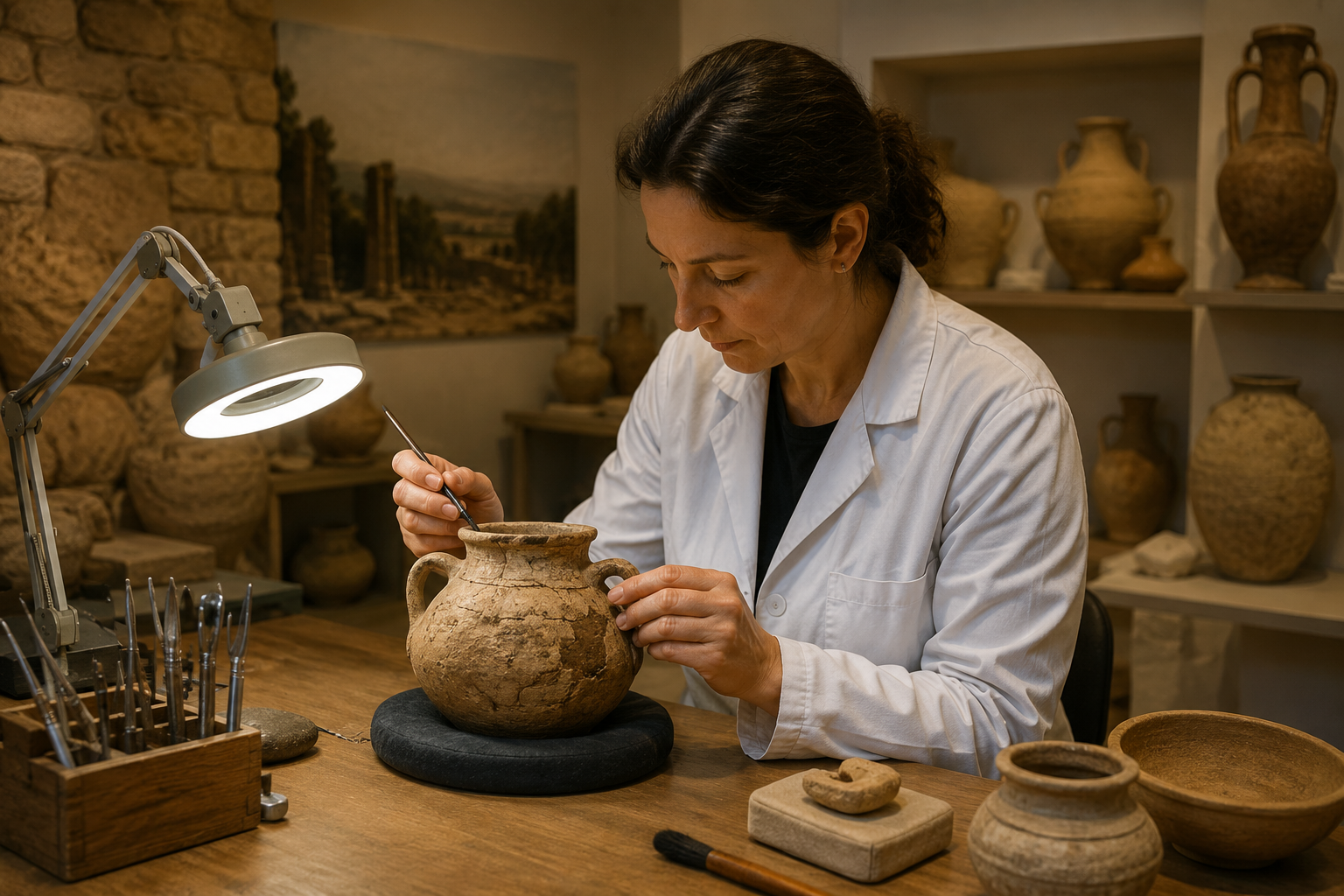
Donors often imagine conservation as a single moment: a conservator repairing a cracked pot or stabilizing a manuscript leaf. In reality, the treatment is only one part of a chain. A museum can pay for a conservation report and still fail the object if storage is unstable, staff are untrained, or monitoring is absent.
A well-designed sponsorship can fund both the “hands-on” intervention and the conditions that prevent recurring damage. That includes environmental monitoring, archival housing, mounts, and staff training—costs that donors sometimes mislabel as “overhead,” though they are the mission when the mission is preservation.
Budgets that tell the truth about capacity
Many ministries have learned that underfunded conservation creates a starvation cycle: short-term funding pressures lead to deferred maintenance, rushed work, and avoidable future costs. Stanford Social Innovation Review has described this dynamic as the “Nonprofit Starvation Cycle,” in which funders’ preference for artificially low administrative costs pushes organizations toward chronic underinvestment in essential infrastructure.Stanford Social Innovation Review
For donors, the implication is uncomfortable but necessary: a conservation sponsorship that refuses to fund documentation, storage, and quality controls may unintentionally subsidize a ministry’s public-facing programs while leaving the collections at risk. Strong ministries will name these trade-offs plainly rather than hiding them.
- Conservation assessment: condition reports, treatment proposals, and risk prioritization
- Stabilization and treatment: cleaning, consolidation, desalination, corrosion inhibition, repairs
- Preventive conservation: monitoring, pest management, archival enclosures, safe mounts
- Documentation: cataloging, imaging, materials analysis, updated provenance files
- Stewardship safeguards: handling protocols, staff training, emergency planning
How to evaluate a biblical museum ministry before you sponsor
Due diligence that respects both faith and public accountability
Christian giving is not exempt from prudence. Jesus commends counting the cost (Luke 14:28). Museum ministries often work with restricted gifts and donor expectations that can unintentionally create perverse incentives. The mature donor asks for evidence of governance maturity, financial integrity, and transparency—not because the ministry is presumed guilty, but because stewardship requires clarity.
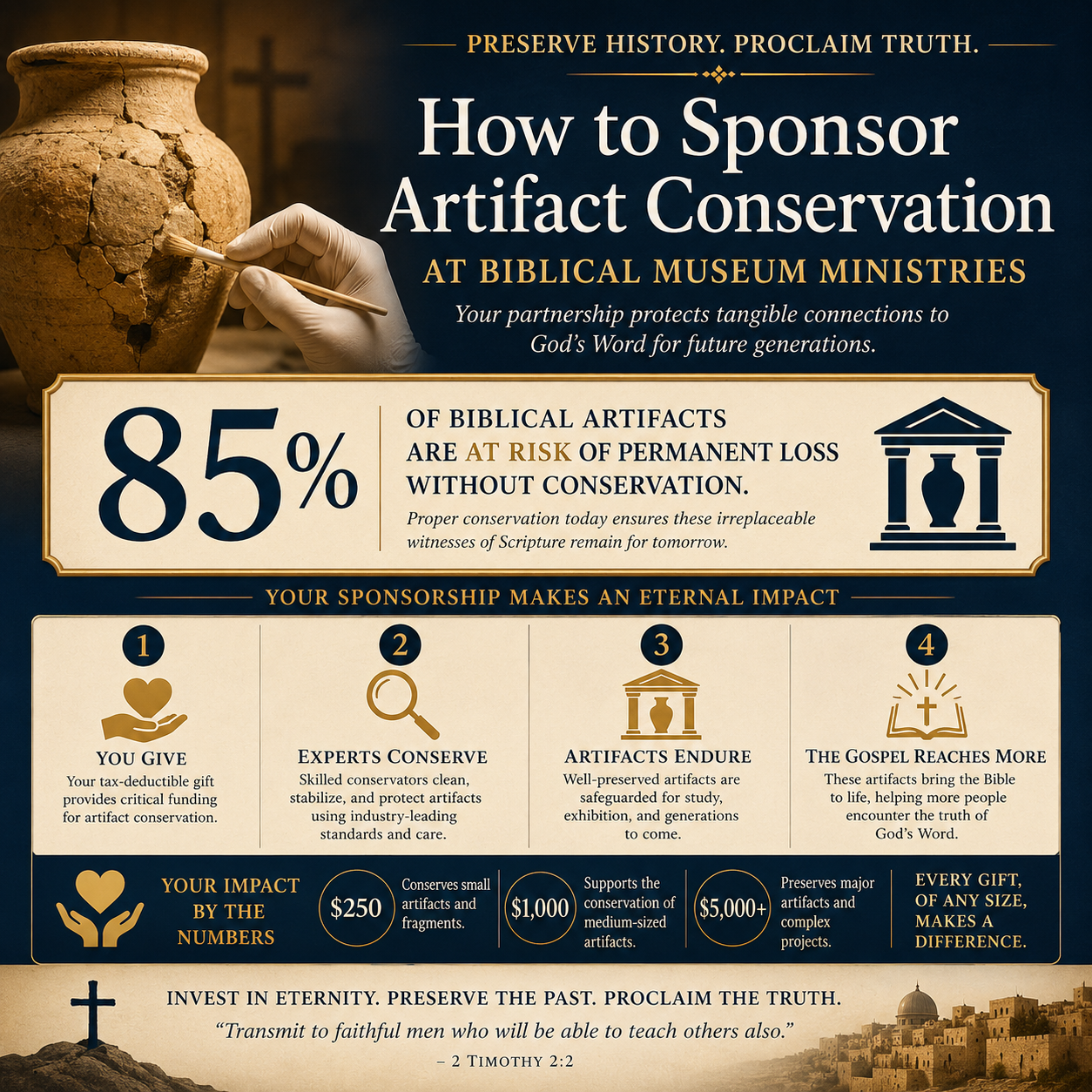
Across our verification work at Most Trusted, we observe that ministries strong in conservation tend to be strong in governance discipline as well: board oversight that understands risk, audited financial statements where appropriate, clear conflict-of-interest policies, and a willingness to publish what they can and cannot claim about an artifact.
Practical questions that reveal institutional health
Conservation sponsorship is a form of underwriting long-term trust. The right questions should be specific enough that a responsible ministry can answer them without defensiveness.
We recommend asking:
- Who is responsible for collections care, and what training or credentials do they have?
- What is the preventive conservation plan for storage, monitoring, and handling?
- How are provenance and legal title documented, and what is the policy for disputed items?
- What is the ministry’s incident history regarding damage, theft, or corrective actions?
- How will your sponsorship be reported with measurable outputs and clear limitations?
When a ministry answers with verifiable documents—policies, sample reports, redacted condition assessments, and a realistic budget—donors can support the work with confidence rather than with sentiment.
Structuring a conservation sponsorship for clarity and integrity
Restricted gifts, milestones, and reporting that respects complexity
Conservation work often includes uncertain findings. A materials analysis may reveal previous repairs, modern adhesives, salt contamination, or conditions that alter the treatment plan. The sponsorship structure should allow honest adaptation without losing accountability.
For many donors, the best fit is a restricted gift with agreed milestones: assessment completed, treatment performed, preventive housing installed, documentation updated, and a final report delivered. This is not bureaucratic; it is how preservation disciplines maintain chain-of-custody for decisions. It also protects the ministry from the subtle temptation to promise more than evidence supports.
Naming rights and publicity handled with restraint
Museums sometimes offer naming opportunities for conservation labs, galleries, or specific objects. Christians should consider the spiritual hazards here. Jesus warns against giving for human praise (Matthew 6:1). That does not forbid public recognition, but it does require a posture of restraint.
We recommend approaching recognition as secondary. The donor’s goal is not personal legacy but faithful transmission. If recognition is offered, it should be proportionate, truthful, and never require exaggerated claims about what the artifact demonstrates. Ministries that meet The Most Trusted Standard tend to avoid donor-driven overstatement because they understand that reputational collapse harms the mission and the broader Christian witness.
Finding ministries worthy of sponsorship and avoiding common failures
Where reputable biblical museum work is happening
Biblical museum ministries range from small collections attached to seminaries and churches to large institutions engaged in research, education, and public exhibitions. Some maintain active partnerships with universities, conservation labs, or regional museum networks. The ecosystem is varied, and donors should expect that different ministries will excel in different areas: preventive care, research publication, educational programming, or digitization.
For donors seeking a broader view of the field, our coverage of Biblical Museum Ministries surveys the kinds of institutions operating in this space and the integrity questions that repeatedly matter for long-term trust.
Failures donors can unintentionally subsidize
Because biblical artifacts generate public interest, the field has had to reckon with real scandals: forged objects, overconfident claims, and acquisitions that later raised legal and ethical questions. These are not merely public-relations problems. They can become moral problems when fundraising uses ambiguity as a tool.
Donors can reduce risk by favoring ministries that publish acquisition policies, disclose uncertainty, and welcome scrutiny. The most credible institutions will sometimes say, “We do not know,” and they will treat that honesty as part of their educational mission. For related preservation questions and best practices, our work on How Biblical Museum Ministries Preserve Artifacts addresses what strong collections care looks like over time.
One additional caution is financial. The IRS requires that tax-exempt organizations make certain filings publicly available, including the Form 990 for many nonprofits, which can help donors assess governance and financial patterns.Internal Revenue Service Strong ministries will not treat these disclosures as hostile; they will treat them as part of public stewardship.
FAQs for How to sponsor artifact conservation at biblical museum ministries
Should we restrict our gift to a specific artifact or fund a general conservation fund?
Both can be faithful. Restricting to a specific object can create clarity and measurable reporting, especially when the ministry can provide a condition assessment and treatment plan. A general conservation fund can be wiser when the institution needs flexibility to address the highest-risk items as conditions change. We recommend aligning the restriction level with the ministry’s demonstrated capacity for planning, documentation, and transparent reporting.
What documentation should we expect after sponsoring conservation?
A responsible ministry can typically provide a written conservation report with before-and-after photography, a description of materials and methods used, a statement of remaining risks, and any changes made to housing or display. If the ministry cannot share full details for security or legal reasons, it should still provide a substantive summary and specify what is being withheld and why.
Stewardship that preserves testimony without manufacturing certainty
Artifact conservation sponsorship is most effective when it is treated as long obedience rather than short-term excitement. It funds careful work: stabilizing material realities, strengthening documentation, and sustaining institutional habits of truth-telling. For Christian donors, that combination matters. We are not called to manufacture certainty through spectacle. We are called to bear faithful witness, which includes preserving what can be preserved and speaking accurately about what we know and what we do not.



