
Questions about what administrative costs fund in Christian adoption ministries are rarely abstract. Donors ask because they want to honor God with integrity, and because adoption work touches vulnerable children, birth families, and adoptive families where mistakes carry lifelong consequences. The practical concern is stewardship: whether a ministry’s “admin” line is quietly absorbing funds that were given for children and families, or whether it is funding the infrastructure that makes ethical, lawful, trauma-informed service possible.
Christian donors often inherit a simple assumption: low overhead equals faithfulness. Scripture does not teach that. Scripture teaches honest weights and measures, accountable leadership, and care for those at risk of being exploited (Prov. 11:1; Jas. 1:27). The deeper question is not whether administration exists, but whether it is ordered toward truth, protection, and fruit. Across our verification work at Most Trusted, the ministries that meet The Most Trusted Standard tend to treat administration as a moral responsibility, not as a regrettable necessity.
Administrative costs are often the safeguards donors are asking for
Compliance is not a distraction from mission in adoption
Adoption and adoption-adjacent work sits inside dense legal and regulatory environments: state licensing, federal requirements, international agreements, mandated reporting, privacy rules, and contracting expectations. In the United States, intercountry adoption operates under the Hague Adoption Convention framework when the sending country and the U.S. are treaty partners. That framework is administered nationally through the U.S. Department of State, and it places real obligations on accredited entities, documentation, and ethical practice. Those obligations do not disappear when a ministry has a warm heart; they become more important because the work involves children. A substantial portion of what donors call “admin” is often the staffing and systems needed to obey these requirements rather than improvise around them.
International adoption itself has also contracted sharply over the last two decades, which has reshaped the operating realities of many ministries. For context, U.S. intercountry adoptions have declined dramatically from mid-2000s peaks to far lower levels today, a long-term trend documented by the U.S. Department of State’s annual adoption statistics U.S. Department of State. In a smaller, more regulated field, durable compliance capacity matters more, not less.
Child protection and ethical practice require back-office strength
Donors rightly fear that “admin” can become bureaucratic bloat. But in adoption work, thin administration can create conditions for harm: weak vetting of partner organizations, inadequate documentation, insufficient screening and training of staff and volunteers, poor data security, and lack of clear escalation channels when a safeguarding concern arises. The goal is not paperwork for its own sake. The goal is a system that makes it harder for coercion, trafficking, fraud, or mishandled trauma to hide in the margins.
The same logic applies to domestic work that supports families at risk of separation. Strong administrative functions help ensure services are delivered consistently, records are accurate, and referrals are handled responsibly. When ministries say they want to prioritize family preservation and kinship care, those priorities typically require coordination with local churches, public agencies, and licensed providers. Coordination is administration.

What administrative costs typically fund in adoption ministries
People who do the unglamorous, high-trust work
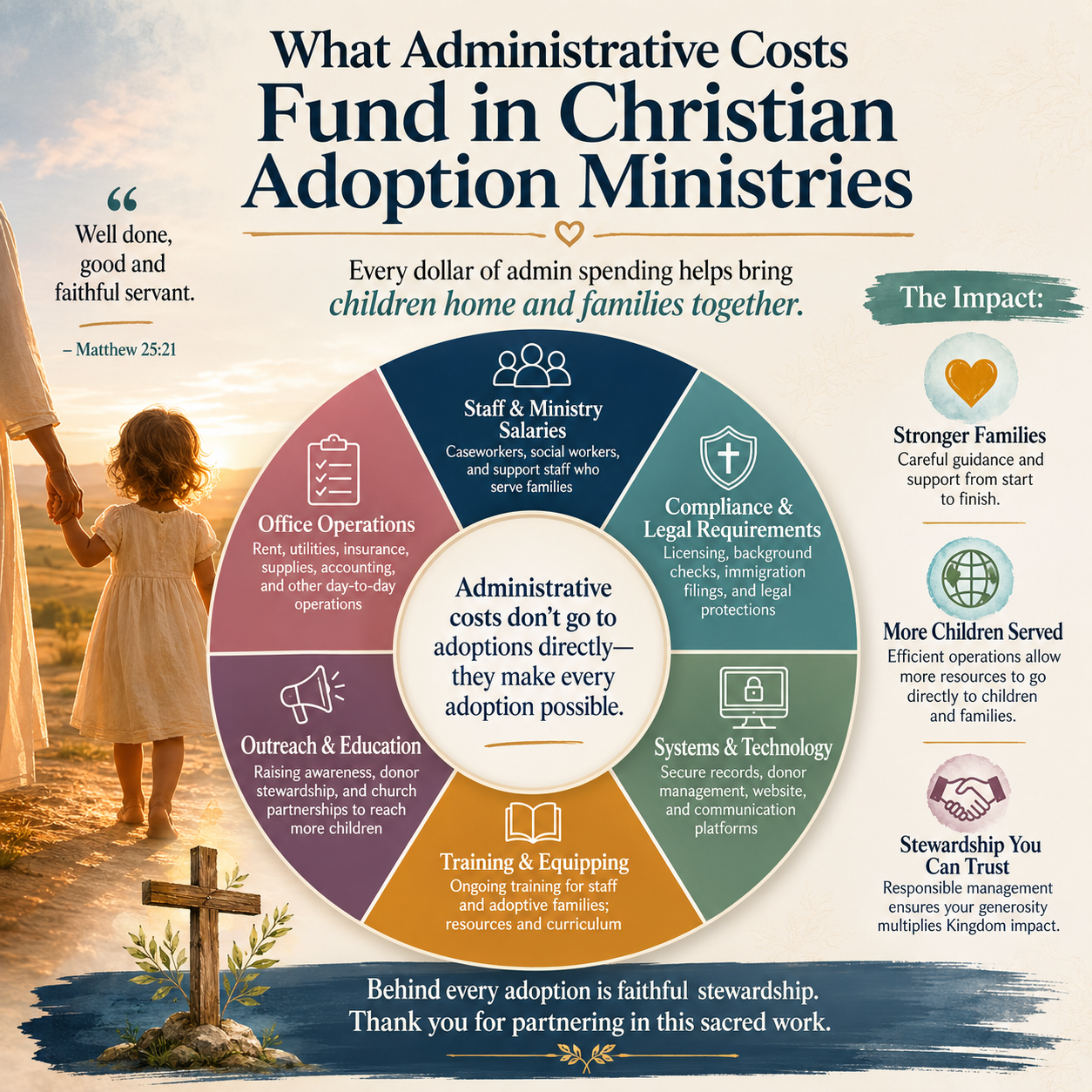
Many Christian donors associate administration with “non-ministry staff.” In reality, some of the most mission-critical roles are housed in administrative budgets: compliance officers, finance leaders, HR personnel, licensing coordinators, and safeguarding leads. These staff members are not optional. They create internal controls, ensure restricted gifts are honored, manage grant compliance, and build the accountability structures that donors expect when vulnerable children are involved.
Financial administration is also where integrity is either built or neglected. Good ministries maintain clear separation of duties, documented approval processes, and regular reconciliations. When these controls are absent, fraud risk increases, restricted funds can drift, and reporting becomes unreliable. The Apostle Paul’s concern in handling relief funds was explicit: he wanted to “avoid any criticism” by administering gifts honorably “not only in the Lord’s sight but also in the sight of man” (2 Cor. 8:20–21). That is a biblical case for competent administration, not against it.
Systems that prevent the starvation cycle
Underinvestment in administration often leads to predictable failure modes: staff turnover, weak training, incomplete documentation, and crisis-driven decisions. The nonprofit sector has described this dynamic as a “starvation cycle,” where pressure to minimize overhead drives chronic underinvestment in the very capacities that make programs effective and accountable. Stanford Social Innovation Review has analyzed this pattern and its consequences for nonprofit performance Stanford Social Innovation Review.
In adoption ministries, the consequences are not merely operational. A poorly trained staff member can mishandle a birth parent conversation, miscommunicate timelines, or fail to recognize a coercive dynamic. A ministry without adequate data security can expose sensitive information about children and families. A ministry without a documented partner-vetting process can drift into relationships that raise ethical concerns. These risks do not show up neatly on a pie chart, but they show up in lives.
- Financial reporting, audits, and donor receipting that consistently matches restricted intent
- Staff training and supervision, including safeguarding and trauma-informed practice expectations
- Legal and licensing compliance work, documentation management, and case record integrity
- Technology and security that protect sensitive family and child data
- Volunteer management systems that reduce unmanaged access to vulnerable populations
Why overhead ratios alone mislead conscientious Christian donors
The sector has corrected the simplistic overhead narrative
Many donors were taught to ask, “How much goes to programs?” That instinct aims at faithfulness, but it can be manipulated. Organizations can reclassify expenses, undercount real administrative needs, or maintain low ratios by pushing costs onto staff through burnout. Leading evaluators have publicly argued that overhead ratios are not reliable measures of nonprofit performance. Charity Navigator has articulated this in its discussion of the “overhead myth,” encouraging donors to look beyond overhead to governance, results, and transparency Charity Navigator.
Christians genuinely disagree about how much administrative spending is prudent. Some donors prioritize direct service intensity; others prioritize institutional maturity and risk controls. The field is not helped when ministries turn that disagreement into marketing, promising “almost everything goes straight to the child.” In adoption work, such claims can function as a warning sign, because the work itself requires professional capacity.
Program and administration are often intertwined in real life
Adoption ministries routinely face allocation questions that do not have an obvious moral answer. Is a case management database “program” or “admin”? Is clinical supervision for social workers “program” or “admin”? Is background screening for volunteers “program” or “admin”? Different auditors and accounting practices may treat these differently, and that is not necessarily deceptive. What matters is whether the ministry applies a consistent methodology, documents it, and discloses it in ways donors can understand.
For donors who want a reliable frame, the best questions move from ratios to evidence: What internal controls exist? How are restricted funds tracked? What is the safeguarding policy, and how is it trained and enforced? How does leadership handle conflicts of interest? Those questions align with what we evaluate through The Most Trusted Standard.
Administrative spending becomes a concern when it obscures truth or concentrates power
Warning signs donors can evaluate without suspicion
Administrative costs should not be immune from scrutiny. The concern is not that a ministry has administrative spending, but that it may use administration to shield decision-making from accountability. When donors cannot access timely financial statements, when related-party transactions are unclear, or when a founder’s authority is functionally unchecked, administrative structures can become instruments of control rather than stewardship.
Adoption work also carries reputational and relational pressures that can tempt ministries toward opacity: confidentiality concerns, complicated international relationships, and sensitive family situations. Confidentiality is legitimate, but it must not become a pretext for refusing basic transparency about finances, governance, and safeguarding. Accountability and candor are part of Christian witness.
How Most Trusted approaches the question
Most Trusted exists because donors deserve more than marketing language. We assess Christian nonprofits against The Most Trusted Standard, a 15-criteria framework that examines faith commitments, financial integrity, governance, and public transparency. In adoption ministries, we pay particular attention to controls that protect children and families: board independence and oversight, financial policies, conflict-of-interest management, restricted-fund practices, safeguarding policies, and clear public reporting.
Donors exploring specific organizations within Christian Adoption Ministries are often best served by evidence that the ministry can sustain ethical practice over time. Administrative spending is one part of that evidence, but it is rarely decisive on its own.
How to ask better questions about admin in Christian adoption work
Questions that respect the complexity and still demand clarity
Stewardship requires more than skepticism; it requires discriminating judgment. The goal is to identify ministries that can explain their administrative costs plainly, defend them ethically, and demonstrate the fruit those costs make possible. A mature organization welcomes such questions because it knows that clarity builds trust and that trust protects the mission.
What this means in practice is asking for a narrative, not merely a percentage. Ask how the ministry defines administration, how it allocates shared costs, and what investments it has made in compliance and safeguarding. If the answers remain vague, inconsistent, or defensive, donors should slow down.
Where transparent reporting should be easy to find
Most credible ministries make baseline information accessible: annual reports, audited financials when appropriate to size and complexity, current leadership and board lists, key policies, and a clear explanation of programs. Donors should also expect truthful language about outcomes. Adoption work is not a factory line; results are measured in durable family stability, ethical processes, and careful care for birth families as well as adoptive families. Ministries that communicate these realities without sentimentality tend to be safer places to give.
Donors working through Accountability and Transparency in Christian Adoption Ministries often find that the most reassuring signal is consistency: financial reporting matches public claims, governance is visible, and administrative investments make the ministry more truthful, not merely larger.
FAQs for What administrative costs fund in Christian adoption ministries
Is it unbiblical for an adoption ministry to spend meaningfully on administration?
No. Scripture condemns dishonest scales and self-serving leadership, not competent infrastructure. In adoption ministry, administration often funds compliance, safeguarding, accurate financial stewardship, and accountable governance. The biblical question is whether those costs are ordered toward integrity and neighbor-love, and whether leaders can explain them transparently.
What should we do if a ministry promotes extremely low overhead as its main trust signal?
We recommend treating it as a prompt for follow-up rather than an automatic disqualifier. Ask what is included in “program,” what is excluded from “admin,” and how safeguarding, compliance, and financial controls are funded. In adoption work, ethical practice typically requires meaningful administrative capacity, and ministries that cannot describe that capacity clearly are taking a risk that donors should not ignore.
Stewardship is measured by truth, protection, and lasting fruit
Administrative costs in Christian adoption ministries often fund the quiet work that keeps children safer, keeps promises clearer, and keeps finances honest. Donors do not need to choose between compassion and accountability; the most faithful giving holds them together. The ministries most worthy of confidence can show, in verifiable ways, that their administration serves the mission rather than consuming it.



