
Verifying Christian adoption ministry nonprofit status is a stewardship decision, not a bureaucratic exercise. Donors who care about vulnerable children also carry a sober awareness: in adoption and family care, good intentions can be exploited, and the human cost of weak oversight is borne by children and birth families.
Scripture sets a high bar for integrity in giving. “It is required of stewards that they be found faithful” (1 Corinthians 4:2) BibleGateway. Faithfulness includes verifying that a ministry is legally recognized, properly governed, and operating in ways consistent with Christian ethics and with child welfare best practice.
Start with legal identity and the government record
The first task is mundane but decisive: confirm the organization exists as a legally recognized nonprofit and that the name you see in fundraising materials matches the name the government recognizes. Adoption-related fundraising sometimes runs through fiscal sponsors, affiliated churches, or similarly named entities. Those arrangements are not automatically improper, but they can obscure accountability if donors do not verify what entity is actually receiving funds.
Confirm federal tax status using the IRS
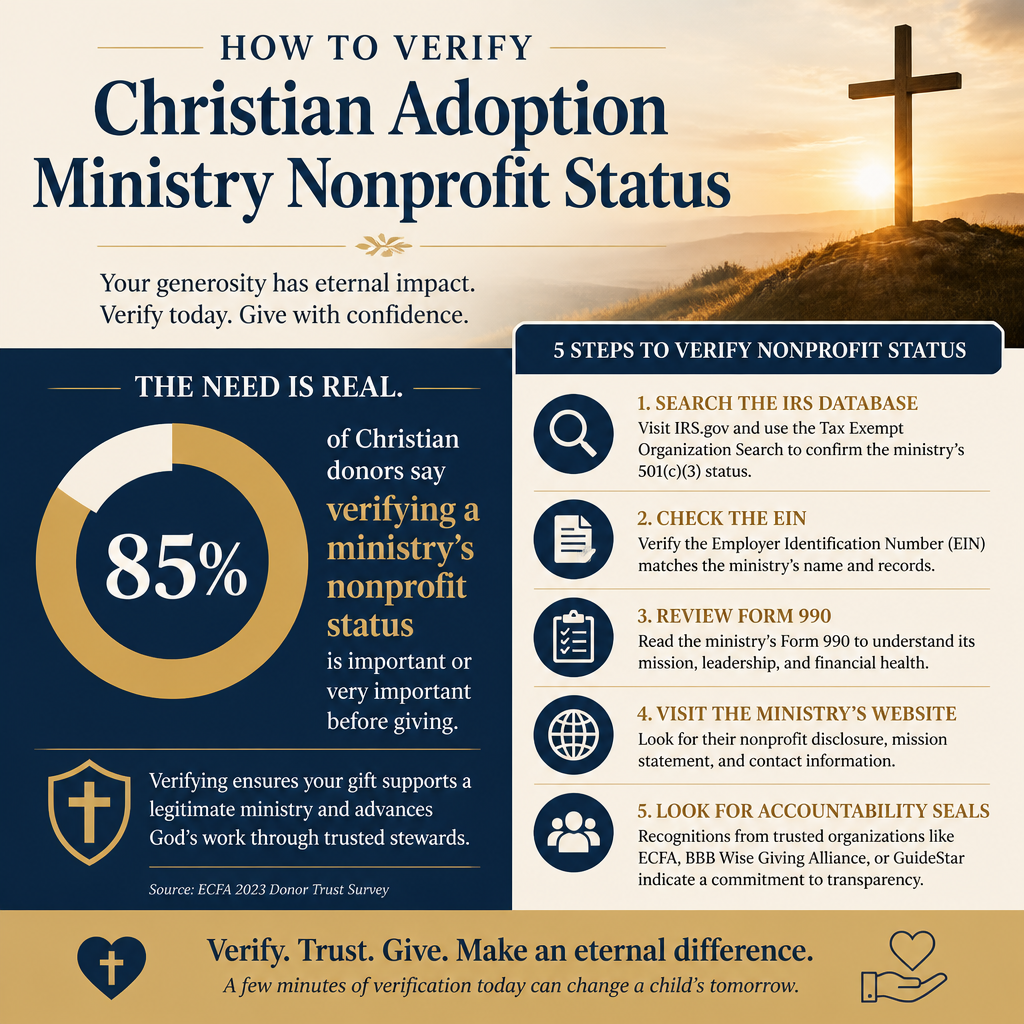
In the United States, the clearest public signal of nonprofit standing is recognition by the Internal Revenue Service. Use the IRS Tax Exempt Organization Search to confirm the organization’s exemption status, ruling date, and whether the IRS has recorded an automatic revocation or other loss of status IRS. A legitimate ministry should be willing to provide its legal name and Employer Identification Number to help donors verify.
Verify state registration and solicitation compliance
Federal tax exemption does not replace state requirements. Many states require charitable organizations to register before soliciting donations. Where that applies, the relevant state Attorney General or charities regulator will usually have a public lookup tool. When a ministry solicits across state lines, the compliance burden increases, and a serious organization will treat it as part of its fiduciary duty rather than an afterthought.

Do not confuse ministry language with nonprofit reality
“Adoption ministry” is often used as a broad label, covering everything from adoption grants, to foster care support, to international child advocacy, to direct placement services. Donors should distinguish between organizations that are primarily charitable and those that are professional service providers, since different legal and ethical expectations attach to each.
Identify whether it is an adoption agency, a grantmaker, or an advocacy ministry
Some organizations are licensed child-placing agencies; others provide donor-funded grants to families; still others fund overseas care or family preservation. The nonprofit status question is only the beginning. The more important question is whether the entity’s model aligns with child welfare realities and with Christian moral commitments about truth-telling, protection of the vulnerable, and respect for lawful authority.
Beware of misdirection in the “giving pathway”
Donations sometimes flow to an affiliated entity that is tax-exempt while the frontline work is performed by a for-profit partner, a contractor network, or an overseas organization with limited disclosure. None of this is inherently disqualifying. What it requires is clarity: who receives the funds, who controls decisions, who is accountable for outcomes, and who is responsible when something goes wrong.
For donors evaluating adoption-related organizations alongside other child-serving ministries, context matters. Our broader coverage of Christian Adoption Ministries addresses the range of models donors encounter and the accountability questions each model raises.
Read the Form 990 as an integrity document, not a marketing artifact
For many ministries, the most revealing public document is the IRS Form 990 (or 990-EZ). It is imperfect and often delayed, but it is designed to disclose governance practices, compensation, related-party transactions, and program descriptions in a standardized way. A ministry’s posture toward these disclosures often signals how it thinks about accountability.
Where to find the 990 and what to look for
Most donors access 990s through nonprofit databases that source documents from the IRS. When a ministry does not provide the 990 on request, that is not a minor inconvenience; it is a direct limitation on donor due diligence. Congress designed the 990 to be publicly available, and nonprofits are generally expected to make their three most recent returns available for public inspection IRS.
Key places to read carefully include:
- Part I and Part III for consistency between stated mission and described programs.
- Part VI for governance practices: independent board, conflict-of-interest policy, whistleblower policy, document retention.
- Schedule L for transactions with interested persons, which can surface related-party risks.
- Compensation sections for how leadership pay is set and disclosed.
- Fundraising and professional fees for reliance on outside fundraising firms or unusual cost patterns.
Interpret overhead with maturity
Christian donors often ask for a simple “program percentage.” Mature accountability resists simplistic conclusions. Charity Navigator, Candid (GuideStar), and the BBB Wise Giving Alliance jointly warned that financial ratios alone are a poor measure of nonprofit performance and can pressure organizations to underinvest in systems that protect beneficiaries and donors Charity Navigator. In adoption and child welfare, underinvestment in compliance, trauma-informed training, and safeguarding is not merely inefficient; it can be dangerous.
Assess governance, safeguarding, and child welfare ethics
Nonprofit status can be technically valid while ethical practice is deficient. Adoption is a domain where Christians genuinely disagree about policy and practice, but there is broad agreement on core obligations: honesty, the protection of children, respect for birth families, and refusal to commodify human life. Those obligations should be visible in governance and in operational safeguards.
Board independence and conflict-of-interest controls
Adoption-related work can involve emotionally compelling storytelling and substantial donor flows. That combination can create temptation, even in sincere ministries. Donors should look for an active, independent board; documented conflict-of-interest processes; and clear separation between oversight and executive authority. A board composed primarily of employees, family members, or paid contractors is not automatically disqualifying, but it does heighten risk and demands stronger compensating controls.
Safeguarding, privacy, and ethical storytelling
Child-serving ministries should have written child protection policies, staff screening procedures, and mandatory reporting practices appropriate to their context. They should also treat images and narratives of children with restraint. Adoption fundraising has at times drifted into “poverty porn” and over-disclosure of children’s histories. The ethical standard is not what produces donations; it is what honors the dignity of the child made in God’s image.
Confirm transparency and effectiveness beyond legal compliance
Legal nonprofit status answers a narrow question. Donors usually mean a larger one: can this ministry be trusted to do what it claims, in a way consistent with Christian faith and moral seriousness? The answer requires evidence of transparency, measurable activity, and a willingness to be scrutinized.
Look for clear reporting that can be verified
Responsible ministries report on what they do in a way that can be cross-checked: number of families served, nature of services provided, geographic scope, and constraints. Where work is conducted overseas, transparency should include local partners, oversight mechanisms, and a clear account of how funds move. Donors should be cautious of ministries that only communicate in emotionally powerful narratives without program-level specifics.
Use third-party verification with a defined standard
Across our verification work at Most Trusted, we find that the strongest ministries do not treat outside review as an intrusion. They regard it as part of Christian stewardship and public witness. Most Trusted evaluates ministries against The Most Trusted Standard, a 15-criteria framework spanning Faith Foundation, Financial Integrity, Governance and Leadership, and Transparency and Effectiveness. Verification cannot eliminate all risk, but it can meaningfully reduce uncertainty for donors who want their giving to be both generous and careful.
Donors who want to place nonprofit status within a broader accountability frame can also review Accountability and Transparency in Christian Adoption Ministries, where we address the practical questions that surface repeatedly in adoption-related giving.
FAQs for How to verify Christian adoption ministry nonprofit status
Is an adoption ministry legitimate if it is not a 501 c3?
It depends on what “legitimate” means. Some adoption-related work is conducted by for-profit entities that are licensed and regulated as service providers, while charitable support may flow through a separate tax-exempt organization. That structure can be lawful, but it increases the donor’s responsibility to confirm who receives the donation, whether the gift is tax-deductible, what oversight applies, and whether the organization is transparent about fees, referrals, and decision-making authority.
What should raise concern even if the ministry shows up in the IRS database?
IRS recognition is necessary but not sufficient. Significant concerns include refusal to share recent Form 990s, unclear governance or board independence, weak conflict-of-interest controls, opaque use of donor-restricted funds, and storytelling that compromises child privacy. In adoption and child welfare, ethical risk is often not visible in tax status alone; it is visible in how a ministry handles power, money, and truth.
Stewardship requires verifiable clarity
Christian donors give to adoption and family care because Scripture trains the church to love the vulnerable and to honor God with material resources. That same Scripture calls for faithful stewardship and honest weights and measures. Verifying nonprofit status is a beginning. Responsible giving continues with governance review, transparency expectations, and a sober assessment of whether a ministry’s model protects children and honors the dignity of every family involved.



