
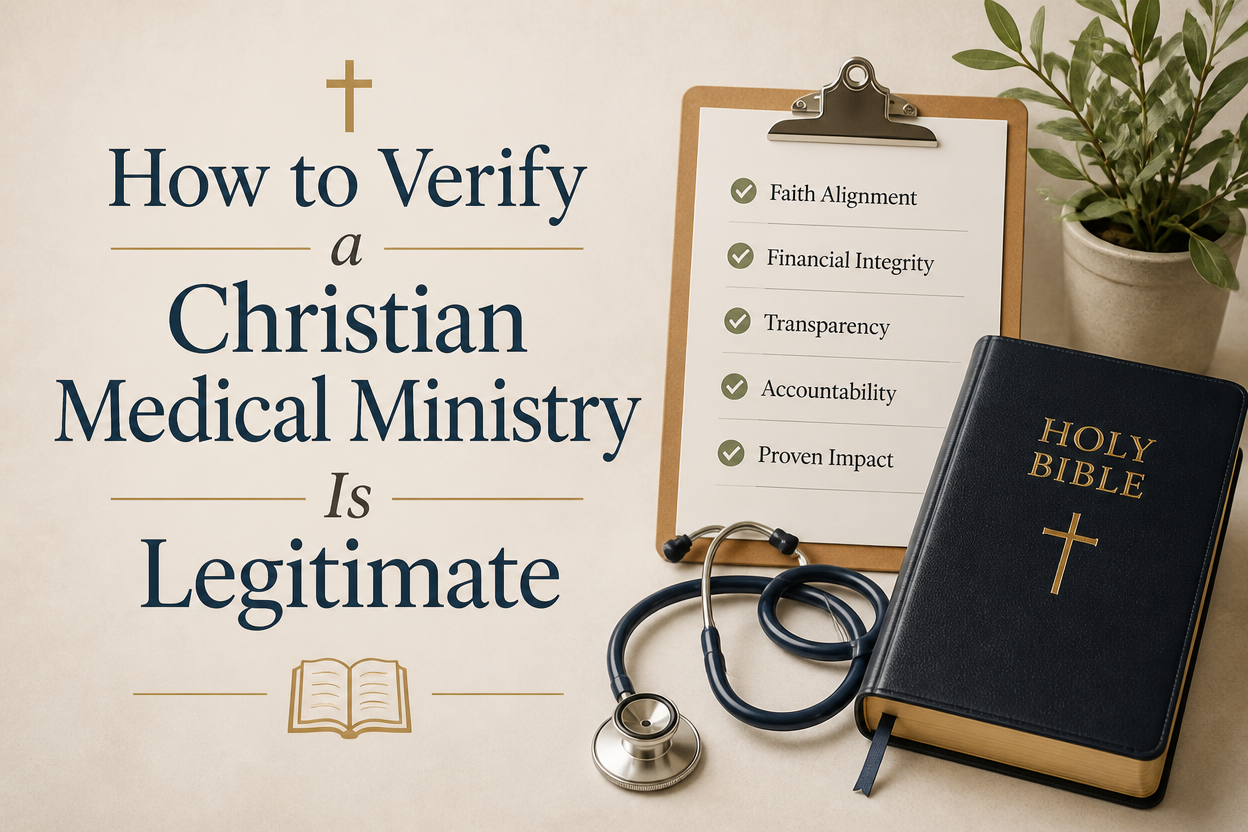
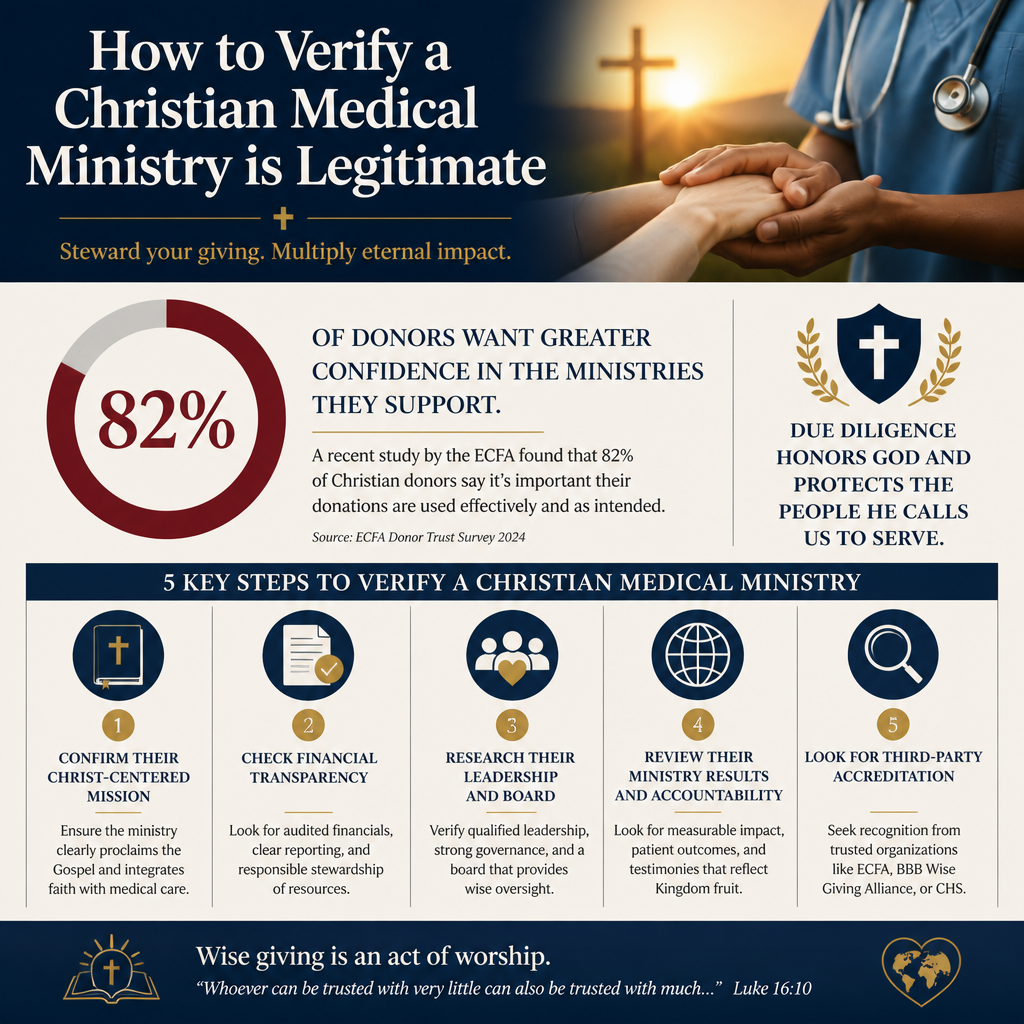
To verify a Christian medical ministry is legitimate, donors need more than a sincere story and a handful of photos from the field. Medical work carries unique risks: vulnerable patients, complex regulation, significant financial flows, and the real possibility that spiritual language can be used to deflect hard questions. Christian donors should not feel conflicted about asking for verifiable evidence. Scripture consistently joins compassion with honesty and careful stewardship, and both are required when we give in Christ’s name.
Legitimacy in this sector is rarely proved by one document. It is established through a pattern: clear faith commitments, accountable governance, clean financial practices, credible medical partners, and transparency about what is actually happening on the ground. Across our verification work at Most Trusted, the ministries that meet The Most Trusted Standard tend to treat donors as responsible stewards, not as an audience to be managed.
Start with identity and calling, then look for verification
Clarify what kind of medical ministry it claims to be
“Christian medical ministry” can mean very different things: a domestic free clinic, an international surgical team, a maternal health program, a medical ship, a disability ministry, or a prayer-and-care model embedded in a local church. Before evaluating competence, establish the ministry’s own stated purpose and scope. Legitimate organizations define their mission in a way that sets limits and makes evaluation possible: who they serve, where they work, what services they provide, and what they do not do.
In practice, donors should be wary of vague language that implies comprehensive impact without naming programs, geography, or constraints. Medical care requires licensure, supply chains, referral networks, and clinical standards; ministries that will not describe these realities usually cannot meet them consistently.
Test whether the faith foundation shapes ethics, not just branding
Christian identity is not primarily a marketing category. A legitimate Christian medical ministry should be able to explain how its faith commitments shape patient dignity, informed consent, confidentiality, non-coercive evangelism, and care for people who will never join their church. Christians genuinely disagree about the best models for integrating proclamation and medical care, but there is broad moral agreement that the vulnerable must not be manipulated.
For donors, the question is not whether the ministry uses Christian language, but whether Christian convictions produce accountable practices. Ministries with mature theology typically name guardrails: patients are not required to participate in religious activities to receive care, and staff are trained to honor conscience and vulnerability.

Confirm legal standing and governance that can restrain bad decisions
Verify basic nonprofit legitimacy and regulatory posture
In the United States, donors can verify that an organization is recognized by the IRS as a tax-exempt nonprofit. The IRS Tax Exempt Organization Search allows donors to confirm status and review basic information using the organization’s legal name and EIN: IRS. If an organization is not a U.S. nonprofit, donors should ask what legal entity receives funds, how those funds are governed, and whether gifts are tax-deductible.
For health services, legal standing also includes how the ministry relates to medical regulation. A ministry does not need to disclose private patient information, but it should be able to describe its licensure environment, clinical oversight, and the standards it follows for pharmaceuticals, sterilization, and referrals. If it cannot discuss these basics, donors should slow down.
Look for a functioning board and meaningful oversight
Legitimate ministries are not controlled by one charismatic founder or one family without real checks. Donors should expect a board that meets regularly, documents decisions, and can remove senior leadership when necessary. Governance failures are a recurring factor in ministry scandals, including in health-related work where large sums may move quickly during crises.
Transparency here is concrete: are board members named, are their roles clear, and is there evidence of independence? A board made up entirely of staff or close relatives may be legal in some contexts, but it creates obvious conflicts and weak accountability.
Follow the money with disciplined questions, not simplistic ratios
Use IRS Form 990 to understand revenue, expenses, and concentration risk
For U.S. nonprofits, Form 990 is a baseline tool. Donors can find 990s through reputable repositories such as Candid (GuideStar): Candid. The goal is not to chase an “overhead number,” but to look for patterns that indicate integrity and operational reality: consistent reporting, reasonable compensation practices, and a plausible relationship between expenses and stated activities.
Donors should also watch for concentration risk. If a ministry relies heavily on one or two revenue sources, or experiences dramatic year-to-year swings, that may not be disqualifying, but it should prompt questions about sustainability and internal controls—especially if the ministry maintains large restricted funds or runs major in-kind medical supply programs.
Reject the overhead reflex and examine whether spending serves mission
Mature donors have learned that low “overhead” is not a moral category by itself. Charity Navigator has documented why administrative and fundraising ratios can mislead donors and can even incentivize underinvestment in systems that protect beneficiaries: Charity Navigator. Medical ministries, in particular, require strong operational capacity: compliance, credentialing, supply management, clinical protocols, and safeguarding.
What this means in practice is that donors should ask whether the ministry’s spending supports safe, effective care. A clinic with no meaningful investment in training, supervision, and data systems may look “lean” while creating serious clinical risk.
- Ask for audited financial statements when the organization is of a size where an audit is reasonable, and confirm the auditor is independent.
- Ask how restricted gifts are tracked and whether donors receive follow-through reporting on designated funds.
- Ask about internal controls for cash handling, procurement, and approval authority for large expenses.
- Ask how in-kind medical donations are valued and who verifies quality and expiration.
- Ask whether the ministry carries appropriate insurance for its context, including liability where applicable.
Evaluate medical credibility and safeguarding for patients and communities
Credentials, standards, and local partnerships matter more than hero narratives
Some ministries are built around short-term medical trips; others are long-term platforms with local clinicians. The models are not morally equivalent in every context, and donors should not assume that “more trips” equals better care. Legitimate medical ministries can explain how they credential clinicians, supervise practice, and coordinate with local health systems. In international settings, they should be able to describe how they avoid undermining local providers and how they ensure continuity of care after teams leave.
The harder question is whether a ministry has systems that reduce harm when things go wrong. Medical work is complex, and even capable teams make mistakes. Responsible ministries anticipate that reality and build pathways for incident reporting, patient follow-up, and accountability.
Safeguarding is part of medical integrity
Safeguarding is often discussed in the context of children, but patient vulnerability extends across ages. Legitimate ministries have written policies and training that address boundaries, privacy, photography, and the handling of sensitive medical information. Donors should not be satisfied with assurances that “we would never.” They should look for documented practices that operationalize respect for dignity.
For Christian donors, this is also theological. The imago Dei is not a slogan; it is a claim about what a human being is, including the poor, the sick, the disabled, and the displaced. Ministries that treat patients as props for fundraising communications contradict the very gospel they claim to serve.
Insist on transparency that allows a donor to verify outcomes without spectacle
Distinguish between stories and evidence
Stories are not the enemy; Jesus taught with parables. But when donors are trying to verify legitimacy, stories must be paired with evidence: program descriptions, counts of patients served with definitions, referral numbers, follow-up processes, and third-party partnerships that can be named. Donors should ask what the ministry measures, why it measures it, and what it has learned that changed its practice.
Evidence in medical settings is not always clean. Outcomes can be difficult to track, especially in mobile populations or areas with weak record systems. Legitimate ministries will name those limitations directly and still show seriousness: careful data stewardship, ethical review where relevant, and humility about what can and cannot be concluded.
Use independent verification when personal knowledge is not possible
Many donors cannot visit field sites, evaluate clinical protocols, or read financial statements with professional confidence. Independent verification exists for that reason. At Most Trusted, we evaluate ministries against The Most Trusted Standard, a 15-criteria framework that examines faith commitments, financial integrity, governance, and transparency and effectiveness. The aim is not to replace a donor’s discernment, but to strengthen it with verifiable documentation and consistent evaluation.
Donors who want a broader view of the sector can also review the wider landscape of Christian Medical Ministries, where credible organizations tend to share recognizable patterns of accountability even when their models differ.
When questions arise around governance, disclosure, and public reporting, donors will often find helpful context in Accountability and Transparency in Christian Medical Ministries, since the same issues recur across organizations even when the medical programs are very different.
FAQs for How to verify a Christian medical ministry is legitimate
What documents should a legitimate Christian medical ministry be willing to share with donors?
A legitimate ministry should normally be willing to share its legal name and EIN, recent annual reports, current board roster, key policies that affect patients and staff, and recent financial reporting appropriate to its size (often including Form 990 for U.S. nonprofits and, for larger organizations, audited financial statements). In medical contexts, donors can also reasonably ask for a plain-language description of clinical oversight, credentialing, and partnerships with local health systems, without requesting private patient information.
Is a ministry illegitimate if it does not publish detailed outcome data?
Not necessarily. Outcome measurement can be difficult in clinical work, especially in unstable environments. The legitimacy question is whether the organization is transparent about what it does, measures what it reasonably can, protects patient dignity, and demonstrates learning over time. Ministries that refuse any meaningful disclosure, rely exclusively on emotional storytelling, or cannot explain basic clinical and financial safeguards should not receive trust by default.
Giving with confidence requires evidence worthy of the gospel
Christian donors are not choosing between compassion and scrutiny. Care for the sick is a clear work of mercy, and faithful stewardship requires that our giving be tethered to truth. The legitimate Christian medical ministries we most respect welcome disciplined questions because they know that accountability protects patients, honors donors, and strengthens the credibility of Christian witness in places where trust is easily lost.



