
Legacy and planned giving for biblical museum ministries is not primarily a financial technique; it is a spiritual act of stewardship shaped by time, mortality, and hope. For Christian donors who care about the public witness of Scripture in a skeptical age, the question is whether the work of preserving, interpreting, and exhibiting the biblical world can be strengthened not only by annual gifts, but by faithful provisions that endure beyond our lifetimes.
Many donors already feel the tension. Estate planning carries emotional weight, family dynamics, and genuine uncertainty about future needs. At the same time, Scripture commends sober preparation and purposeful generosity. “A good man leaves an inheritance to his children’s children” (Proverbs 13:22), and Jesus’ warnings about wealth make clear that the heart is always implicated in the way we order our possessions. Planned giving does not eliminate hard decisions, but it can align them with clear priorities and verified trust.
Why legacy giving belongs in the stewardship conversation for biblical museums
Biblical museum ministries occupy a distinctive place in the Christian ecosystem. They are custodians of material culture, texts, and interpretive work that shape how millions understand Scripture’s setting and credibility. Their impact is often indirect: fewer altar-call moments, more long-form formation through exhibits, archives, research, and education. That indirectness is precisely why durable funding matters. Collections care, curatorial integrity, provenance review, conservation labs, and educational programs cannot be sustained by impulse giving alone.
Legacy gifts, when handled with integrity, help a ministry resist the pressure to chase novelty. They can underwrite long-horizon work: endowing a curator position, funding ongoing conservation, expanding teacher training, or increasing access for schools and churches that cannot afford admission. In practice, planned giving is one of the few forms of generosity that can be both patient and strategic—two virtues that biblical museums require.
What donors are actually trying to protect
In our verification work, we see donors repeatedly return to three concerns. First is fidelity: Will the ministry’s presentation of Scripture and the biblical world be theologically serious and historically responsible, rather than sensationalized? Second is integrity: Are acquisitions and exhibitions governed by clear ethical standards, strong internal controls, and transparent reporting? Third is permanence: Will the ministry still be healthy in twenty years, when a bequest might mature, and will it use restricted gifts as promised?
These are not abstract worries. The broader museum sector has had to reckon publicly with provenance failures, repatriation disputes, and donor restrictions that create mission drift. Christian donors should not assume that a “biblical” label immunizes an organization from the temptations that attend money, prestige, and collection-building. Mature legacy giving begins with clear-eyed trustworthiness, not romanticism.
Why planned gifts are growing across American philanthropy
Planned giving has expanded in part because the scale of intergenerational wealth transfer is significant. The research estimate frequently cited in philanthropy is that tens of trillions of dollars will move across generations in coming decades, which is why many nonprofits and advisors urge donors to consider testamentary giving as part of their overall stewardship. For a widely cited framing of the magnitude, see the Cerulli Associates homepage and their work on U.S. wealth transfer projections.
For Christian donors, the more important point is not the headline number but the moral opportunity: estate planning is one of the few moments when a household can intentionally weigh family care, Kingdom priorities, and long-term witness in a single, coherent plan.
How to evaluate a biblical museum ministry before naming it in your estate plans
A legacy gift binds your name—and often your family’s name—to an organization’s future decisions. That reality warrants more due diligence than many donors assume. The simplest mistake is to treat planned giving as “later money” that requires “later scrutiny.” The opposite is true: because you will not be present to correct course, a legacy commitment should rest on stronger verification, not weaker.
Most Trusted exists to help donors give with confidence by evaluating ministries against The Most Trusted Standard, a 15-criteria framework that tests evidence across Faith Foundation, Financial Integrity, Governance and Leadership, and Transparency and Effectiveness. When planned gifts are involved, several criteria become especially concrete.
Faithful mission and disciplined interpretation
Biblical museum ministries vary in theological posture and interpretive approach. Christians genuinely disagree about some questions: how to present contested scholarly debates to the public, how to handle chronological and archaeological uncertainties, and how to acknowledge interpretive differences among orthodox believers without turning a museum into a polemical battleground. We recommend asking whether the ministry can be both confessional and intellectually honest—clear about its commitments, careful with evidence, and unafraid of complexity.
Donors should look for explicit statements of faith, clarity on educational aims, and a demonstrated commitment to serving the church rather than merely courting cultural influence. A ministry’s public programming, exhibit tone, and scholarly partnerships often reveal more than marketing copy.
Governance that can withstand donor pressure and public scrutiny
Legacy gifts can create subtle distortions. A major bequest can tempt leadership to move too quickly, relax controls, or accept restrictions that complicate future stewardship. Healthy governance protects the ministry from both internal and external pressures. That means a functioning board, documented conflict-of-interest policies, and a clear separation between curatorial decisions and fundraising imperatives.
We also recommend attention to whether a ministry has a credible plan for handling restricted gifts and whether it can clearly articulate the difference between program funding, acquisitions, capital projects, and endowment. The question is not merely “Is the work good?” but “Is the institution structured to remain good when incentives change?”
Financial transparency and the discipline to tell the truth
Planned gifts are often discussed in aspirational terms: future impact, enduring witness, generational fruit. Those aims are appropriate, but they must be anchored in observable financial practices. Donors should expect accessible financial statements, annual reports that name both successes and limitations, and a willingness to describe how funds are allocated without hiding behind simplistic ratios.
The nonprofit sector has repeatedly warned donors against over-weighting overhead percentages, because effective work requires capable administration and sound infrastructure. The best-known sector statement on this point is the “Overhead Myth” letter signed by GuideStar, Charity Navigator, and the BBB Wise Giving Alliance; see the Candid (formerly GuideStar) homepage for reference to this discussion and related resources.
For donors who want broader context on ministry evaluation, we address related issues across Biblical Museum Ministries, including the kinds of evidence that tend to distinguish durable, trustworthy institutions from those that rely on inspiration without accountability.
Planned giving vehicles that fit the realities of Christian households
Planned giving options should be chosen with humility about the future. The goal is not to impress a ministry with complexity, but to match your assets, tax situation, and family responsibilities with a gift structure you can explain to your spouse, executor, and children without confusion.
Bequests in a will or living trust
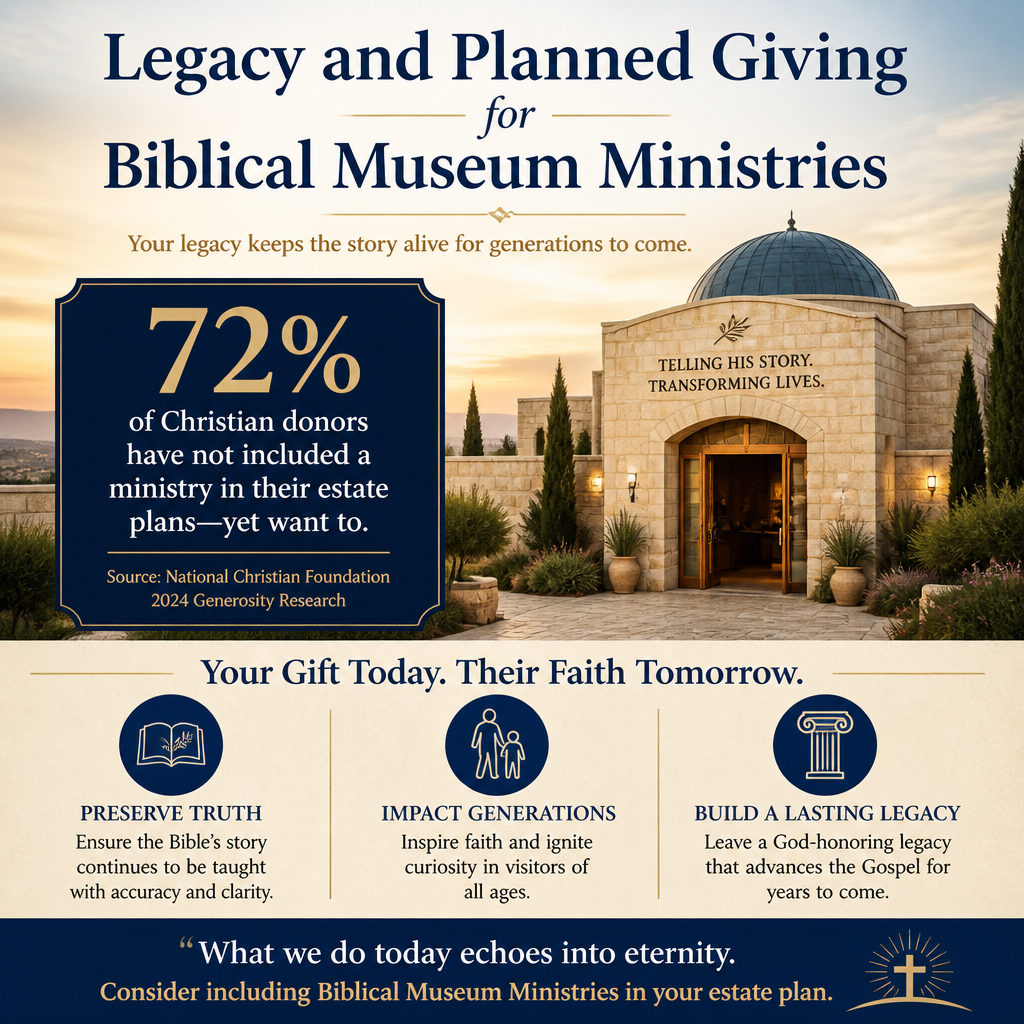
A bequest is often the most straightforward form of legacy giving. It can be a specific dollar amount, a percentage of the estate, or a residual bequest (what remains after other obligations are met). For many Christian donors, percentage-based or residual bequests provide flexibility: they adjust as the estate changes over time, and they reduce the risk that a fixed sum unintentionally crowds out family provision if circumstances shift.
Donors should pay attention to two practical matters. First, correct legal names matter; ministries may have similar public-facing brands but different corporate entities. Second, restrictions should be used sparingly and drafted carefully. A tightly restricted bequest can become unusable if programs change, laws shift, or a museum’s strategic plan evolves. When restrictions are essential, a well-crafted variance clause can allow the ministry to apply the gift to the closest feasible purpose consistent with the donor’s intent.
Beneficiary designations for retirement accounts and life insurance
Beneficiary designations are powerful because they pass outside of probate and can be updated without rewriting a will. They are also often tax-wise: retirement accounts can carry income tax consequences for heirs, while charities can generally receive them without those burdens. Many donors choose to name family as primary beneficiaries and a ministry as contingent, or to assign a percentage to each.
What this means in practice is that legacy giving can be integrated into existing accounts with comparatively little administrative friction. The harder question is coordination: beneficiary designations can override a will, so households should ensure that their estate documents and account forms tell one coherent story.
Charitable gift annuities and other life-income arrangements
Some donors want to make a meaningful gift now while also securing predictable income. A charitable gift annuity is one common tool: the donor contributes assets, and the charity commits to pay a fixed amount for life (or for two lives), with the remainder supporting the ministry. These arrangements can be appropriate for donors who value stability and simplicity, but they require careful attention to the charity’s financial strength, reserves, and regulatory compliance in the states where annuities are offered.
Life-income gifts are not interchangeable. Charitable remainder trusts, pooled income funds, and other structures can serve different needs. Because these decisions touch taxes, cash flow, and family planning, we recommend that donors involve qualified legal and tax counsel, and that they confirm a ministry has the administrative capacity to steward these instruments well.
Gifts of appreciated securities
Appreciated stock is a common planned giving on-ramp because it can allow a donor to give more while potentially avoiding capital gains tax that would be incurred on a sale. Many ministries can receive securities directly through brokerage transfers. For donors with highly appreciated positions, this can be one of the cleanest ways to convert market growth into ministry support without reducing the gift through unnecessary tax friction.
As with any asset-based gift, clarity matters: confirm the receiving instructions, whether the ministry has a gift acceptance policy, and whether it has a consistent practice for selling or retaining securities. A ministry that improvises here may be improvising elsewhere.
Common tensions donors face and how to address them with integrity
Planned giving presses on questions that are not merely technical. Mature Christian donors often name competing goods: care for aging parents, provision for children, support for a local church, and concern for ministries that strengthen the faith of future generations. Legacy planning is where those goods must be ordered, not merely affirmed.
Family provision and Kingdom generosity are not adversaries
Some donors fear that legacy giving signals distrust of children or a withdrawal of care. Others fear that any priority given to family is a concession to materialism. Scripture refuses both caricatures. The New Testament’s warnings against hoarding do not annul the call to provide for one’s household (1 Timothy 5:8). The question is not whether to love family, but whether family provision is shaped by faith or by anxiety.
One practical approach is to treat generosity as part of the inheritance itself: an estate plan can provide for heirs while also including named ministries, donor-advised funds, or charitable trusts that express the household’s spiritual commitments. Some donors also choose to communicate their intent in a letter alongside the legal documents, not as control from the grave, but as pastoral clarity for their children.
Restricted gifts can protect intent or create future harm
Restrictions feel responsible because they preserve control. Sometimes they are responsible—particularly when a donor is funding a clearly defined capital need, collection care endowment, or educational program with measurable costs. But restrictions can also cause long-term harm when they lock an institution into outdated assumptions. Museums, especially, operate in shifting legal and ethical landscapes around acquisitions, cultural patrimony, and exhibition practices.
We recommend that donors ask whether the ministry already has a disciplined approach to restricted funds and whether it reports on them clearly. If the ministry cannot explain how it tracks restricted gifts today, it is unlikely to honor a complex restriction faithfully decades from now.
Verification matters more when time horizons are long
Legacy giving assumes continuity: that the organization will still exist, still be faithful, and still be competently governed when the gift arrives. That is not a cynical assumption; it is a sober one. Planned gifts are often executed by executors who are not specialists in Christian philanthropy, which means that clarity, documentation, and public accountability become part of stewardship itself.
Across our work at Most Trusted, the ministries that meet The Most Trusted Standard tend to share certain institutional habits: they document decisions, publish meaningful disclosures, submit to independent oversight, and resist exaggerated storytelling about impact. Those traits are not cosmetic. They are the difference between a legacy gift that quietly strengthens a ministry’s witness and a gift that becomes a future dispute.
A faithful legacy is built on clarity and trust
Planned giving for biblical museum ministries is ultimately about what kind of witness Christians intend to leave behind. Museums can help the church remember that the gospel came to us in real places, among real peoples, under real empires—and that Christian faith is not a disembodied idea. Legacy gifts can strengthen that work when they are made with theological seriousness, family wisdom, and verified confidence in a ministry’s governance and integrity.
Donors should insist on the kind of trust that can bear the weight of time: clear mission, accountable leadership, transparent finances, and disciplined truth-telling. When those foundations are present, legacy giving becomes less a gesture of sentiment and more a durable act of Christian stewardship.



