

Setting up recurring gifts for Christian adoption ministries is not primarily a technical task. It is a spiritual and fiduciary commitment: a decision to underwrite long, complex work that touches children, birth families, adoptive families, and local churches. For donors who want to be faithful over time, recurring giving can translate conviction into steady capacity without being driven by emotion, crises, or year-end pressure.
Adoption-related ministry sits at the intersection of mercy, justice, and pastoral care. Christians agree that God sets the lonely in families and calls his people to defend the vulnerable; Christians also genuinely disagree about the best policy paths, ethical safeguards, and the right balance between direct services and prevention. Recurring giving should be structured to strengthen what is demonstrably good, and to constrain what can become exploitative when funding is loose and accountability is thin.
Begin with the ministry model, not the payment form
Many donors start with the question, “How do we set up a monthly gift?” The more important prior question is, “What are we actually funding?” Christian adoption ministries operate across multiple models: domestic adoption agencies, foster care support, family preservation, international adoption facilitation, post-adoption counseling, and church-based wraparound care. A recurring gift is only as wise as the program it sustains.
Clarify whether the work strengthens families or unintentionally replaces them
The orphan care movement has had to reckon with the fact that institutional and incentive-driven models can separate children from families. The best adoption ministries describe how they prioritize kinship care, ethical relinquishment practices, trauma-informed services, and family preservation where appropriate. Donors should ask for plain descriptions of safeguards, not inspirational language.
Ask for evidence of outcomes that match the mission
Outcomes in this field are not only “adoptions completed.” A mature ministry will speak about child well-being, placement stability, post-placement support, adoptive family resilience, and partnerships with local churches. Where measurement is hard, donors should still expect honest reporting: what is being tracked, what is not, and why.

Choose a recurring structure that matches the real cost curve
Adoption-related services rarely have uniform monthly expenses. Home studies, legal fees, counseling, and crisis intervention spike irregularly. What this means in practice is that recurring giving should be designed to build durable capacity, not to force a ministry into artificial predictability.
Match the cadence to the ministry’s operational reality
Monthly gifts are common, but quarterly or biweekly giving can be equally faithful and sometimes more fitting for household cash flow. Some ministries prefer donors to underwrite a defined need category (for example, post-adoption counseling sessions) rather than a general fund. Others need flexible unrestricted support to respond to placements and family crises.
Decide when restricted giving helps and when it harms
Restricted gifts can protect intent, but they can also increase administrative strain and reduce responsiveness. The “Overhead Myth” statement, signed by major charity evaluation organizations, warns against simplistic distinctions between “program” and “administration,” because effective work requires adequate infrastructure and staffing GuideStar. For recurring giving, a prudent approach is often a primarily unrestricted commitment paired with periodic, project-specific gifts when the ministry demonstrates clear plans and reporting.
Set recurring gifts with controls that honor stewardship
Christian donors are not only generous; we are accountable. Recurring giving should be simple to administer, but it should never be untethered from review. A recurring gift is a standing instruction with moral weight, and it should be treated accordingly.
Use a short stewardship checklist before enabling autopay
- Confirm the ministry’s legal status and current contact information in writing.
- Review the most recent audited financials or, for smaller ministries, a reviewed statement and clear internal controls.
- Verify board governance practices and conflict-of-interest policies.
- Read the ministry’s child safeguarding and trafficking prevention policies when applicable.
- Ensure the recurring gift can be changed or cancelled easily without friction.
For donors who want help evaluating these fundamentals, Most Trusted exists to do independent verification against The Most Trusted Standard, a 15-criteria framework spanning faith foundation, financial integrity, governance and leadership, and transparency and effectiveness. Across our verification work, the ministries that meet The Most Trusted Standard tend to treat recurring donors as partners who deserve clear reporting, not as a revenue stream to be managed.
Build review into the commitment
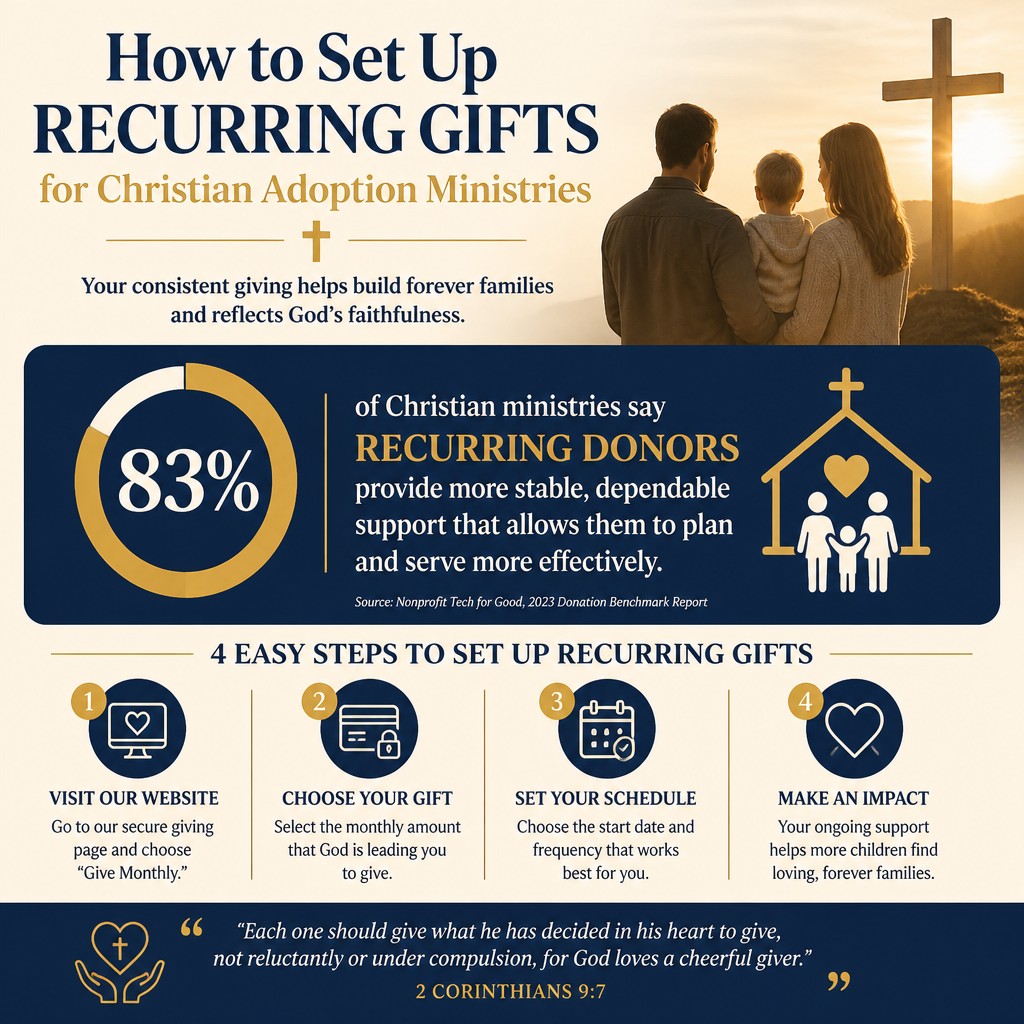
A practical pattern is to set a recurring gift for 12 months with a calendar reminder to reassess before renewing. Some donors use a “renewal month” tied to the ministry’s fiscal year or annual report cycle. The goal is not suspicion; it is stewardship that is awake rather than automatic.
Verify credibility and theology without confusing them
Christian donors often face a painful dilemma: a ministry’s theological language may be strong while operational accountability is weak, or operational sophistication may be high while Christian identity is thin. Recurring giving should not force a false choice, but it should refuse to treat either category as optional.
Assess faith commitments as lived governance, not slogans
For an explicitly Christian adoption ministry, donors should expect a coherent statement of faith, but also evidence that faith shapes practice: how leaders speak about human dignity, how services are delivered without coercion, and how the ministry partners with churches. James’s concern for “pure and faultless” religion is inseparable from integrity and restraint; Scripture does not bless zeal detached from righteousness.
Ask adoption-specific integrity questions
Because adoption involves legal authority, vulnerable families, and significant money flows, the risk profile is distinct. Donors should not be embarrassed to ask pointed questions: How are fees structured? How is consent documented? What is the process when a placement destabilizes? What external oversight exists? A ministry worthy of long-term partnership will answer without defensiveness and without hiding behind confidentiality.
Christians who want broader context on this field often begin with Christian Adoption Ministries, not to find a single perfect model, but to understand the range of faithful approaches and the cautions learned through hard experience.
Integrate recurring giving into a coherent adoption ethic
Recurring gifts are most faithful when they are not isolated from the rest of a donor’s discipleship and giving. Adoption ministries sometimes receive generous bursts of attention while related needs remain chronically underfunded: foster family support, trauma counseling, respite care, and church-based wraparound services.
Fund what makes families durable, not only what creates placements
Many adoptive and foster families describe the same pressure point: the months and years after placement when trauma, schooling, attachment challenges, and marital strain intensify. A recurring gift that sustains post-adoption support can be as consequential as funding the front end of the process. When a ministry can show that it equips churches to support families locally, the impact often extends beyond the ministry’s own caseload.
Hold space for prevention and preservation alongside adoption
The field has learned that a Christian commitment to orphan care does not automatically imply that every family separation is inevitable or righteous. In many contexts, supporting family preservation, kinship care, and crisis pregnancy services may reduce unnecessary separations. Recurring giving can reflect that moral seriousness by supporting ministries that hold these goods together rather than pitting them against each other.
For donors thinking through these choices, How to Give Wisely to Christian Adoption Ministries names practical considerations that distinguish heartfelt giving from accountable partnership.
FAQs for How to set up recurring gifts for Christian adoption ministries
Should recurring gifts be restricted to a specific child or family?
Usually, no. Designated giving can create inequity, confidentiality problems, and incentives that distort case decisions. A wiser approach is often to support a defined program category, such as post-adoption counseling or foster family training, while allowing the ministry discretion within clear policies and reporting. If a ministry offers sponsorship-style options, donors should ask how it avoids creating pressure on case outcomes or public storytelling.
What should we review each year before renewing a recurring gift?
At minimum, donors should review (1) current financial statements and whether an audit or external review exists, (2) governance and conflict-of-interest controls, (3) child safeguarding policies and incident response, (4) evidence of outcomes and what has been learned, and (5) whether the ministry’s theology is expressed through ethical practice rather than only through marketing. If the ministry cannot provide clear documentation, that is a stewardship signal, not a minor inconvenience.
A recurring gift is a standing act of trust
Recurring giving is one of the most effective ways donors can strengthen Christian adoption ministries, because it funds the unglamorous work that keeps families supported and children safe. The task is to make that gift accountable: matched to a sound ministry model, structured with controls, and reviewed with sober joy. When recurring gifts are set with verification, clarity, and moral seriousness, they become a quiet form of endurance in a field that requires it.



