

How to pray for Christian adoption ministries is not primarily a question of finding the right phrases. It is a question of aligning our intercession with God’s revealed heart for children, with the moral complexity of modern adoption systems, and with the stewardship responsibility donors carry when we fund the work.
Scripture does not permit indifference toward children without protection. God identifies himself as “Father of the fatherless” (Psalm 68:5), and James ties the credibility of our religion to care for the vulnerable (James 1:27). Yet Christian adoption ministry sits at the intersection of family loss, state authority, international law, poverty, trauma, and race. Faithful prayer names those tensions without pretending they are simple, and it asks God for outcomes that are righteous, verifiable, and merciful.
Pray from Scripture’s vision of family and justice
Ask for a ministry posture that honors both compassion and truth
Adoption is one of Scripture’s most profound metaphors for salvation (Romans 8:15; Ephesians 1:5). But the fact that adoption can image the gospel does not mean every adoption process is automatically just. Our prayers should resist sentimental shortcuts. We can ask God to keep ministries tender toward suffering and uncompromising toward truth, because biblical compassion is never detached from righteousness (Psalm 89:14).
That means praying that ministries speak honestly about what adoption is and is not. Adoption is not a “rescue story” that erases first families. It is a legal act that creates a new family when a child cannot safely remain in their original one. A ministry that serves children well will honor the dignity of birth mothers and fathers, the gravity of family separation, and the child’s right to truthful identity.
Pray for the protection of children and for clean hands in the process
The adoption field has repeatedly faced scandals tied to coercion, document fraud, and financial incentives that distort judgment. These are not merely administrative failures; they are violations of the eighth and ninth commandments in institutional form. Pray for “clean hands and a pure heart” (Psalm 24:4) for agency staff, partner ministries, attorneys, social workers, and every intermediary. Ask God to expose wrongdoing early and to give leaders the courage to stop processes that would otherwise “work” on paper but fail the test of justice.
When we pray this way, we are also praying against the subtle temptation to treat speed as the highest good. A rushed placement can become a spiritualized version of impatience. Pray for patient diligence: that ministries would pursue lawful, well-documented, child-centered placements even when it costs time, money, and public applause.

Pray for child-centered outcomes that reduce family separation when possible
Pray for wise discernment between adoption and family preservation
Christian donors often want the clearest possible moral line: adopt whenever there is need. The harder reality is that some needs call for preservation support, not adoption. The same Christian compassion that rejoices when a child finds a permanent family should also grieve preventable separation and invest in keeping families intact when it is safe and feasible.
Pray for ministries to know the difference between a child who truly needs adoption and a family that needs economic stabilization, trauma care, addiction treatment, or accountable discipleship. Ask God to provide the resources and local partnerships for preservation work that is not merely aspirational but operational.
Pray for humility about what helps and what harms
Many in the Christian orphan care movement have been shaped by the “When Helping Hurts” framework articulated by Steve Corbett and Brian Fikkert, which warns that well-intended aid can deepen dependency or displace local capacity if it is not designed with dignity and local ownership in view (When Helping Hurts). Adoption ministries can fall into similar patterns: outside funding, outside decision-making, and outside narratives that unintentionally weaken families and communities.
Pray for ministries to learn from evidence rather than from anecdotes. Pray for evaluation that is honest enough to reveal hard truths: disrupted adoptions, failed reunifications, inadequate post-placement care, and the long-term mental health burdens many adoptees carry. Truthful measurement is not faithlessness; it is obedience to the God who loves the light (John 3:21).
Pray for integrity where money and incentives exert pressure
Ask God to guard against financial patterns that distort judgment
Adoption is expensive, and the economics can create pressure on agencies and families alike. Prayer should be specific about those pressures. Ask God to protect ministries from the temptation to build budgets that require a constant flow of placements. Ask for boards and executives who will not confuse organizational survival with moral necessity.
We have also found it clarifying to pray with the “Overhead Myth” in mind: legitimate effectiveness is not measured by starving administration, but by whether spending aligns with mission and is openly explained. Charity Navigator, Candid (GuideStar), and BBB Wise Giving Alliance have jointly warned donors against evaluating nonprofits by overhead ratios alone, because that approach can reward underinvestment in governance, systems, and accountability (Charity Navigator). Adoption ministries need trained staff, careful documentation, and trauma-informed services—costs that should be visible and defensible, not hidden.
Pray for verifiable transparency and sober reporting
Ministries sometimes feel pressure to market outcomes in ways that reassure donors and simplify complex stories. Pray for leaders who fear God more than donor expectations. Ask for reporting that is concrete: what services were provided, what safeguards are in place, how complaints are handled, and how the ministry measures child well-being over time.
This is also where donors can pray with their giving decisions in view. Most Trusted exists to help donors give with confidence by evaluating ministries against The Most Trusted Standard, a 15-criteria framework across Faith Foundation, Financial Integrity, Governance and Leadership, and Transparency and Effectiveness. Prayer and due diligence are not competing virtues; together they form a mature stewardship posture.
Pray for governance, leadership, and local partnership that withstand scrutiny
Pray for boards that exercise real oversight
In high-stakes ministry work, the board is not a formality. It is a moral safeguard. Pray that boards understand their fiduciary and spiritual responsibilities: to ask hard questions, require documentation, investigate complaints, and refuse to be managed by charisma. Pray for a culture where whistleblowers are protected, not punished, and where repentance is practiced institutionally, not merely privately.
Across our verification work, we observe that ministries that withstand scrutiny tend to maintain clear conflict-of-interest policies, independent board membership, and disciplined financial controls. Those are not secular intrusions into ministry; they are practical expressions of accountability before God and neighbor.
Pray for cross-cultural competence and lawful partnership
Many adoption ministries operate across borders and cultures. Pray for humility toward local churches, local authorities, and local social-service ecosystems. Ask God to protect against “savior” narratives that center Western donors and diminish the agency of local believers. Pray that partnerships are lawful, transparent, and resilient enough to endure government audits and investigative journalism without fear.
For donors seeking context on the broader landscape, Christian Adoption Ministries is where we track common models, accountability questions, and what mature practice tends to include.
Pray for long-term care for adoptees and for families who bear the cost
Pray for trauma-informed, lifelong pastoral and clinical support
Adoption does not end at placement. Many adoptees and adoptive families encounter attachment challenges, grief, identity questions, and complex trauma that intensify over time. Pray that ministries treat post-placement support as core mission, not optional add-on. Ask God to provide qualified counselors, trained pastoral care, and peer communities where adoptive parents and adoptees can speak truth without shame.
Research and public health guidance broadly recognize that children exposed to adversity are at higher risk for later mental and physical health challenges, which reinforces the importance of early, sustained support (Centers for Disease Control and Prevention). Prayer that ignores these realities can become a form of denial. Prayer that faces them can become a means of perseverance.
Pray for birth families with dignity and concrete mercy
Christian donors sometimes struggle to know how to pray for birth families without undermining adoption. The right question is whether our prayers reflect God’s concern for everyone harmed by sin and scarcity. Pray for birth mothers and fathers to receive compassionate care, truthful counsel, and material support that does not coerce their decisions. Pray for churches to become communities where single mothers are protected, where men are called into responsibility, and where poverty is met with practical solidarity.
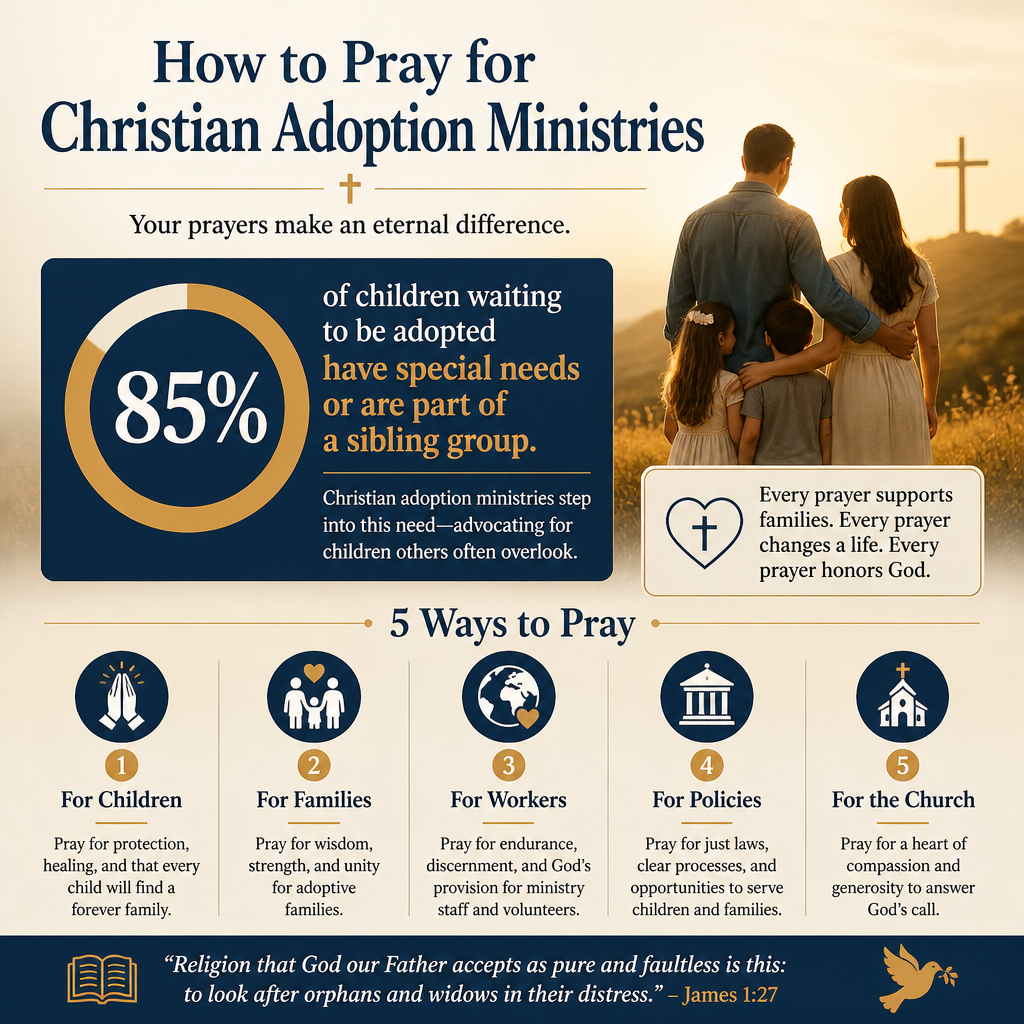
- Pray for children to be protected from coercion, trafficking, and neglect, and to receive stable, loving care.
- Pray for adoptive parents to have endurance, trauma-informed support, and wise spiritual covering.
- Pray for birth families to receive dignity, truthful options, and concrete help that reduces preventable separation.
- Pray for agency and ministry leaders to refuse dishonest practices even when pressured by timelines and budgets.
- Pray for boards and auditors to detect problems early and to act with courage when correction is costly.
For donors following the wider theological and operational questions in this field, The Christian Mission Behind Adoption Ministries is where we address the biblical mandate alongside the hard lessons the movement has had to learn.
FAQs for How to pray for Christian adoption ministries
What should donors pray when adoption stories feel emotionally compelling but the system seems complicated?
We should pray for truth and restraint alongside compassion: that ministries would refuse simplistic narratives, that children’s best interests would govern decisions, and that donors would not be manipulated by urgency. We can also pray for discernment to fund organizations that document safeguards, submit to oversight, and report outcomes with sobriety rather than marketing pressure.
How can donors pray about their own responsibility without slipping into cynicism?
We should pray for a stewardship posture shaped by Scripture: generosity without naivety, and trust without credulity. That includes asking God for the patience to do due diligence, the humility to change our giving when evidence warrants it, and the courage to support long-term care—post-placement services, preservation work, and accountability systems—that rarely produce dramatic stories but often produce faithful outcomes.
Praying as stewards, not spectators
Prayer for Christian adoption ministries is one way we refuse to outsource moral responsibility to agencies, boards, or compelling narratives. We ask God to protect children, to uphold justice, to sustain families, and to purify leadership where incentives distort judgment. Then we give in a way that honors those prayers: with careful verification, transparent expectations, and long obedience in the same direction.



