

Knowing how to vet a Christian counseling ministry before donating is a stewardship question, not a marketing exercise. Counseling ministries work at the intersection of suffering and trust, where a donor’s good intentions can either strengthen careful, Christ-centered care or unintentionally subsidize harm.
Christian donors often give because they want the church to be a place where burdens are carried, not merely discussed. Yet counseling is a field with real complexity: credentialing standards vary by state, theological convictions differ across traditions, and trauma-informed practice has corrected earlier ministry instincts that were sincere but incomplete. Serious giving begins by asking not only whether a ministry is “Christian,” but whether its counseling is competent, accountable, and truthful about outcomes.
Start with theology that can bear the weight of human suffering
A Christian counseling ministry should be able to articulate a theological account of the human person that does not collapse into slogans. Scripture insists that people are both embodied and spiritual, responsible and wounded, capable of change and in need of grace. A ministry’s counseling model should reflect that moral and pastoral realism, not reduce all distress to either “sin only” or “chemistry only.”
Evaluate the ministry’s stated faith commitments
Begin with what is public: statement of faith, doctrinal distinctives, and the way they describe sanctification, suffering, and the local church. Mature ministries can name where Christians genuinely disagree—on deliverance language, on the use of psychiatric medication, on the boundary between pastoral counseling and clinical therapy—without caricature. When a ministry cannot describe its convictions with clarity, donors should expect similar ambiguity in counseling rooms.
What this means in practice is asking whether the ministry’s theology makes space for lament as well as repentance. The Psalms teach God’s people to bring sorrow, fear, and even confusion before the Lord without pretense. When a counseling ministry treats grief as merely a spiritual failure, it will tend to offer brittle counsel and create shame where Christ offers refuge.
Watch for theological overreach that substitutes for competence
Some ministries implicitly promise that correct doctrine alone ensures safe counseling. That is not how Scripture speaks about wisdom. Proverbs commends skill, counsel, and prudence; James warns that teachers are judged more strictly; Jesus condemns leaders who “tie up heavy burdens” without helping people carry them. When theological confidence is used to dismiss professional standards, donors should press harder, not soften scrutiny.
In our verification work at Most Trusted, the ministries that meet The Most Trusted Standard tend to show a disciplined humility: they name the sufficiency of Scripture for faith and obedience while also acknowledging the legitimate contributions of clinical training, medical care, and supervised practice.

Confirm clinical competence and ethical safeguards
Good intentions do not make counseling safe. A donor’s first obligation is to ensure that the people receiving care are protected by clear qualifications, enforceable ethics, and appropriate supervision.
Ask who is actually providing counseling
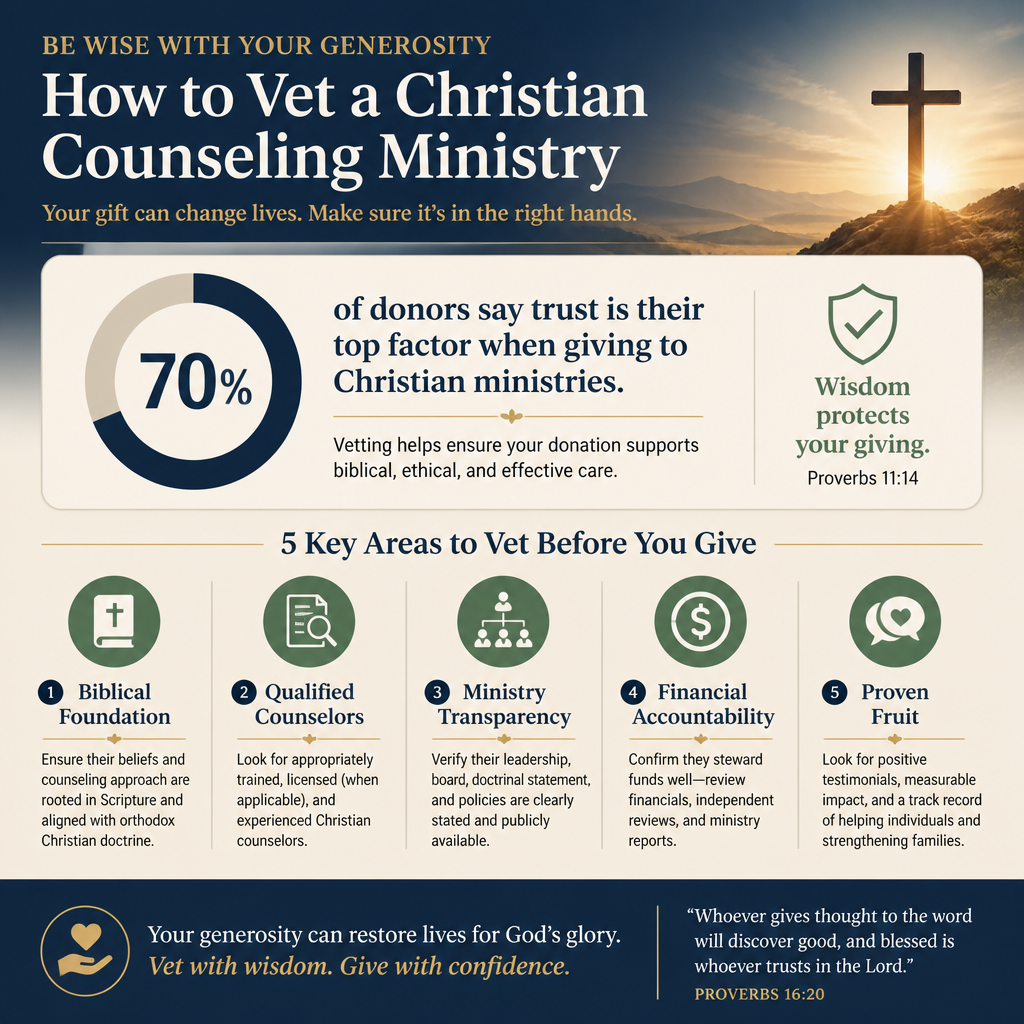
Many ministries use the word “counselor” broadly. That may include licensed clinicians, supervised interns, pastoral counselors, or trained lay helpers. Donors should ask for a breakdown of roles and credentials and whether counseling is offered as clinical therapy, pastoral counseling, coaching, or peer support. Each category carries different standards and risks.
If a ministry provides clinical mental health treatment, it should have licensed professionals responsible for care. Licensing does not guarantee spiritual maturity, but it does establish a public accountability structure. In the United States, professional licensure is regulated at the state level; donors can verify license status through state boards and understand common licensure categories through the U.S. Department of Labor’s occupational resources on mental health counseling U.S. Bureau of Labor Statistics.
Require clear policies for safety, reporting, and boundaries
Ethics are not an appendix; they are a pastoral necessity. A Christian counseling ministry should publish or provide, upon request, written policies covering confidentiality, mandated reporting, record-keeping, dual relationships, and counselor-client boundaries. This is not cynicism. It is love that refuses to gamble with vulnerable people.
Donors should ask how the ministry handles suicidal ideation, domestic violence disclosures, child abuse allegations, and severe mental illness. “We pray and refer out” may be appropriate in some settings, but it should be backed by specific referral relationships and crisis protocols. If a ministry cannot explain its process calmly and concretely, that itself is a warning sign.
Examine governance and accountability beyond the founder
Counseling ministries can become personality-driven, especially when a gifted teacher or counselor builds a strong following. Donors serve both the mission and the counseled when they insist on governance that can correct leaders, not merely celebrate them.
Look for an active, independent board
Ask for a current board roster, role descriptions, and evidence of oversight. Independence matters. If the board is largely family members, employees, or close friends, donors should expect weaker accountability in conflict situations. A board that cannot challenge leadership will struggle to address counseling harms, financial irregularities, or theological drift.
Healthy boards ensure that counseling practice is reviewed at the organizational level, not left to private discretion. They commission outside reviews when needed, document decisions, and set boundaries around who can provide care. In our experience, the best-run ministries are not those without controversy, but those with structures that can respond to controversy with truthfulness and repair.
Assess how complaints are handled
Donors should ask a direct question: “If a counselee alleges spiritual abuse, ethical misconduct, or harmful counsel, what is your complaint process?” The answer should include a written mechanism, an independent investigator or ombudsman in serious cases, and a commitment to cooperate with lawful authorities when required.
Some ministries fear that complaint processes invite frivolous accusations. That concern is not imaginary. But the alternative—no process, or a process controlled entirely by those being accused—invites deeper injustice. Scripture’s concern for truthful witness does not compete with its concern for protecting the vulnerable.
Follow the money without reducing the ministry to overhead ratios
Christian donors rightly want to know whether their gifts are stewarded with integrity. The harder question is how to evaluate financial health without falling into simplistic metrics that can incentivize underinvestment in quality counseling.
Request audited statements and clear revenue explanations
If a ministry is large enough to afford an audit, donors should expect audited financial statements, not only internal reports. Smaller organizations may not have an audit, but they should still provide recent financial statements, a budget, and a clear explanation of revenue sources: donations, counseling fees, church contracts, grants, and event income.
Where counseling is fee-based, donors should ask how fees are set and whether scholarships are available. Where counseling is free, donors should ask what volume is sustainable and whether counselors are paid fairly. Underpaying counselors or relying on excessive volunteer labor can create instability and ethical risk.
Use a few focused indicators rather than a single score
Financial stewardship is multidimensional. A short list of donor questions often reveals more than a glossy annual report:
- What percentage of counseling staff are employees versus contractors, and why?
- What portion of donations is restricted, and how are restrictions honored?
- Is there a conflict-of-interest policy, and do leaders disclose related-party transactions?
- How is executive compensation set and reviewed?
- What is the ministry’s financial reserve policy, and what is current cash on hand?
Many donors were trained to focus on “overhead.” The sector has broadly corrected that instinct. In 2013, Charity Navigator, GuideStar, and the BBB Wise Giving Alliance warned that overhead ratios can mislead donors and can pressure nonprofits to underinvest in accountability and effectiveness Charity Navigator. For counseling ministries, underinvestment can mean inadequate supervision, weak safeguarding, and staff burnout—costs that are eventually borne by counselees.
Demand transparency about outcomes, not just testimonials
Stories matter. They also mislead when they are used as a substitute for evidence. Counseling outcomes are difficult to measure, and Christians should be careful about demanding the kind of certainty that only God can provide. Yet donors can still ask for honest indicators of whether care is wise and whether people are being helped.
Ask what the ministry counts and why
Numbers are not sanctified merely because they are numbers. Donors should ask what the ministry tracks: session counts, wait times, completion rates, referral sources, client satisfaction, and safety incidents. Some ministries use validated clinical tools when appropriate; others track pastoral outcomes more qualitatively. The point is not to force every ministry into one model, but to require a coherent rationale and a willingness to learn.
Transparency should extend to limitations. A counseling ministry should be able to say, without defensiveness, what cases they are not equipped to handle and when they refer out. That clarity is a mark of competence and love.
Evaluate communications for truthfulness and restraint
Donors should read a ministry’s website, fundraising appeals, and conference content with an editor’s eye. Do they promise rapid transformation, guaranteed healing, or near-universal success? Do they imply that those who remain depressed or anxious simply did not believe enough? Such claims may raise money, but they deform souls.
Across our verification work, we observe that ministries aligned with The Most Trusted Standard tend to communicate with restraint: they celebrate God’s work, they protect counselee privacy, and they refuse to make people’s pain a fundraising asset.
FAQs for How to vet a Christian counseling ministry before donating
Is it unfaithful to prioritize licensed counseling in a Christian ministry?
No. Licensure is not a sacrament, but it is a meaningful form of public accountability and training. A Christian donor can affirm the authority of Scripture while also recognizing that counseling involves clinical competencies, ethical obligations, and safeguarding responsibilities. Many faithful ministries integrate licensed clinicians with pastoral care and church partnership, each operating within clear boundaries.
Should we stop giving if a counseling ministry has had a public controversy?
Not automatically. The more decisive question is how the ministry responded: whether it investigated credibly, disclosed appropriately, made restitution where warranted, and strengthened safeguards. Some controversies reveal deep corruption; others reveal that a ministry is willing to submit to correction. Donors should look for verifiable governance actions, not only statements.
Giving that strengthens care rather than funding risk
Donating to Christian counseling ministries is one of the most personal forms of Christian philanthropy because it touches what is most fragile in people: hope, conscience, memory, and trust. The goal is not suspicion; it is stewardship shaped by love of neighbor.
For donors who want a wider view of the field, we track organizations in Christian Counseling Ministries and offer guidance for discerning support through How to Give Wisely to Christian Counseling Ministries. Most ministries welcome careful questions. Those that resist basic accountability are telling donors something, and we should listen.



