

How to give wisely to Christian counseling ministries is a stewardship question with unusually high stakes. Unlike many categories of charity, counseling touches the hidden places of a person’s life—trauma, marriage rupture, addiction, depression, fear—and the counsel offered can either strengthen faith and restore agency or compound harm in the name of spiritual care.
Scripture treats care for the vulnerable as a measure of fidelity, not a niche interest. Yet Scripture also warns that zeal without knowledge can mislead (Romans 10:2). Christian donors feel that tension acutely in counseling: compassion urges immediate action, while prudence asks whether a ministry is clinically competent, spiritually faithful, and governed with the kind of accountability that protects both clients and staff.
Begin with a clear theological and clinical aim
Christian counseling is not a single model. Some ministries operate outpatient counseling centers with licensed clinicians. Others provide pastoral counseling, peer support, or biblical counseling rooted in a particular theological tradition. Christians genuinely disagree about where “counseling” should sit on the spectrum between clinical treatment and discipleship, and donors should not pretend the field has settled that debate.
What this means in practice is that wise giving begins by naming what the ministry is actually attempting to do. A ministry that claims to treat clinical depression and trauma must be evaluated differently than a ministry focused on short-term pastoral care, marriage enrichment, or crisis prayer support. Confusing those categories is one of the most common ways donors accidentally fund overreach.
Match the ministry’s claims to the level of risk
The greater the clinical risk, the higher the burden of proof. Ministries serving suicidal clients, severe trauma, domestic abuse, or serious mental illness should demonstrate formal clinical leadership, appropriate referral pathways, and clear safety protocols. When ministries claim to serve these populations without explaining how they manage risk, donors should slow down.
One reason is straightforward: mental health need is widespread, and the pressures on ministries are real. In a 2023 survey, roughly one in five U.S. adults reported symptoms of anxiety or depressive disorder in the prior two weeks Centers for Disease Control and Prevention. High demand can tempt ministries to expand beyond their competence, especially when donors reward growth narratives more than careful practice.
Distinguish discipleship language from clinical language
Some ministries use clinical terms—“trauma-informed,” “evidence-based,” “licensed”—as fundraising shorthand. Others reject that vocabulary entirely and emphasize Scripture, sanctification, confession, and repentance. Donors should ask whether the ministry’s public language matches its actual service model and whether it communicates limitations honestly to those seeking help.
We also recommend watching for a false dichotomy. A ministry can be deeply Christian and still practice appropriate clinical humility, including referrals and collaboration with local providers. Faithfulness does not require pretending that complex psychiatric conditions can be resolved by exhortation alone.
Clarify what faithfulness looks like in counseling practice
Theological fidelity in counseling ministries is not merely a statement of faith posted online. It shows up in how counsel is applied to suffering: whether sin is addressed without crushing the bruised reed, whether forgiveness is taught without minimizing abuse, whether spiritual disciplines are encouraged without implying that medication or treatment is unbelief. Donors should ask for concrete examples of how the ministry handles difficult cases—especially domestic violence, suicidal ideation, and addiction relapse—because vague assurances are easy to produce.

Evaluate credentials without reducing the ministry to credentials
Credentials matter because counseling is a helping profession with real power dynamics. When a counselor is wrong, a client may not have the strength, knowledge, or freedom to push back. Wise donors honor that asymmetry by taking competence seriously.
At the same time, donors should not equate “licensed” with “safe,” or “unlicensed” with “unsafe.” The harder question is whether the ministry’s staffing model fits its claims and whether oversight, supervision, and boundaries are strong enough to protect the vulnerable.
Look for role clarity and supervision
In healthier counseling ministries, roles are clearly defined: licensed clinicians treat clinical conditions; pastoral staff provide spiritual care; peer leaders offer support within well-defined limits. If a ministry uses volunteers or peers, donors should ask how those leaders are trained, what they are not permitted to do, and who supervises them when situations escalate.
Supervision is not an administrative detail. In clinical settings it is a primary safeguard against drift, burnout, and isolation. Donors can reasonably ask whether counselors receive ongoing clinical supervision, whether pastors offering counseling are trained in referral decisions, and whether the ministry has written protocols for crisis situations.
Ask what accountability exists when counseling goes wrong
Every counseling ministry will face difficult outcomes: marriages still break, addictions recur, trauma symptoms persist. The relevant question is not whether outcomes are uniformly positive, but whether the ministry has mechanisms to receive complaints, investigate misconduct, and correct practice. Donors should listen for whether leadership can describe that process plainly, including how conflicts of interest are prevented when a complaint involves staff members.
For ministries operating in a licensed clinical environment, donors can ask how the ministry complies with state licensure requirements and professional ethics. For ministries rooted in pastoral or biblical counseling, donors can ask what external accountability exists beyond internal leadership, because self-policing is rarely sufficient in high-trust religious environments.
Be cautious with promises and universal solutions
Ministries sometimes promise rapid healing, total deliverance, or “guaranteed” relational restoration. Donors should treat that as a spiritual and ethical warning sign. Scripture’s hope is real, but it does not flatten human complexity or remove the need for patient care. In counseling, grand promises can become a form of coercion, especially for the suffering who want relief at any cost.
Governance and financial integrity are not secondary in soul care
Counseling ministries often feel more like churches than nonprofits: deeply personal work, close relationships, strong spiritual authority. That intimacy can be life-giving. It can also create conditions where weak governance is excused because “the mission is too important” or “people are getting helped.” Mature donors do not accept that trade.
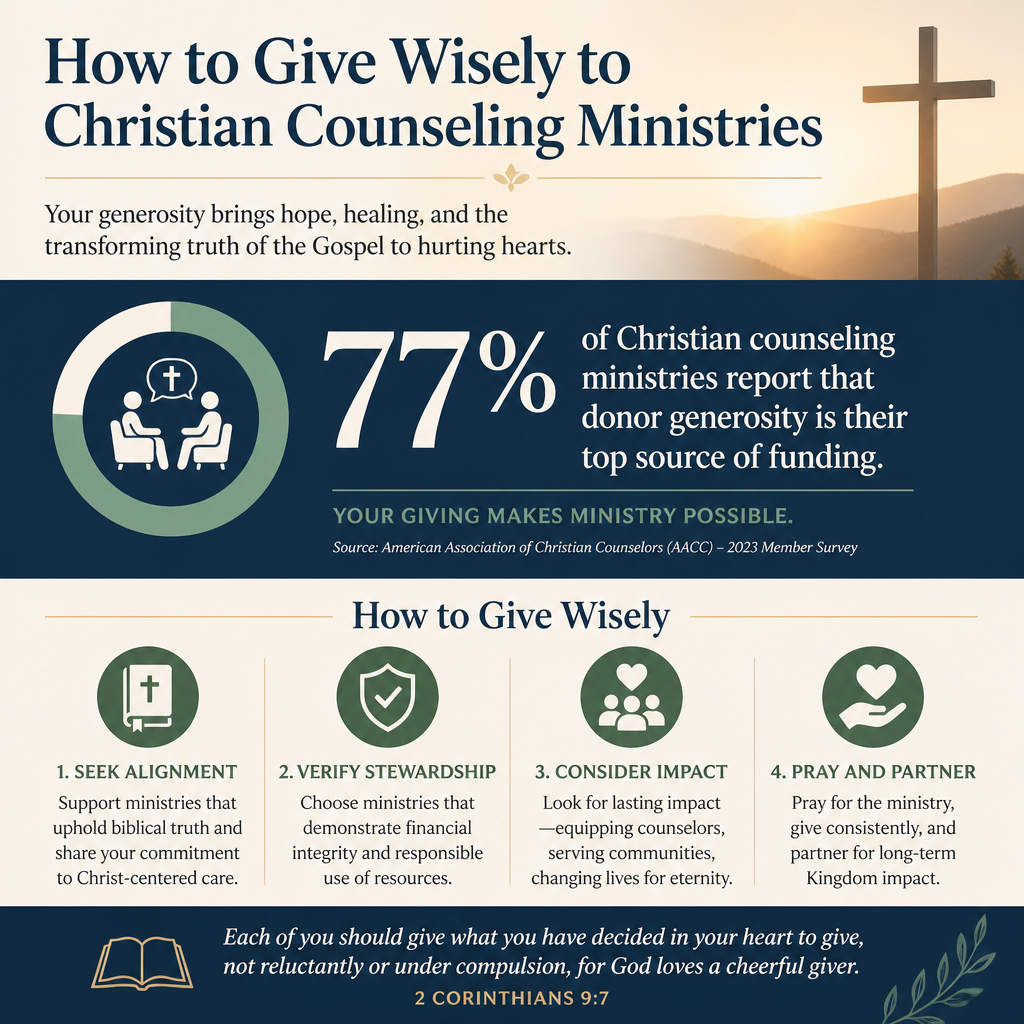
Across our verification work at Most Trusted, the ministries that meet The Most Trusted Standard tend to treat governance and financial integrity as part of spiritual credibility. They understand that mishandled money, unchecked authority, and vague reporting eventually damage the very people the ministry exists to serve.
Prefer boards that actually govern
A board should not function as a spiritual cheering section. It should provide oversight, ask hard questions, set boundaries for executive authority, and protect the mission from the charismatic gravity of a founder. Donors can ask basic questions that reveal much: How many independent board members are there? How are conflicts of interest handled? Does the board evaluate the CEO? Is there a written whistleblower policy?
Some donors are hesitant to press on governance for fear of seeming distrustful. In a counseling ministry, governance is a form of care. It is how an organization signals that clients are not at the mercy of a single personality or inner circle.
Financial transparency should be normal, not exceptional
Donors should expect accessible financial reporting: a recent Form 990 (for U.S. nonprofits), audited financial statements when scale warrants, and a clear explanation of how funds are used. A ministry serving vulnerable clients should also be clear about how it subsidizes care, how it prices services, and whether it relies on aggressive fundraising to cover operating gaps.
Wise donors resist simplistic overhead scoring. The philanthropic sector has repeatedly warned that overhead ratios alone are not a reliable indicator of effectiveness, a point emphasized in the Overhead Myth statement endorsed by leading evaluators Candid GuideStar. Counseling ministries in particular may need significant administrative investment for supervision, compliance, and data security. A low administrative number can signal underinvestment in safeguards rather than efficiency.
Audits and controls should fit the ministry’s size and risk
Not every ministry needs an annual audit at a small scale, but every ministry needs basic internal controls: separation of duties, documented approval thresholds, and clear handling of restricted gifts. As ministries grow, independent audits and strong finance committees become increasingly appropriate. Donors should ask not only whether an audit exists, but whether recommendations are addressed.
Fundraising practices also deserve scrutiny. Pressure-based appeals that trade on shame, confidentiality, or exaggerated crisis can be spiritually corrosive. Ministries that do counseling work should be especially careful not to monetize stories in ways that exploit client pain or imply that donors are paying for a particular person’s breakthrough.
Assess outcomes, but do not demand the wrong kind of proof
Donors should care about results. Yet counseling outcomes are complex to measure, and privacy is a moral constraint, not an inconvenience. The most responsible ministries avoid turning client stories into marketing assets, and they often cannot share the kind of granular outcome data a donor might want.
The goal is not perfect measurement. The goal is credible evidence of faithful practice: clear program descriptions, appropriate metrics, responsible evaluation, and honest reporting about limitations.
Ask for evidence of effectiveness that respects confidentiality
Ministries can share aggregate data without exposing clients: number of sessions provided, wait times, completion rates for structured programs, referral rates to higher levels of care, and client satisfaction surveys administered with appropriate safeguards. They can also describe their clinical model, training pipeline, and how they update practice in light of feedback.
Donors should be cautious of ministries that share highly detailed stories that could plausibly identify a client, even with names changed. In counseling, discretion is part of integrity.
Look for strong transparency about limits and referrals
Healthy counseling ministries say clearly who they can and cannot serve. They describe when they refer to psychiatric care, inpatient treatment, legal services, or domestic violence shelters. They do not present themselves as a one-stop solution for every kind of suffering.
This is one place where theological maturity shows. Christians believe God can heal, and we also accept that ordinary means—medical care, community support, patient skill—are often part of God’s providence. A ministry that refuses all partnership with outside expertise should explain why, and donors should judge whether that posture serves the vulnerable.
Use independent verification when the category is hard to evaluate
Counseling ministries are difficult for donors to assess from the outside because the most important work happens in private. That is why independent verification can serve donors who want to give with confidence. Most Trusted evaluates ministries against The Most Trusted Standard, a 15-criteria framework spanning faith foundation, financial integrity, governance and leadership, and transparency and effectiveness. This kind of evaluation does not replace prayerful discernment; it adds due diligence where visibility is limited.
Donors who want to focus specifically on Christian Counseling Ministries often find it helpful to compare ministries within the category on the same set of criteria, rather than evaluating each ministry on its own terms with inconsistent questions.
A wise gift strengthens both care and credibility
Giving wisely to Christian counseling ministries means refusing the false choice between compassion and scrutiny. The Gospel calls Christians to move toward the suffering, and Christian stewardship calls Christians to test what is trustworthy. When donors honor both, they help build ministries that combine theological seriousness with professional competence, and mercy with accountability.
The best giving does more than fund sessions. It strengthens the conditions under which vulnerable people can receive safe, faithful care—care that can withstand questions, endure crises, and remain worthy of the name of Christ.



