

Donors often ask what credentials Christian counseling ministry counselors should have because the stakes are unusually high: spiritual authority is involved, human suffering is present, and vulnerable people can be harmed by sincere but unqualified care. A mature Christian approach does not pit “biblical” against “clinical.” It insists on both truth and love, both doctrinal fidelity and competent practice.
The harder question is that “credentialed” does not automatically mean “trustworthy,” and “uncredentialed” does not automatically mean “unsafe.” Credentials tell us something real about training and accountability, but they do not settle questions of theology, character, supervision, or how a ministry handles risk. Donors can fund counseling that heals—or counseling that confuses consciences, mishandles trauma, or quietly enables abuse.
Credentials are a baseline for competence, not a substitute for Christian maturity
In counseling, good intentions cannot replace skill. Scripture’s call to shepherd wisely assumes knowledge and discernment; zeal without knowledge can injure (Romans 10:2). In practice, competent counseling requires training in assessment, confidentiality, documentation, crisis response, trauma dynamics, and referral thresholds. Those capacities are not optional when someone presents with suicidality, domestic violence, psychosis, or severe depression.
What credentials can and cannot tell a donor
Licensure and recognized clinical degrees generally indicate formal education, supervised hours, and an external code of ethics. They also create a disciplinary pathway if a counselor violates professional standards. That accountability matters for ministries that serve the public.
But credentials alone cannot tell you whether a counselor’s theology is sound, whether they practice within their scope, or whether the ministry culture pressures counselors to “solve” complex clinical problems with spiritual shortcuts. Donors should treat credentials as necessary information, not sufficient assurance.
Why ministries sometimes resist credentials and why donors should still ask
Some Christian counseling ministries prioritize lay discipleship models, peer support, or pastoral care, and they may worry that licensure will secularize their approach. Christians genuinely disagree about integration models. Still, when a ministry advertises “counseling,” charges fees, treats diagnosed disorders, or serves high-risk populations, donors should expect professional standards, clear scope, and documented safeguards.

Start with role clarity: pastor, lay counselor, coach, or licensed clinician
Many disputes about “what credentials should they have” come from category confusion. In churches, “counseling” can refer to anything from prayer and spiritual direction to psychotherapy. Donors can bring clarity by asking a ministry to define roles, titles, and services precisely. That is not bureaucratic fussiness; it is a protection for clients and for the ministry.
Four common roles and the expectations that follow
- Pastoral counseling: shepherding, spiritual care, and discipleship under church authority; should have doctrinal accountability and training in referral and safeguarding.
- Lay counseling: structured peer care; should have standardized training, supervision, and clear boundaries on what they do not treat.
- Coaching: goals and habits; should not present as treatment for mental illness; should use transparent disclaimers and referral pathways.
- Clinical counseling: diagnosis and treatment; should be delivered by licensed professionals practicing within scope, with clinical supervision and documentation standards.
Questions donors can ask that quickly reveal whether a ministry is precise
Ask: “Who provides psychotherapy here?” “Who provides pastoral care?” “Do you diagnose?” “Do you treat trauma clinically?” “What happens when a client needs medication evaluation?” Clear answers suggest the ministry knows its lane. Vague answers often signal unmanaged risk.
When donors are comparing organizations in Christian Counseling Ministries, role clarity is one of the simplest indicators that a ministry understands both people and responsibility.
Licensed clinical credentials donors should recognize and verify
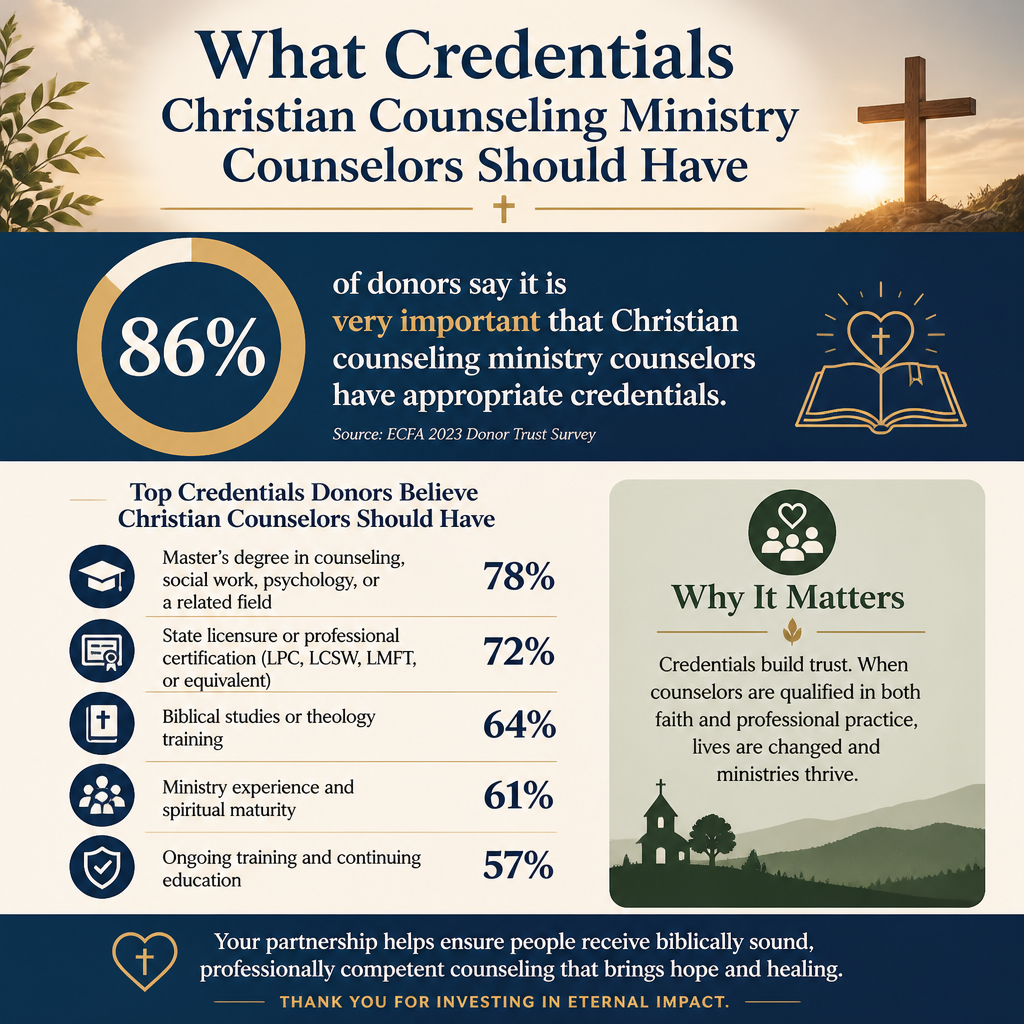
If a ministry provides clinical mental health treatment, donors should expect licensed clinicians in good standing, practicing under applicable state law. Titles vary by state, but the principle holds: licensure is the public’s basic protection. It signals minimum education, supervised practice, continuing education, and enforceable ethical standards.
Common licenses and degrees in the United States
Depending on the state, common licenses include Licensed Professional Counselor (LPC), Licensed Clinical Social Worker (LCSW), Licensed Marriage and Family Therapist (LMFT), Licensed Psychologist (PhD or PsyD), and Psychiatrist (MD or DO). Some ministries also employ psychiatric nurse practitioners for medication management. Each license has different scopes of practice; donors should not assume interchangeability.
Verification should be ordinary, not adversarial
Strong ministries typically welcome verification. Donors can ask whether the ministry checks licenses on hire and re-checks them periodically, including any disciplinary history. Most states provide public license lookup tools through their licensing boards. Ministries that resist basic verification, or that rely heavily on “life experience” to justify clinical work, are asking donors to underwrite preventable risk.
Donors should also pay attention to the distinction between “licensed” and “license-eligible.” Graduate interns and pre-licensed associates can serve effectively when they are properly supervised, documentation standards are in place, and clients are informed. Without those safeguards, a ministry can drift into a low-accountability model while still using professional language.
Specialized training matters for trauma, abuse, and high-risk cases
Licensure is not the end of competence. It is the floor. The counseling field has had to reckon with the reality that trauma, abuse, and coercive control can be mishandled even by well-meaning professionals. Christian ministries have an added burden: spiritual language can either protect the vulnerable or pressure them into silence.
When trauma competence becomes a donor issue
If a ministry serves survivors of sexual abuse, domestic violence, combat trauma, or complex childhood trauma, donors should expect counselors trained in evidence-informed trauma treatment and in safeguarding protocols. “Trauma-informed” has become a broad label; donors should ask what training counselors actually receive, how supervision is conducted, and how the ministry handles mandatory reporting.
Some donors assume that “faith-based” care naturally encourages disclosure and safety. Experience across the wider church suggests caution. Reported abuse is widely understood to be undercounted, and ministry environments can unintentionally discourage reporting through misplaced concerns about reputation, forgiveness language detached from justice, or premature reconciliation counsel.
For donors who want a sober sense of the landscape, the Rape, Abuse and Incest National Network summarizes the problem of underreporting and the complexity of disclosure in sexual violence cases, which should temper any ministry’s confidence in informal approaches.
Clinical skill should be paired with spiritual restraint
In high-risk cases, the most faithful counsel is often careful counsel: precise language, documented safety planning, collaboration with medical and legal professionals where needed, and humility about what counseling alone can accomplish. A counselor who invokes Scripture to override safety, minimize violence, or silence a victim has moved from pastoral care into spiritual misuse.
Donors should evaluate the ministry system around the counselor
Even excellent counselors can be compromised by weak systems. Donors are not only funding individual sessions; they are funding an organizational model. Across our verification work at Most Trusted, the ministries that meet The Most Trusted Standard tend to treat counseling as a regulated and accountable service, not a charismatic gift exercised without guardrails.
Governance and accountability signals that protect clients
Ask whether the ministry has written policies for informed consent, confidentiality, record retention, mandated reporting, conflicts of interest, and referral criteria. Ask who provides clinical oversight. A credible model names a clinical director or supervisor, defines supervision cadence, and documents escalation pathways for crises and ethical concerns.
Financial integrity and transparency also intersect with counseling practice. If counselors are paid primarily on volume, pressured to retain clients indefinitely, or encouraged to avoid referrals to protect revenue, donors should be concerned. The goal is care, not dependence.
Faith foundation should be explicit and disciplined
Because Christian counseling uses spiritual language, donors should expect an explicit statement of faith and theological commitments that shape practice. The question is not whether a ministry quotes Scripture, but whether it handles Scripture responsibly—distinguishing moral culpability from clinical symptom, repentance from recovery, and sanctification from the slow work of healing in a fallen world.
Donors who want to compare ministries on these questions can do so within How to Give Wisely to Christian Counseling Ministries, where our evaluation categories help separate sincere claims from verifiable practice.
FAQs for What credentials Christian counseling ministry counselors should have
Is a licensed counselor automatically a better Christian counselor?
No. Licensure indicates standardized training and accountability, but it does not guarantee theological soundness, spiritual wisdom, or relational maturity. Donors should look for both: appropriate clinical credentials for the services offered and a disciplined Christian framework that governs how Scripture, prayer, and pastoral authority are used in care.
What should donors think about ministries that use only lay counselors?
Lay counseling can serve the church well when it is clearly framed as discipleship or peer support, when lay counselors are trained, supervised, and limited to appropriate cases, and when referral pathways are explicit. Donors should be cautious when a lay-only model presents itself as treatment for serious mental illness or trauma without licensed oversight and documented safeguards.
Credentialing is a donor stewardship question
Christian donors give to counseling ministries because they want truth spoken with compassion and help offered with integrity. The most responsible ministries treat credentials, supervision, and safeguarding as forms of love for neighbor, not as concessions to bureaucracy. When donors fund counseling, they are funding a ministry’s handling of wounded people made in God’s image, and that deserves standards that can be verified.



