
To check Christian counseling ministry financial transparency, donors need more than a compelling testimony or a moving story of healing. Counseling ministries handle sacred trust: suffering is real, privacy is essential, and money is often given out of gratitude for the work of Christ in hard places. Transparency is not a demand for spectacle. It is a practical way to test whether a ministry’s stewardship is consistent with the gospel it proclaims.
The harder question is how to ask for verifiable clarity without forcing ministries into disclosures that would compromise counselee confidentiality or staff safety. Mature donor diligence names that tension directly. The goal is not to punish ministries for complexity, but to identify the ones whose public reporting, internal controls, and governance practices withstand ordinary scrutiny.
Begin with what a transparent counseling ministry is obligated to disclose
Most Christian counseling ministries do not exist to satisfy donor curiosity. They exist to serve people in pain, often with sensitive family histories, trauma, and clinical risk. Yet Scripture does not treat money as spiritually neutral. Jesus tied money to discipleship with unusual frequency, and the New Testament repeatedly commends financial integrity as part of a credible witness. Transparency, then, is not a secular add-on; it is one expression of walking “in the light.”
Start with baseline public documents
If the ministry is a U.S. nonprofit recognized as tax-exempt under section 501(c)(3), donors should expect access to its IRS Form 990 for prior years, and to current governing documents and leadership information. The IRS requires many nonprofits to make their Form 990 available for public inspection (IRS). A ministry may post the 990 on its own site, but donors can also find it via established nonprofit databases.
Know what a Form 990 can and cannot tell you
A Form 990 is not a spiritual scorecard, and it is not a clinical quality report. It can, however, show whether the organization reports revenue and expenses consistently over time, how it compensates key employees, whether it has independent board members, whether it discloses related-party transactions, and whether it claims basic policies such as conflict of interest and whistleblower procedures. A ministry that refuses to share basic filings without a principled reason is asking donors to fund work they cannot verify.

Read the financials like a steward, not a consumer
Christian donors often ask, “How much goes to counseling versus overhead?” The impulse is understandable, but the question can mislead. The nonprofit sector has been correcting this for years: the so-called “overhead ratio” is an incomplete measure of effectiveness and can incentivize underinvestment in accountability, staff development, and systems. Charity Navigator, Candid, and the BBB Wise Giving Alliance warned donors against judging nonprofits primarily by overhead in their “Overhead Myth” statement (Charity Navigator).
Ask whether spending patterns match the stated model of care
A counseling ministry’s financial story should align with its ministry story. For example, a clinic that claims to offer subsidized counseling to low-income families should show a credible funding strategy for subsidy: a mix of donations, grants, and earned revenue that is stable enough to avoid sudden service disruptions. A ministry that emphasizes training church leaders should show meaningful program expense in curriculum development, cohort facilitation, and supervision, not only marketing and event production.
Watch for the starvation cycle in counseling ministries
Counseling ministries are especially vulnerable to underfunding because donors often want counseling to be “free,” even when the work requires licensed clinicians, ongoing supervision, and compliance systems. The “Nonprofit Starvation Cycle,” described by Ann Goggins Gregory and Don Howard, explains how pressure to minimize overhead can produce weak infrastructure and ultimately poorer outcomes (Stanford Social Innovation Review). Donors can unintentionally reward ministries that appear lean but lack the capacity to manage risk responsibly.
- Consistency: Are revenue and expenses stable enough to sustain care, or does the ministry swing dramatically year to year?
- Liquidity: Does it have reasonable cash reserves for payroll and continuity of services?
- Program clarity: Are counseling, training, and outreach costs clearly distinguished?
- Fundraising reasonableness: Are fundraising costs proportionate to the funds raised over time?
- Concentration risk: Is the ministry dependent on one donor, one church, or one government contract?
Look for governance signals that reduce spiritual and financial risk
Financial transparency is rarely a stand-alone virtue. It tends to appear where governance is sober, accountable, and structurally capable of resisting temptation. Christian counseling ministries often have charismatic founders, strong pastoral influence, and high relational trust. Those are not defects. They are common features of Christian work. But they can also become risk factors when there is no independent oversight.
Board independence and conflict of interest controls
A donor should ask whether the board has independent members who can question leadership, and whether conflict of interest policies are more than paperwork. On a Form 990, these issues surface in the governance section and in disclosures about related-party transactions. When a ministry is closely held—family members employed, vendors connected to leadership, board members dependent on the founder—financial statements can remain technically accurate while accountability erodes.
Executive compensation and related-party transactions
Compensation is a morally serious topic and a complex one. Clinical leaders with advanced credentials and significant responsibility may be appropriately compensated. At the same time, counseling ministries can attract donors through moral authority, and donors rightly expect restraint. A transparent ministry explains how it sets pay, who reviews it, and whether it uses independent comparability data. Related-party transactions are not automatically wrong, but undisclosed related-party transactions are nearly always a warning sign.
Across our verification work at Most Trusted, the ministries that meet The Most Trusted Standard tend to treat governance as discipleship in institutional form: clear policies, minutes that reflect real oversight, and a board that is strong enough to protect the mission from any one personality.
Demand clarity about outcomes without forcing ministries to betray confidentiality
Counseling is not the same kind of work as distributing food boxes or drilling wells. Outcomes are often gradual, individualized, and difficult to quantify. Christians genuinely disagree about what “success” should mean: symptom reduction, spiritual formation, relational repair, or some combination. Still, donors can rightly ask for evidence that the ministry learns from its work, monitors quality, and handles clinical risk competently.
What credible outcome reporting can look like
A counseling ministry can share outcomes in ways that honor privacy: aggregated measures, de-identified case themes, and clear explanations of tools used. If a ministry uses standardized instruments, it can report aggregate change over time without exposing any individual’s story. If it offers pastoral counseling rather than clinical therapy, it can describe supervision practices, referral pathways, and boundaries on scope of care.
Safeguarding, mandatory reporting, and referral integrity
Financial transparency is incomplete without operational transparency where risk is highest. Donors should ask: Does the ministry have written safeguarding policies? How does it handle allegations of abuse? What is its policy on mandatory reporting, and how does it coordinate with local authorities when required? Counseling ministries that serve minors, couples in crisis, or trauma survivors need documented procedures and training, not merely good intentions.
For donors who want to place counseling support in a broader giving strategy, it helps to situate individual ministries within the wider ecosystem of Christian Counseling Ministries, where models of care, accountability practices, and funding structures vary widely.
Use a repeatable transparency checklist before you give
Many donors default to relational trust: a pastor’s recommendation, a friend’s story, an Instagram post. Those inputs matter, but they should not replace verification. A repeatable process protects donors from being swept by urgency and protects ministries from being judged by rumor or incomplete information.
Practical questions that a trustworthy ministry can answer
These questions are not hostile. They are the ordinary inquiries of faithful stewardship:
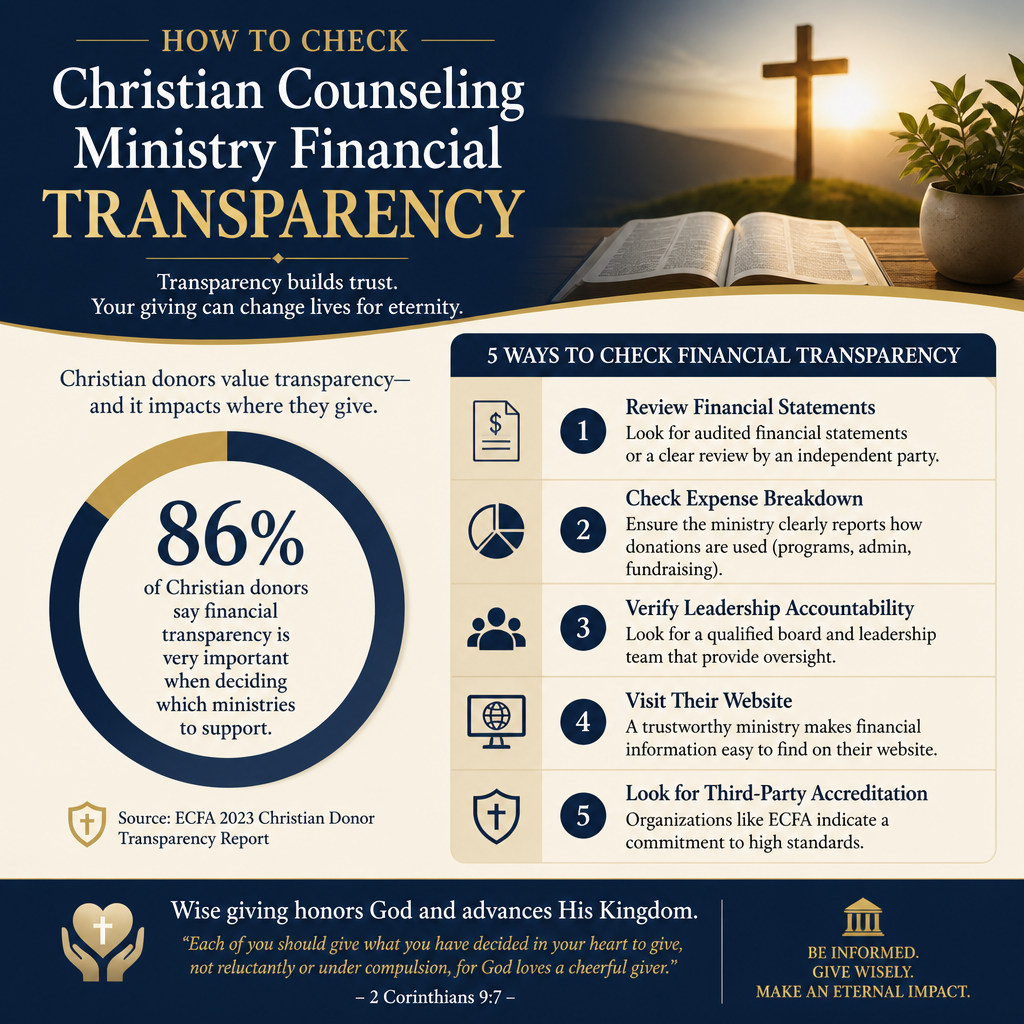
- Where can we access your last three years of Form 990s and audited or reviewed financial statements, if you have them?
- Do you have an independent financial review, audit, or compilation, and who performs it?
- How does your board review budgets, major contracts, and executive compensation?
- What proportion of your counseling is subsidized, and what funding supports that subsidy?
- How do you measure counseling quality and outcomes while protecting confidentiality?
How Most Trusted fits into donor diligence
Most Trusted exists because donors should not have to become forensic accountants to give faithfully. Our team evaluates ministries against The Most Trusted Standard, a 15-criteria framework that examines faith commitments, financial integrity, governance and leadership, and transparency and effectiveness. Verification does not replace prayer, local church discernment, or wise relationship. It does provide a tested set of evidences that can be compared across ministries.
For donors making decisions in this specific category, the discipline of giving is strengthened when it is paired with a clear set of expectations like those outlined in How to Give Wisely to Christian Counseling Ministries.
FAQs for How to check Christian counseling ministry financial transparency
Should we avoid a counseling ministry that does not have an audit?
Not necessarily. Many smaller counseling ministries cannot justify the cost of a full audit, and the absence of an audit is not proof of misconduct. What matters is whether the ministry offers an appropriate level of independent financial oversight for its size and complexity, whether it provides timely Form 990s when required, and whether its board exercises real financial governance. A growing ministry with substantial revenue, multiple locations, or significant restricted funds should be able to explain why it has chosen a review, compilation, or audit, and what safeguards are in place.
What if a ministry says it cannot share details because of confidentiality?
Confidentiality is essential in counseling, and donors should respect it. But confidentiality should not be used to block ordinary financial transparency. A ministry can protect counselee privacy while still providing Form 990s, board and policy disclosures, audited or reviewed financial statements when available, and aggregate reporting about services delivered. If a ministry refuses basic financial documentation, or treats reasonable questions as disloyalty, that posture is itself relevant information for donor discernment.
A credible ministry welcomes light
Christian counseling ministries stand near tender suffering, and donors who fund that work are participating in mercy. But mercy is not served by opacity. The ministries most worthy of sustained support tend to be those that can describe their finances plainly, govern themselves with restraint, and report outcomes honestly without violating trust. That combination does not guarantee perfection. It does provide the kind of evidence that lets donors give with confidence and a clear conscience.



