
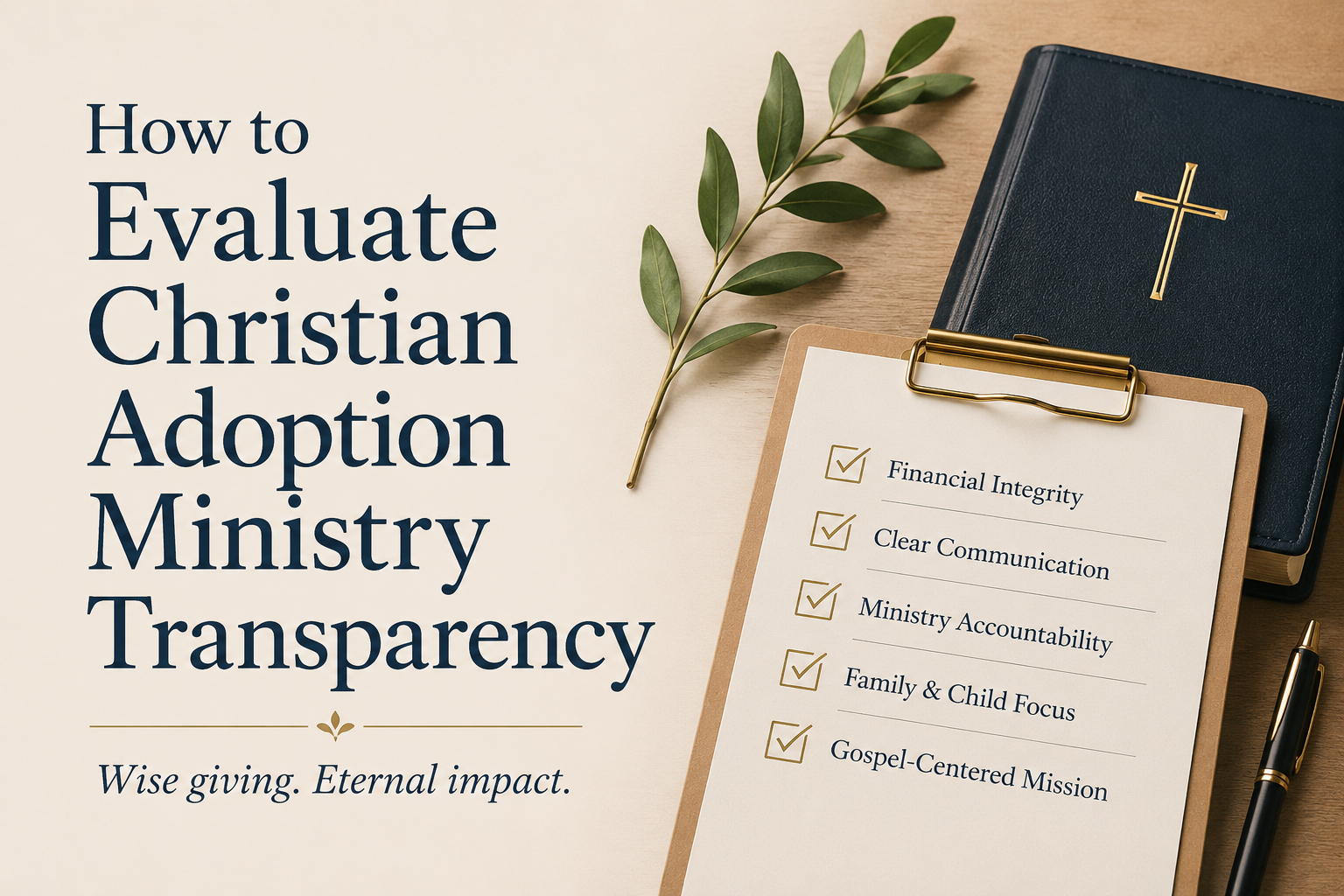
To evaluate Christian adoption ministry transparency is to decide whether a ministry’s public account of its work is sufficiently truthful, complete, and verifiable to warrant the trust of donors, churches, and families. Because adoption involves children, legal authority, and profound trauma histories, the costs of vague reporting are not merely reputational. They are pastoral, ethical, and sometimes judicial.
Scripture treats truth as a moral obligation, not a communications preference. “We renounce disgraceful, underhanded ways… we refuse to practice cunning or to tamper with God’s word, but by the open statement of the truth we would commend ourselves to everyone’s conscience in the sight of God” (2 Corinthians 4:2). When a ministry asks the church to fund adoption work, that request carries an implicit claim: this ministry is telling the truth about what it does, how it does it, and what the outcomes actually are.
Transparency begins with clear claims that can be tested
Many ministries unintentionally make transparency harder by speaking in spiritual or emotional abstractions. Donors respond to language about “saving,” “rescuing,” and “forever families,” but those terms can obscure essential operational realities: What services are provided? To whom? Under what authority? With what safeguards? The first test of transparency is whether the ministry’s stated mission is concrete enough to evaluate.
Distinguish the type of adoption work being funded
Christian adoption ministry can mean several distinct activities: domestic infant adoption support, foster care recruitment, international adoption facilitation, post-adoption counseling, family preservation, or humanitarian support that is adjacent to adoption. Responsible transparency names which of these are in view, and which are not. It also clarifies whether the organization is an accredited adoption agency, a fundraising partner, a church-based support network, or a grantmaking intermediary. Each model carries different legal duties and different risk profiles.
Where the ministry operates matters as well. International adoption has faced recurring concerns about coercion, weak documentation, and perverse incentives when money flows toward child placement. The U.S. Department of State has repeatedly documented improper practices and child-buying risks in some intercountry adoption contexts, underscoring why donors should expect unusually specific disclosure when an organization works across borders U.S. Department of State.
Require operational definitions, not only stories
Stories can be true and still be misleading if they function as a substitute for real reporting. A transparent ministry explains what it means by phrases such as “orphan care,” “adoption advocacy,” or “family reunification,” and it draws boundaries around what donor funds do not support. Verifiable language sounds like this: “We provide X hours of clinical counseling to adoptive families,” or “We fund Y months of trauma-informed caregiver training for foster parents,” rather than “We change lives through adoption.”
What this means in practice is that donors should look for a ministry’s ability to connect its most compelling narratives to the systems and safeguards that make those narratives ethically possible.

Financial transparency must fit adoption’s moral hazard
Adoption ministry sits near forms of vulnerability where money can distort judgment: a family in crisis, a pregnant mother under pressure, an overburdened child welfare system, or an under-resourced overseas institution. Financial disclosure is not merely about efficiency. It is about ensuring that funding does not create incentives for separation, coercion, or opaque fee structures.
Expect readable financial statements and plain explanations
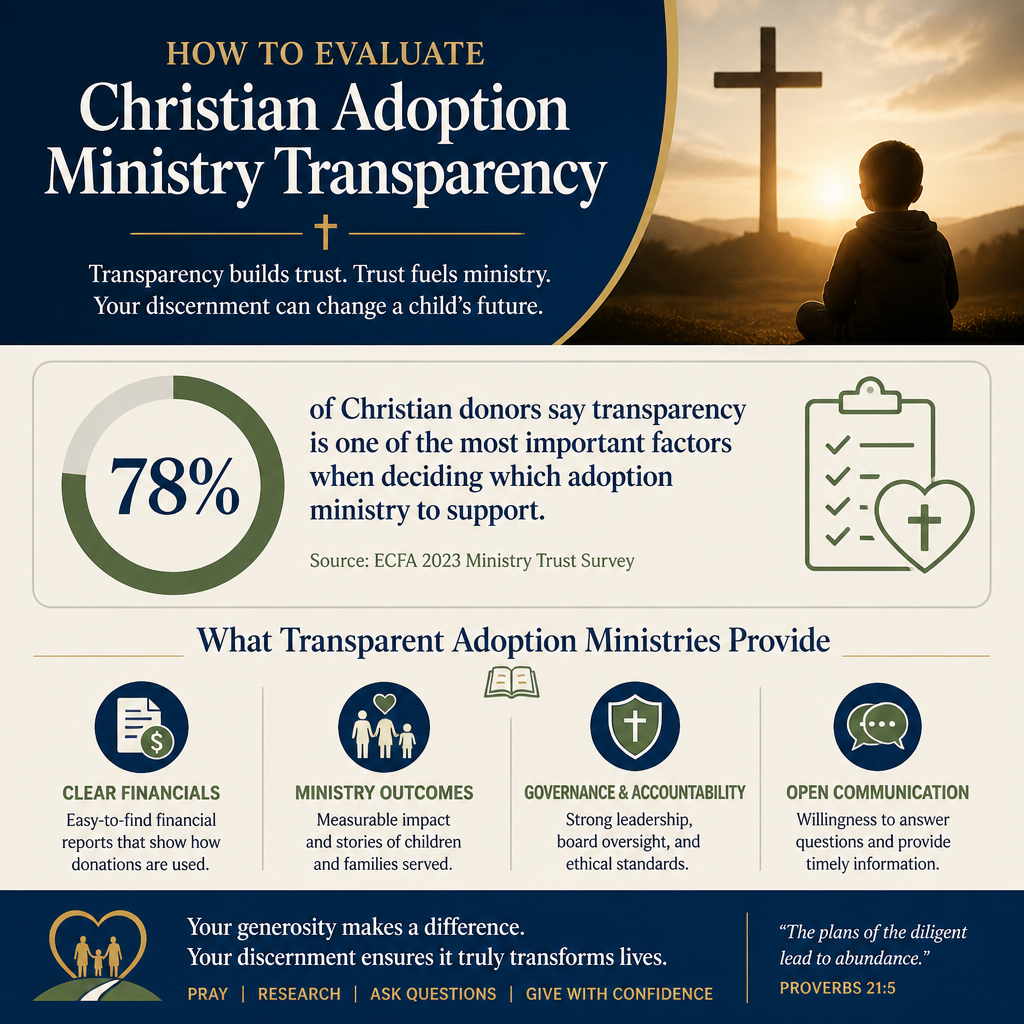
A transparent organization provides timely annual reports, audited financials when appropriate to size and complexity, and clear explanations of major revenue sources and major expense categories. Donors should be able to identify whether the ministry receives program fees, referral fees, pass-through grants, or designated gifts that restrict use. Complexity is not automatically a red flag, but secrecy is.
Donors should also be cautious about simplistic “overhead” arguments. The sector has learned that healthy programs require competent administration and governance. The “Overhead Myth” statement—signed by major evaluators—argued that overhead ratios alone are a poor proxy for nonprofit performance, pushing donors toward deeper questions about results and accountability Charity Navigator.

Follow the money to the point of impact
Adoption-related work can involve subgrants, overseas partners, and contractor networks. A transparent ministry can trace funds from donor to program activity, including what portion is retained for administration, what portion is distributed, and what controls govern those transfers. For international partnerships, donors should expect explanations of partner vetting, written agreements, monitoring practices, and how the ministry addresses currency, fraud, and local compliance risks.
Across our verification work at Most Trusted, the ministries that meet The Most Trusted Standard tend to treat financial disclosure as a pastoral act: they make it easy for donors to understand where money goes, and they do not rely on ambiguity to preserve fundraising flexibility.
Governance transparency tells donors who holds power
In adoption ministry, governance is not background paperwork. It is the structure that determines whether anyone can meaningfully challenge a leader, investigate allegations, or pause a program when harm is suspected. Donors should view governance transparency as child-safety infrastructure.
Board independence and real oversight
A credible organization discloses its board members, basic biographies, and leadership structure. It should be clear whether the board is independent or dominated by employees, close relatives, or financial beneficiaries. Donors should also look for evidence of active oversight: conflict-of-interest policies, whistleblower protections, and an external audit or independent review process when warranted by scale and risk.
When governance information is hidden, it becomes difficult to know whether the ministry is accountable to anyone beyond its own internal narrative. That is especially concerning when the ministry operates in high-stakes spaces—supporting expectant mothers, arranging placements, or advocating within foster care systems.
Child protection and safeguarding disclosures
Safeguarding should be visible. Transparent ministries publish child protection policies, background check practices, training expectations, incident reporting procedures, and partner requirements. They explain how allegations are handled, including when law enforcement or child protective services must be notified. Adoption work often touches individuals with trauma histories; donors should expect trauma-informed practices, confidentiality standards, and clear boundaries for volunteers.
Christians genuinely disagree about the best models for orphan care and adoption support in different contexts. But there is far less disagreement about this: children must be protected from preventable harm, and ministries must be able to show how they take that responsibility seriously.
Program transparency requires outcomes, not only activity
Adoption ministry outcomes are hard to measure well. Some of the most important fruit is long-term: stability, attachment, mental health, educational progress, and family durability. Outcomes can also be morally complicated. Not every “successful” placement was ethically obtained, and not every disruption indicates failure by the adoptive parents alone. Still, ministries can report responsibly without pretending to control what they cannot control.
Meaningful metrics and honest limits
Transparent reporting distinguishes between outputs (what was done) and outcomes (what changed). Outputs might include families served, counseling hours delivered, trainings conducted, or grants issued. Outcomes might include caregiver competency measures, post-placement stability indicators, or clinically validated improvements in child well-being when services are therapeutic. When a ministry cites outcomes, donors should expect definitions, time horizons, and methodology at a level appropriate to the claim.
Some donors will ask for placement numbers. That may be relevant for certain models, but it must not become a quota mentality. A responsible ministry explains how it resists pressure to increase numbers at the expense of ethical rigor, especially where financial support could create incentives for separation rather than preservation.
Evidence of alignment with best practice
Transparency also includes intellectual honesty about what the field has learned. The orphan care movement has had to reckon with the harms of institutionalization and the complex reasons children enter orphanages. UNICEF and other major child welfare authorities have long emphasized family-based care as the preferred setting for children when it can be made safe and stable, which should shape how ministries describe “orphan care” strategies UNICEF.
Where ministries draw on established frameworks—such as the When Helping Hurts approach articulated by Corbett and Fikkert—transparent organizations explain how those principles affect program design, partner selection, and measurements of success.
Practical due diligence questions donors can ask with integrity
Donors often hesitate to ask hard questions about adoption ministry because the cause feels too sacred to interrogate. But Christian stewardship is not suspicion; it is moral clarity about what love requires. When donors ask precise questions, they protect children, families, and the integrity of Christian witness.
A short set of questions that reveals transparency quickly
- What exactly do donor funds pay for, and what do they never pay for?
- Are you an accredited agency, a service provider, or a funding partner, and under what authority do you operate?
- What are your written safeguarding policies, and how do you handle allegations of misconduct or coercion?
- How do you vet and monitor partner organizations, especially outside the United States?
- What outcomes do you track over time, and what limits do you acknowledge in interpreting them?
Where Most Trusted fits into donor discernment
Due diligence can become overwhelming, particularly for donors who support multiple causes and want to act with both generosity and precision. Most Trusted exists to serve that stewardship work by evaluating Christian nonprofits against The Most Trusted Standard, a 15-criteria framework covering faith commitments, financial integrity, governance, and transparency and effectiveness. We do not replace prayerful discernment, but we can reduce information asymmetry by checking whether a ministry’s public claims are supported by verifiable documentation and credible practices.
For donors tracking this work across the broader landscape, engagement with Christian Adoption Ministries can help situate a single organization within the wider range of models and risks that exist in this space.
Adoption-related programs also intersect with broader questions of disclosure, reporting, and accountability. A donor’s standards for transparency should be consistent across causes, and Accountability and Transparency in Christian Adoption Ministries is a useful context for those expectations.
FAQs for How to evaluate Christian adoption ministry transparency
What is the clearest sign that an adoption ministry is not transparent?
The clearest sign is not imperfect reporting; it is evasiveness when asked to define claims, disclose governance, or explain how money moves through the organization. When a ministry cannot plainly describe what it does, who oversees it, and what safeguards are in place, donors have no stable basis for trust. In adoption work, that uncertainty is not neutral.
Should donors avoid ministries that protect privacy and limit details in stories?
No. Protecting the privacy of birth parents, adoptive families, and children is often a mark of maturity. Transparency does not require publishing identifying details or emotionally intimate narratives. It requires providing verifiable information at the right level: audited or reviewed financial reporting as appropriate, clear policies, program descriptions, partner oversight, and outcomes reporting that respects confidentiality while still allowing donors to assess integrity and effectiveness.
A Christian standard of openness worthy of the cause
Adoption ministry asks the church to participate in costly love, and Scripture honors that impulse. Yet the same Scriptures that command mercy also bind God’s people to truth, justice, and sober stewardship. Donors serve the vulnerable when they require ministries to be specific, accountable, and open about their work, their finances, their safeguards, and their results. The goal is not to withhold generosity. The goal is to ensure that generosity strengthens families and protects children in ways that can bear the weight of public scrutiny and the searching light of Christian conscience.



