

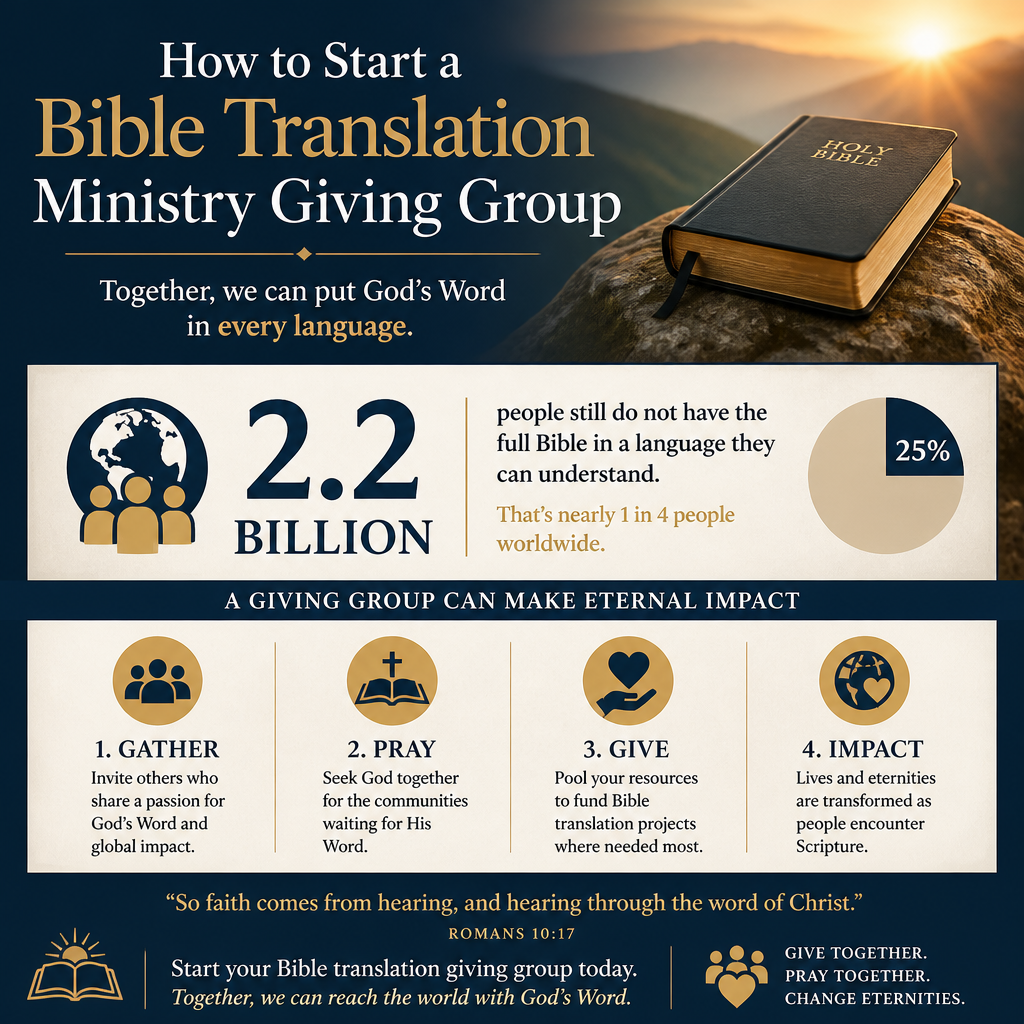
How to start a Bible translation ministry giving group is, at its core, a question about stewarding influence. Many Christian donors can give faithfully as individuals, yet still sense that the needs of Scripture access require more than isolated generosity. A giving group is one way to align prayer, due diligence, and shared resources so that the Church’s desire—“that the word of the Lord may speed ahead and be honored” (2 Thess. 3:1)—is pursued with clarity and accountability.
But Bible translation is not a sentimental cause. It is a long-horizon, technically complex, and spiritually contested field that involves languages, communities, denominational commitments, security realities, and the ethics of outside funding. A mature giving group takes those complexities seriously. It resists two errors at once: treating translation as an abstract “project” detached from the life of the local church, and treating it as an un-auditable spiritual good that does not require governance, controls, or measurable outcomes.
Begin with theological purpose and a sober theory of change
Anchor the group in Scripture and the Church’s mission
Bible translation is not merely content distribution. It is one means by which God gathers and builds his Church through his Word. Scripture itself frames the stakes: “Faith comes from hearing, and hearing through the word of Christ” (Rom. 10:17). The giving group’s first work is to agree on a theological purpose that is explicit enough to govern decisions: which kinds of translation and Scripture engagement are within scope, how the group understands the role of the local church, and what “faithful translation” means in contested contexts.
Christians genuinely disagree about questions that will surface quickly: What counts as a faithful translation approach? How should translation relate to oral Bible storytelling in primarily oral cultures? When does contextualization become distortion? A giving group does not need to resolve every debate to begin, but it does need shared boundaries—otherwise relational capital is spent repeatedly on arguments that should have been settled in advance.
Define what the group is actually trying to accomplish
Most donors are accustomed to “a program” with visible outputs. Translation and related work does not always behave that way. It is often measured in phases—language assessment, community testing, drafting, checking, consultant review, publication, and then adoption and use. A giving group should define a theory of change that includes both production and reception: not only whether Scripture is translated, but whether it is accessible, trusted, and used in worship, discipleship, and evangelism.
Publicly available data can help a group take the scale seriously. For example, Ethnologue has long reported that there are thousands of living languages worldwide, and that only a portion have a full Bible; the details shift as progress is made and classifications change, but the basic reality is stable: translation is a multi-generational task for the global Church. See Ethnologue.

Choose a governance model that protects unity and integrity
Decide whether this is a donor circle, a fund, or a committee
Giving groups tend to drift into ambiguity unless structure is decided early. Is the group a relational donor circle that gives individually but learns and prays together? Is it a pooled fund with collective decision-making? Or is it a committee under a church or foundation with delegated authority and formal reporting? Each model has trade-offs. Pooled funds can move larger sums with coherence, but they require stronger controls. Informal circles can remain flexible, but they often fail to maintain consistent standards when leadership changes.
Whatever model is chosen, mature donors typically expect a small leadership team with defined roles: chair, treasurer or finance lead, and a research lead who can coordinate diligence. If the group is housed under a church, clarify how pastoral oversight functions without turning funding decisions into ecclesial politics.
Establish conflict of interest and decision rules before money is in the room
Translation ministries are relational by nature. Donors will know staff personally, have friends serving overseas, or carry loyalties to particular agencies. Those relationships are not disqualifying, but they are inherently biasing. Put a conflict-of-interest policy in writing early: when members must recuse themselves, how recommendations are documented, and what happens when a decision is contested.
As a practical baseline, we recommend written decision rules: quorum, voting threshold, and a process for emergency grants. The goal is not bureaucracy; it is to protect fellowship by reducing the occasions where a disappointed member suspects favoritism.
Build a repeatable diligence process using The Most Trusted Standard
Evaluate ministries with criteria that match the real risks
Many donors want a simple shortcut: “Is this ministry good?” Bible translation rarely allows shortcuts. Funds may move across borders. Security constraints may limit transparency. Translation quality is hard to audit without specialized expertise. And yet donors are still obligated to give wisely, not only generously.
Most Trusted exists to help donors give with confidence by evaluating Christian nonprofits against The Most Trusted Standard, a 15-criteria framework across four domains: Faith Foundation, Financial Integrity, Governance and Leadership, and Transparency and Effectiveness. In a giving group, the value of a shared framework is that it turns subjective impressions into comparable judgments. Members can disagree about strategy while still agreeing about basic integrity.
Across our verification work, the ministries that meet The Most Trusted Standard tend to show several patterns that matter in translation work: clear doctrinal commitments that actually shape operations; independent governance with competent financial oversight; financial statements that can be meaningfully understood; and communications that do not confuse inspirational storytelling with verifiable reporting.
Ask translation-specific questions that donors often miss
A general diligence framework should be supplemented with questions specific to translation and Scripture engagement. For example:
- Who owns the translation process and the resulting work—an outside organization, a local church network, or a mixed governance structure?
- What is the methodology for community testing and checking, and who provides consultant oversight?
- How does the ministry handle theological disputes within a language community without coercion?
- What is the plan for distribution, literacy, oral access, and ongoing Scripture engagement after publication?
- How are safety and security handled without using “security” as a blanket excuse for avoiding accountability?
Donors should also recognize the sector’s legitimate tension around overhead. Translation requires specialist labor, training, and years of iterative checking. A low administrative ratio does not necessarily indicate strength, and pressuring organizations to underinvest in systems can harm quality and integrity. The Overhead Myth letter, signed by GuideStar, Charity Navigator, and BBB Wise Giving Alliance, explains why overhead ratios are a poor measure of nonprofit performance. See Candid GuideStar.
For donors who want to understand the broader ecosystem of Bible translation organizations and approaches, we encourage sustained attention to Bible Translation Ministries as a field rather than a single brand or campaign.
Design the group’s prayer and communication rhythms to cultivate humility
Pray with specificity, not generalities
Giving groups often underestimate how prayer can sharpen judgment. Prayer is not a substitute for diligence; it is one means by which God forms wisdom, exposes hidden motives, and restrains a desire for control. In translation work, prayer should be concrete: for translators and local church leaders, for unity in language communities, for protection in unstable regions, and for Scripture to be received with faith and obedience.
Specificity also discourages performative spirituality. When the group prays for named risks—political pressure, theological distortion, internal conflict, burnout—members grow more realistic about what they are funding and less susceptible to triumphal reporting.
Communicate like stewards, not marketers
Many Christian donors have grown wary of communications that feel like fundraising theater. Giving groups can model another way: truthful, restrained, and grateful. That includes saying “we do not know” when metrics are uncertain, and refusing to treat every update as a proof of spiritual success.
This posture is especially important when reporting on “impact.” Scripture teaches us to honor faithfulness (1 Cor. 4:2) without pretending we can quantify spiritual fruit with precision. Still, donors can ask for measurable indicators appropriate to the work: translation milestones, training outcomes, distribution reach, Scripture engagement efforts, and third-party checks on quality. The group’s communications should reflect both spiritual seriousness and evidentiary discipline.
Fund for durability and partnership, not only projects
Prefer long-horizon commitments when the ministry is trustworthy
Translation is often slowed not by lack of vision but by unstable funding and staff turnover. A giving group can be unusually helpful by making multi-year commitments to ministries that have demonstrated integrity and competence. That does not mean blank checks. It means setting clear expectations, scheduled reporting, and periodic re-evaluation against consistent criteria.
Some donors hesitate to commit for fear of locking themselves into a flawed partner. That caution is reasonable. The answer is not perpetual short-term giving; it is a disciplined review process that can both sustain faithful work and correct course when warning signs appear.
Hold local church partnership as a non-negotiable value
Translation efforts that are detached from local believers tend to face problems that donors do not see from a distance: low adoption, community distrust, and disputes over authority. Conversely, efforts with credible local church partnership often show more durable fruit, even when progress is slower.
Partnership is not a slogan. Donors can ask: Who is accountable to whom? Who can stop the work if it becomes harmful? Who has the right to revise or reject choices in the translation? Those questions protect against paternalism, and they also protect the integrity of the gospel in places where outside money can distort incentives.
As donors prayerfully consider what partnership should look like, it is worth engaging Praying for and Partnering with Bible Translation Ministries with the seriousness the work deserves.
FAQs for How to start a Bible translation ministry giving group
How large should a Bible translation ministry giving group be?
Most effective giving groups are small enough for trust and disciplined discussion, but large enough to share real responsibility. In practice, many begin with 6–15 committed households or donors, then grow slowly. The limiting factor is rarely headcount; it is whether the group has agreed standards for diligence, conflict of interest, and decision-making.
Should our giving group fund one translation ministry or several?
Funding one ministry can deepen partnership and reduce administrative complexity, but it concentrates risk. Funding several can diversify risk and support complementary work—translation, literacy, and Scripture engagement—but it requires more diligence capacity. A prudent approach is to start with one or two trusted partners, then add only as the group’s research and governance maturity grows.
A giving group is a spiritual discipline and a fiduciary responsibility
Starting a Bible translation ministry giving group is not mainly about assembling donors; it is about forming a community of stewards who can pursue Scripture access with prayerful seriousness and verifiable integrity. The Church has long supported translation through sacrificial giving. Our generation has the opportunity to do so with better information, stronger controls, and deeper partnership with local believers. When those elements are held together, generosity becomes more than enthusiasm—it becomes a durable witness to the worth of God’s Word.



