

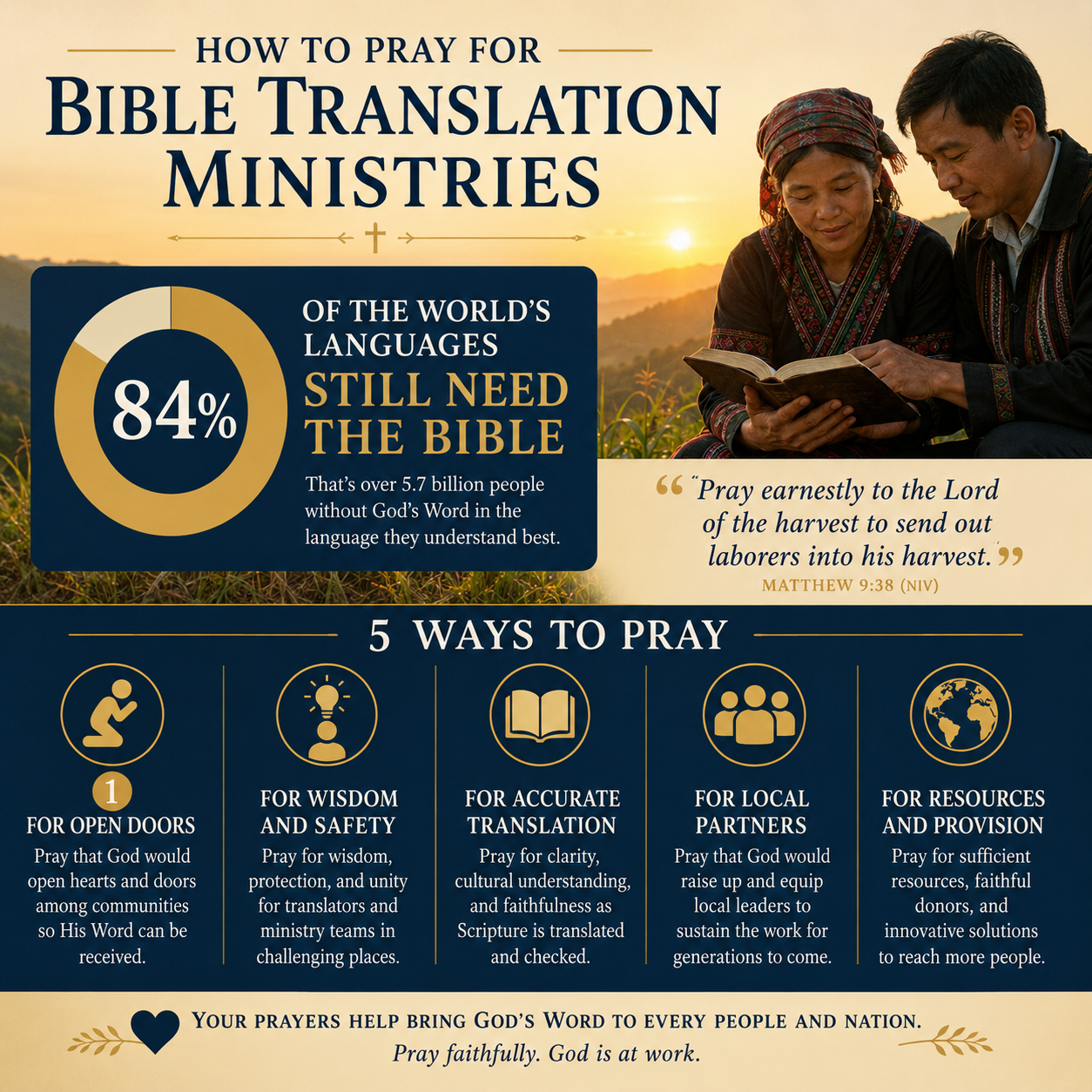
How to pray for Bible translation ministries is not mainly a question of finding the right words. It is a question of aligning our intercession with what Scripture says God is doing through his Word, and with the real constraints, risks, and responsibilities that translation organizations carry in the field. Donors often support translation work for decades, across multiple countries and leadership transitions. Prayer that matures with that long horizon becomes a form of stewardship.
The Bible does not treat God’s Word as a religious accessory. “The word of God is living and active” (Heb. 4:12), and “faith comes from hearing” (Rom. 10:17). Translation ministries exist so that people can hear, in their own language, what God has spoken. That mission also unfolds amid linguistic complexity, security pressures, and organizational trade-offs. Christians genuinely disagree about methods, timelines, and partnerships, but few dispute the spiritual stakes.
Begin with the purpose God assigns to his Word
Pray for clear proclamation, not mere access
Many donors rightly celebrate the moment a New Testament is dedicated or a first Scripture portion is printed. Yet Scripture’s own emphasis is not simply distribution. It is comprehension, conviction, and obedience. Pray that newly translated text would be understood with clarity, taught with fidelity, and received with faith. The Ethiopian official in Acts 8 had access to Isaiah and still needed Spirit-guided explanation; translation is often the beginning of a longer discipleship arc.
Pray that translation teams and partner churches resist a subtle functionalism that treats publication as the finish line. Ask God to raise teachers, evangelists, and pastors who can handle the Word rightly, especially where formal theological training is scarce and oral cultures require different teaching approaches.
Pray for spiritual fruit that withstands time and pressure
Jesus warns about initial reception that withers under tribulation or is choked by competing loves (Mark 4:13–20). Pray not only for first-read enthusiasm but for durable conversion, repentance, and holiness. In contexts where Christians face pressure from family systems, local authorities, or extremist violence, Scripture engagement can quickly become costly. Prayer that anticipates suffering is not pessimism; it is biblical realism.
For donors, this also recalibrates expectations. Translation outcomes are sometimes measured in chapters completed or languages reached. Those metrics matter, but they are not the ultimate test of faithfulness. Pray that the ministries you support keep spiritual fruit central even when donors, boards, or public reporting incentives reward visible milestones.
Pray for faithfulness in the contested work of translation
Pray for linguistic excellence and theological courage
Translation is never a simple word-for-word substitution. It requires judgments about meaning, register, idiom, and how to render key theological terms in languages that may not have established Christian vocabulary. Pray for translators who can hold together deep reverence for the text, technical competence, and pastoral sensitivity to how Scripture will be heard.
Christians genuinely disagree about translation philosophies, especially where audiences are primarily oral learners or where receptor languages carry strong religious associations. Pray for humility without capitulation. Ask God to guard teams from producing texts that are technically polished but theologically thin, or theologically precise but linguistically unnatural and therefore unused.
Pray for integrity in community testing and review
Most serious translation work includes community checking, back-translation, consultant review, and iterative revision. These processes are slow because accuracy is costly and errors can mislead generations. Pray for patience, honest feedback loops, and the courage to correct mistakes even when timelines and fundraising narratives make revision feel like failure.
Also pray for local believers to have meaningful voice, not merely symbolic participation. Translation done to communities rather than with them tends to produce materials that sit on shelves. Pray that local churches, mother-tongue speakers, and emerging leaders are treated as co-laborers rather than beneficiaries.
Pray for the people and partnerships that carry the work
Pray for local church ownership and pastoral formation
Translation ministries often operate at the intersection of missions agencies, local congregations, and denominational networks. The long-term health of Scripture use depends heavily on whether local churches can teach, disciple, and correct error. Pray for pastors who can preach from translated texts, for women and men who can lead small-group Scripture engagement, and for healthy ecclesial structures that sustain the work after foreign staff rotate out.
In many regions, literacy is not assumed, and oral Bible storying, audio Scripture, and dramatized portions become essential. Pray for wise integration of these approaches without fragmenting doctrine. Ask God to raise skilled local communicators who can carry the full counsel of God, not only favorite passages.
Pray for unity with discernment across institutions
Collaboration is often necessary: few organizations can fund, staff, and secure every aspect of work alone. At the same time, partnerships can introduce misaligned theology, governance weaknesses, or unclear accountability. Pray for unity anchored in truth, and for leaders who can say no when collaboration would compromise doctrinal fidelity or fiduciary responsibility.
For donors tracking a range of translation efforts, our team at Most Trusted often sees that the healthiest partnerships have clear memoranda of understanding, transparent budgeting, and defined authority for final text decisions. Pray for those “unseen” governance details. They are rarely celebrated, but they protect the mission and the people involved.
Pray for security, resilience, and ethical practice in fragile contexts
Pray for protection without romanticizing risk
Some translation work occurs in places where Christian activity is restricted or where ethnic conflict and criminal violence threaten communities. Pray for the safety of local believers, not only expatriate staff. Pray for prudence in travel, communication, and data handling, and for leaders who do not confuse unnecessary exposure with faith.
At the same time, pray against fear-driven decisions that abandon communities midstream. The moral burden of leaving can fall disproportionately on local partners who cannot relocate or change identities. Resilience is often a matter of long obedience in the same direction, sustained by prayer and careful planning.
Pray for ethical fundraising and honest storytelling
Translation ministries face strong donor demand for inspiring narratives and rapid progress. That demand can tempt organizations to oversimplify timelines, understate obstacles, or highlight isolated success while neglecting ongoing costs of engagement, revision, and distribution. Pray for truthfulness that refuses both cynicism and hype.
American giving remains significant, but it is not uniformly generous. Research on charitable behavior continues to show the fragility of donor confidence and the ease with which scandals can harm entire sectors. Giving patterns are widely discussed and measured; for example, Giving USA reports on national charitable totals and trends each year (Giving USA). Pray that translation leaders communicate in ways that strengthen trust through clarity, not through emotional pressure.
Pray like a steward by pairing intercession with verification
Pray for ministries to meet high standards of governance and transparency
Prayer and due diligence are not competitors. Scripture commends both spiritual dependence and practical wisdom. Donors can pray fervently and still ask hard questions about financial controls, board independence, theological accountability, and program effectiveness. In our verification work, the ministries that meet The Most Trusted Standard tend to welcome that combination. They do not treat scrutiny as hostility, because they understand that credibility protects the vulnerable and honors the gospel.
What this means in practice is that prayer can be specific: pray for clean audits, timely financial reporting, conflict-of-interest discipline, and leaders who correct problems early. Pray for boards that govern rather than merely endorse. Pray for churches and donors to resist the “overhead” fixation that can incentivize underinvestment in compliance and staff care. The sector has repeatedly emphasized that simplistic overhead ratios are a poor measure of impact, a point summarized in the Overhead Myth statement by major charity evaluators (Candid GuideStar).
Pray for wise donor partnership over the long haul
Donors often ask how to pray when they cannot assess every linguistic or security detail. A faithful approach is to pray for what you can name and to verify what you can measure. One reason donors seek independent assessment is that translation organizations may report outcomes in specialized categories that are difficult to compare across ministries. That is where our work at Most Trusted can serve the church: we evaluate nonprofits against The Most Trusted Standard so donors can give with confidence while maintaining a posture of prayer.
As you deepen this work, it may help to situate prayer within the wider landscape of Bible Translation Ministries. Many donors support not only translation but also audio Scripture, literacy, oral engagement, and training of local leaders. Each dimension carries distinct prayer needs and accountability questions.
- Pray for accuracy, clarity, and theological fidelity in every key term and passage.
- Pray for local church ownership and durable discipleship structures around the translated Word.
- Pray for safety, prudence, and resilience for teams serving under pressure.
- Pray for ethical storytelling, honest reporting, and fundraising free from manipulation.
- Pray for governance, financial controls, and transparency that protect the mission.
FAQs for How to pray for Bible translation ministries
Should donors pray for faster translation timelines?
We may pray for progress and provision without demanding haste. Quality translation requires careful exegesis, linguistic analysis, community testing, and review. In some contexts, political instability or security restrictions slow work further. Pray for wise sequencing and sustained capacity, and for donors to celebrate faithful work that is slow for good reasons.
What is a responsible way to pray when a ministry cannot share details publicly?
In restricted-access settings, limited disclosure can be an appropriate security practice rather than a lack of transparency. Donors can still pray concretely for protection, integrity, and fruit, and can still ask for confidential briefings, third-party verification, audited financials, and clear governance information. For donors who want to integrate prayer with careful partnership, exploring the broader category of Praying for and Partnering with Bible Translation Ministries can help frame what accountability should reasonably look like in different environments.
A prayer posture shaped by Scripture and truth
Praying for Bible translation ministries means praying for God to give what only he can give: illumination, repentance, faith, and endurance. It also means praying for the ordinary faithfulness that keeps translation work honest, accurate, and sustainable. Mature donors do not have to choose between spiritual seriousness and institutional seriousness. When prayer and verification travel together, the church’s support becomes steadier, and the Word is served with the reverence it deserves.



