
Choosing a Christian adoption ministry to support is not primarily a question of sentiment. It is a stewardship decision made before God, with real consequences for children, birth families, adoptive families, and the church’s public witness. Scripture’s concern for the fatherless is unambiguous (Psalm 68:5), but Scripture also insists that compassion must be joined to truth and integrity.
The adoption field has learned, sometimes painfully, that sincere donors can finance harmful incentives: unnecessary family separation, ethically compromised placements, or glossy storytelling that trades a child’s dignity for fundraising. Christians genuinely disagree about contested questions in this space, including international adoption policy, the best role for faith-based agencies in public systems, and whether certain models unintentionally pressure vulnerable mothers. The donor’s task is not to resolve every debate, but to fund ministries whose commitments, safeguards, and results can be examined.
Start with a biblical vision that protects children and honors birth families
Adoption imagery in Scripture is theological, not a fundraising device
The New Testament’s language of adoption is among its richest doctrinal themes: believers are received as sons and daughters through Christ (Romans 8:15–17). That theological reality should make Christian donors more cautious, not less, about how adoption is invoked in appeals. When ministries treat “adoption” as a catch-all brand for any orphan-related work, donors can end up funding activities that are not actually adoption or that bypass wise child-protection practice.
What this means in practice is that we look for ministries that can articulate a coherent Christian ethic of care: protecting children, honoring the imago Dei in every person involved, and resisting outcomes that benefit institutions at the expense of families. A mature ministry can speak plainly about the difference between caring for children without parents and separating children from parents. Those are not the same moral act, even when both are framed as compassion.
Prioritize family preservation where it is safe and possible
Many donors assume that most children in institutional care are true orphans. The global evidence challenges that assumption. UNICEF has long reported that the majority of children living in residential care worldwide have at least one living parent, which raises urgent questions about poverty, disability, conflict, and social stigma driving separation rather than parental death UNICEF.
That reality does not negate adoption. It does clarify the order of moral priorities: where safe reunification or kinship care is possible, funding should not pull children away from it. A Christian adoption ministry worth supporting can describe how it avoids creating demand for adoptable children, how it supports ethical family preservation, and how it partners with competent local authorities rather than substituting for them.

Test whether the ministry’s model reduces harm, not only increases placements
Ask about safeguards against coercion and conflicted incentives
Adoption is not a consumer transaction, but it can drift toward one when demand is high and safeguards are weak. Donors should expect ministries to name the risks directly: coercion of birth mothers, pressure through material aid tied to relinquishment, conflicts of interest in fee structures, and recruitment practices that privilege speed over integrity. A serious ministry does not wait for scandals to tighten its protocols.
We recommend asking for written policies and evidence of practice: how informed consent is documented, how counseling is provided independently of the placement decision, and how the ministry responds when a birth parent changes course. The moral credibility of an adoption ministry is often revealed in how it protects the vulnerable person who has the least power in the process.
Understand what the ministry measures, and what it refuses to measure
Some outcomes should not be treated as performance metrics. “Number of adoptions completed” can become a dangerous proxy for success if it is pursued without equal concern for ethics, long-term stability, and the welfare of birth families. Better indicators include placement stability over time, post-adoption support utilization, trauma-informed care practices, and documented efforts to keep siblings connected when appropriate.
Donors should also look for theological clarity about suffering and control. Adoption involves profound loss as well as redemption; ministries that promise uncomplicated “happy endings” are often preparing donors for disappointment and families for disillusionment. A truthful narrative honors lament while still affirming God’s fatherly care.
Require governance and finances that withstand scrutiny
Financial integrity is a child-protection issue
Weak internal controls are not merely administrative problems; they can become child-protection failures. In adoption and orphan care, money can touch especially sensitive points: facilitator compensation, travel and legal payments, and support to birth families. Donors should insist on clear accounting, reputable audits when appropriate, and policies that prevent funds from functioning as inducements.
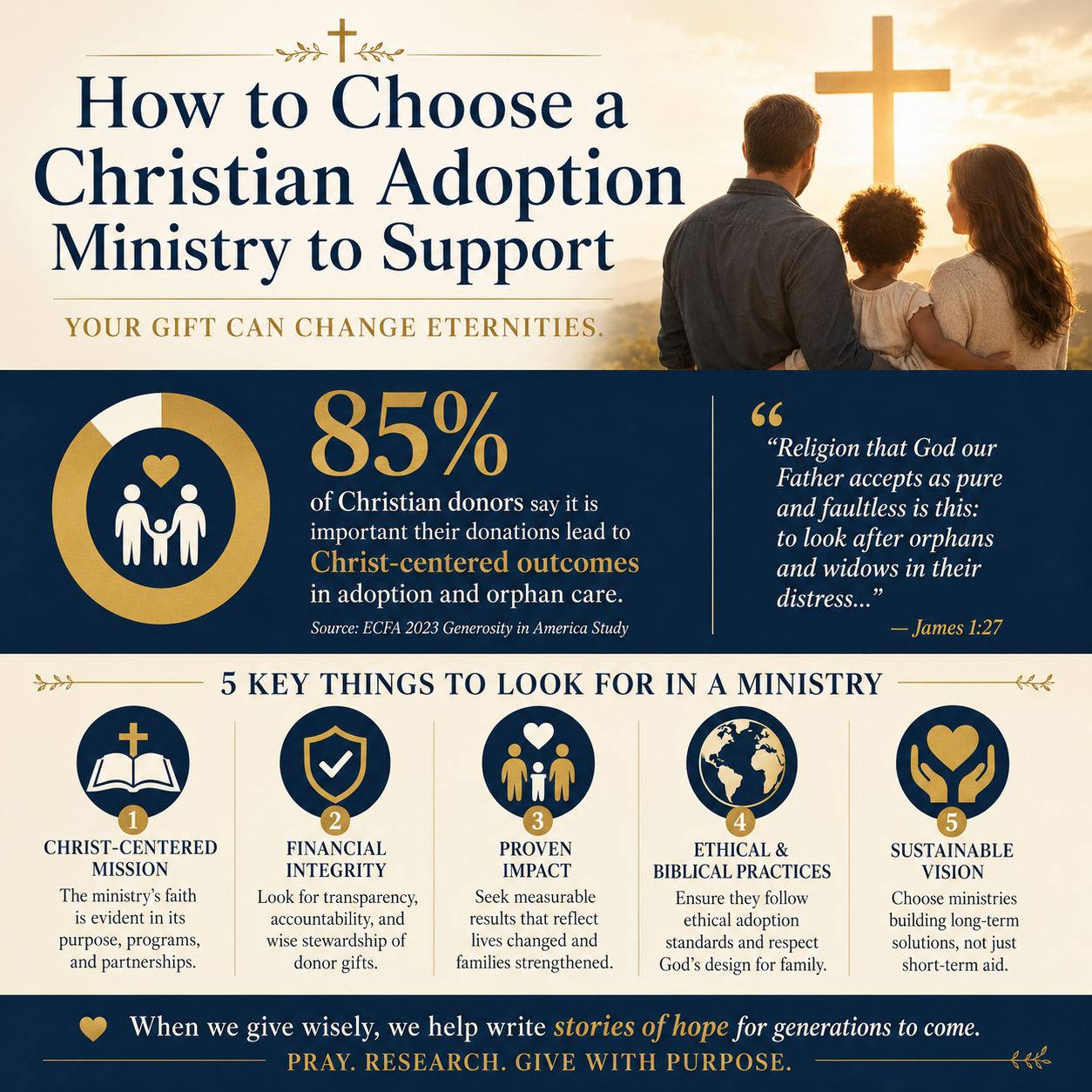
Across our verification work at Most Trusted, ministries that meet The Most Trusted Standard tend to treat finance and governance as moral disciplines. They can explain how their fee structures work, what portion of revenue comes from donations versus services, and how they prevent conflicts of interest in decision-making. The goal is not perfection, but verifiable integrity.
Board oversight and leadership formation matter more than charisma
Adoption ministry is emotionally charged. That makes it vulnerable to founder-centered leadership and donor-driven storytelling. Healthy governance is a counterweight. Donors should look for an engaged board with relevant expertise, documented oversight practices, and a culture where concerns can be raised without retaliation.
When evaluating governance, we recommend attention to basics that are often neglected: related-party transaction policies, whistleblower protections, term limits or board renewal practices, and clarity about who holds authority over ethical decisions. A ministry that cannot describe its accountability structure in plain language is asking donors to substitute trust for evidence.
Insist on transparency and effectiveness that respect human dignity
Storytelling can either honor children or commodify them
Adoption fundraising frequently relies on personal stories. Donors should not accept story-driven appeals without safeguards for privacy, consent, and dignity. Children should not be displayed to inspire giving. Birth parents should not be portrayed as villains or as props in a redemption narrative for others.
Credible transparency looks like this: anonymized case examples when needed, clear permission practices, and restraint in sharing identifiable details. It also looks like honest reporting of hard cases and service gaps, not only celebratory updates.
Expect evidence of learning, not only claims of impact
Effectiveness in this field is complex, and Christians should resist simplistic scorecards. Still, donors can reasonably require ministries to demonstrate learning. Do they track disruptions and dissolutions? Do they evaluate their post-adoption services? Do they change practices when data or pastoral realities indicate harm?
Where a ministry works in child welfare systems, donors should understand basic realities: children in foster care often have living parents, and the system’s stated goal is frequently reunification. In the United States, the federal Adoption and Foster Care Analysis and Reporting System provides public reporting on child welfare outcomes and trends Administration for Children and Families. A ministry that engages foster care should be able to explain how it supports reunification and kinship care while still serving adoptive families when adoption becomes appropriate.
Use a verification lens that matches the moral weight of the cause
Ask questions that correspond to The Most Trusted Standard
Many donors are tempted to make decisions based on personal familiarity, social proof, or a compelling presentation. Those inputs are not irrelevant, but they are insufficient. The moral gravity of adoption warrants a structured evaluation across faith commitments, finances, governance, and transparency.
At Most Trusted, we evaluate Christian nonprofits against The Most Trusted Standard, a 15-criteria framework designed to help donors give with confidence. For adoption ministries, the framework is especially valuable because it pushes beyond brand and emotion toward verifiable practices: doctrinal clarity, accountable leadership, sound financial controls, and evidence-based reporting.
A short due-diligence checklist for donors
Before making a significant commitment, we recommend that donors seek clear answers to a focused set of questions. A mature ministry will not treat these as hostile; it will recognize them as faithful stewardship.
- What safeguards prevent coercion or conflicted incentives for birth families and intermediaries?
- How does the ministry prioritize family preservation, kinship care, and reunification when safe?
- What governance practices ensure ethical oversight, including independent board engagement?
- How are finances audited or reviewed, and how are sensitive payments documented and controlled?
- What post-adoption supports are provided, and what outcomes are tracked over time?
Donors who want to situate this decision in the wider landscape can review Christian Adoption Ministries for context on the field, and then compare approaches within How to Give Wisely to Christian Adoption Ministries as specific giving priorities come into focus.
FAQs for How to choose a Christian adoption ministry to support
Should we prioritize adoption placements or family preservation programs?
We recommend resisting an either-or framing. Scripture’s concern is for vulnerable children, which often means strengthening families when that can be done safely. Where adoption is necessary, ethical practice requires rigorous safeguards and long-term support. Donors can fund both, but should ensure that no program creates incentives to separate families who could remain together with appropriate assistance and protection.
What documents should a credible Christian adoption ministry be willing to share?
At minimum, donors should expect clarity on governance and finances and a willingness to discuss ethical safeguards. Commonly requested items include recent financial statements, an audit or independent financial review if available, board and leadership information, written policies on conflicts of interest and whistleblowing, and an explanation of consent and counseling practices for birth families. Transparency should be proportionate to the sensitivity of the work and should never depend on insider relationships.
Choosing support that honors the God who adopts
Christian adoption ministry sits at the intersection of mercy, justice, trauma, and family. The faithful donor does not ignore that complexity; we weigh it before God and insist on ministries that can be examined. When giving is guided by theological seriousness and verifiable integrity, support becomes more than assistance for a program. It becomes a form of witness that protects the vulnerable and reflects the Father who sets the lonely in families.



