

Requesting a different sponsorship match is sometimes the most faithful next step a donor can take. Child sponsorship is designed to create steady, personal support for a child and their community, but matches do not always fit the realities on the ground or the donor’s intent. A thoughtful request is not a failure of commitment; it is often an attempt to steward a commitment with greater clarity and integrity.
Most ministries treat sponsorship matching as a pastoral and operational responsibility, not a marketing feature. Across our verification work at Most Trusted, we observe that the strongest sponsorship programs tell donors the truth about what they can and cannot promise, and then keep those promises with disciplined systems. When a match needs to change, the goal is not to “win” a customer-service exchange, but to honor a child’s dignity, protect program stability, and keep the donor’s giving aligned with conscience.
Start by naming why you are requesting a different match
Stewardship clarity matters more than convenience
Ministries can respond quickly when the request is clear. Many donors ask for a different match for reasons that are morally weighty, not merely preferential: a change in financial capacity, concerns about the integrity of correspondence, discomfort with how funds are described, or a desire to support a child in a particular region where the donor has long-term church partnerships.
The more concrete the reason, the easier it is for staff to determine whether a rematch is appropriate and what alternatives exist. Sponsors are not purchasing a product; they are entering a relationship of responsibility. Scripture consistently frames giving as stewardship before God, not self-expression before others (Luke 16:10–12; see Bible Gateway for the passage). That does not mean donors should ignore their concerns. It means the concern should be articulated with sobriety and precision.
Common reasons ministries can responsibly accommodate
Not every request should be granted, but many can be handled without disruption when communicated early. In mature programs, we commonly see these categories treated as legitimate triggers for review:
- A child is no longer in the program, has moved, or has graduated, and the donor wants to continue sponsoring.
- Letters have stopped arriving for an extended period and the ministry confirms communication disruption.
- The donor’s giving strategy has changed, and they are seeking alignment with a specific field approach or geography.
- A sponsor has credible questions about the program’s integrity and wants to pause or change until those are addressed.
- The donor is consolidating commitments and needs a different sponsorship type or amount.
The caution is also real: requests driven by a desire for more emotionally gratifying communication, more “gratitude,” or more personal access can unintentionally pressure a program toward unhealthy dynamics. Responsible ministries protect children from becoming content for donor retention.

Ask the right questions about what a match actually means
Clarify whether sponsorship is direct or community-based
Before requesting a change, clarify the ministry’s sponsorship model. Some programs are structured so that a sponsor’s gift supports a broader set of services in the child’s community, with child-level enrollment and correspondence serving as a relational connection rather than a ledger of individualized benefits. Others attempt a closer tie between a child’s enrollment and a defined bundle of services, while still recognizing that money is pooled for program integrity and fairness.
The language a ministry uses should be consistent and non-manipulative. The Federal Trade Commission’s guidance on charitable solicitations emphasizes that fundraising representations must not be deceptive and should match how funds are actually used (Federal Trade Commission). Donors do not need to be suspicious to ask for clarity. They need to be serious about truth.
Distinguish a rematch from a transfer of obligation
A rematch is typically a reassignment to another child or project within the same program. A transfer may involve moving the commitment to a different sponsorship track, a different country office, or a different giving vehicle such as a general child and family fund. Each has different implications for continuity and administrative handling.
What this means in practice is that your request should include a brief statement of what you are seeking: “a new child match in the same country,” “a match with a different age range,” or “a transition out of individual sponsorship into community support.” If a program cannot ethically deliver what you want, a responsible ministry will say so plainly.
Make the request in a way that protects children and supports program stability
Use communication channels designed for sponsorship changes
Most child sponsorship ministries have a dedicated sponsorship services team, and some also have an online portal. Use those channels rather than sending requests through social media or field staff. Field teams are often focused on program delivery and safeguarding, and they should not be pulled into donor negotiation.
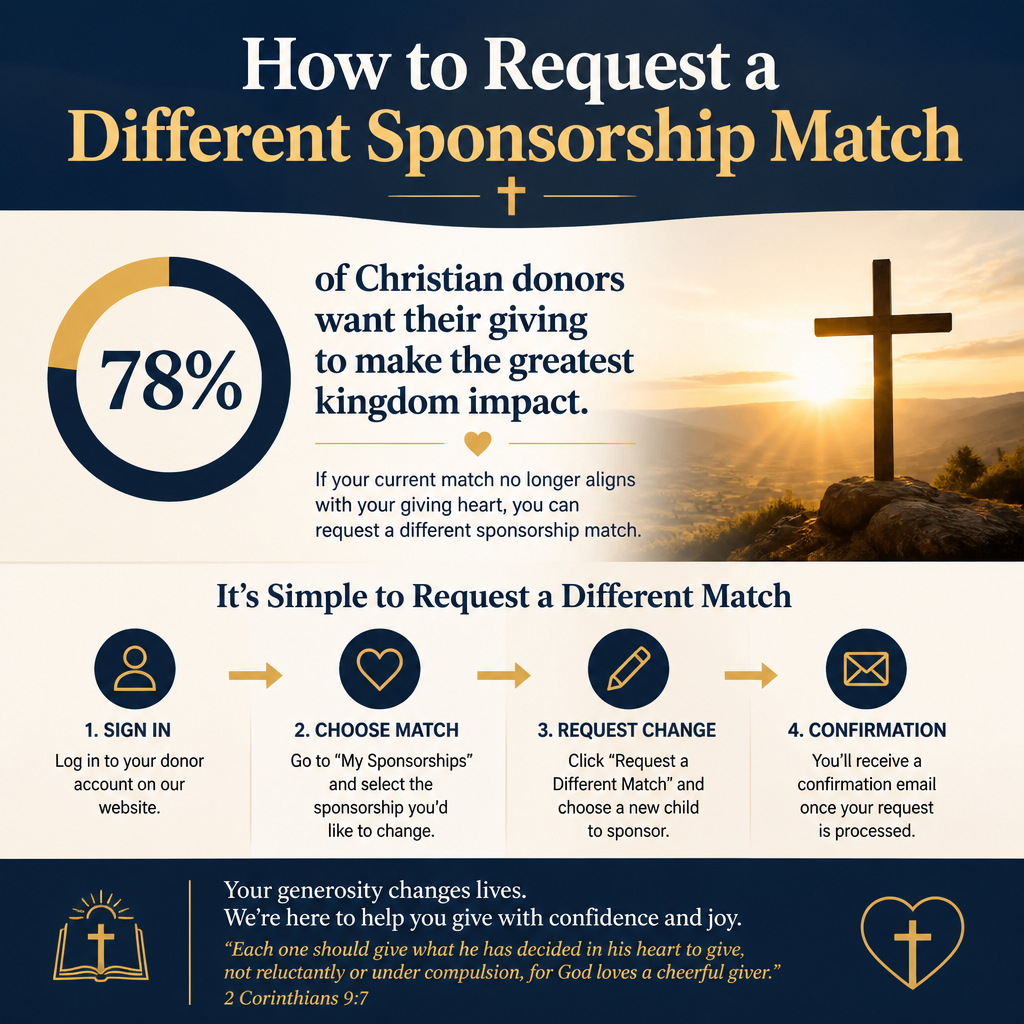
If you are unsure where to begin, start with the ministry’s sponsorship support line or email and request a written summary of next steps. Written confirmation protects both donor and ministry. It also reduces the risk of misunderstandings about timing, charges, and whether the prior match will continue during the transition.
State what you will do financially during the transition
The hardest operational issue in rematching is continuity. Programs are built on predictable revenue, and sudden drops can destabilize services. Many donors prefer to pause charges until a new match is confirmed; others prefer to continue giving so the ministry can maintain planning stability. Neither is universally “right,” but the donor should decide and communicate it explicitly.
Christians genuinely disagree about how “relational” sponsorship should be versus how “programmatic” it should be. Yet most agree that children should not carry the cost of donor dissatisfaction. If you intend to pause, do so respectfully and clearly, and ask whether there is a temporary fund that sustains services while the match is resolved.
For donors who want to think more broadly about how sponsorship fits within a portfolio of Christian giving, we maintain editorial coverage of Child Sponsorship Ministries that names both the spiritual motivations and the field-level risks that mature donors should keep in view.
Discern whether the issue is a match problem or a trust problem
When a rematch is appropriate
Some disruptions are normal and not morally alarming: children relocate, correspondence schedules change, field offices face instability, and staffing constraints slow translation. A rematch can be an appropriate administrative solution when the original match is no longer viable. It can also be appropriate when a donor’s life circumstances change and the program can provide a different commitment structure without compromising its safeguarding standards.
In these cases, we recommend asking for a simple, documented explanation: why the change is necessary, how the ministry will notify the field, what happens to prior correspondence, and how the ministry handles continuity of care for children whose sponsors change.
When a rematch may not resolve the deeper concern
Other issues are not primarily about matching. They are about credibility: vague or shifting claims about how sponsorship dollars are used, pressure to increase gifts through emotionally coercive messaging, or refusal to answer straightforward questions about governance and reporting. A rematch cannot repair a broken trust relationship if the donor believes the underlying program is not operating with integrity.
Most Trusted exists for this reason. We evaluate ministries against The Most Trusted Standard, a 15-criteria framework covering faith foundations, financial integrity, governance and leadership, and transparency and effectiveness. Donors should not need to become investigative journalists to give wisely. Where a ministry meets rigorous expectations, rematching is usually a manageable operational matter. Where it does not, the more faithful response may be to redirect giving entirely.
For donors actively managing ongoing sponsorship responsibilities and decisions over time, our coverage of Managing a Child Sponsorship Commitment addresses the practical and moral questions that recur: correspondence, changes in status, program claims, and when to escalate concerns.
Know what to document and what to expect after the change
Keep a small record that protects both parties
Sponsorship is often a long commitment. Records prevent confusion and help a ministry resolve problems quickly. Maintain a brief file with your sponsor ID, the child’s ID, the date you requested the change, and any written confirmation of the new arrangement. If you donate through a donor-advised fund or a foundation, keep a record there as well so disbursements match the new designation.
Strong ministries will typically confirm several items in writing: whether charges will continue uninterrupted, when the new match will be assigned, whether you will receive an introduction packet, and how any prior gifts are treated during the transition.
Expect time lags and field constraints
Even well-run programs cannot instantly change everything donors see. Data systems, field communication, translation, and safeguarding checks introduce delays. A rematch may take weeks rather than days, especially if the ministry is careful about appropriate child selection, consent, and documentation.
Some donors interpret delay as evasiveness. Sometimes it is. Often it is simply the cost of doing child-focused work with seriousness rather than speed. A useful benchmark is responsiveness, not immediacy: staff should acknowledge the request promptly, explain the process plainly, and provide a realistic timeline.
FAQs for How to request a different sponsorship match
Is it wrong to ask for a different child to sponsor?
Not necessarily. A request can be an act of stewardship when it is made for clear reasons and in a way that protects children from being treated as interchangeable. The moral hazard comes when donors seek a different match primarily for emotional satisfaction or increased access, which can pressure ministries toward unhealthy practices. A responsible request focuses on integrity, clarity, and continuity of care.
Should we stop giving until the ministry assigns a new match?
That depends on your capacity and your confidence in the ministry’s process. Continuing the gift during the transition helps program stability, but pausing may be appropriate if the request is tied to unresolved trust concerns or significant financial changes. What matters is communicating your decision clearly and asking for written confirmation of how your gift will be handled in the interim.
Requesting a different match as an act of responsible care
Child sponsorship can be a durable expression of Christian love when it is grounded in truth, safeguarded relationships, and accountable administration. Requesting a different sponsorship match should follow that same pattern: clear reasons, respectful communication, documented steps, and an insistence that children are protected from donor-driven instability. When ministries operate with transparency and donors pursue stewardship with humility, a rematch can strengthen—not weaken—the integrity of the commitment.



