

How to involve your church in child sponsorship is not primarily a question of logistics. It is a question of discipleship: whether a congregation will bear one another’s burdens in a sustained, accountable way, rather than offering only episodic compassion.
Child sponsorship can become one of the church’s most durable practices of mercy when it is treated as a long obedience in the same direction. It can also become a source of disappointment when it is built on sentiment, thin information, or unclear expectations. Mature Christian donors have seen both. The aim is not to create a program that runs smoothly; the aim is to form a people who give faithfully, pray intelligently, and insist on integrity in the ministries they support.
Begin with theology and truth before you begin with sign ups
Scripture’s concern for children and the poor is not ambiguous. James calls the care of the vulnerable “pure and undefiled religion” (James 1:27). Jesus identifies himself with those in need in Matthew 25. Yet the same Bible that commands generosity also condemns dishonest weights and measures, the exploitation of the weak, and religious activity that masks injustice. Churches do not honor the poor by lowering standards for truth.
Teach child sponsorship as shared discipleship, not spiritual retail
Many sponsorship appeals are built as if the donor is purchasing a personal relationship or guaranteeing a specific outcome. That framing is fragile. A healthier approach is covenantal: a congregation commits to sustained support for a child’s well-being and local community development through a ministry with verifiable safeguards, while receiving updates that are meaningful but not romanticized.
What this means in practice is that the church should talk about sponsorship as a form of stewardship, not as a sentimental attachment. Sponsors may receive letters and photos, but the deeper relationship is between the church and Christ, expressed through faithful giving and prayer for a child they may never meet.
Name the tensions the field has had to reckon with
Christians genuinely disagree about the best models for helping children in poverty. Some worry that sponsorship can become transactional, or that it unintentionally incentivizes unhealthy dependency. Others note the real good done by long-term support and the dignity of personal communication. The point is not to settle every debate from the pulpit. It is to acknowledge the questions openly and commit to choosing partners who can answer them with evidence rather than slogans.
The When Helping Hurts framework, articulated by Steve Corbett and Brian Fikkert, has shaped much of the modern conversation by warning that well-intentioned aid can harm when it displaces local agency or reinforces harmful narratives. A church does not need to agree with every application of that framework to take its central warning seriously: help that is not guided by humility and accountability can wound the people it intends to serve.

Choose a sponsorship ministry your elders can defend
A congregation can only sustain child sponsorship if leaders can speak with confidence about where the money goes, how children are selected, what protections exist, and what evidence suggests the work is effective. That is not cynicism; it is pastoral care for both donors and the families being served.
Use a verification lens that matches Christian convictions
At Most Trusted, we evaluate ministries against The Most Trusted Standard, a 15-criteria framework across Faith Foundation, Financial Integrity, Governance and Leadership, and Transparency and Effectiveness. The categories matter because churches are not only funding outcomes; they are endorsing a witness. A ministry’s theology, financial discipline, leadership accountability, and honesty with supporters all shape that witness.
Some churches hesitate to apply rigorous standards because the need feels urgent. Yet Scripture is clear that urgency never justifies careless stewardship. If a ministry cannot answer basic questions about governance, audited financials, child protection policies, and program claims, a church should not ask its people to bind their consciences to it.
Make child protection a non negotiable
Any church involvement in sponsorship should begin with safeguarding: how a ministry screens staff, prevents exploitation, handles photography and communications, and responds to allegations. A credible ministry will have written child safeguarding policies, training expectations, and reporting mechanisms. If leaders cannot obtain these documents, that is itself an answer.
Churches should also examine whether communications dignify children and families. Poverty imagery can become a tool of fundraising rather than a truthful portrayal of image-bearers. A ministry that meets high standards will treat children as persons, not props.
Build a churchwide practice that lasts longer than initial enthusiasm
Sponsorship succeeds in congregations that treat it as a durable rhythm: prayer, giving, correspondence, and periodic re-evaluation. Churches that treat sponsorship as a one-time campaign often see a wave of sign-ups followed by quiet attrition, which is discouraging for sponsors and disruptive for programs.
Assign clear roles and keep pastoral oversight visible
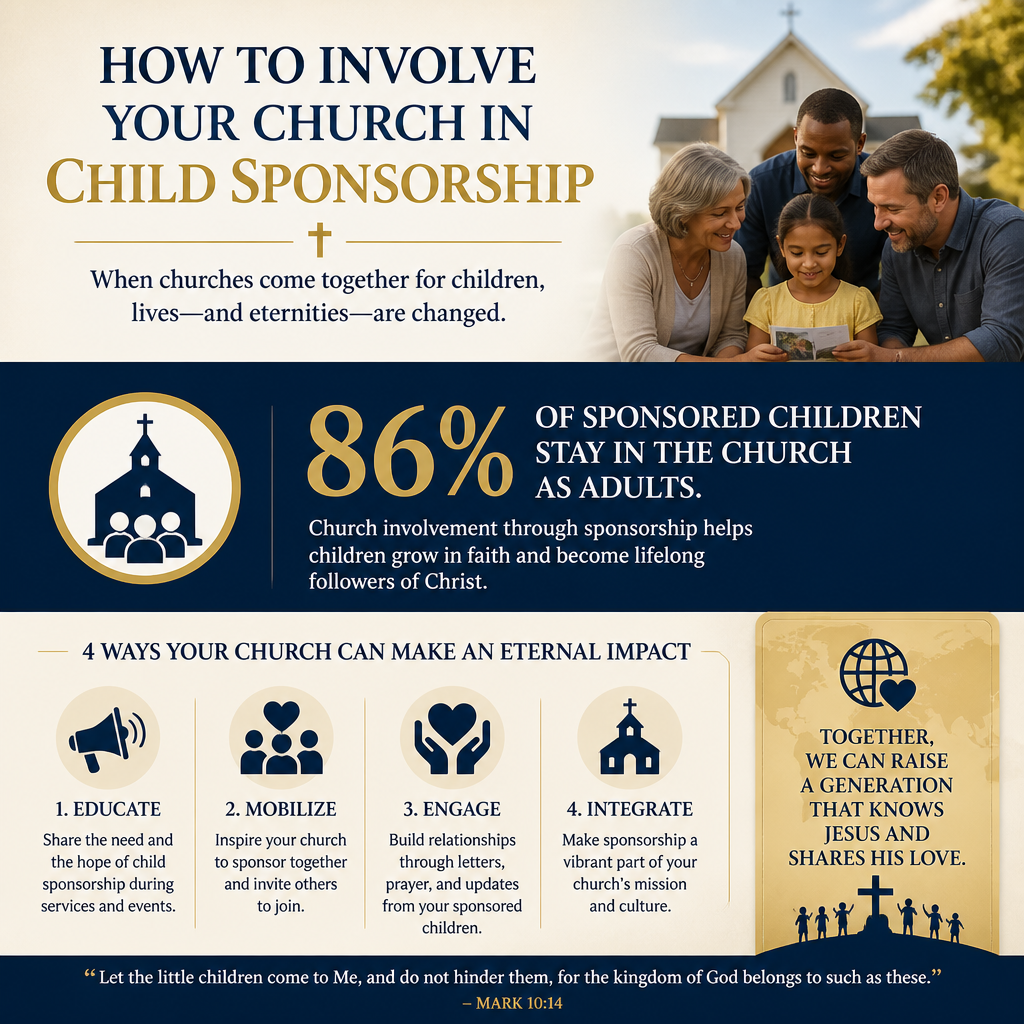
Child sponsorship should not be owned by a single charismatic volunteer. It should be stewarded by a small team with defined responsibilities and clear reporting lines to church leadership. Pastors and elders do not need to manage details, but their visible oversight signals that this is part of the church’s discipleship, not a side project.
Many churches find it helpful to create a simple annual cadence: a Sunday of prayer for sponsored children and communities, a brief update on the ministry partner’s work, and a reminder of the church’s commitments. This keeps sponsorship connected to worship rather than detached from it.
Make participation accessible without lowering the bar
Not every household can take on a full sponsorship commitment, and churches should not press people into promises they cannot keep. Yet congregations can widen participation through shared models while preserving clarity.
- Offer team sponsorship where a small group shares one commitment and divides correspondence responsibilities.
- Create a benevolence-style assistance fund to help sponsors who face temporary hardship continue faithfully.
- Provide templates for letter-writing that encourage encouragement and prayer without inappropriate personal promises.
- Host periodic letter-writing gatherings after services for sponsors who want communal support.
- Encourage families to involve children in praying and writing, framing it as formation rather than a performance.
Set expectations for money, communication, and outcomes
Many frustrations in child sponsorship come from mismatched expectations. Sponsors assume their full gift goes directly to a child, or that measurable transformation will be visible within a year, or that every letter reflects the child’s personal voice without mediation. Some ministries contribute to confusion through overconfident marketing. Churches can protect their people by clarifying what sponsorship is and what it is not.
Explain how sponsorship funds are typically used
Different ministries structure sponsorship differently: some allocate a portion to direct child benefits and a portion to community-level services such as education support, health screenings, or local staff. These models can be legitimate, but they must be explained plainly. The church’s responsibility is not to demand a simplistic story; it is to ensure the story is true.
It also helps to situate overhead conversations within the broader nonprofit accountability discussion. The “Overhead Myth” letter argued that overhead ratios alone are poor measures of nonprofit performance and called for attention to transparency, governance, and results. It was signed by Charity Navigator, GuideStar, and BBB Wise Giving Alliance. A church that understands this can ask better questions than “How low is your overhead?” and instead ask “What controls and evidence demonstrate faithful stewardship?” See the statement at Charity Navigator.
Clarify communication practices without embarrassment
Letter-writing is often spiritually fruitful, but it is rarely straightforward. Some letters are translated. Some are facilitated by staff to protect children or to manage logistics. Some children move, change schools, or exit programs. A responsible ministry will disclose these realities and describe how it maintains authenticity and safety.
Church leaders should prepare sponsors for discontinuities. A child’s situation can change for good reasons: reunification with family, relocation, or aging out. Sponsors should be ready to respond without feeling deceived, and churches should help them reframe the moment as part of real life rather than a broken promise.
Keep the church accountable through prayer, reporting, and periodic review
Church involvement in sponsorship should strengthen accountability, not weaken it. A congregation that mobilizes support at scale has a duty to review the partnership periodically, listen carefully to donor concerns, and confirm that the ministry’s claims remain credible.
Integrate sponsorship into corporate prayer
It is easy for sponsorship to become purely financial. Churches should resist that drift by praying publicly for sponsored children, families, and local churches or community partners overseas. Prayer does not replace diligence, but it does keep the relationship from becoming merely transactional. It also forms donors to see support as participation in God’s work rather than personal accomplishment.
Re evaluate ministries with a steady cadence
Ministries change over time: leadership transitions, program shifts, financial strain, and evolving country contexts. A church should plan to revisit its sponsorship partner periodically, asking questions about audited financials, governance controls, safeguarding incidents and responses, and evidence of impact. For many congregations, a simple annual review is sufficient.
This is also where donors can benefit from broader context on child sponsorship models and common risks. Churches that want a deeper view of the category often begin by surveying the wider landscape of Child Sponsorship Ministries and then considering how the church’s own commitments fit within it. Later, when questions arise about sustaining the commitment, many leaders find it useful to consult resources focused on Managing a Child Sponsorship Commitment in a way that honors both the sponsor’s capacity and the child’s dignity.
FAQs for How to involve your church in child sponsorship
Should our church sponsor children as a congregation or encourage individual families to sponsor?
Both models can be faithful, and the best choice depends on the church’s culture and capacity. Congregational sponsorship, funded through a missions line item or special offering, can ensure stability and reduce sponsor attrition. Individual or family sponsorship can deepen personal discipleship and prayer. Many churches combine approaches by encouraging individual sponsorship while providing a support structure and contingency assistance so commitments are kept even during seasons of hardship.
How can we talk about integrity without sounding distrustful of ministries?
The church can frame diligence as love. Scripture pairs compassion with honesty, and Christian stewardship requires both. Leaders can say plainly that accountability protects children, honors donors, and strengthens credible ministries. The goal is not suspicion; it is clarity—asking for audited financials, safeguarding policies, and transparent reporting as ordinary practices of Christian responsibility.
A church involved in sponsorship should be known for faithfulness
The measure of church involvement in child sponsorship is not the size of the launch or the emotion of the first Sunday. It is whether the church sustains a truthful, dignifying partnership over time—one that forms donors in patient generosity, protects children through serious safeguards, and can be defended in public without exaggeration. When sponsorship is pursued with theological seriousness and verifiable integrity, it becomes a credible expression of the mercy Christ commands and the stewardship Scripture requires.



