

Managing a child sponsorship commitment is ultimately a stewardship question: how to make a clear promise, keep it with integrity, and respond faithfully when circumstances change. For many Christian donors, sponsorship becomes one of the most personal forms of giving precisely because it connects a monthly budget line to a particular child’s well-being and to the credibility of a ministry’s systems.
The harder reality is that child sponsorship sits at the intersection of devotion and administration. Churches and families often treat sponsorship as a relational bond, while ministries must implement it as a program with compliance, safeguarding, finance controls, and communications protocols. Mature donor stewardship takes both dimensions seriously, and refuses to let sentiment substitute for due diligence.
Clarify what you are committing to before you commit
Many sponsorship difficulties trace back to an imprecise promise. Some ministries frame sponsorship as direct provision to a named child; others frame it as participation in a broader child-and-community program where the sponsored child is the representative connection. Donors should insist on clarity about which model is in use, because the ethical expectations differ. Neither model is inherently unfaithful, but ambiguity invites misunderstanding, disappointment, and occasionally manipulation.
Across our verification work at Most Trusted, we observe that the ministries that meet The Most Trusted Standard tend to describe sponsorship mechanics in plain language: what portion is restricted to the child, what portion supports shared programming, how in-country partners are monitored, and what happens when sponsorships lapse. Where a ministry cannot explain these basics without euphemism, donors should slow down and ask why.
Read the ministry’s sponsorship terms like a covenant document
Most Christian donors would not sign a mortgage without reading the terms; sponsorship deserves similar seriousness. Review cancellation policies, data privacy language, and what the ministry promises regarding communication frequency and use of images. Child protection expectations matter here. Responsible programs avoid creating incentives for children to perform poverty for donors, and they handle letters and photos with safeguarding controls.
If the ministry’s language implies that a child’s access to food or school depends on a single donor’s uninterrupted payment, ask direct questions. In healthy programs, sponsorship revenue supports a stable plan with contingencies, rather than forcing a child’s well-being to rise and fall with one donor’s month-to-month consistency.
Distinguish emotional urgency from operational honesty
Christian giving is never meant to be cold, but it should be discerning. Appeals that trade heavily on guilt or spiritual fear often signal a weak theory of stewardship. Scripture binds generosity to wisdom: “The plans of the diligent lead surely to abundance” (Prov. 21:5). Donors are not obligated to fund programs that depend on pressure rather than faithful administration.
Start with a sustainable number, not a heroic one
Many sponsorship cancellations arise from overpromising. A sustainable commitment honors the child and protects the donor from later disruption. If a family wishes to sponsor multiple children, it is usually wiser to begin with one sponsorship, establish a stable monthly rhythm, and then add a second only when the margin is proven.

Build sponsorship into your financial discipleship
A sponsorship commitment functions like a recurring vow inside a household budget. It is not the largest line item for most donors, but it is often the most relationally charged. That combination can produce anxiety: “What if our income changes?” “What if the ministry raises rates?” “What if we disappoint a child?” The answer is not to avoid commitment; it is to embed commitment within a disciplined approach to money.
American households routinely underestimate how exposed they are to disruption. The Federal Reserve reports that many adults still struggle to cover an unexpected $400 expense, a basic measure of financial fragility (Federal Reserve). A sponsorship plan that assumes uninterrupted surplus month after month may be spiritually aspirational but practically brittle.
Establish a sponsorship reserve and a clear giving hierarchy
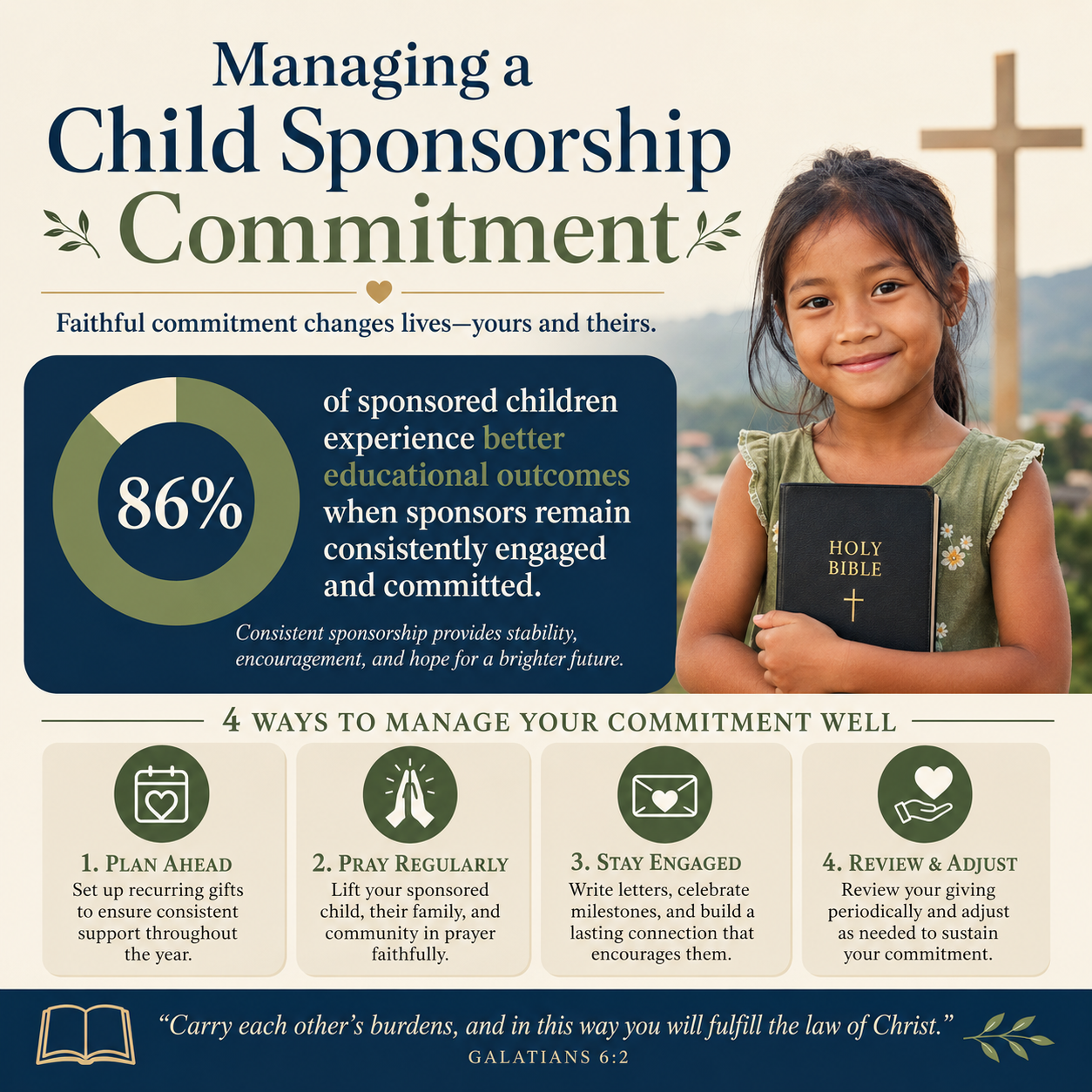
We recommend treating sponsorship like other recurring obligations: set it to auto-pay, and create a modest reserve that could cover several months if an income delay or medical bill arises. This approach reduces the likelihood of abrupt cancellation and gives a donor time to make a measured decision if circumstances deteriorate.
It also helps to decide in advance where sponsorship fits within a household’s priorities. Many Christian donors treat local church giving as primary, with additional commitments as secondary. Others reverse the order. Christians genuinely disagree about sequencing, but mature stewardship avoids improvisation under stress. Decide the hierarchy when calm, not when financial pressure is high.
Plan for normal change, not just crisis
Sponsorship can be disrupted by ordinary life events: job transitions, the birth of a child, tuition payments, caring for aging parents, or a relocation. A wise plan anticipates those seasons. If a donor knows a major expense is coming, it is better to reduce commitments early with candor than to default later with silence.
Hold the ministry accountable for predictable inflation and cost adjustments
Some ministries periodically increase sponsorship amounts to reflect rising costs in-country, currency shifts, or program expansion. Cost increases can be legitimate, but they should be communicated in advance, justified with specific program details, and accompanied by options rather than ultimatums. Donors should expect transparency about what has changed and how the additional funds will be managed.
For donors seeking a broader view of how sponsorship programs are structured and evaluated, our coverage of Child Sponsorship Ministries addresses the recurring questions that separate clear programs from confusing ones.
Communicate with the ministry in ways that protect the child and strengthen the program
Most donors think of sponsorship communication as letters and updates, but the deeper issue is whether the ministry’s communication practices are ethically sound. The child is not a content asset. The child is an image-bearer, and program communication should reflect that doctrine with restraint, accuracy, and consent-aware processes.
Responsible ministries typically filter letters through trained staff, translate carefully, and avoid sharing identifying information that could expose the child to harm. They will also have policies that govern photography, social media sharing, and the handling of sensitive stories. Donors should be willing to accept limits on contact when those limits serve safeguarding.
Request clarity without demanding inappropriate access
It is appropriate to ask how funds are used, what services the program provides, and how outcomes are tracked. It is not appropriate to demand direct access, private phone calls, or unmediated contact that bypasses child protection controls. Donors should be suspicious of programs that promise unrestricted access as a selling point. Healthy programs protect children even when donors would prefer fewer boundaries.
Understand why updates can be irregular
Delays in letters and updates can be caused by school calendars, staff turnover, translation capacity, or instability in a community. Donors should still expect reasonable responsiveness and honest explanations, but it is unwise to equate relational warmth with program quality. Some of the most serious programs are restrained in communication precisely because they treat children’s stories with care.
Engage your church without turning sponsorship into a platform
Many donors rightly want sponsorship to shape the spiritual formation of a household or congregation. This can be fruitful when handled humbly: praying regularly for the child and community, teaching children the habits of generosity, or coordinating support for a vetted ministry partner. But sponsorship can also become performative if it is used to signal virtue. Jesus’ warning against public piety is not a rejection of shared encouragement; it is a rejection of self-display (Matt. 6:1–4).
Practically, donors should avoid sharing identifying details publicly, especially online. A church can celebrate generosity while still guarding the child’s dignity and privacy.
Prepare for disruption with integrity and a truth-telling posture
Even careful donors face seasons when a sponsorship must change. Illness, unemployment, unexpected caregiving burdens, or other obligations can make a long-term commitment temporarily or permanently unsustainable. A faithful response is not denial, nor is it abrupt disappearance. It is truthful communication coupled with a reasonable effort to minimize harm.
Christian ethics does not demand impossible promises. It does demand honesty. “Let your ‘Yes’ be yes and your ‘No’ be no” (Matt. 5:37). In sponsorship terms, that means communicating early, understanding the ministry’s process, and avoiding patterns that create instability for the program.
If you need to cancel, cancel with lead time and clarity
Where possible, provide notice so the ministry can seek a new sponsor or reassign funds internally according to policy. Ask what support the child continues to receive during a gap, and how the ministry avoids sudden service interruption. Strong programs have contingency reserves and program designs that do not depend on perfect donor retention.
Donors should also ask whether the ministry’s cancellation process is designed to be honest rather than coercive. Some organizations use heavy emotional pressure to prevent cancellation; others treat it as a normal administrative reality. The latter posture tends to reflect healthier governance and a more sustainable theology of giving.
If you want a different match, treat the request as a program decision
Sometimes a donor requests a different sponsorship match because communication has stalled, the child has transitioned out of the program, or the donor’s preferences have changed. This is not inherently wrong, but it should be approached as a program adjustment rather than a consumer transaction. Ask how rematching works, whether the ministry prioritizes continuity for the child, and how it prevents “shopping” dynamics that treat children as interchangeable profiles.
Expect tax receipts and financial documentation to be handled with rigor
Sponsorship donations are charitable contributions and should be receipted accordingly. Donors should expect timely annual statements and clear confirmation of donation amounts for tax purposes. The Internal Revenue Service outlines substantiation expectations for charitable contributions, including contemporaneous written acknowledgments for gifts of $250 or more (Internal Revenue Service).
Financial rigor is not merely a compliance matter. It is a governance signal. When receipting is inconsistent or ambiguous, it often correlates with weaker financial controls more broadly. Under The Most Trusted Standard, documentation practices sit alongside broader questions: whether the board is active, whether financial statements are credible, and whether the ministry tells the truth about results.
Stewardship that honors both the child and the truth
Managing a child sponsorship commitment requires more than a willing heart. It requires durable planning, clear expectations, and a refusal to let sentiment eclipse accountability. The Christian donor’s aim is not to maintain an unbroken record of payments at any cost; it is to practice truthful, disciplined generosity that respects the child’s dignity and supports ministries capable of responsible care.
When donors treat sponsorship as a serious commitment and evaluate ministries with sober standards, they help build programs that are stable enough to serve children well over time. That is not cynicism. It is love ordered by truth.



