
What happens if you need to cancel a sponsorship is rarely a simple administrative question. For many Christian donors, it touches conscience, stewardship, and the fear of harming a child who has already experienced too much instability.
The closer a sponsorship relationship feels, the more weight its interruption can carry. Yet the moral burden is not borne by the donor alone. Ministries choose how they design sponsorship programs, how they communicate expectations, and how they protect children from avoidable disruption. A mature approach holds both realities together: donors should keep commitments when possible, and ministries should structure commitments so children are not made vulnerable to the private crises of adults.
Canceling is not the same as abandoning
Why this question presses on Christian conscience
Sponsorship often sits in the category of vowed giving: a recurring commitment with a named beneficiary. Scripture treats vows and promises with seriousness, not because God is impressed by human willpower, but because faithfulness reflects his character (Matthew 5:37). That spiritual seriousness is one reason canceling a sponsorship can feel like moral failure rather than a change in circumstances.
At the same time, Scripture also assumes human limitation. Paul commends willingness and proportionate generosity: “If the readiness is there, it is acceptable according to what a person has, not according to what he does not have” (2 Corinthians 8:12). That is not a loophole for convenience. It is a biblical guardrail against guilt-driven giving that ignores real constraints.
What responsible ministries design for
Across our verification work at Most Trusted, we observe that the ministries most attentive to long-term child well-being tend to avoid making a child’s essential care depend on a single donor’s uninterrupted payment. Sponsorship can be a funding channel, but the program design should protect children from financial whiplash. Donors should not assume this protection exists. It is a governance and program integrity question, and it belongs in the same category as financial controls and truthful communications.

What ministries usually do when a sponsor cancels
Common operational pathways
Practices vary widely, but most established sponsorship ministries follow a set of predictable steps when a monthly gift stops. Some are pastorally sensitive; others are primarily transactional. The difference often reveals whether the ministry sees the sponsor as a customer, a partner in discipleship, or simply a revenue source.
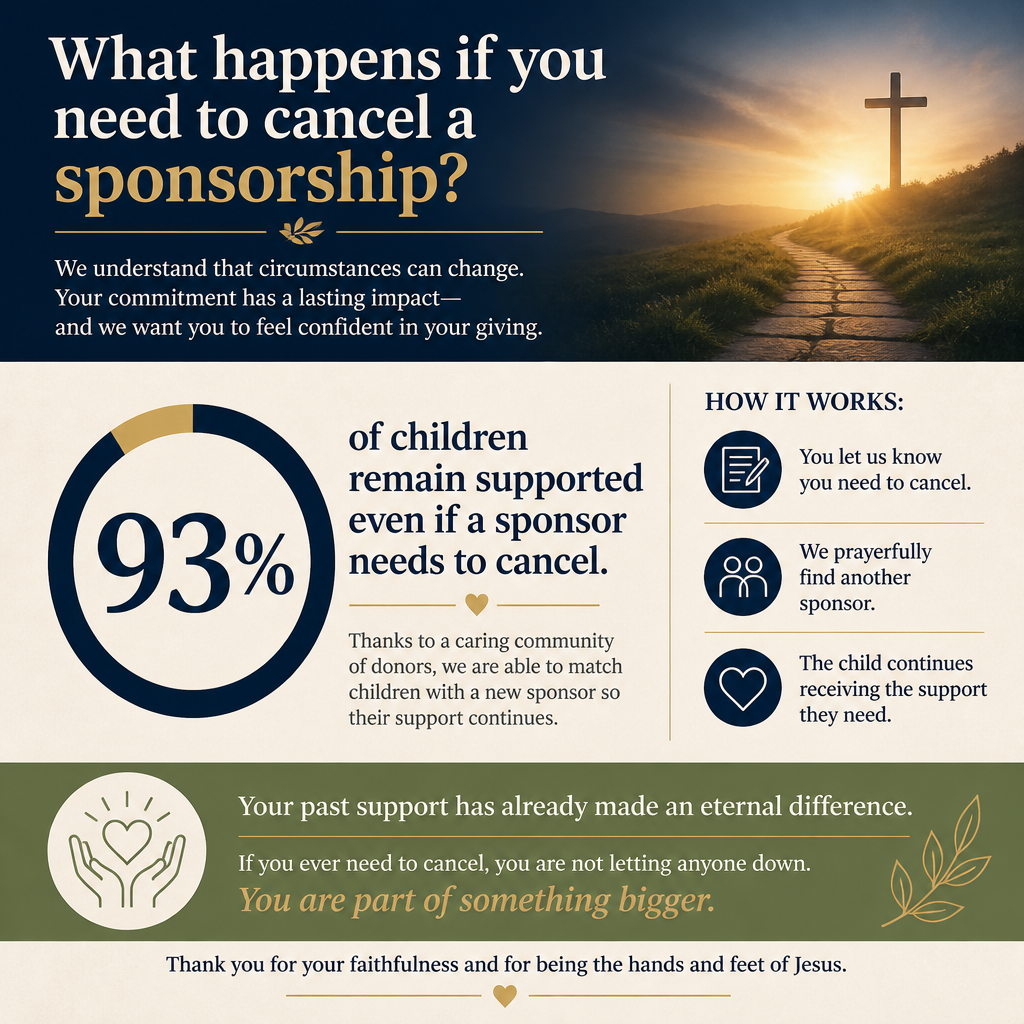
In many programs, cancellation triggers an internal attempt to reassign the child to a new sponsor. Some ministries maintain a general fund that covers gaps until the reassignment occurs. Others quietly redistribute the child’s budget across the portfolio of sponsored children, effectively averaging the impact across the program. A few programs reduce services tied to “sponsorship benefits,” which is where donor communication and ethical clarity matter most.
Where donor expectations can diverge from reality
Many donors have been led—sometimes unintentionally—to believe that their monthly gift directly “pays for” one specific child’s food, school fees, and medical care in a one-to-one manner. In practice, sponsorship is often closer to restricted fundraising tied to a beneficiary story than a direct remittance to a household. That is not automatically deceptive, but it creates moral hazard if the ministry implies a level of individual dependency it cannot or does not maintain.
For donors trying to think carefully about sponsorship models, it can be helpful to situate the issue within the broader landscape of Child Sponsorship Ministries. Not all sponsorship is identical, and the details of program structure are not secondary; they are the difference between a child-centered model and a marketing-centered one.
How to cancel with integrity and minimal harm
A decision framework before you cancel
The hardest part of canceling is rarely the phone call. It is discerning whether a financial change is temporary, whether it reflects a broader reordering of life, or whether the sponsorship has become a proxy for guilt rather than a disciplined act of stewardship. Mature giving does not treat every change in capacity as a moral emergency, but it also does not treat commitments as disposable.
What this means in practice is that donors should separate three questions that often get tangled: (1) Can we continue this commitment without neglecting obligations of vocation, family, and church? (2) If we must change, can we phase down rather than stop abruptly? (3) Are we confident the ministry is structured to protect the child if we step away?
Practical steps that usually help
- Contact the ministry before the next scheduled charge to avoid an avoidable gap.
- Ask whether the child’s core services depend on continuous sponsorship, and how gaps are covered.
- If feasible, offer a 30–90 day transition period or a one-time bridge gift to reduce disruption.
- Request written confirmation of cancellation and any changes to recurring billing.
- If you sponsor through a donor-advised fund or employer giving portal, confirm the stop order there as well.
When communicating with the ministry, clarity is charity. “We can no longer continue this commitment” is often sufficient. Over-explaining can invite unwanted negotiation, and it can also create the impression that the ministry is entitled to your private financial details.
What to ask a sponsorship ministry before and after cancellation
Questions that reveal program health
Sophisticated donors do not treat sponsorship as merely sentimental. They ask whether the ministry’s systems are sound, whether communications are truthful, and whether child protection is taken seriously. A sponsorship program that cannot answer basic questions in plain language is asking donors to subsidize opacity.
These questions are especially relevant within Managing a Child Sponsorship Commitment, because long-term faithfulness is easier when expectations are clear at the outset.
A short set of questions worth asking
Consider asking the ministry:
How is sponsorship revenue allocated? Does it support a specific child’s costs, a community program, or a blended budget?
What happens when a sponsor cancels or lapses? Is there a reserve fund, a reassignment process, or a reduction in benefits?
How do you avoid creating perverse incentives? For example, does the program unintentionally reward staff for the number of sponsored profiles rather than measurable child and family outcomes?
How do you protect children’s dignity and privacy? What information is shared with sponsors, and what safeguards exist around photos, letters, and online profiles?
What evidence do you provide of outcomes? Not merely stories, but credible indicators that the intervention is helping and not inadvertently harming.
As donors compare organizations, independent verification can serve as a stabilizing reference point. Most Trusted evaluates ministries against The Most Trusted Standard, a 15-criteria framework across Faith Foundation, Financial Integrity, Governance and Leadership, and Transparency and Effectiveness. The point is not to replace relational giving with bureaucracy; it is to ensure that love of neighbor is paired with disciplined truth-telling and accountable systems.
The spiritual tension is real and should be handled honestly
Faithfulness without false guilt
Christians genuinely disagree about the moral status of canceling a commitment. Some emphasize the seriousness of promises and the formative value of keeping them. Others emphasize freedom of conscience and the priority of meeting immediate obligations. Both instincts can be biblically informed, and both can become distorted—either into scrupulosity or into consumer choice disguised as “stewardship.”
A useful moral test is whether the decision is being made with truthfulness. If the reason is financial constraint, it is better to name it plainly than to spiritualize it. If the reason is loss of confidence in the ministry’s integrity, that is also worth naming, because it directs attention to a real accountability problem rather than hiding it behind vague language.
When canceling may be the more responsible act
There are circumstances where canceling is not merely permissible but prudent. If a ministry’s communications appear misleading, if child protection practices are unclear, or if financial reporting is evasive, continuing to give can become a form of complicity. Donors are not responsible for perfect knowledge, but we are responsible for reasonable diligence. Scripture’s warnings about dishonest weights and measures are not confined to ancient marketplaces (Proverbs 11:1).
In those cases, a thoughtful donor may redirect giving to an organization that demonstrates clearer governance, stronger financial integrity, and more transparent reporting. That redirection can be done without cynicism. It is a way of insisting that Christian compassion should be expressed through institutions that can bear the moral weight of the work.
FAQs for What happens if you need to cancel a sponsorship
Will the child lose support if we cancel?
It depends on how the ministry is structured. In stronger programs, a child’s core services are not immediately reduced when a sponsor cancels; the ministry covers the gap through a general fund or reassignment process. In weaker or less transparent programs, “sponsorship benefits” may be tied more tightly to continuous payments. The responsible approach is to ask the ministry directly what happens during a sponsorship gap and whether the child’s essential care is protected.
Should we tell the child we are canceling?
Most programs do not expect sponsors to communicate a cancellation directly to a child, and in many cases it would be unwise. A child should not carry adult financial information or feel responsible for a donor’s circumstances. If the ministry facilitates letter-writing, it is reasonable to ask how they handle transitions and whether they provide age-appropriate support that protects the child’s dignity.
A faithful decision is both compassionate and truthful
What happens if you need to cancel a sponsorship should be approached with the seriousness that commitments deserve and the realism that human limits require. When donors communicate clearly, seek to minimize disruption, and give only through ministries that protect children from avoidable instability, cancellation does not have to mean abandonment. It can be an act of truthful stewardship carried out with reverence for the child and confidence in the God who does not abandon his own.



