
Learning how to read a biblical museum ministry annual report is not a niche skill for specialists. For Christian donors, it is part of the stewardship Scripture assumes: giving that is thoughtful, truthful, and ordered toward worship rather than mere admiration of religious artifacts.
Biblical museums and traveling exhibitions often sit at an intersection of evangelism, education, scholarship, and fundraising. The annual report is where a ministry implicitly answers three donor questions: What did you do with what was entrusted to you? What fruit did it produce? And what kind of truthfulness governs your handling of money, governance, and public claims?
Begin with the ministry mandate and the ministry claims
Clarify what the ministry believes it is responsible to accomplish
Many annual reports begin with an origin story, an inspiring visitor testimony, or a highlight reel of exhibits. A donor’s first task is more basic: identify the ministry’s stated mandate. Is the museum primarily an evangelistic outreach? A Christian educational institution? A research and conservation effort? A public apologetics platform? A hybrid of all four?
The most reliable reports do not hide behind broad language. They name what success means in plain terms: audiences served, learning objectives, pastoral partnerships, academic standards, and the ethical boundaries governing acquisitions and representation. Christians genuinely disagree about certain questions here—how to frame apologetics, how to engage secular scholarship, how to speak about contested historical claims. The annual report should show that leaders are aware of those tensions and have chosen a posture that can be defended in the light.
Test whether the report treats truth as a spiritual obligation
A biblical museum ministry, by definition, trades in truth claims. That makes accuracy a theological issue, not a public relations preference. The ninth commandment is not limited to courtroom perjury; it forms a people who refuse to build credibility through half-truths. When an annual report describes visitor impact or cultural influence, the question is not only whether the work sounds impressive, but whether the language is careful enough to be trusted.
Across our verification work at Most Trusted, we observe that ministries worthy of deep donor confidence tend to distinguish between what they can measure, what they can reasonably infer, and what they can only hope. That clarity is a moral strength, not a marketing weakness.
Read the financial story as a moral story
Start with the audited financial statements and the auditor relationship
If a biblical museum ministry is of meaningful scale, an annual report should either include audited financial statements or clearly point to them. An audit is not a guarantee of holiness, but it is a meaningful discipline: independent testing of whether the financial statements are fairly presented under recognized accounting standards.
The report should name the audit firm and indicate whether the audit produced an unmodified opinion. If the report references significant internal control issues, that is not automatically disqualifying; new organizations, rapid growth, and complex revenue streams can create control weaknesses. What matters is whether leaders disclose problems plainly and demonstrate a plan to remediate them.
Interpret revenue sources and volatility with sobriety
Biblical museum ministries often blend donations, ticket revenue, retail sales, sponsorships, grants, and sometimes debt financing for capital projects. This mixture can strengthen sustainability, but it also adds volatility and temptation: pressure to grow attendance metrics at the expense of integrity, pressure to overpromise outcomes to donors, or pressure to fundraise with urgency that is not fully candid.
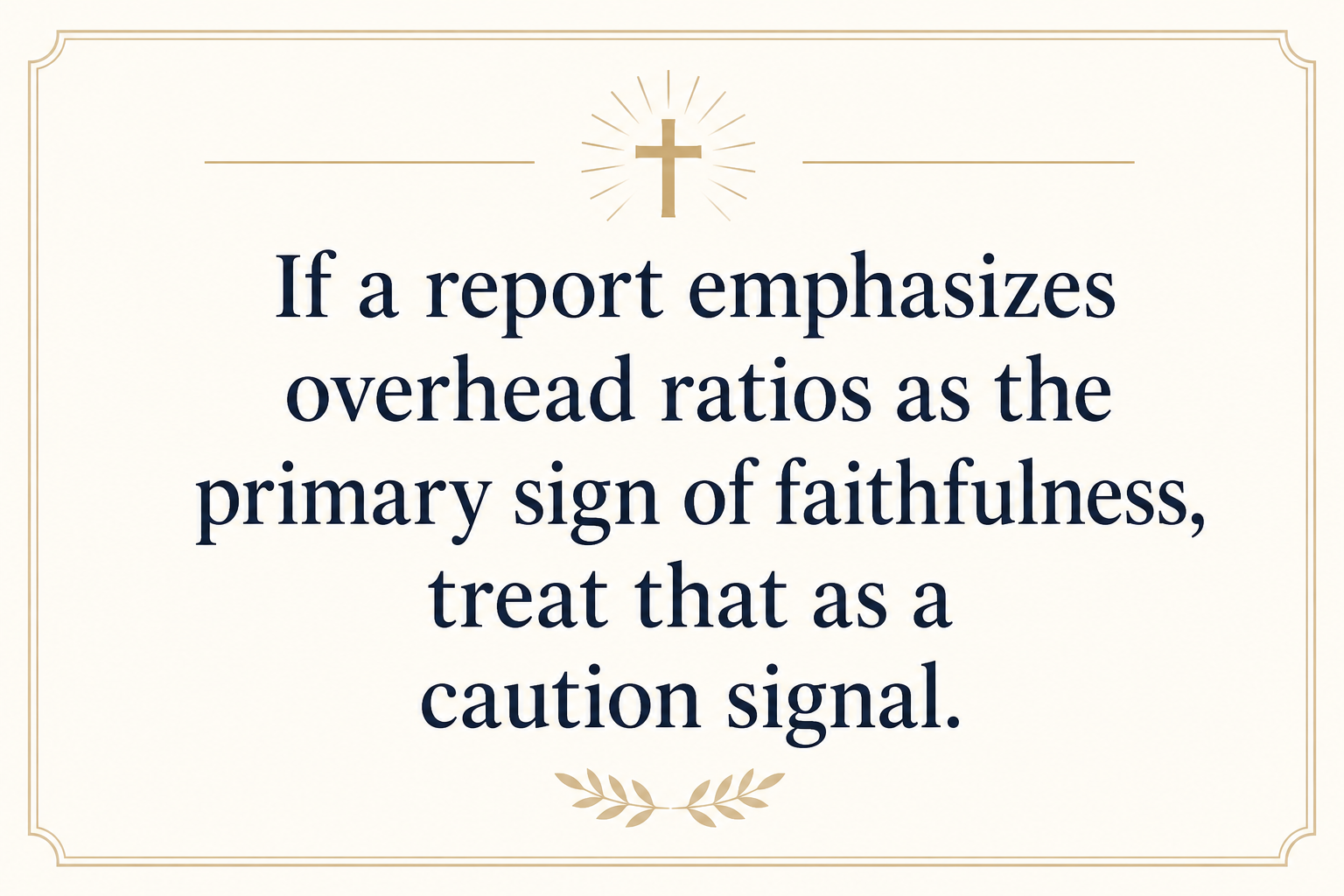
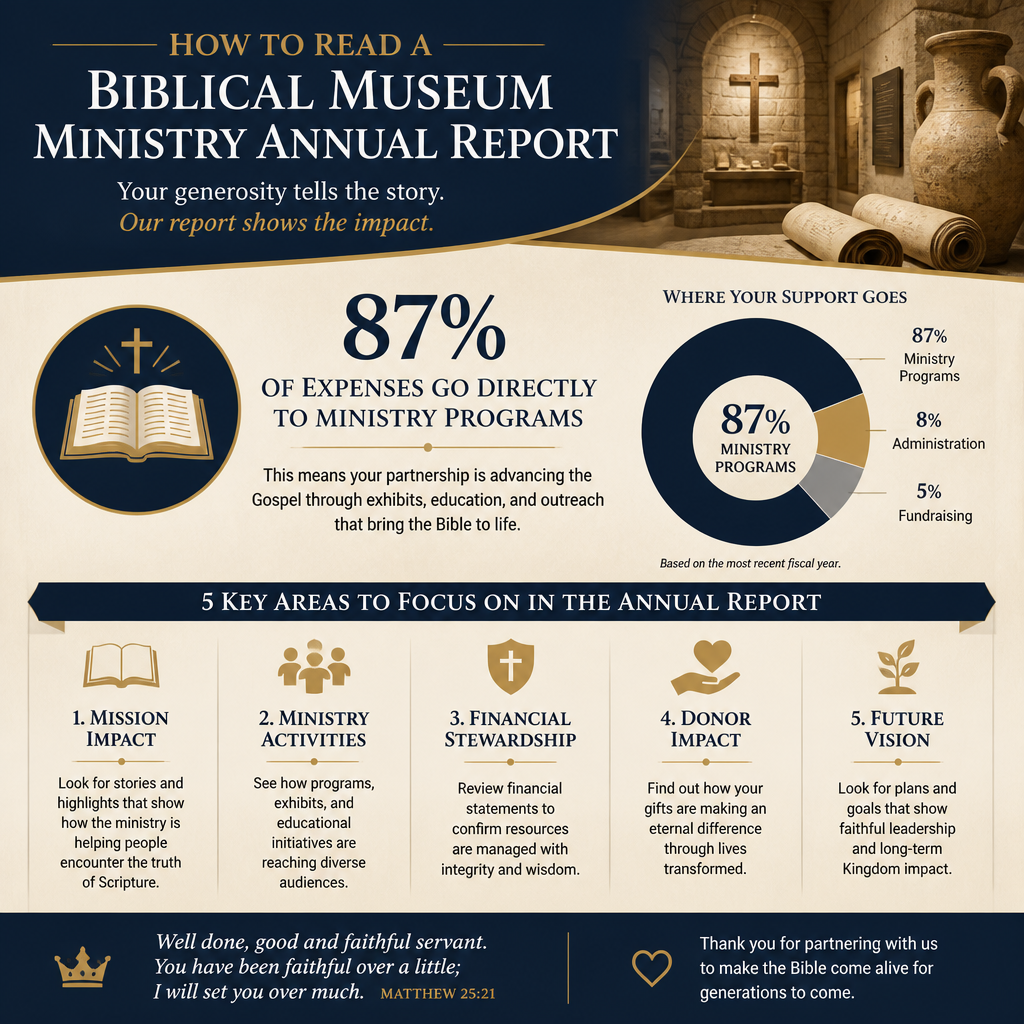
If a report emphasizes overhead ratios as the primary sign of faithfulness, treat that as a caution signal. The nonprofit field has widely challenged simplistic overhead obsession; in 2013, Charity Navigator, GuideStar, and the BBB Wise Giving Alliance publicly warned donors against judging charities primarily by overhead and called for attention to results, transparency, and governance (Charity Navigator).
What this means in practice is that a museum ministry can spend too little on conservation, security, staff formation, or visitor safety and still look “efficient” in a narrow accounting sense. Christian donors should want the kind of spending that matches the ministry’s calling and protects its people.
Evaluate program reporting for credibility, not volume
Look for outcomes that match the ministry type
Annual reports often list impressive counts: visitors, school groups, exhibit stops, online impressions, and media mentions. Some of these numbers are useful, but they are mostly outputs. A donor should ask whether the report also offers outcomes that fit the ministry’s actual work: learning gains for students, pastoral feedback from churches served, scholarship produced and peer engagement, artifact stewardship practices, and the quality of interpretive materials.
Digital reach claims require particular caution. “Impressions” and “views” can be purchased, inflated, or measured inconsistently. The report should define key terms and avoid treating online attention as a proxy for spiritual fruit.
Ask whether the ministry understands formation and limits
Museums can help visitors see Scripture within history, geography, and material culture. They can also tempt visitors toward a faith built on novelty, spectacle, or overconfident claims. A mature annual report will acknowledge limits: that a powerful exhibit does not replace the ordinary means of grace in the local church, that apologetics can clear obstacles but cannot regenerate hearts, and that Christian institutions must resist turning the holy into merchandise.
As donors, we do not need ministries to claim that every visitor was transformed. We need ministries to demonstrate that they are faithful with influence, careful with claims, and accountable for what they put before the public.
Scrutinize governance and leadership as carefully as the artifacts
Board composition and independence are not technicalities
For biblical museum ministries, governance is not a background concern. Museums can accumulate significant assets, handle restricted donations, and shape public perceptions of Christianity. A credible annual report should disclose board members, leadership, and meaningful governance policies.
Pay attention to independence and related-party transactions. Ministries can be compromised not only by overt scandal but by a slow drift into insider arrangements—family control, vendor relationships without competitive bids, or boards that function as loyal supporters rather than fiduciaries. An annual report does not need to disclose every internal detail, but it should provide enough clarity that a donor can see meaningful oversight.
Signals of healthy governance Christian donors should look for
- Named board members and senior leaders, with roles clearly stated
- Clear conflict-of-interest policy and disclosure practices
- Evidence of board oversight of budget, audit, and risk management
- Executive compensation governance described with restraint and clarity
- Policies for handling restricted gifts and donor intent
Across our work applying The Most Trusted Standard, we find that ministries with durable credibility usually treat governance as spiritual stewardship: the humble work of restraint, documentation, and accountability. The opposite pattern is also common—charismatic leadership carrying the organization without adequate structures. That approach can “work” for a time. It rarely ends well.
Use transparency as a proxy for truthfulness under pressure
Watch how the report handles controversy and contested questions
Biblical museums can attract scrutiny about provenance, acquisition ethics, representational choices, and historical claims. Donors should not assume that criticism automatically means wrongdoing; cultural pressure against Christian public witness is real. But the annual report’s tone matters. If leaders dismiss all critique as persecution, or if they never acknowledge any legitimate question, credibility weakens.
Conversely, if a report names what is difficult—what remains under review, what policies were strengthened, how scholars or partner institutions were consulted—that is often a sign of integrity. Truth does not fear examination.
Connect the annual report to a broader accountability posture
An annual report is one artifact in a larger ecosystem of public accountability: IRS Form 990 filings when applicable, audited statements, donor privacy policies, artifact stewardship statements, and clear communication about the use of restricted funds. For donors who want to understand the broader landscape, the ongoing questions of accountability belong within Accountability and Transparency in Biblical Museum Ministries, where donors often compare common ministry practices and disclosure norms.
When a ministry invites scrutiny—making core documents easy to find, explaining decisions without defensiveness, and offering contact pathways for donor questions—it signals a seriousness that aligns with Christian ethics. When a ministry hides basic documents behind paywalls, vague language, or constant fundraising urgency, donors should slow down and request clarity before giving.
For context on the wider field of organizations in this space, many donors begin by reviewing Biblical Museum Ministries and then drilling into the specific museum or exhibition they are considering supporting.
FAQs for How to read a biblical museum ministry annual report
What if the annual report is inspiring but light on financial detail?
Inspiration is not a substitute for disclosure. We recommend requesting audited financial statements or at least clear financial summaries tied to recognized categories, along with an explanation of how restricted gifts are handled. If a ministry resists basic transparency, the prudent response is to withhold funding until credible documentation is provided.
Should donors prioritize evangelistic impact metrics over scholarship and conservation?
Different biblical museum ministries have different callings, and faithful work may take different forms. Evangelistic outcomes are meaningful, but so are careful scholarship, ethical stewardship of artifacts, and durable educational impact. A trustworthy annual report will not force a false choice; it will show how the ministry’s activities, spending, and leadership practices fit the mandate it claims to serve.
Giving with confidence requires reading with discernment
A biblical museum ministry annual report is a stewardship document before it is a fundraising document. It should allow a Christian donor to see whether the organization treats truth as an obligation, money as entrusted capital, and influence as something to be handled with fear of God and love of neighbor. When those commitments are visible—financially, programmatically, and in governance—generosity can proceed with confidence rather than anxiety.



