
How Christian adoption ministries support birth mothers is a theological and practical question, not a marketing one. Donors who care about vulnerable children cannot evade the reality that nearly every adoption begins with a woman in crisis, and that crisis is often compounded by isolation, shame, poverty, coercion, or violence.
Scripture’s ethic is clear on both fronts: God defends the vulnerable and condemns partial care that ignores the neighbor at hand. James joins “orphans and widows in their affliction” in a single moral frame (James 1:27). The church’s credibility in adoption is tested not only by whether children find stable homes, but also by whether birth mothers are treated as image-bearers whose agency, safety, and long-term flourishing matter before God.
Support begins before the paperwork and before the pressure
Birth mother care is not an adoption tactic
In the strongest ministries, care for birth mothers is not contingent on whether an adoption occurs. That distinction is not merely ethical; it is spiritual. Christians genuinely disagree about policy approaches in adoption, but there is little disagreement about the sin of manipulation. A ministry that ties tangible help to a particular decision can create coercive dynamics even when staff members intend compassion.
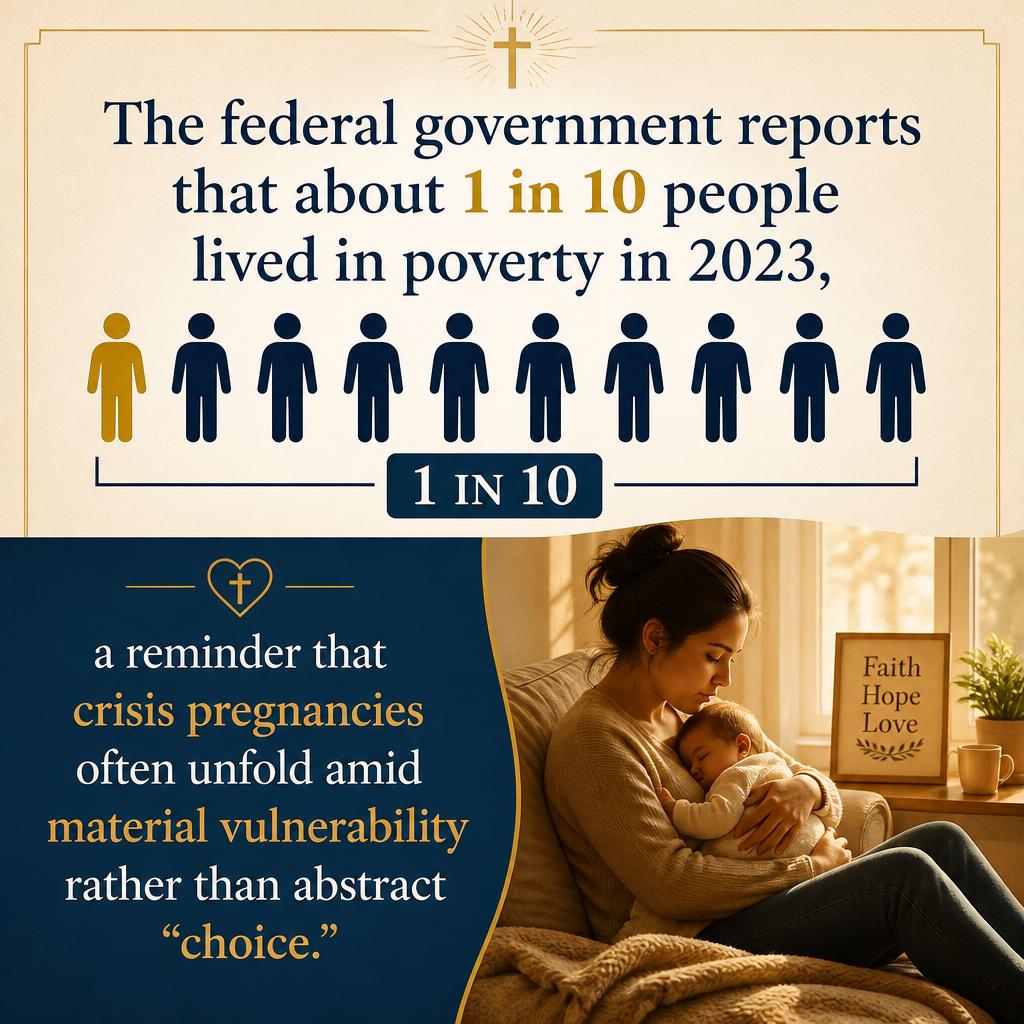
In the United States, economic instability is a frequent feature of pregnancy decision-making. The federal government reports that about 1 in 10 people lived in poverty in 2023, a reminder that crisis pregnancies often unfold amid material vulnerability rather than abstract “choice.” U.S. Census Bureau
Practical support that honors agency
What this means in practice is that early support tends to look less like persuasion and more like stabilization: safe housing, transportation to prenatal care, help securing identification documents, accompaniment through court or protection orders when abuse is present, and trauma-informed counseling. The donor implication is straightforward: the most humane work is often the least photogenic, and it requires patient funding rather than one-time gifts tied to “placements.”

Holistic care includes medical, legal, and emotional safeguards
Trauma-informed counseling and mental health support
Pregnancy under crisis conditions frequently intersects with trauma histories: domestic violence, childhood abuse, housing instability, or previous pregnancy loss. Many ministries now use trauma-informed models—slow pacing, clear consent, and predictable processes—because a woman’s capacity to make a free decision is undermined when she is dysregulated, threatened, or materially cornered.
Donors sometimes ask whether counseling is “mission drift.” It is not. Pastoral care and clinical care can coexist without confusion when a ministry is clear about role boundaries and referral protocols. A serious Christian approach refuses to pit spiritual care against competent mental health support.
Legal clarity that protects everyone involved
Adoption is a legal act with lifelong implications, and confusion is a breeding ground for regret and litigation. Ethical ministries ensure independent legal counsel is available to birth mothers, explain revocation windows in plain language, and document consent carefully. That posture protects adoptive families as well, because an adoption built on ambiguity is a fragile foundation for a child.
Some donors hesitate to fund legal support, assuming it slows the process. In reality, it often strengthens it by ensuring decisions are informed and defensible. When a woman’s rights are treated casually, the ministry’s testimony is compromised even if placements increase.
Material assistance must resist dependency and coercion
Help that is real but not transactional
Many Christian adoption ministries provide concrete aid: maternity clothing, groceries, utility assistance, childcare for existing children, and support with rent arrears. The moral risk is that help can become an unspoken contract: “We paid; now you owe.” The best ministries design aid policies that reduce that pressure—time-limited assistance, documented criteria, and a clear statement that services are not conditioned on choosing adoption.
The broader Christian relief sector has learned similar lessons. The When Helping Hurts framework, articulated by Steve Corbett and Brian Fikkert, has shaped how many ministries think about assistance that preserves dignity and avoids paternalism. When Helping Hurts
Economic pathways that outlast a single crisis
Support for birth mothers is more than emergency relief. Some ministries partner with workforce programs, community colleges, or employers to create realistic pathways to stability: job readiness, budgeting help, and case management that persists after delivery. Donors who prioritize outcomes should look for evidence that a ministry measures long-term stability, not simply short-term crisis resolution.
- Written aid policies that forbid conditioning assistance on an adoption decision
- Clear budgeting for client care funds with documented approvals
- Referral networks for housing, domestic violence advocacy, and mental health
- Case management with goals defined by the mother, not only by the ministry
- Aftercare plans that include grief support and practical follow-through
Aftercare is where credibility is proved
Grief, identity, and spiritual care over time
Even when a birth mother believes adoption is the right decision, loss is still loss. Churches that speak confidently about adoption as a picture of redemption sometimes underestimate the ongoing grief that can follow placement. Mature ministries plan for anniversaries, triggers, relationship changes, and the slow work of rebuilding a life that may still carry financial and relational fragility.
Aftercare may include peer groups, counseling subsidies, pastoral connection to a local church, and practical support as she returns to work or school. Donors should ask a simple question: what happens three months after placement, when attention fades and the emotional weight often intensifies?
Openness and boundaries with the child’s good in view
Christians genuinely disagree about open adoption practices, and laws vary widely by jurisdiction. Still, the field has had to reckon with two realities at once: some forms of openness can serve a child’s identity and reduce secrecy, and unmanaged openness can harm everyone involved. Ethical ministries help parties set expectations and boundaries, often with mediated communication plans and clear guidance on what is realistic, safe, and developmentally appropriate.
Donors should be cautious of ministries that promise relational outcomes they cannot control. Integrity requires naming limitations plainly, especially where safety concerns exist.
What donors should verify before funding birth mother support
Why verification matters in a high-stakes ministry category
Adoption is emotionally charged. That intensity can attract both remarkable compassion and unwise shortcuts. Some organizations do excellent work but struggle with governance, financial controls, or transparency. Others use spiritual language while operating with incentives that subtly prioritize placements over people. For donors, the question is not whether a mission statement sounds Christian, but whether an organization’s practices are coherent, accountable, and verifiably aligned with its stated convictions.
Most Trusted exists to help donors give with confidence by evaluating Christian nonprofits against The Most Trusted Standard, a 15-criteria framework spanning faith commitments, financial integrity, governance and leadership, and transparency and effectiveness. In our review work, the organizations that perform strongest tend to treat birth mother care as a protected priority with documented safeguards, not as an optional program when budgets allow.
Practical due diligence questions that reveal integrity
Donors do not need to become adoption attorneys to ask meaningful questions. Clear documentation and consistent reporting are not bureaucratic burdens; they are how ministries demonstrate that vulnerable women are not being managed but served.
We recommend exploring the broader field through Christian Adoption Ministries, then evaluating individual organizations with attention to governance, client safeguards, and measurable follow-through. When donors fund ministries that can explain both their theology and their controls, the work becomes more resistant to scandal and more faithful over time.
To place birth mother support within the larger Christian calling that motivates adoption work, see The Christian Mission Behind Adoption Ministries. A coherent theology should produce coherent practices: truthfulness, patient care, and a refusal to treat anyone’s crisis as a means to an end.
FAQs for How Christian adoption ministries support birth mothers
Should Christian donors prioritize birth mother support even if it does not lead to adoptions?
Yes. If support is offered only when it yields an adoption, the ministry risks coercion and damages its Christian witness. Faithful care treats a birth mother as a neighbor to be served, not as a gate to a desired outcome, and it recognizes that a stable, informed decision—whatever it is—honors human dignity and protects children from contested, unstable beginnings.
What are warning signs that a ministry is not supporting birth mothers ethically?
Warning signs include material assistance that is implicitly conditional, unclear descriptions of consent and legal counsel, a lack of aftercare planning, and public storytelling that exposes identifying details or frames birth mothers primarily as problems to be solved. Donors should also be cautious when an organization cannot describe governance oversight, client safeguarding policies, or how it handles conflicts of interest between placement goals and client care.
Support that honors both mother and child
Christian adoption ministries are strongest when they refuse a false choice between caring for children and caring for the women who bear them. Birth mother support requires money, professional competence, and spiritual seriousness, but it also requires restraint: a commitment to truthfulness, informed consent, and patient care even when outcomes are uncertain. Donors who fund that kind of work participate in a form of mercy that is harder to measure but easier to recognize as faithful.



