
How churches can engage Christian anti-trafficking speakers is not primarily a programming question. It is a stewardship question: whether a congregation’s concern is formed by truth, ordered by love of neighbor, and disciplined by humility before the realities of trauma and organized exploitation. When churches treat “a trafficking speaker” as a one-night event to inspire generosity, they can unintentionally reward sensationalism, mishandle survivors’ stories, and mobilize people toward simplistic solutions.
Yet silence is not faithful either. Scripture’s insistence on justice is not abstract. The prophets condemn those who “sell the righteous for silver” and profit from the vulnerable. Jesus identifies himself with the oppressed and commands his people to practice mercy with integrity. The question is how to engage speakers in a way that increases clarity, strengthens wise action, and protects those most at risk.
Start with theological clarity rather than emotional urgency
Put trafficking inside a Christian doctrine of the person
Anti-trafficking communication often swings between moral panic and bureaucratic detachment. Churches have an alternative: a doctrine of the imago Dei that resists both cynicism and spectacle. A Christian anti-trafficking speaker should help a congregation see exploitation as a direct assault on God’s image-bearers and as a distortion of God-given work, sexuality, family, and community. That framing forms donors differently than a purely emotive appeal.
What this means in practice is that churches should ask prospective speakers how they speak about victims, buyers, facilitators, and systems. A faithful Christian witness will name sin without flattening people into villains and will hold together justice and mercy without collapsing either. In our work at Most Trusted, the ministries that meet The Most Trusted Standard typically communicate with restraint: they refuse to trade in rumor, and they do not need graphic detail to establish moral seriousness.
Resist the demand for simple narratives
Christians genuinely disagree about some anti-trafficking strategies, and the field has had to reckon with real failures: overconfident “rescue” efforts that ignored local context, awareness campaigns that overstated claims, and well-intended volunteers who inadvertently endangered those they meant to help. A strong speaker does not hide those tensions. They explain why the work is complex and why responsible action requires patience.
Church leaders can test this by listening for how a speaker handles questions about migration, online exploitation, law enforcement cooperation, survivor leadership, and long-term care. The best communicators can name legitimate differences in approach without caricature, and they can explain what evidence would change their mind.

Vet speakers with the same seriousness used for financial stewardship
Make credibility verifiable, not assumed
Churches often vet theological alignment and personal character but neglect operational credibility. Anti-trafficking work is an area where claims are easy to make and hard to verify, and donors are rightly wary of ministries whose fundraising outpaces their demonstrated competence. Churches can honor donor trust by applying basic due diligence to speakers and the organizations they represent.
At minimum, confirm affiliations, governance, and reporting. Ask whether the speaker is representing a direct-service ministry, an advocacy organization, a survivor network, or a training provider. Each category carries different risks. Direct-service ministries should be able to articulate safeguards, referral pathways, and partnerships. Training providers should disclose their curriculum sources and limitations. Advocacy organizations should clarify what outcomes they can actually measure.
One reason donors seek independent evaluation is that internal claims are rarely enough. Most Trusted exists to help donors and churches give with confidence by assessing Christian nonprofits against The Most Trusted Standard, a 15-criteria framework that examines faith commitments, financial integrity, governance, and transparency. Churches do not need to outsource discernment, but they should not pretend discernment can be done without evidence.
Ask questions that reveal incentives
Trafficking content can be used to build a platform. Churches should ask questions that clarify whether a speaker’s incentives align with the church’s formation and with survivor well-being. Useful questions include: What safeguards protect survivor privacy? What does “success” mean in this work? How do you avoid vigilantism or amateur investigation? What partnerships ensure continuity of care beyond a crisis moment?
The research community has also warned against inflated prevalence claims and viral narratives that collapse distinct phenomena into one alarming story. The U.S. National Human Trafficking Hotline itself cautions that hotline reports are not prevalence estimates and should not be treated as such; they are signals that require context and careful interpretation National Human Trafficking Hotline.
Design events that protect survivors and form long-term discipleship
Put trauma-informed practice into the event plan
A church can host a truthful event and still harm people if it is not trauma-informed. Survivors and those with adjacent trauma may be present in any congregation, including children and teens. Churches should coordinate with the speaker in advance on content warnings, appropriate language, and whether any explicit material is necessary. Often it is not. Precision serves the church better than graphic storytelling.
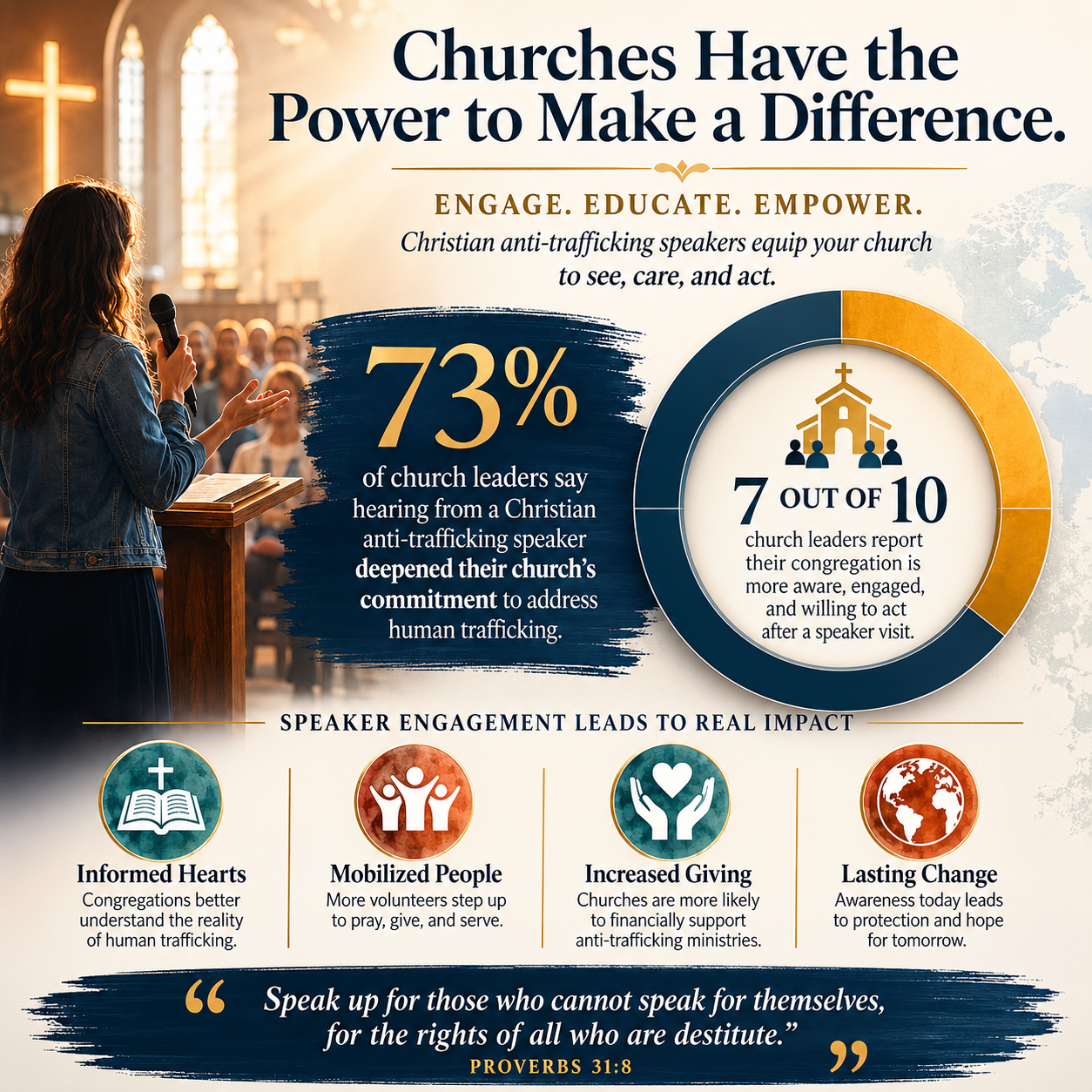
Churches should also prepare pastoral care and referral pathways. A trafficking talk can surface disclosures of abuse, coercion, or exploitation. That requires trained responders, clear reporting obligations, and relationships with local professionals. If a church is not prepared for that, a public event may be premature.
Refuse storytelling that treats people as fundraising material
Survivor testimony can honor God and strengthen the church, but it can also become a performance that extracts pain for impact. A church should be cautious about booking speakers who build their message on repeated retelling of traumatic stories, especially stories that identify locations, timelines, or details that could put someone at risk. It is also appropriate to ask whether survivors are compensated, whether they have ongoing support, and whether their participation is truly voluntary.
The harder question is whether a single event is the right format at all. Sometimes the most faithful approach is a smaller, controlled setting for leaders and volunteers, followed by a longer formation plan for the church. For congregations seeking broader context on ministry approaches, our coverage of Prevention and Education in Christian Anti-Trafficking Ministries reflects a consistent pattern: mature programs invest in training, policies, and community partnerships rather than relying on one-time awareness peaks.
Connect the speaker’s message to accountable pathways for donors
Give donors clarity on what their gifts will actually do
Many donors are ready to respond, but they have learned caution. They want to know whether a ministry can show measurable outcomes, whether funds are restricted appropriately, and whether leadership is accountable. Churches honor that concern by refusing to make vague appeals. If an offering is taken, donors should know what is being funded: survivor housing nights, licensed counseling, case management, legal services, prevention curriculum in schools, or staff training for mandated reporters.
Christian giving is not only about sincerity; it is about wisdom. Jesus commends sacrificial generosity, and he also condemns religious hypocrisy that devours widows’ houses. Donors should not be pressured into giving based on urgency alone. A strong speaker will welcome scrutiny and will be able to explain how programs are evaluated, what failures have taught them, and what safeguards prevent mission drift.
Practical criteria for selecting a speaker
Churches can reduce risk by using a short set of selection criteria. The aim is not perfection, but coherence between theology, evidence, and ethics:
- Clear theological grounding that honors the dignity of every person without sensationalism
- Demonstrated competence in a defined area of work, with appropriate credentials or partnerships
- Trauma-informed communication that protects survivors and avoids graphic detail
- Transparent accountability: governance, financial reporting, and external oversight where appropriate
- Concrete next steps for the church that do not encourage amateur investigations or risky confrontation
Where a church does not have the capacity to evaluate these matters internally, it is reasonable to prioritize ministries that have undergone serious independent assessment. Across our verification work, we see that organizations willing to be examined against clear criteria tend to welcome donor questions rather than deflect them.
Integrate speaker engagement into the church’s broader witness
Pair awareness with prevention inside the congregation
Trafficking is not only “out there.” Grooming, coercion, and exploitation often intersect with pornography, domestic abuse, family instability, homelessness, and online exposure. A church that hosts a speaker should be ready to look inward as well: child safety policies, volunteer screening, reporting protocols, and discipleship that teaches sexual integrity and the responsible use of technology. Without that internal work, awareness can become a way of condemning distant evil while ignoring proximate vulnerabilities.
Churches should also avoid implying that a single ministry or strategy is the church’s whole response. The body of Christ has many callings: some congregations will support survivor aftercare, others will strengthen foster care, others will invest in prevention education, and others will serve immigrants and refugees who face elevated risk. Donors often have a similar posture: they want a portfolio of faithful action rather than a one-time gift driven by a moving evening.
Choose partnerships that can endure beyond the event
Enduring partnership matters because trafficking work often involves long timelines and high complexity. Churches can ask whether the speaker’s organization collaborates with local service providers, whether it participates in multi-agency task forces where appropriate, and whether it has clear boundaries about what it will and will not do. That protects the church from becoming a stage for someone else’s brand and helps ensure that any mobilization can be sustained.
For donors seeking a wider map of the field and the range of Christian ministry models, Christian Anti-Trafficking Ministries is a useful starting point for understanding how prevention, intervention, and aftercare fit together—and where accountability questions tend to concentrate.
FAQs for How churches can engage Christian anti-trafficking speakers
Should a church take a special offering after an anti-trafficking speaker?
A special offering can be appropriate when the church can describe the use of funds with specificity and when the receiving organization is demonstrably accountable. Churches should avoid vague appeals tied only to emotional impact. Donors should be given time and information to evaluate, including basic financial transparency and program clarity, and the church should be prepared to answer questions without pressuring conscience.
How can a church avoid spreading misinformation when addressing trafficking?
Require speakers to distinguish between verified facts, plausible inferences, and illustrative stories, and do not allow prevalence claims without clear sources. Churches should also treat hotline data and anecdotal reports with care rather than presenting them as population-wide estimates. When uncertainty exists, it is better to name uncertainty than to repeat figures that cannot be defended.
Faithful engagement requires both conviction and discipline
Churches can engage Christian anti-trafficking speakers in ways that deepen compassion, strengthen wisdom, and honor survivors, but only if they refuse the temptations of spectacle and simplification. The goal is not a single inspired night; it is a formed congregation with accountable partnerships and donors who can give with confidence. That kind of engagement is slower, more demanding, and more credible—precisely the kind of witness the church is called to offer.



