
How charitable gift annuities work for biblical museum ministries is a stewardship question before it is a tax question. A charitable gift annuity can help a donor provide predictable income while also strengthening long-term support for ministries that preserve, interpret, and teach Scripture through artifacts, manuscripts, and historical context.
For many Christian donors, the tension is not whether to give, but how to give with both generosity and prudence. Scripture commends openhanded care for the work of the Lord (Philippians 4:17), and it also commends wisdom that counts the cost (Luke 14:28). A charitable gift annuity sits directly in that space: part gift, part contract, part legacy decision.
What a charitable gift annuity is and what it is not
A contract with a ministry, backed by its general resources
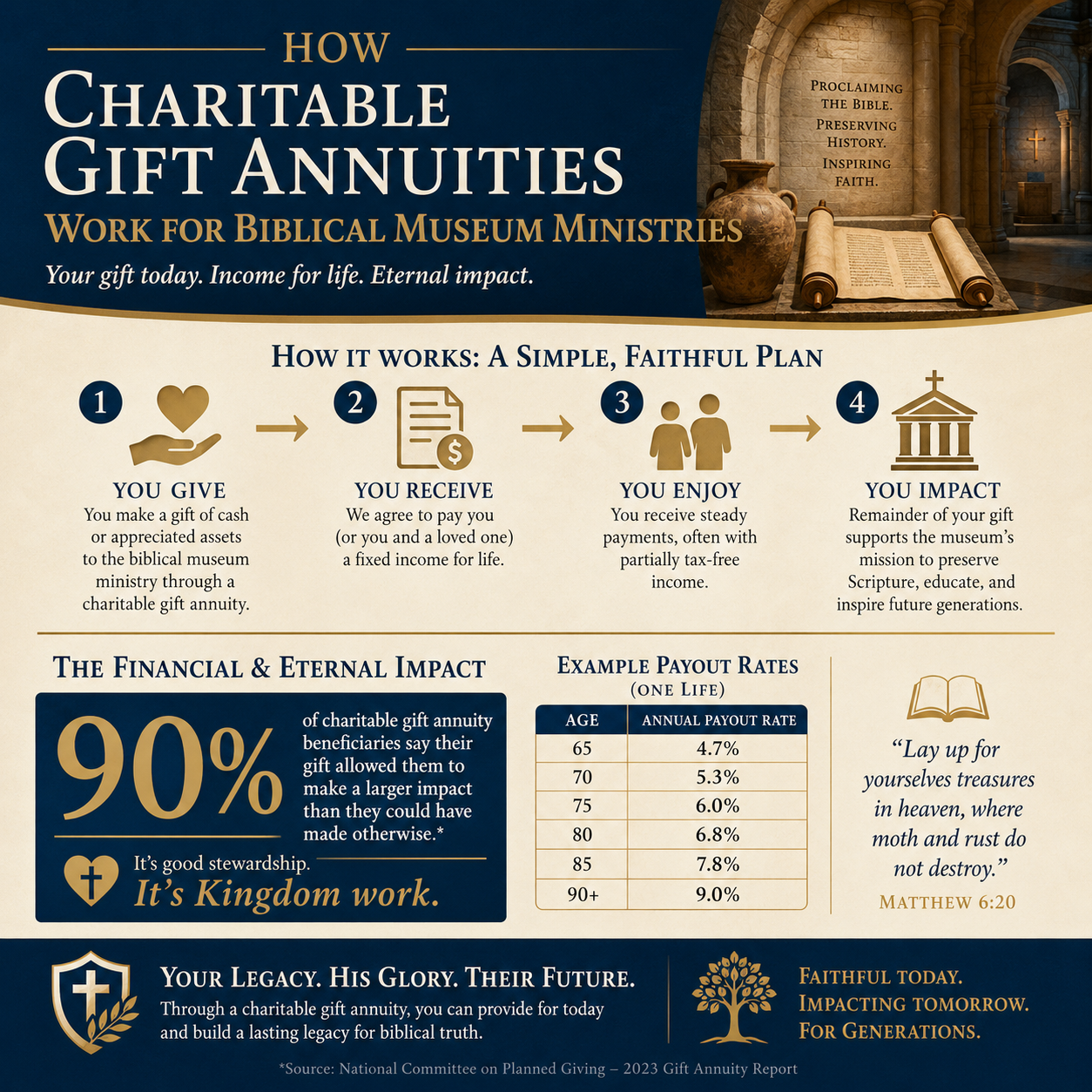
A charitable gift annuity is a simple agreement: a donor makes an irrevocable gift to a ministry, and the ministry promises to pay a fixed amount to one or two beneficiaries for life. The payout does not change with markets. The donor receives an immediate charitable deduction for a portion of the gift, and part of each payment may be treated as tax-free return of principal for a period of years, depending on how the annuity is structured and the donor’s tax situation.
It is essential to understand what backs the promise. In most cases, the obligation is backed by the issuing organization’s general assets, not by a segregated account and not by the federal government. Some ministries use a reserve fund as a matter of prudence, and some states regulate how charities issue gift annuities, but the donor is still relying on the ministry’s financial strength and governance to keep its promise over decades.
Not an investment product and not primarily a tax strategy
A charitable gift annuity is not a market investment and not a way to “beat” interest rates. It is a philanthropic tool with an income feature. The payout rate is typically guided by the American Council on Gift Annuities, which publishes suggested rates that many nonprofits follow as a conservative standard; readers can review the council’s rates directly at American Council on Gift Annuities.
Christians genuinely disagree about how much weight to place on tax benefits in giving. The New Testament does not condemn wise planning, but it does expose how easily the heart turns strategies into idols. The healthiest use of a gift annuity is when the income stream serves faithful obligations—supporting a surviving spouse, maintaining stability in retirement, or reducing anxiety that can choke generosity—while the underlying intent remains love of God and neighbor.
Why biblical museum ministries are a distinctive fit for gift annuities
The long time horizon of preservation and interpretation
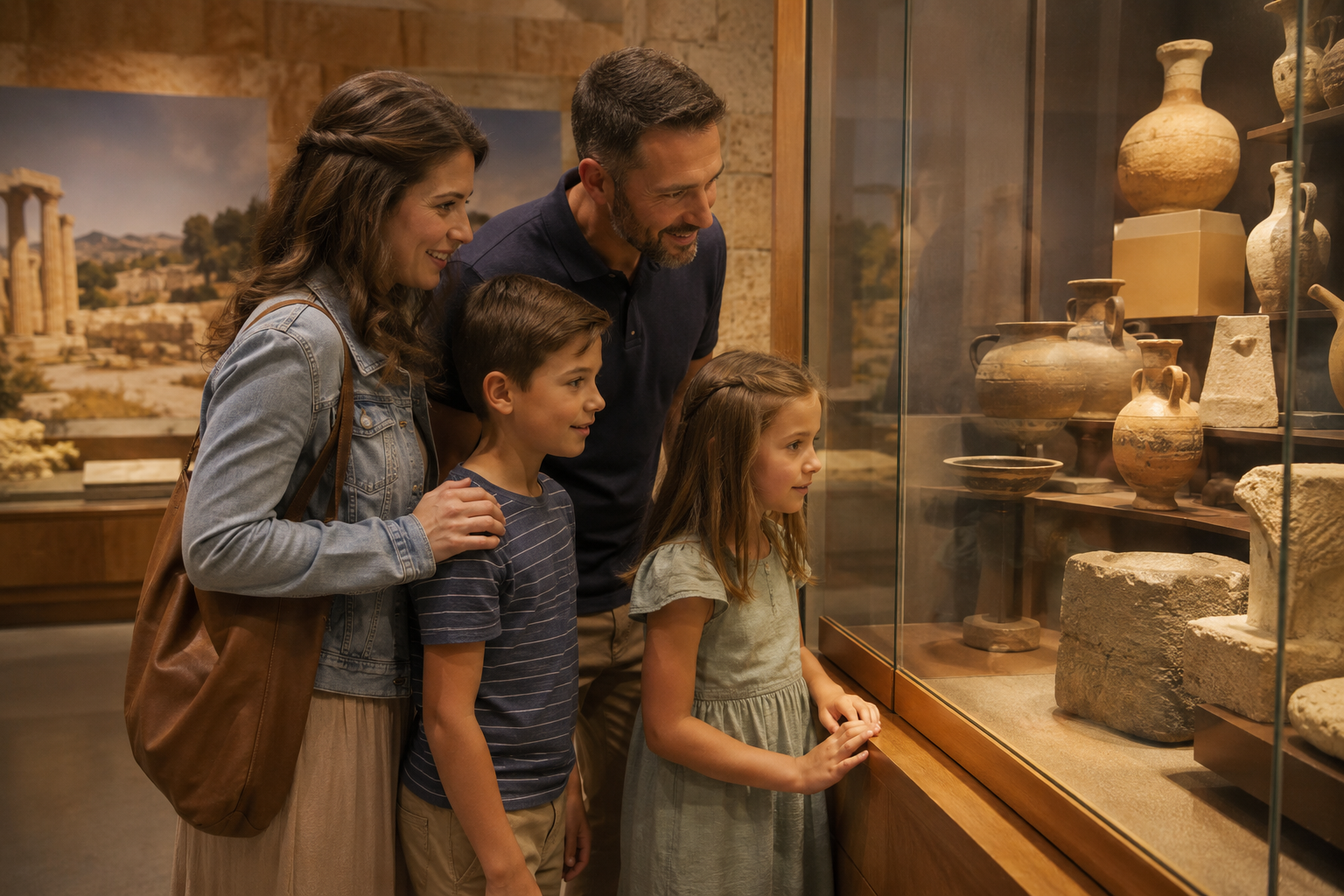
Biblical museum ministries often carry responsibilities that do not resolve within a quarterly cycle: conservation of fragile materials, controlled storage environments, ongoing provenance research, and curatorial scholarship that must be careful rather than sensational. The costs are not always visible to visitors, but they are real. An annuity allows a donor to make a meaningful gift now while allowing the ministry to plan for its future with greater confidence.
The work can also be contested. Christians differ on questions such as how artifacts should be displayed, how to handle uncertain provenance, and how museums should relate to modern political debates about history and the Middle East. A donor who loves Scripture may still want assurance that a museum ministry is committed to truthfulness, ethical sourcing, and transparent correction when errors are discovered.
Donor motivations that align with Scripture and with prudence
Many donors support biblical museum ministries because they want to strengthen confidence in the reliability of Scripture and deepen biblical literacy. In a culture where religious knowledge has thinned, ministries that responsibly teach historical context can serve the church well. At the same time, donors often want to avoid creating pressure on adult children or draining liquid assets needed for care in later years.
That combination—conviction about the value of the mission and sober realism about aging—explains why planned giving is common in this space. For readers comparing different ways to structure legacy support, we maintain a broader set of resources under Legacy and Planned Giving for Biblical Museum Ministries.
How the numbers typically work and what donors should ask
Gift amount, payout rate, and the charitable portion
In a typical arrangement, the donor contributes cash or appreciated securities. The ministry calculates the fixed annuity payment based on the beneficiary’s age, the gift amount, and the rate schedule it follows. The donor receives a charitable deduction for the portion of the gift that is projected to remain for the ministry after fulfilling the lifetime payments, calculated using IRS assumptions. The IRS provides the underlying frameworks and tables governing charitable contributions and annuities at IRS Charities and Nonprofits.
Donors should recognize that “fixed” can be both strength and limitation. In high-inflation periods, a fixed payment buys less over time. In low-rate environments, the payment may feel modest compared to other income sources. The steadiness is the point, but steadiness is not the same as maximization.
Questions that indicate whether the ministry is prepared to issue annuities responsibly
Because a gift annuity is a promise extending into an unknown future, diligence should focus on the issuing organization’s financial integrity and governance. Across our verification work at Most Trusted, the ministries that meet The Most Trusted Standard tend to treat long-term obligations with documented policies, conservative assumptions, and transparent reporting, rather than relying on optimism.
Before signing an agreement, donors should ask clear questions such as:
- Does the ministry follow American Council on Gift Annuities suggested rates, and if not, why?
- What reserves does the ministry maintain for annuity obligations, and how are they invested?
- Is the annuity regulated in the donor’s state, and who is responsible for compliance filings?
- How will the ministry report payments and tax forms each year?
- What happens if the ministry merges, experiences financial distress, or changes its legal structure?
These questions are not a lack of faith. They are a form of neighbor-love toward beneficiaries who will depend on the payments, and a form of honesty toward the ministry itself. A credible organization should welcome them.
Risks, trade-offs, and theological clarity
Irrevocability and opportunity cost
The gift is generally irrevocable. That means the donor no longer controls the principal, even though the donor or spouse receives payments. If a donor anticipates major expenses—long-term care, support for a dependent family member, or housing transitions—an annuity may be premature. Some donors choose a smaller annuity than they could afford precisely to preserve flexibility.
There is also opportunity cost. A donor who gives highly appreciated securities to fund an annuity may reduce capital gains tax compared to selling the asset outright, but that does not mean the donor has increased wealth. The donor has converted an asset into a fixed lifetime payment and a charitable gift. Whether that trade is wise depends on the donor’s broader balance sheet and objectives.
Organizational risk and the moral duty of truthful presentation
Because the ministry’s promise is only as secure as the ministry’s ability to pay, donors should pay attention to audited financial statements, liquidity, debt, and governance maturity. Most reputable ministries provide audited financials and board information; when they do not, donors should treat that as a serious warning sign rather than a minor administrative gap.
This is also where Christian ethics matter. Biblical museum ministries often carry public-facing credibility: they interpret history and Scripture for thousands of visitors. If a ministry is careless with truth in its exhibits or communications, donors should not assume it will be careful with long-term financial promises. For donors seeking a way to evaluate ministries consistently, our work at Most Trusted applies The Most Trusted Standard across faith foundation, financial integrity, governance, and transparency.
How Most Trusted recommends evaluating a biblical museum ministry before making an annuity gift
Verification is not cynicism, and trust should be earned
Christian generosity is meant to be free, but it is not meant to be undiscerning. Jesus warns against naïveté even as he commands love (Matthew 10:16). A charitable gift annuity intensifies the need for discernment because the donor is not only giving; the donor is entering a long-term financial relationship.
For donors comparing multiple biblical museum ministries, we recommend beginning with clarity about mission and then moving quickly into verifiable governance and financial evidence. That includes looking for audited statements, conflict-of-interest policies, independent board oversight, and transparent reporting of outcomes. These are not secular hoops; they are expressions of integrity.
Patterns we look for under The Most Trusted Standard
The Most Trusted Standard is a 15-criteria framework designed to help donors give with confidence. When applied to a biblical museum ministry that offers gift annuities, the framework highlights practical indicators such as whether leadership speaks carefully about artifacts and evidence, whether financial reporting is consistent and comprehensible, and whether governance appears capable of sustaining obligations across decades.
Donors who want to situate a specific annuity decision within a broader understanding of this field may also benefit from our coverage of Biblical Museum Ministries, where we address common questions of credibility, stewardship, and public trust.
FAQs for How charitable gift annuities work for biblical museum ministries
Can a charitable gift annuity be funded with appreciated stock for a biblical museum ministry?
Often, yes. Many ministries can accept appreciated securities, and this is a common way donors fund gift annuities. The tax treatment is fact-specific, particularly regarding capital gains recognition and the charitable deduction amount, so donors should coordinate with a qualified tax advisor and confirm the ministry’s procedures for receiving securities.
What happens to the remaining annuity value after the beneficiary dies?
After the last annuitant dies, the remaining value stays with the ministry and is used according to the donor’s documented intent in the gift agreement, if restrictions are included, or according to the ministry’s general charitable purposes if the gift is unrestricted. Donors should insist on clear written language, especially if they want the remainder directed to collections care, education programs, or another defined purpose.
Stewardship that joins generosity and stability
A charitable gift annuity can be an orderly way to convert assets into lifetime income while strengthening the future of biblical museum ministries that serve the church through careful preservation and truthful interpretation. The instrument is not magic, and it is not risk-free. But in the hands of a prudent donor and a transparent, well-governed ministry, it can express the kind of settled stewardship Scripture commends: generous in purpose, disciplined in practice, and attentive to what will endure.



