
To fund Bible engagement ministry resources well, Christian donors must finance more than content distribution. The hard work is sustaining the formation ecosystem around Scripture—translation, production, training, follow-up, and local ownership—without rewarding shallow metrics or starving the ministry’s long-term capacity.
Scripture itself frames the question in stewardship terms. “Moreover, it is required of stewards that they be found faithful” (1 Corinthians 4:2). Faithful funding asks not only whether a resource is orthodox, but whether the ministry’s model can bear the moral weight of its claims: that God’s word is living and active, and that engagement with it should form resilient disciples, families, and churches.
Begin with a theology of Scripture and a theory of change
Resource funding is never only about materials
Bible engagement ministries typically offer a bundle: Scripture access, study tools, small-group curriculum, digital media, and coaching for leaders who help people persevere. Funding “resources” therefore means funding a ministry’s theory of change—how a Bible, a reading plan, or a discovery study becomes repentance, obedience, worship, and mission in actual communities.
Donors sometimes assume the resource is the intervention. The New Testament’s pattern is thicker: “What you have heard from me in the presence of many witnesses entrust to faithful men, who will be able to teach others also” (2 Timothy 2:2). Entrusting requires teachers, trust, and time. If a ministry cannot explain how resources move through people and structures into lasting discipleship, its outcomes will be fragile even when its distribution numbers are impressive.
Ask what the ministry is actually counting
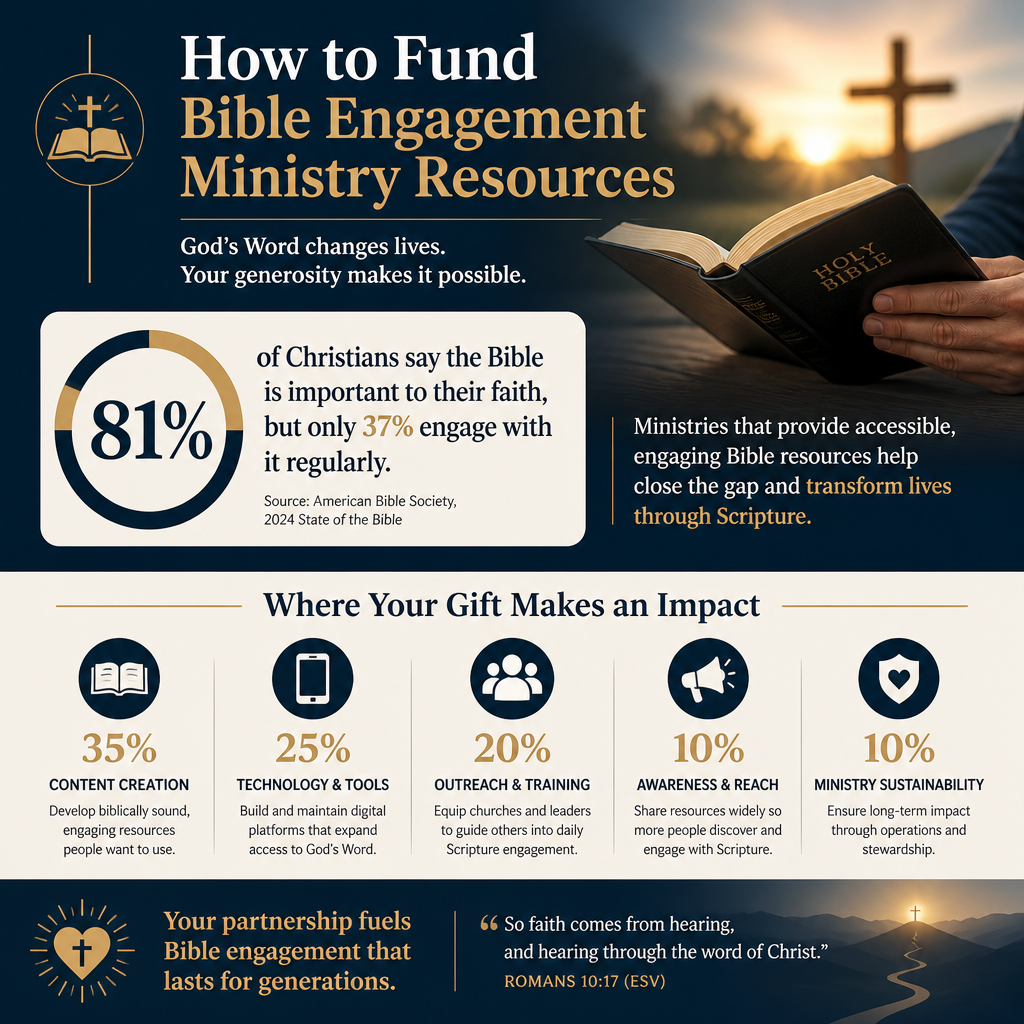
Counting is unavoidable, but not all counting is honest. A “Bible distributed” is different from “Bible read,” and “Bible read” is different from “Bible obeyed.” Ministries vary in how carefully they measure engagement, retention, and transformation. Research on Bible engagement consistently shows that frequency and integration matter more than one-time exposure; donors should prefer ministries that can describe sustained patterns rather than episodic reach. The American Bible Society’s State of the Bible work is a common reference point in this field and offers a baseline vocabulary for engagement segments and trends (American Bible Society).
What this means in practice is that funding should follow the logic of durable formation: leader development, contextualization, and follow-up systems that help Scripture remain present after the campaign ends.

Fund the full cost of faithful delivery
Reject the spiritualized version of the overhead myth
Many donors still feel pressure to treat administration and fundraising as suspect, even when they know better. The modern nonprofit field has had to correct this assumption publicly; major charity evaluators have argued that focusing narrowly on overhead can undermine effectiveness and distort behavior. The “Overhead Myth” statement signed by GuideStar, Charity Navigator, and BBB Wise Giving Alliance is one of the clearest summaries of why underfunding core capacity creates long-term damage (Candid GuideStar).
Bible engagement resources require real infrastructure: editorial review, translation accuracy, safeguarding policies when working with minors, secure digital systems, donor reporting, and pastoral partnerships. Underfunding these functions does not produce purity; it produces fragility and, at times, preventable harm.
Insist on clarity about unit economics and constraints
Responsible ministries can explain, in plain terms, the cost drivers of their resources. Printing and shipping are visible, but the hidden costs are often higher: content development cycles, theological review, localization, and training for facilitators. Digital delivery can reduce marginal costs, but it introduces new ones—platform maintenance, data security, and the temptation to chase attention rather than depth.
Donors can press for a credible answer to questions such as: What does it cost to place this resource into a local ministry ecosystem where it will be used for at least a year? What proportion of spending is fixed versus variable? Where are the choke points—translation approvals, last-mile delivery, leader training capacity, or follow-up? Serious answers are rarely short, but they are usually straightforward.
Choose funding instruments that match ministry reality
Restricted gifts have a place, but they are not neutral
Restricted giving can protect a donor’s intent, and there are contexts where it is prudent—such as funding a translation project with defined deliverables or underwriting a new curriculum series. Yet restriction also transfers risk to the ministry: if donor priorities do not match operational needs, staff will either contort programs to fit the restriction or absorb costs elsewhere. Neither outcome is faithful stewardship.
Christians genuinely disagree about the best balance between designated gifts and general support. The stronger question is whether the restriction arises from meaningful knowledge of the ministry’s constraints or from an anxiety that confuses control with faithfulness. In many cases, multi-year, mostly unrestricted support produces the most honest outcomes because it funds the real work: staffing, training, evaluation, and correction over time.
Prefer multi-year commitments tied to learning
Bible engagement is rarely a single-year project. Habits form slowly; leaders mature through practice; contextualization requires iteration. Donors who can commit over multiple years often enable better theology and better measurement because ministries are not forced into short-term reporting theater.
A sound approach is to fund in stages with explicit learning goals: year one establishes training and distribution; year two tests retention and small-group multiplication; year three strengthens local ownership and leader pipelines. That pattern does not guarantee success, but it does reward honesty and adaptation rather than marketing.
Evaluate ministries against verifiable standards
Trust should be earned with evidence and accountability
Most Christian donors are not suspicious; they are conscientious. They want to honor the Lord with what has been entrusted to them and to avoid naïveté. That requires more than compelling stories. It requires verifiable governance, transparent finances, and evidence that programs are doing what they claim.
This is where Most Trusted serves the Church. We verify Christian nonprofits against The Most Trusted Standard, a 15-criteria framework spanning Faith Foundation, Financial Integrity, Governance and Leadership, and Transparency and Effectiveness. Across our verification work, we observe that ministries with durable Bible engagement impact tend to share several traits: clear doctrinal commitments, non-defensive financial reporting, board oversight that is more than ceremonial, and program measures that can withstand scrutiny.
What to examine before funding Bible engagement resources
Before underwriting materials, platforms, or distribution, donors can ask for documentation and decide whether the answers are coherent. The goal is not to burden ministries with bureaucracy; it is to distinguish between mature operations and ministries running on charisma.
- Audited or reviewed financial statements and a credible explanation of major revenue concentrations
- Board independence and documented conflict-of-interest policies
- Doctrinal clarity and theological review processes for published resources
- Safeguarding policies, especially when engaging youth or vulnerable populations
- Outcome reporting that distinguishes distribution, participation, and sustained engagement
For donors supporting this work at scale, it is also reasonable to ask whether the ministry can explain attrition: how many recipients stop using the resource, why that happens, and what changes are being made. Ministries that never report attrition usually have not measured it.
Align funding with the Church, not with a campaign
Local ownership is a spiritual and operational safeguard
Bible engagement flourishes where churches and local leaders own the work. External funding can accelerate access, but it can also unintentionally displace responsibility. The New Testament pattern of generosity supports interdependence without erasing agency: the Jerusalem church received relief, yet local elders and accountable messengers handled distribution (Acts 11:29–30).
The donor’s aim should be to strengthen the local ecosystem: equip pastors and lay leaders, invest in reproducible methods, and build handoffs that reduce long-term dependency. In practice, that can mean funding training cohorts, translation review by local scholars, or tools that churches can sustain without perpetual subsidy.
Learn the funding patterns in Bible Study and Engagement Ministries
Different models carry different financial pressures. Some ministries primarily print and distribute. Others develop curriculum and training. Others operate digital platforms where the resource is free but the costs sit in content production and user support. Understanding these models helps donors avoid simplistic assumptions about “low cost” and “high impact.” For a broader view of the ministry landscape, see Bible Study and Engagement Ministries.
It is also wise to understand how these ministries are typically financed—individual donors, church partnerships, major gifts, foundations, and sometimes earned revenue. Each revenue stream shapes incentives. For donors who want to engage that complexity directly, our analysis of How Bible Study and Engagement Ministries Are Funded can help frame the questions that matter before a major commitment is made.
FAQs for How to fund Bible engagement ministry resources
Should we fund Bible distribution or Bible study resources and training?
Both can be faithful, but they are not interchangeable. Distribution addresses access; study tools and training address use and persistence. Where access is the limiting factor, distribution can be decisive. Where access exists but engagement is thin, training and follow-up often produce more lasting fruit. Many of the strongest models pair Scripture access with leader development so that the resource remains embedded in a community of practice.
What should we ask a ministry that reports very large Bible engagement numbers?
We recommend asking what the number represents and how it is verified. Is it downloads, attendance, completed reading plans, small groups formed, or months of continued use? Ask how the ministry defines engagement, how it measures retention over time, and what attrition looks like. Large numbers can reflect genuine reach, but without definitions and methods they can also reward marketing over formation.
Funding Scripture work with faithfulness and realism
Funding Bible engagement ministry resources is an opportunity to serve the Church at one of its most foundational needs: hearing, reading, and obeying God’s word. The donor’s task is to finance the full moral and operational cost of that calling—content that is theologically sound, delivery that is accountable, and formation that endures. The ministries most worthy of significant support are rarely those with the loudest claims, but those whose work can be tested, explained, and strengthened over time.



