

What Bible engagement ministry curriculum funding covers is not a narrow question about books and lesson plans. For Christian donors, it is a question about what it costs to place the Word of God within reach—faithfully translated, wisely taught, and sustainably practiced—without turning formation into a product and people into outputs.
Scripture assumes that the Word is both proclaimed and received. Israel was commanded to teach God’s words diligently to children (Deuteronomy 6:6–7). The risen Christ commanded the church to make disciples by teaching obedience to all he commanded (Matthew 28:20). Curriculum is never the gospel itself, but it is often the scaffolding that helps churches, prisons, shelters, refugee communities, and classrooms handle the text carefully rather than casually.
Curriculum is a formation tool before it is a content asset
What donors are actually underwriting
Curriculum funding is often described as “materials,” but mature Bible engagement ministries treat it as formation design. A curriculum is a sequence of decisions about theological boundaries, interpretive approach, spiritual practices, and pedagogy. Funding therefore covers the work of ensuring that the curriculum is biblically responsible, accessible to the audience, and usable by leaders who may not have formal training.
In practice, donors are paying for costs that are easy to overlook because they are upstream: theological review, instructional design, age-appropriate development, and safeguards against harm. The question is not simply whether content is “orthodox,” but whether it forms readers to read Scripture as Christians—within the storyline of redemption, attentive to genre, and accountable to the church.
The theological and pastoral guardrails behind the pages
Sound curriculum requires more than a capable writer. Ministries frequently fund editorial oversight that clarifies doctrinal commitments and hermeneutical method, then tests that method across hard texts. This is especially important in discipleship environments where curriculum can implicitly teach prosperity assumptions, moralism, or proof-texting even while quoting Scripture heavily.
Christians genuinely disagree about certain interpretive questions—spiritual gifts, eschatology, baptism, women in ministry, and the relationship between law and gospel, among others. Responsible curriculum funding often includes clear disclosure about what is assumed and what is treated as secondary, so leaders can adopt materials with open eyes rather than surprise disagreements midstream.

What curriculum development and production funding commonly includes
People, process, and the hidden costs of faithfulness
Developing curriculum is labor-intensive. Even when a ministry uses volunteer scholars or pastors, competent development still requires paid coordination, editing, and quality control. The costs tend to fall into several categories: content creation, theological review, pedagogical design, field testing, and production. If the curriculum is intended for high-need settings—incarceration, trauma recovery, ESL contexts, or low-literacy communities—additional testing and adaptation are often essential.
When donors ask whether their gift is paying for “overhead,” the more accurate question is whether their gift is paying for integrity. The ministry must ensure that Scripture is handled with care and that the curriculum can be implemented faithfully. Across our verification work at Most Trusted, ministries that meet The Most Trusted Standard tend to name these costs plainly rather than hiding them behind vague program labels.
Typical line items donors should expect
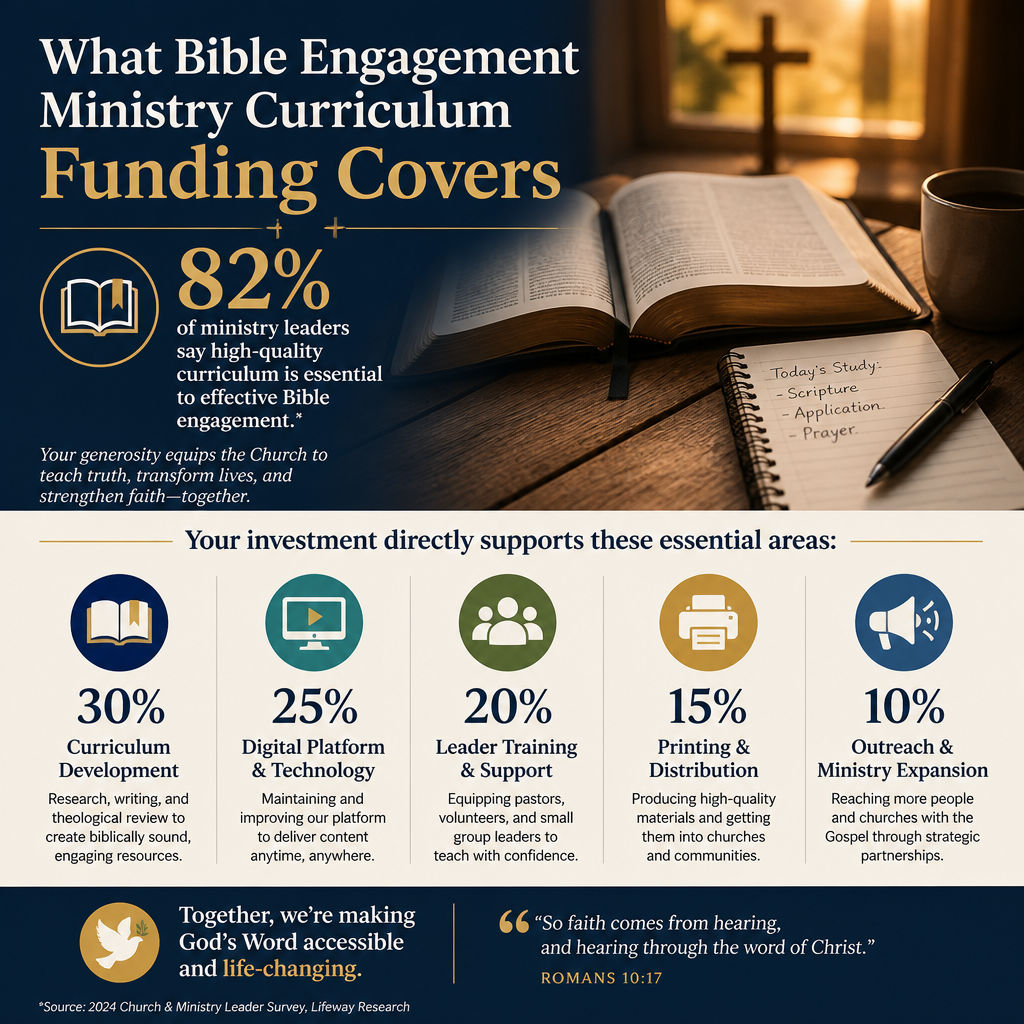
Curriculum funding often covers a mix of direct and indirect expenses. The line items vary by medium and audience, but donors frequently underwrite some combination of the following:
- Authoring, editing, and theological review for doctrinal and interpretive integrity
- Instructional design, including leader guides and assessment tools
- Pilot testing with real facilitators and learners, then revision cycles
- Translation and localization for language, culture, and literacy level
- Design, printing, and distribution or digital platform costs
Digital delivery is not automatically cheaper. It can reduce printing and shipping, but it introduces platform development, device compatibility, offline access, cybersecurity, and user support—especially for ministries serving prisons or rural areas with limited connectivity.
Delivery and leader formation are often the decisive costs
Curriculum that is not taught is not ministry
Donors sometimes assume curriculum is a one-time purchase that “scales.” Yet in Bible engagement work, distribution is not the end; it is the beginning. Ministries often fund training for pastors, small-group leaders, chaplains, volunteers, and peer facilitators. This training is not a luxury. It is frequently what keeps curriculum from becoming either a rigid script or a vague conversation starter untethered from the text.
Scripture itself ties teaching to accountability. James warns that teachers will be judged with greater strictness (James 3:1). For that reason, curriculum funding may include leader formation that addresses both competence and character: how to prepare, how to handle questions, how to avoid spiritual manipulation, and how to shepherd people through Scripture without turning the classroom into a platform for the teacher.
Context-specific delivery costs donors should not penalize
Delivery costs are shaped by context. Incarceration ministries may need print-only formats, facility approvals, and secure logistics. Refugee and immigrant ministries may need multilingual leader training and trauma-informed facilitation. Rural churches may need offline access and simpler leader materials. What looks like “extra” cost can be the difference between a curriculum that exists and a curriculum that is actually used.
This is where donor expectations about efficiency can unintentionally pressure ministries toward shallow implementation. The well-known “Overhead Myth” letter—signed by GuideStar, BBB Wise Giving Alliance, and Charity Navigator—warned donors against equating low overhead with high impact, because underinvestment in infrastructure can undermine results GuideStar. Curriculum ministries live in that tension: underfunded training and support can quietly waste the investment made in the content itself.
Translation, localization, and accessibility are not secondary work
Why translation costs are often mission-critical
The church is not monolingual, and Bible engagement cannot be either. Curriculum funding frequently includes translation and localization so that Scripture study is not reserved for those fluent in majority languages. This can mean professional translation, theological checking, back-translation, and formatting that fits the reading patterns of the target language.
Translation work also intersects with the complex realities of Bible translation and distribution. Many donors will be familiar with the scale of the remaining need: as of its 2024 reporting, Wycliffe Global Alliance states that over 1,000 languages still lack a full Bible translation Wycliffe Global Alliance. Curriculum in those contexts may need to be paired with Scripture portions, oral Bible storying approaches, or materials designed for communities where literacy is emerging rather than assumed.
Accessibility, disability inclusion, and the ethics of “reach”
Accessibility is part of Christian love of neighbor, and it has budget implications. Curriculum funding may include large-print editions, audio resources, captioning, screen-reader compatibility, and simplified-language versions. These adaptations are rarely glamorous, but they embody a doctrine of the imago Dei that refuses to treat people with disabilities as an afterthought.
The harder question is how ministries report “reach” when accessibility work slows production. Speed can be purchased; faithfulness often cannot. Donors should recognize that a smaller set of well-supported, accessible resources can be more truthful—and more fruitful—than rapid expansion that leaves vulnerable readers behind.
How to evaluate whether curriculum funding is stewarded well
Questions donors can ask without sliding into cynicism
Healthy scrutiny is not distrust; it is stewardship. Jesus commended faithfulness with what is entrusted (Luke 16:10–12), and donors have a legitimate interest in whether curriculum funding serves the church rather than a brand. The evaluation challenge is that curriculum outcomes are often long-term and indirect. A ten-week study may not produce immediate measurable behavior change, but it can shape biblical literacy, doctrinal clarity, prayer habits, and resilience over years.
Across Bible Study and Engagement Ministries, we observe that the strongest organizations make their theory of change explicit: how curriculum is expected to form people, what faithful implementation requires, and what evidence they will collect without pretending that sanctification is reducible to metrics.
What strong evidence and transparency tend to look like
Curriculum ministries that handle donor funds responsibly usually do three things. First, they define theological commitments and interpretive method clearly enough that churches can discern fit. Second, they invest in leader training and delivery support, not only content creation. Third, they communicate costs in a way that respects donors’ intelligence—naming what is being paid for and why.
Most Trusted evaluates ministries against The Most Trusted Standard, which considers faith foundation, financial integrity, governance and leadership, and transparency and effectiveness. In curriculum funding, that means looking for more than attractive materials. It means confirming that doctrine is stated, financial reporting is coherent, oversight is real, and impact claims are proportionate to evidence. Donors who want a broader view of funding patterns can also consult How Bible Study and Engagement Ministries Are Funded to understand the typical mix of earned revenue, donor support, and restricted grants that underwrite this work.
FAQs for What Bible engagement ministry curriculum funding covers
Does funding curriculum mainly pay for printing and distribution?
Sometimes, but not usually. Printing and shipping can be significant, especially for prison and international contexts, yet the larger and more decisive costs are often upstream and downstream: theological review, instructional design, field testing, translation, leader training, and user support. Curriculum that is not implemented well can waste the investment made in the materials.
Should donors prefer ministries that spend less on curriculum development?
Low development cost can reflect admirable efficiency, but it can also reflect underinvestment in theological rigor, testing, accessibility, or leader support. A wiser question is whether the ministry can explain its process, disclose its assumptions, and show that the curriculum is being used as intended. Faithful stewardship is measured by integrity and fruit over time, not by minimal line items.
Funding curriculum is funding the church’s capacity to teach
Christian donors are not primarily funding content; they are funding the church’s capacity to hear and obey Scripture in specific places and among specific people. Curriculum funding covers the costly work of translating conviction into instruction, and instruction into lived discipleship. When that work is done with theological clarity, operational competence, and transparent reporting, it becomes a quiet but durable investment in the ministry of the Word.



