

How much does it cost to fund a Bible study group depends less on the word “Bible” and more on what kind of group the ministry is actually running. A weekly living-room circle with a volunteer facilitator has a very different cost profile than a prison-based study, a multi-site women’s discipleship cohort with childcare, or a year-long curriculum pathway tied to measurable spiritual formation outcomes.
Christian donors often ask this question because they want to fund something faithful and fruitful without subsidizing waste. That instinct is not cynical. Scripture assumes that stewardship requires discernment, not sentiment. Jesus commends faithfulness in small things and warns against burying resources entrusted for the Master’s purposes (Luke 16:10; Matthew 25:14–30). The harder question is not whether Bible study matters, but what it actually costs to do it well, safely, and in a way that can endure.
What donors are really buying when they fund a Bible study group
Bible study is a ministry system, not a meeting
A Bible study group is rarely just an hour around an open Bible. Most sustainable programs include recruitment, leader screening, training, curriculum selection, pastoral oversight, participant care, and follow-up. When those elements are absent, the ministry may still meet, but it is more vulnerable to doctrinal drift, preventable harm, and short-lived impact.
Across our verification work at Most Trusted, we observe that the ministries that meet The Most Trusted Standard tend to describe their Bible study activity as a coherent set of practices: who leads, what is taught, how leaders are supported, how participants are protected, and how fruit is assessed without reducing discipleship to mere metrics. Donors are funding that whole ecosystem, whether they see it itemized or not.
Different groups have different cost drivers
The ministry context determines costs. A small group in a suburban church network may have low direct expenses but still require real staff time for leader care and theological alignment. A group hosted in a recovery setting may need trauma-informed training and coordination with licensed professionals. A prison Bible study often requires background checks, facility approvals, transportation, and a volunteer management system designed for high turnover and strict access rules.
What this means in practice is that “cost per group” is only comparable within similar contexts. Donors should resist the false comfort of a single universal number.

The main cost categories and typical ranges
A practical budget frame for a single group
For donor decision-making, it is usually more helpful to think in cost categories than in slogans about overhead. The credible question is whether each expense is reasonable for the ministry’s stated outcomes and whether leaders can explain the trade-offs.
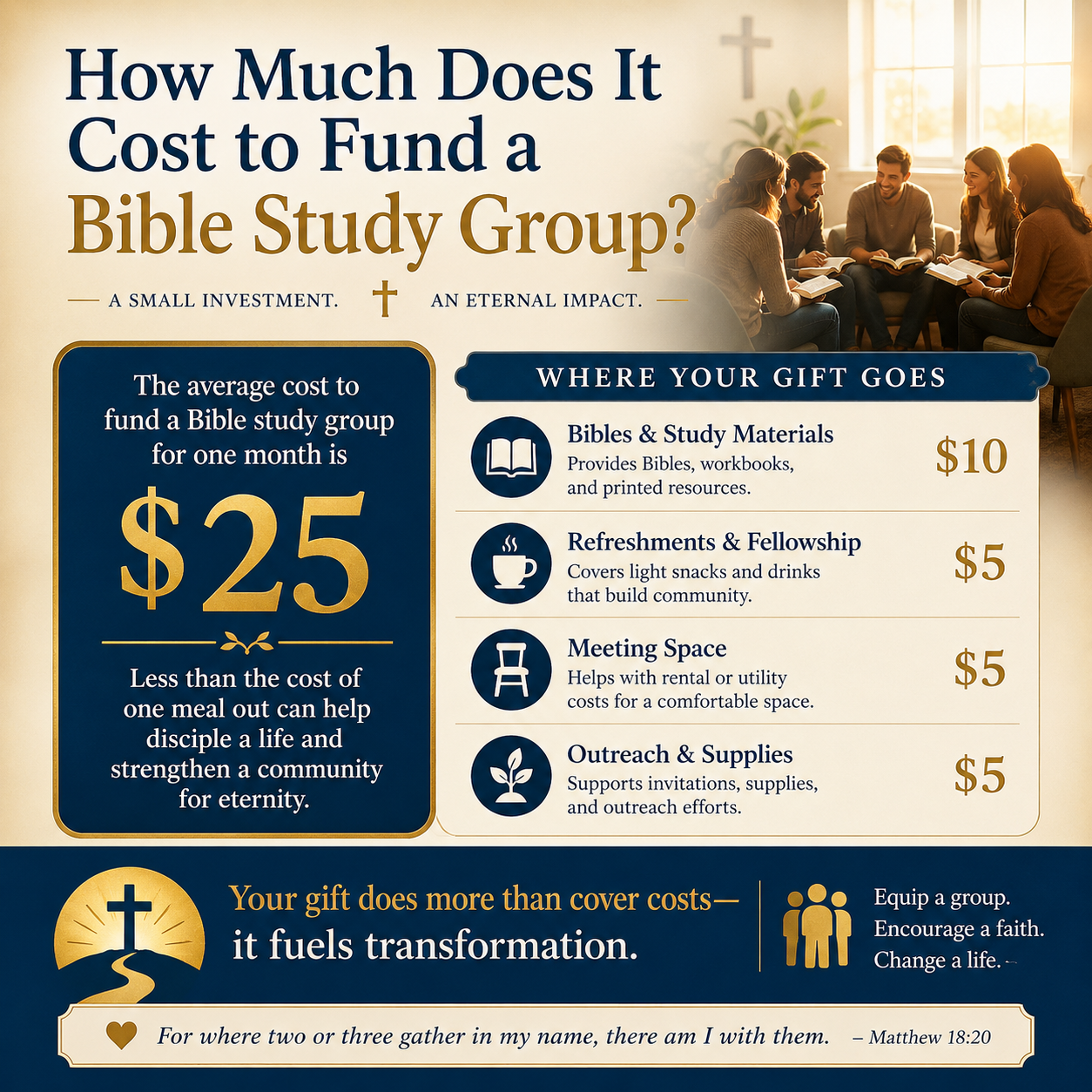
For many community-based adult Bible study groups meeting weekly, a reasonable annual expense range is often in the hundreds to a few thousand dollars per group when leadership is volunteer and space is donated. When paid staff are directly responsible for group formation and care, per-group costs rise meaningfully. Costs can increase sharply for specialized settings such as prisons, campuses, or contexts requiring childcare, translation, or security.
Line items donors should expect to see
- Curriculum and Bibles: printed studies, leader guides, Scripture resources, or licensed digital platforms
- Leader development: training materials, coaching, theological review, and occasional retreats
- Participant care: childcare, transportation assistance, accessibility accommodations, or benevolence referrals
- Operations: background checks, insurance, facility use fees, and scheduling tools
- Staff time: coordination, volunteer management, reporting, and pastoral oversight
Donors sometimes react to staffing costs as if they are automatically suspect. Yet Scripture assumes laborers deserve wages (1 Timothy 5:18). The question is whether staffing is proportionate and whether it increases faithfulness and fruit rather than merely organizational comfort.
Staffing, volunteer leadership, and the real economics of discipleship
The hidden subsidy of volunteer time
Many Bible study groups are inexpensive because churches and volunteers quietly subsidize them. That is often appropriate. The early church’s life together was not a paid service; it was shared devotion, mutual exhortation, and hospitality (Acts 2:42–47). But donors should be clear-eyed: when a ministry reports low per-group costs, it may simply mean that experienced volunteers are carrying responsibilities that would otherwise require staff capacity.
Volunteer-led models can be robust when leader selection is wise, training is consistent, and oversight is real. They can also become brittle when a program depends on a few unusually capable leaders with no bench behind them.
What paid staff can legitimately provide
Paid staff are often justified when they strengthen what volunteers cannot reliably sustain: consistent leader coaching, doctrinal accountability, safeguarding practices, and continuity through seasonal turnover. This is especially true in environments where leaders need ongoing support, such as campus ministry, military communities, or reentry contexts.
For donors comparing ministries, it is worth remembering that the nonprofit field has had to reckon with the “overhead” fixation. Charity Navigator, Candid, and BBB Wise Giving Alliance jointly warned donors against judging charities primarily by overhead ratios in their Overhead Myth statement, emphasizing that investments in administration can be essential for effectiveness and accountability.Charity Navigator
What this means in practice is that donors should ask whether administrative and leadership costs are serving the mission with integrity, not whether they can be driven toward zero.
How faithful ministries handle curriculum, theology, and participant safety
Curriculum decisions are theological decisions
Funding a Bible study group includes funding its teaching. Ministries differ on interpretive tradition, doctrinal distinctives, and how they handle contested questions. Christians genuinely disagree about some secondary matters, but faithful ministries are transparent about what they teach and who is responsible for doctrinal oversight.
Donors should look for clarity on curriculum sources, leader qualifications, and how the ministry responds when questions arise that require pastoral or theological expertise. A ministry that claims the Bible is central but cannot articulate how it protects theological fidelity is asking donors to fund risk.
Safety practices are part of discipleship, not a distraction from it
Groups that include minors, vulnerable adults, or trauma-affected participants require safeguards: background checks, two-adult policies, reporting procedures, and training on boundaries. These practices add cost, and they should. Neglecting them is not frugality; it is moral exposure.
Churches and ministries have learned, sometimes painfully, that the credibility of Christian witness is damaged when preventable harm is ignored. Donors should treat safeguarding expenses as a sign of seriousness rather than as a regrettable encumbrance.
What to ask before you fund a Bible study group
Questions that reveal whether cost aligns with stewardship
Donors do not need to micromanage, but we should insist on intelligible answers. A ministry worth funding can explain its unit economics in plain language: what it costs to start a group, what it costs to sustain one, and what changes as the program scales.
These questions tend to clarify whether a budget is faithful:
- What is the intended outcome? evangelism, spiritual formation, leader multiplication, or pastoral care
- What is the leader pipeline? selection, training, supervision, and replacement
- What is the curriculum and theological oversight? who approves content and how disagreements are handled
- What are the safeguarding practices? especially for minors and vulnerable adults
- How is effectiveness assessed? testimonies, retention, leader reproduction, and appropriate qualitative evidence
For donors evaluating ministries in this space, it often helps to understand the broader ecosystem of Bible Study and Engagement Ministries and the common funding patterns that shape them.
How verification strengthens donor confidence
Because Bible study is inherently relational, donors can be tempted to fund based on stories alone. Stories matter, but trustworthy giving also requires governance, financial integrity, and transparent reporting. Most Trusted exists to support that kind of confidence. We evaluate ministries against The Most Trusted Standard, a 15-criteria framework that examines faith commitments, financial practices, leadership and oversight, and transparency and effectiveness.
When a ministry can clearly document how funds are handled, how leaders are accountable, and how outcomes are reported with humility and honesty, donors can give without needing to guess whether the work is well governed.
Donors who want to compare how different programs budget for discipleship and group-based engagement often benefit from the wider context of How Bible Study and Engagement Ministries Are Funded, especially where staffing, materials, and participant care vary widely by setting.
FAQs for How much does it cost to fund a Bible study group
Is a lower-cost Bible study group always a better stewardship choice?
No. Lower cost can reflect donated space, volunteer leadership, and simple materials, which can be appropriate. It can also reflect underinvestment in leader training, safeguarding, or oversight. Stewardship is not the pursuit of the smallest number; it is the faithful use of resources toward a clear ministry purpose with integrity.
Should donors expect ministries to report a cost per participant or cost per group?
It depends on the program. Cost-per-group can be meaningful when the model is consistent across sites. Cost-per-participant can distort discipleship when attendance fluctuates or when deeper pastoral care is needed. A trustworthy ministry will explain what it measures, why it measures it, and what the numbers can and cannot tell you.
A cost that serves the Word and the people receiving it
Funding a Bible study group is ultimately funding the patient work of formation: people hearing Scripture, learning obedience, and being strengthened in the life of the church. That work is not free, and attempts to make it artificially cheap often shift costs onto volunteers, weaken oversight, or neglect care for the vulnerable.
For mature Christian donors, the goal is not to find the lowest-cost group, but the most faithful and credible ministry expression for a particular context. When costs are transparent, leadership is accountable, and the Word is handled with reverence, the church’s resources can be deployed with confidence and joy.



