

How Bible Study and Engagement Ministries are funded is not a peripheral question for Christian donors; it is a window into what a ministry truly believes about Scripture, discipleship, and stewardship. Funding mechanisms reveal whether a ministry treats God’s Word as a product to be sold, a service to be subsidized, or a trust to be faithfully stewarded for the good of the Church.
Most Bible engagement work sits in a tension the New Testament names without flattening: the gospel is offered freely, and yet those who labor in gospel ministry must be supported (1 Timothy 5:17–18). Mature donors sense this tension in practice. A ministry can drift into scarcity-driven decisions, or it can become complacent about results while still attracting generous support. Both failures are common. Wise giving requires clarity about what, exactly, pays for Bible engagement and what outcomes are realistically measurable.
Why Bible engagement funding is structurally different from other Christian work
Bible study ministries often operate with a blended model: localized gatherings (church-based or community-based), content creation, leader training, and an increasing layer of digital delivery. That mix makes funding more complex than it first appears. Some ministries resemble publishers with a discipleship mission. Others resemble training organizations with modest content needs. Still others function as networks, equipping churches and volunteers rather than running direct programs.
Theologically, Scripture engagement is formation, not merely information. The Church expects fruit over time—repentance, perseverance, deeper prayer, and durable obedience. Yet financial reporting tends to prefer immediate outputs: number of groups, downloads, curriculum units distributed, or app installations. Donors should not despise outputs, but neither should we confuse them with spiritual maturity. Even the apostle Paul distinguished between planting, watering, and God giving growth (1 Corinthians 3:6–7).
Another differentiator is that Bible engagement ministries often depend on lay leadership. Volunteer-led groups can be remarkably effective, but they are not “free.” They require selection, training, supervision, care, and accountability. The funding story is often the cost of faithful scaffolding—quiet work that prevents preventable harm: poor teaching, spiritual misuse, or avoidable dropout.
Common revenue streams donors should expect to see
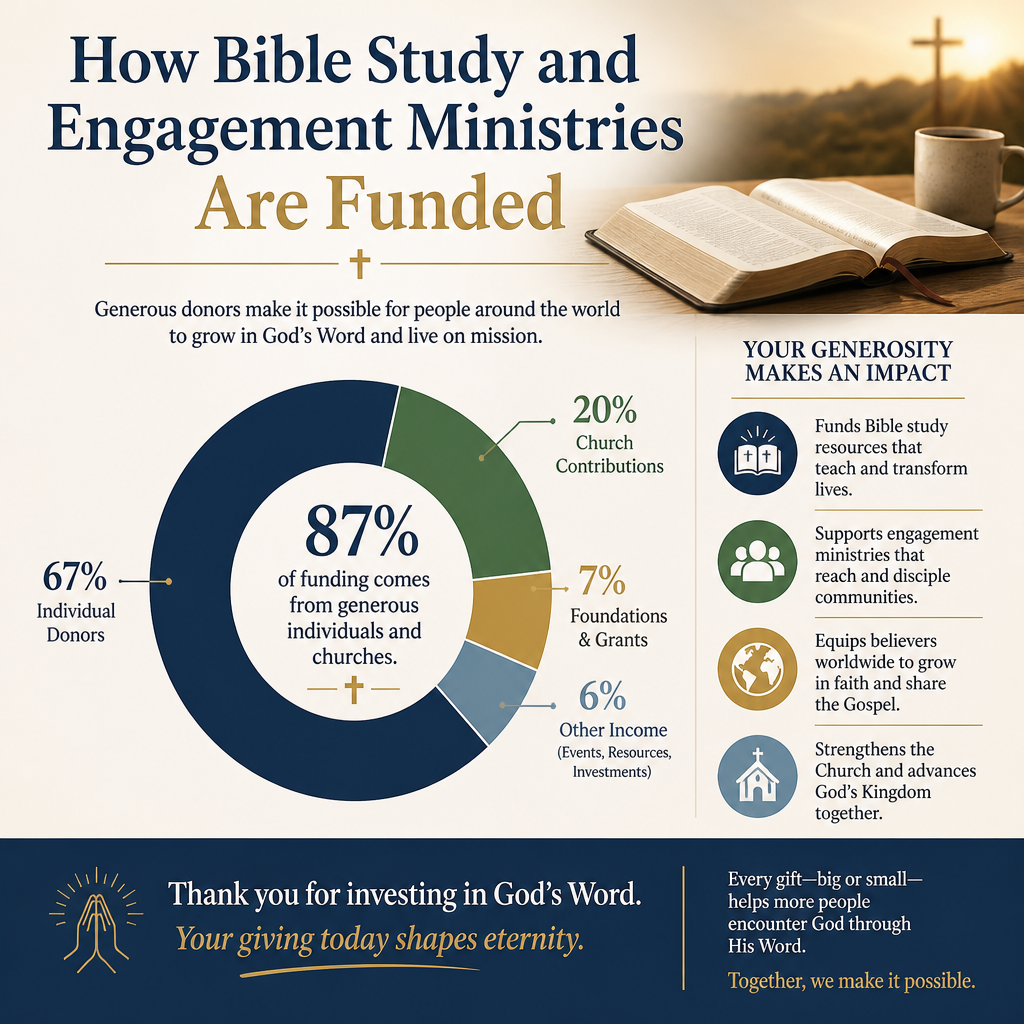
Across the field, funding usually comes through a combination of donor gifts, earned revenue, grants, and church partnerships. Earned revenue can include curriculum sales, event registration, licensing, consulting fees, or subscriptions for digital tools. Donor gifts typically cover what the market will not: scholarships, translation, leader development, outreach to lower-income communities, or the unglamorous infrastructure that keeps a ministry stable.
Christians genuinely disagree about how much earned revenue is appropriate in Bible engagement work. Some believe selling curriculum creates unnecessary barriers to Scripture access. Others argue that charging a fair price can protect excellence, reduce donor dependence, and avoid “free” resources being undervalued and unused. The more important question is not whether a ministry charges, but whether its pricing and fundraising align with its mission and ecclesial posture.
Donor expectations often miss the actual cost drivers
Donors frequently assume the primary cost is printing or content development. In reality, costs often concentrate in people and systems: staff who train leaders, pastoral care for facilitators, safeguarding policies, data security, translation workflows, and donor compliance. Digital delivery can reduce marginal distribution costs, but it adds ongoing software development, privacy risk, and support burdens. “Free” apps still require paid maintenance.
When donors push for minimal overhead, Bible engagement ministries can be tempted toward a thin operational posture that looks efficient but cannot sustain quality. The philanthropic sector has addressed this dynamic directly in the “Overhead Myth” letter signed by Charity Navigator, Candid, and the BBB Wise Giving Alliance, which warns donors not to treat overhead ratios as a proxy for effectiveness https://www.candid.org/. For discipleship work, this caution is especially relevant: formation is labor-intensive, and integrity requires systems.

What donor dollars typically pay for in Bible study and engagement work
Because Bible engagement ministries are diverse, donors should ask ministries to describe their “unit of ministry.” Is the core unit a trained leader? A functioning group? A translated resource? A digital user who completes a reading plan? A church equipped to run its own discipleship pathway? The funding logic changes depending on the answer.
Curriculum and content development
Curriculum costs include theological review, editorial work, doctrinal oversight, cultural contextualization, accessibility design, and in many cases legal permissions for quotations or translation. High-integrity ministries budget for theological accountability, not merely creative output. Donors should expect to see processes that protect orthodoxy and guard against celebrity-driven content that bypasses communal discernment.
When content is translated, costs increase sharply: translation, back-translation or review, typesetting, and field testing for comprehension. Translation is not a mechanical exercise. It is a ministry act that can either honor the target community or unintentionally impose foreign assumptions. Funding that treats translation as an afterthought often yields brittle outcomes.
Leader development, coaching, and safeguarding
A well-run Bible study ministry invests in leader pipelines: recruitment, screening, training modules, observation, and ongoing coaching. This is also where safeguarding belongs—clear policies on working with minors, reporting pathways, boundaries in counseling-like conversations, and digital safety standards for online groups. Donors should ask whether leaders are merely “activated” or actually formed for faithful care of people.
Church history offers sobering reminders that Bible teaching without accountability can become spiritually abusive. Funding for governance, complaint handling, and leader oversight is not bureaucracy; it is love of neighbor expressed in institutional form.
Technology and digital engagement
Many Bible engagement ministries now rely on learning platforms, online group tools, mobile apps, and content libraries. Technology budgets include development, hosting, cybersecurity, analytics, customer support, and compliance with privacy expectations. Donors should be alert to the moral dimension of data practices. If a ministry collects personal spiritual data—prayer requests, confession-like reflections, or group discussions—its handling of that data is a matter of trust.
For donors concerned about whether digital Bible engagement actually works, it is worth acknowledging that the research is mixed on digital religious formation broadly. However, the Bible Society’s long-running research program has documented associations between frequent Bible engagement and various measures of faith practice, while also observing significant generational and participation shifts in the United States https://www.biblesociety.org.uk/. Associations are not the same as causation, but serious ministries should demonstrate that they are measuring beyond downloads.
How trustworthy ministries budget and report to donors
Funding is not only about the size of a budget; it is about the moral quality of budgeting. Ministries that handle Scripture should be especially careful not to manipulate supporters with urgency language, selective reporting, or poorly defined impact. The best ministries treat donors as partners in discernment, offering clarity about both fruit and limits.
Budget signals that deserve careful attention
Across our verification work at Most Trusted, we observe several patterns among ministries that meet The Most Trusted Standard. They tend to budget for staff development and supervision rather than relying on constant turnover. They fund internal controls that prevent mishandling of restricted gifts. They also show realistic allocations for technology upkeep and leader care, not merely initial program launch.
Conversely, certain patterns should prompt questions. A ministry that reports unusually low administrative costs may be undercounting real expenses or shifting costs off-budget through in-kind support that is not properly valued. A ministry that is expanding rapidly while spending little on training and oversight may be accumulating future failures. Rapid scale is not a virtue if it weakens pastoral responsibility.
Restricted giving and scholarships
Many donors prefer restricted gifts: “for curriculum,” “for scholarships,” “for groups in prisons,” or “for translation.” Restricted giving can serve genuine mission priorities, but it can also unintentionally distort a ministry’s capacity. If scholarships are funded without funding the staff who administer them, track outcomes, and support participants, the scholarship program can become a fragile promise.
Scholarship models vary. Some ministries subsidize materials for low-income churches. Others cover registration for leader training. Some underwrite devices or data plans for participants in digital programs. Each approach carries trade-offs. The best question is whether the scholarship advances Scripture access without undermining dignity or local ownership.
What transparency should look like for discipleship outcomes
Discipleship outcomes are inherently harder to quantify than meals served or houses built, and donors should not demand false precision. Yet real accountability is still possible. Ministries can report retention rates for groups, leader certification completion, participant follow-through, Scripture reading consistency over time, and qualitative testimonies that are responsibly gathered and not sensationalized.
When ministries claim broad spiritual impact, donors should ask what is actually measured, how data is collected, and what safeguards exist against cherry-picking. For a donor seeking comparability across organizations, the most useful documents are audited financial statements, a clear theory of ministry, and impact reporting that states what is known and what remains uncertain.
How donors can fund Bible engagement with confidence and theological clarity
Christian donors often give to Bible engagement ministries because they believe Scripture is the living Word of God and the ordinary means by which the Spirit forms the Church. That conviction is sound. The harder question is how to give in a way that strengthens faithful institutions rather than merely financing religious content distribution.
Align giving with the ministry’s ecclesial posture
Some Bible study ministries operate explicitly under local church authority; others serve across denominations and geography with looser accountability. Neither model is automatically wrong, but they imply different donor responsibilities. Donors should favor ministries that can articulate their relationship to the local church, their doctrinal commitments, and the accountability structures that govern teaching and leadership.
When assessing where a ministry sits within the wider ecosystem, the Bible Study and Engagement Ministries category is a helpful lens for comparing models without reducing them to personalities or marketing narratives.
Fund the unglamorous essentials
Many donors are eager to fund “materials,” because the connection between a workbook and a group feels tangible. Yet the unglamorous essentials often determine whether materials lead to mature formation: leader coaching, conflict handling, safeguarding, translation review, and ongoing technology maintenance. Funding these areas is not less spiritual. It is stewardship expressed in operational faithfulness.
Donors can also consider multi-year commitments for core expenses. Short-term, project-only funding can trap ministries in a cycle of constant fundraising that leaves too little time for theological reflection and leader care. Stable funding, paired with rigorous accountability, often produces deeper fruit.
Use verification to reduce avoidable trust risk
Trust is not a mood; it is an assessment grounded in evidence. Most Trusted exists to help donors give with confidence by evaluating ministries against The Most Trusted Standard, a 15-criteria framework that examines faith commitments, financial integrity, governance and leadership, and transparency and effectiveness. For donors supporting Bible engagement, verification is not a substitute for prayerful discernment, but it can reduce preventable risk: weak controls, unclear doctrine, conflicted leadership structures, or opaque reporting.
Christian giving has always carried moral weight because it participates in what the Church becomes. Funding Scripture engagement is not merely supporting education; it is supporting the conditions under which people hear God’s Word, interpret it faithfully, and obey it together. Donors who insist on both theological seriousness and verifiable integrity strengthen the Church’s witness and protect the vulnerable from the costs of avoidable ministry failure.
Funding that honors the Word and the people who receive it
How Bible Study and Engagement Ministries are funded will continue to evolve as churches adapt to shifting attention patterns, digital delivery, and global translation needs. The constant is that Scripture ministry must be both faithful and accountable. Donors serve the Church best when they fund not only the distribution of resources, but the formation of leaders, the safeguarding of communities, and the transparency that allows trust to be more than sentiment.



