

Deciding how to donate to biblical museum ministries online is not merely a question of convenience. It is a stewardship decision about what kind of Christian witness we fund: careful teaching, truthful handling of evidence, and public credibility in a skeptical age.
Biblical museum ministries sit at an unusual intersection. They serve the Church by preserving and interpreting material culture connected to Scripture, and they serve the public by making claims that can be inspected. That combination attracts donors who care about evangelism, discipleship, and cultural engagement. It also requires donors to ask more disciplined questions than “Is this inspiring?” because online giving makes generosity effortless, and effortless giving can become unexamined giving.
Begin with the ministry purpose and theological posture
What the museum says it exists to do
Before entering payment information, clarify what you are actually underwriting. Some biblical museum ministries function primarily as educational institutions: curated collections, scholarly translation work, and public programming that helps people read Scripture with historical seriousness. Others are designed primarily for devotional experience, evangelistic encounters, or apologetics. None of those aims is automatically unfaithful, but they are not interchangeable.
Serious stewardship begins by reading the ministry’s mission statement, statement of faith, and exhibit philosophy. The question is not whether the ministry uses explicitly Christian language. The question is whether its public work reflects a theology of truth-telling: reverence for God’s Word, humility about what is known and unknown, and restraint about claims that exceed the evidence. Scripture commends both conviction and honesty; “we are not, like so many, peddlers of God’s word” (2 Corinthians 2:17). Donors should expect that same moral seriousness in the way artifacts, reconstructions, and interpretive claims are presented.
Why credibility matters for Christian witness
Biblical museums often speak to audiences formed by scientific and historical skepticism. When a ministry makes a contested claim without acknowledging legitimate questions, it may win a moment of excitement and lose long-term trust. Christians genuinely disagree about how to present apologetics in public venues, but most agree that the Church’s witness is weakened when we appear careless with sources.
As you consider ministries within Biblical Museum Ministries, weigh whether the organization demonstrates a disciplined respect for scholarship, transparent citations in exhibits and educational materials, and an ability to distinguish between confessional conviction and historical inference.

Evaluate online giving pathways for security and donor intent
Confirm the ministry is a legitimate recipient
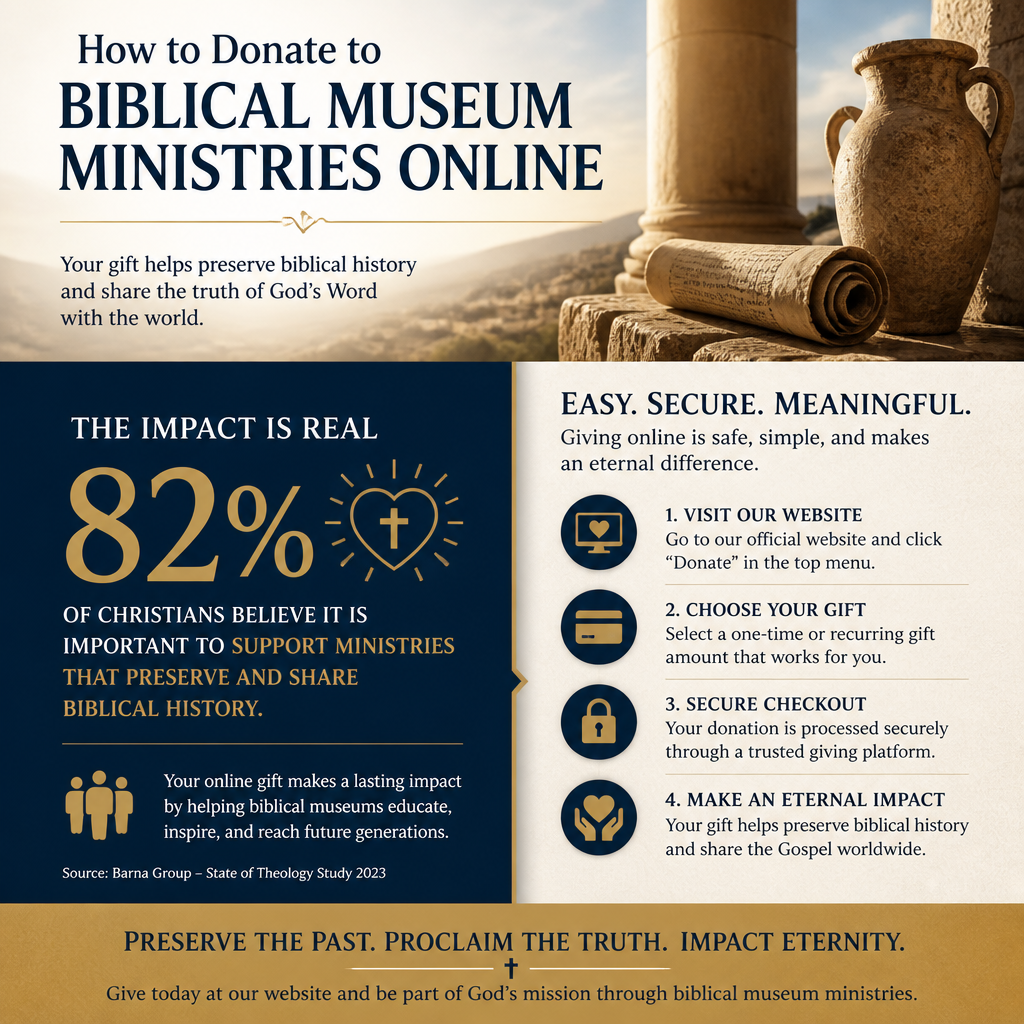
Online giving should never begin with a social media link or a forwarded email alone. Go to the ministry’s official website, find its giving page, and confirm basic legitimacy markers: a physical mailing address, an EIN, and clear contact information. When gifts are intended to be tax-deductible in the United States, confirm the organization’s nonprofit status through the IRS Tax Exempt Organization Search IRS.
This is not cynicism. It is ordinary prudence. Fraudsters imitate real organizations, and donors are responsible for exercising reasonable care, especially when the cause is emotionally compelling.
Assess payment security and data practices
A credible online donation experience should show clear signals of basic security: HTTPS in the browser, recognizable payment processors, and a privacy policy that states how donor data is stored and used. If a ministry offers bank transfer, credit card, donor-advised fund, or cryptocurrency options, the question is not “How many methods?” but “Are these methods administered responsibly?”
Donors should also notice whether the giving form makes donor intent explicit. If you are giving to a restricted purpose—an acquisition fund, a conservation project, or a school program—the ministry should define that purpose plainly. Mature organizations also explain what happens if a restricted project becomes infeasible. Clarity in advance prevents disappointment later and protects the ministry from improper restriction management.
Give with clarity about finances without treating overhead as the enemy
Avoid simplistic rules about administrative costs
Many donors have been trained to treat the lowest “overhead” as the holiest stewardship. That instinct is understandable, and waste should be rejected. But the nonprofit field has had to reckon with how “overhead” metrics can mislead donors and pressure ministries into underinvesting in governance, systems, and staff competence. The “Overhead Myth” letter, signed by GuideStar, BBB Wise Giving Alliance, and Charity Navigator, explicitly warns that overhead ratios are a poor proxy for effectiveness and can incentivize harmful practices Charity Navigator.
Biblical museum ministries, in particular, often carry legitimate infrastructure costs: climate-controlled storage, conservation standards, insurance, collections management systems, and qualified curatorial labor. Those are not distractions from mission; they are often the mission’s enabling conditions.
What to look for in financial reporting
Donors should expect accessible financial information: recent audited financial statements when feasible, a current Form 990 for U.S. nonprofits, and clear explanations of major revenue streams and major expenses. A museum ministry with significant ticket revenue or retail income should show how those earned revenues are accounted for and how they shape the organization’s financial risk. A ministry that relies heavily on a small number of large donors should acknowledge concentration risk and demonstrate responsible reserves or contingency planning.
If the organization is small and cannot afford an audit, it should still be able to provide reviewed statements, board-approved budgets, and evidence of basic internal controls. Online donors should not be asked to subsidize financial opacity.
- Find the organization’s most recent Form 990 or equivalent public filing.
- Look for clear governance disclosures: board composition, related-party transactions, and conflict-of-interest practices.
- Confirm that restricted funds are described and managed in writing.
- Scan for unusual volatility: sudden expense spikes, unexplained deficits, or repeated emergency appeals.
- Prefer ministries that explain major capital projects with budgets and timelines, not only vision language.
Consider governance and truth-telling as donor responsibilities
Why board oversight matters in public-facing ministries
Biblical museum ministries are not only stewarding money. They are stewarding artifacts, donor trust, and the credibility of Christian claims before outsiders. That places weight on governance. Strong boards do more than approve budgets; they set boundaries, ensure ethical acquisition policies, oversee compliance, and require accuracy in public communication.
Donors should expect governance seriousness: documented conflict-of-interest policies, independent board members, and clear lines between executive leadership and board oversight. If the ministry’s public persona revolves around a single charismatic leader, donors should look for evidence that the organization can withstand leadership transition without crisis.
Ethical acquisition and provenance questions
Museums everywhere have faced renewed scrutiny regarding provenance, cultural patrimony, and illicit antiquities markets. Christian donors should not dismiss these concerns as merely political. The commandment against theft and the biblical concern for justice apply to collecting practices as surely as to financial bookkeeping.
When a museum ministry showcases manuscripts, inscriptions, or antiquities, donors can ask whether the organization explains provenance standards, follows applicable laws, and engages reputable scholarly processes. Transparent provenance does not eliminate all debate, but secrecy almost always indicates risk.
Use verification and ongoing engagement to make online giving durable
What durable giving requires after the transaction
Online giving is easy to initiate and easy to abandon. Durable giving—the kind that sustains ministries and produces mature fruit—requires ongoing attention. Donors should expect regular reporting that is more than promotional. A credible biblical museum ministry will communicate what was accomplished, what was learned, and what remains uncertain. It will not treat every development as a triumph.
We also recommend distinguishing between gifts for operations and gifts for special projects. Operations gifts preserve the ministry’s capacity: staff, conservation, security, education, and responsible collections care. Project gifts can advance a defined opportunity, but they can also leave an organization with long-term obligations and short-term funding. A balanced donor approach often includes both.
How Most Trusted fits into wise online giving
Across our verification work at Most Trusted, we observe that donors are often trying to reconcile three legitimate aims: faithfulness to Scripture, accountability for financial stewardship, and confidence that public claims are responsibly made. The ministries that meet The Most Trusted Standard tend to make that reconciliation easier because they provide verifiable evidence across Faith Foundation, Financial Integrity, Governance and Leadership, and Transparency and Effectiveness.
That does not mean verified ministries are perfect, nor does it mean unverified ministries are unfaithful. It means donors can reduce avoidable uncertainty by prioritizing organizations willing to be examined. As you weigh options within How to Give Wisely to Biblical Museum Ministries, treat verification not as suspicion but as a form of Christian love for the truth and for the long-term health of the Church’s public witness.
FAQs for How to donate to biblical museum ministries online
Should we restrict an online gift to a specific exhibit or artifact acquisition?
Restricted giving can be appropriate when the purpose is clearly defined and the ministry has the financial systems to track and report on restricted funds. The donor responsibility is to ensure the restriction is specific, written, and realistic; the ministry responsibility is to state how the gift will be used and what happens if circumstances change. If a ministry cannot explain its restriction policy in plain language, an unrestricted gift or a restricted gift with a contingency clause may be the wiser course.
What documentation should we expect after donating online?
For U.S. donors, a credible ministry should provide a contemporaneous donation receipt that includes the organization’s legal name, the amount given, the date, and a statement about whether goods or services were provided in exchange for the contribution. Donors should also expect year-end summaries and, for larger gifts, access to financial reports that substantiate how resources are governed and deployed.
A giving decision that strengthens public Christian witness
Online giving to biblical museum ministries can fund careful teaching, preservation of fragile materials, and public encounters that deepen confidence in Scripture’s historical rootedness. It can also subsidize weak governance, inflated claims, or avoidable ethical risk if donors confuse enthusiasm with evidence. Christian stewardship calls for both generosity and discernment: a willing hand, and an examined path.



