
Choosing a trustworthy biblical museum ministry requires more than an assessment of exhibits and attendance. Biblical museums carry a particular spiritual weight: they can clarify the world of Scripture and strengthen confidence in the historic faith, or they can trade reverence for spectacle and certainty for salesmanship.
Most Christian donors have two legitimate desires that can pull against each other. We want ministries that defend the faith in a skeptical age, and we also want ministries that handle evidence, people, and money with integrity. A museum is a public-facing institution. If it mishandles scholarship, governance, or the truthfulness of its own claims, it does not only waste donor resources; it can wound Christian witness.
Begin with mission and theological posture, not attractional appeal
Clarity about what the museum is and is not
A biblical museum ministry is not simply an educational nonprofit with Bible-themed content. It is a ministry that interprets Scripture-adjacent history and material culture for public formation. That means donors should ask: what does the organization believe it is doing to the visitor? Is it primarily catechesis, apologetics, cultural engagement, academic education, evangelism, or a blend?
The most trustworthy ministries can articulate their purpose without inflating it. They can say, with precision, what their exhibits can reasonably establish and what belongs to faith. Scripture itself models this kind of honesty. Luke describes his aim as an “orderly account” grounded in investigation and testimony, not in rhetorical pressure (Luke 1:3–4). Museums should share that posture: careful with sources, transparent about limits, and serious about the formation of conscience.
A stated faith foundation that governs practice
Christians genuinely disagree about interpretive questions that museums often touch: the relationship between biblical archaeology and apologetics, the appropriate use of reconstructions, how to treat contested chronologies, and how to communicate to children without distorting complexity. Those disagreements are not a reason to disengage. They are a reason to ask whether a ministry’s statement of faith meaningfully governs exhibit decisions, educational materials, and public communication.
Across our verification work at Most Trusted, the ministries that meet The Most Trusted Standard tend to show consistency between theological commitments and operational decisions. They do not treat faith language as branding while allowing fundraising incentives to dictate public claims. They also resist a false binary between scholarship and devotion, recognizing that love of God includes love of truth.
Ask how the ministry handles evidence, expertise, and intellectual humility
Scholarly accountability without academic posturing
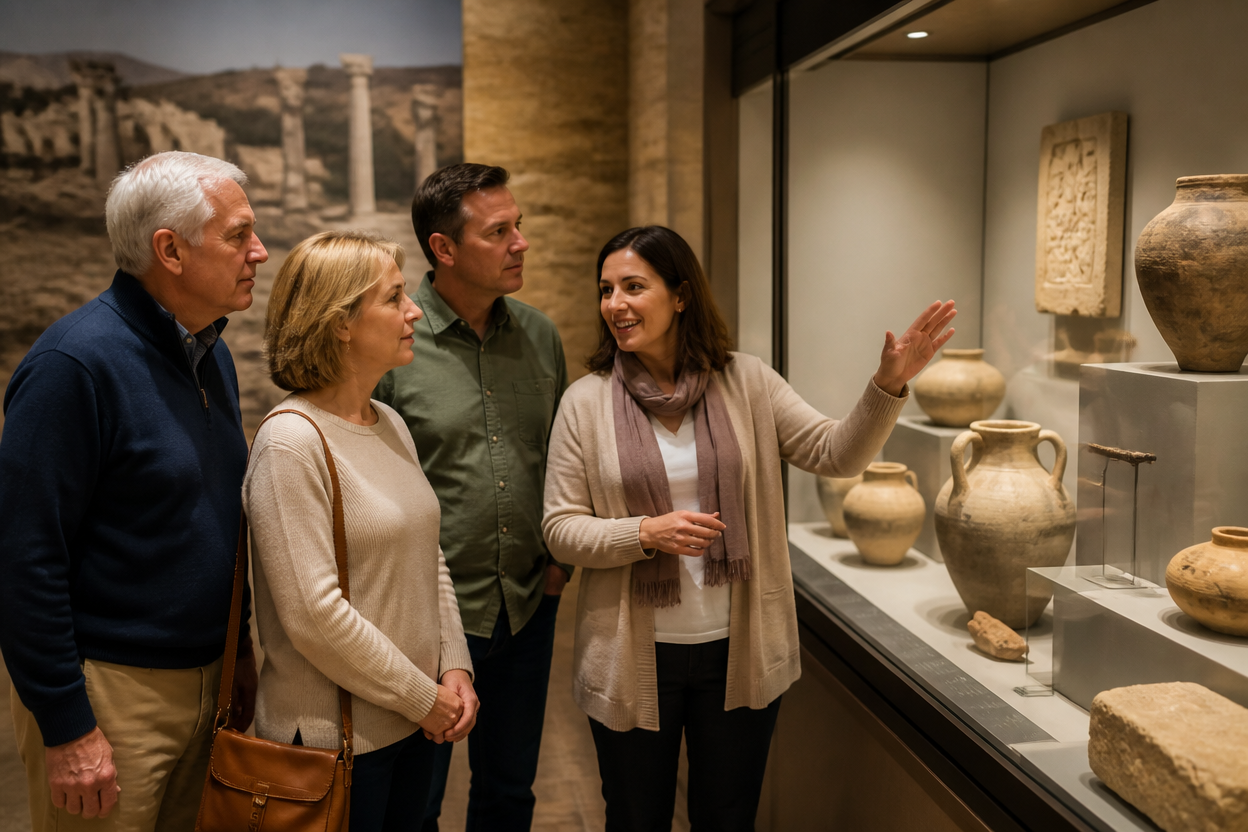
Biblical museums exist in the public crosswinds of skepticism and credulity. The temptation is to respond by overclaiming. A more credible approach is to submit interpretations to real expertise and to disclose where scholarly consensus is limited or contested. Donors can look for advisory structures that include qualified historians, archaeologists, theologians, educators, and conservators, and for a willingness to correct errors publicly.
Trustworthy museum ministries often distinguish between (a) what an artifact is, (b) what we can responsibly infer about provenance and context, and (c) what theological conclusions Christians may draw in faith. That distinction does not weaken Christian conviction; it prevents unnecessary scandals that arise when fundraising narratives outrun verifiable evidence.
Provenance and ethics are not optional
Artifact acquisition is one of the most morally and legally fraught aspects of museum work. Responsible ministries have clear policies on provenance, chain of custody, compliance with cultural property law, and the avoidance of illicit antiquities markets. Donors should not accept vague assurances. A trustworthy ministry can summarize its acquisition policy, name the standards it uses, and explain what it does when questions arise.
What this means in practice is that a biblical museum’s credibility is tied to more than its theology. It is tied to whether it treats neighbors—modern nations, local communities, scholars, and visitors—with justice. Scripture’s insistence on honest weights and measures applies to institutional truthfulness as well (Prov. 11:1). A museum that builds its public case on questionable objects or undisclosed uncertainties is asking donors to subsidize future reputational risk.
Evaluate financial integrity with the discipline of stewardship
Read audited financials as a ministry document
Donors should expect a museum ministry to carry significant fixed costs: facility operations, collections care, security, insurance, conservation, and skilled staff. That does not excuse opacity. A trustworthy ministry provides accessible financial information, typically including audited financial statements when scale warrants it, and plain explanations of revenue streams (admissions, memberships, donations, grants, retail, and special events).
Healthy organizations also avoid simplistic “low overhead” storytelling. The nonprofit field has repeatedly cautioned donors against equating overhead with ineffectiveness; the “Overhead Myth” statement was jointly advanced by leading evaluators to encourage attention to outcomes, governance, and transparency rather than a single ratio Charity Navigator. For museum ministries, this is especially important: underinvestment in collections care or compliance can create long-term harm.
Revenue claims should be tested for resilience
Museums can be unusually exposed to seasonality and economic cycles. Donors should ask whether the ministry has financial reserves, diversified income, and realistic attendance assumptions. The COVID-19 shock illustrated how rapidly museum revenue can decline; the American Alliance of Museums documented widespread financial distress across U.S. museums during the pandemic American Alliance of Museums. Even if a given biblical museum recovered quickly, donors should not assume the risk has disappeared.
Trustworthy ministries plan for volatility without turning urgency into a fundraising style. They communicate needs clearly, they avoid exaggerated “last chance” appeals, and they demonstrate budgeting discipline consistent with Christian stewardship.
Scrutinize governance, leadership, and the integrity of public claims
Board independence and conflict management
Many museum ministries are founder-led, which can be a gift. It can also concentrate power. Donors should ask whether the board is meaningfully independent, whether it meets regularly, and whether conflicts of interest are disclosed and managed. A museum with major real estate, retail activity, or affiliated for-profit entities requires particular clarity. The question is not whether leaders are sincere, but whether structures exist to guard the ministry when incentives press hard.
Across The Most Trusted Standard, governance is not treated as bureaucratic compliance; it is a practical expression of accountability within the body of Christ. A board that can ask difficult questions, review compensation appropriately, and document decisions is a protection for donors, staff, and the ministry’s long-term witness.
Marketing should not exceed what the ministry can substantiate
Because museums are public institutions, their claims travel far beyond the donor base. Donors should evaluate whether promotional language is careful with certainty. Does the ministry present disputed reconstructions as settled fact? Does it blur the line between interpretive narrative and documented evidence? Does it use emotionally charged rhetoric to foreclose legitimate questions?
A trustworthy biblical museum can be confident and evangelistically serious without manipulating the visitor’s conscience. It can invite wonder without demanding intellectual surrender. Mature apologetics is strengthened, not weakened, by careful speech.
Look for transparency about impact and a disciplined approach to effectiveness
Outcomes that match the mission
Museum ministries often default to reporting attendance, exhibit square footage, or gift shop sales. Those are operational metrics, not ministry outcomes. Donors should ask how the organization defines spiritual and educational fruit, and how it tests whether it is happening. For example: Are teachers returning? Are churches using curricular resources? Are visitors engaging Scripture more seriously afterward? Are families better equipped to talk about faith at home?
Not every outcome can be reduced to numbers, and Christians should be wary of treating spiritual formation as a KPI. Still, a ministry can practice disciplined evaluation without claiming to measure the Holy Spirit. Trustworthy organizations often pair quantitative indicators with qualitative evidence: educator feedback, curriculum review, independent peer input, and transparent learning from failures.
A donor checklist for discernment
Most donors will not have time to investigate every museum detail. The goal is to ask the questions that reveal whether the ministry can be trusted over time. We recommend using a short set of indicators before significant giving:
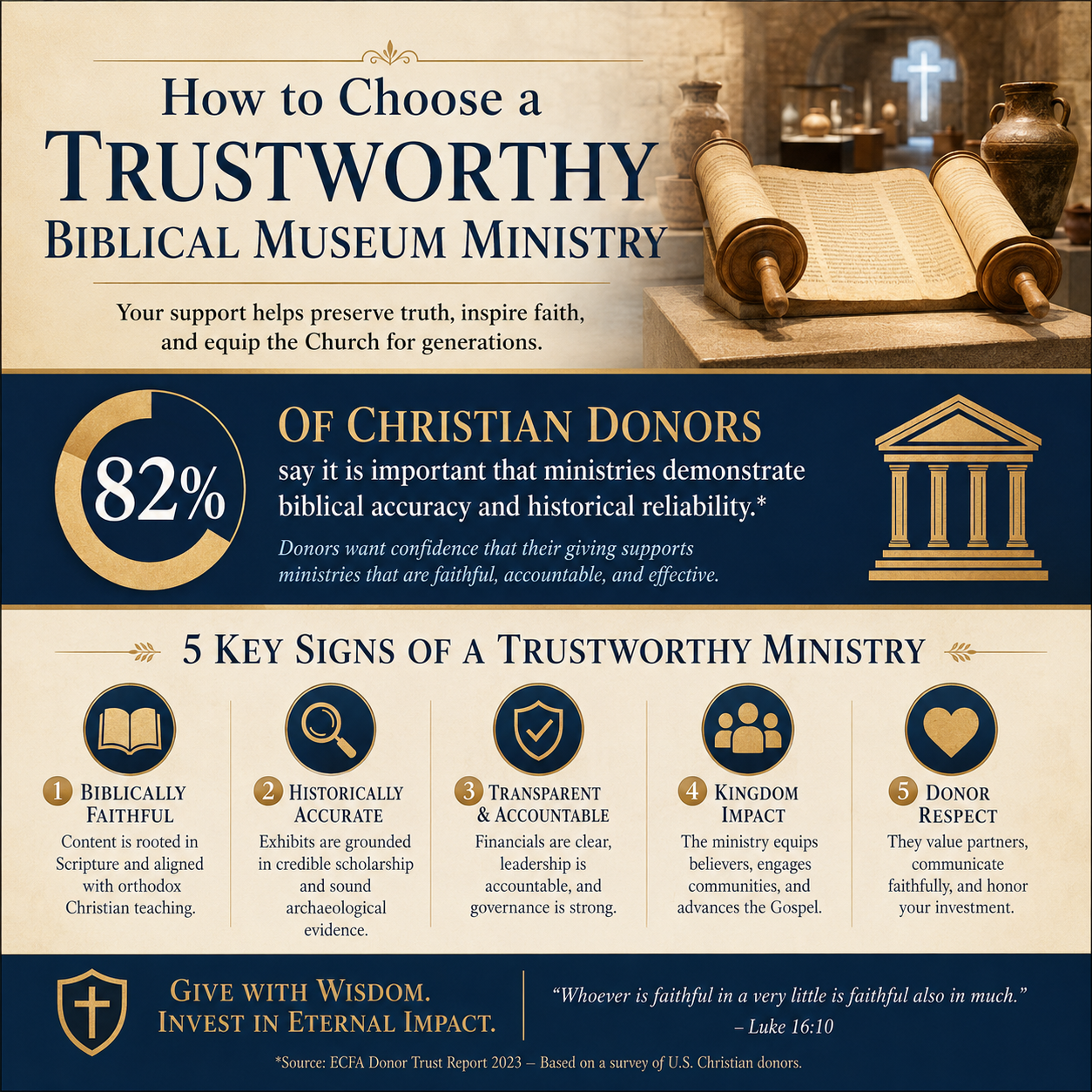
- Clear mission and theological commitments that govern exhibits and communications
- Transparent provenance and acquisition ethics for artifacts and reproductions
- Accessible financial reporting, with audited statements when scale warrants
- Independent governance, documented conflict-of-interest practices, and accountable leadership
- Public claims and marketing language that do not outrun evidence
- Impact reporting that reflects educational and spiritual formation, not only attendance
Donors who want a broader context for this field can review Biblical Museum Ministries as a category of Christian giving. The aim is not to cultivate suspicion, but to practice love of neighbor through careful stewardship and truthful witness.
FAQs for How to choose a trustworthy biblical museum ministry
Should we avoid biblical museum ministries that take strong positions on contested questions?
Not necessarily. A museum can take a clear position and still be trustworthy. The better question is whether the ministry distinguishes between evidence, interpretation, and confession, and whether it communicates disagreements fairly. When a museum treats contestable claims as if they were beyond question, it increases reputational risk and can undermine the very apologetic confidence it seeks to build.
How can we vet a biblical museum ministry if we are not experts in archaeology or history?
Focus on governance and transparency signals that do not require technical expertise. Ask for audited financials or clear financial summaries, review board and leadership disclosures, and evaluate whether the ministry cites sources and corrects errors. For donors seeking a structured approach across multiple dimensions, Most Trusted evaluates ministries against The Most Trusted Standard, which examines faith foundation, financial integrity, governance and leadership, and transparency and effectiveness in a unified framework. For additional guidance on donor decision-making within this space, see How to Give Wisely to Biblical Museum Ministries.
A faithful museum ministry is a public trust
Biblical museum ministries sit at a sensitive intersection of faith, history, education, and public credibility. Donors should expect more than compelling displays. The trustworthy ministries are those that treat truth as a moral obligation, handle money as stewardship, and submit leadership to accountable structures. When those elements are present, donors can give with confidence that the ministry’s public witness will be as careful as its private convictions.



