

To compare Christian development ministries fairly, donors have to resist two equal and opposite temptations: treating suffering as a marketing contest, or treating impact as a spreadsheet exercise detached from Christian faithfulness. Development work sits at the intersection of urgent human need, complex systems, and the Church’s calling to love our neighbor in costly, intelligent ways.
Christian donors also know that publicity can be misleading. A compelling story may be true and still be unrepresentative. A low “overhead” figure may sound virtuous and still conceal weak controls, underinvestment in safeguarding, or evasive reporting. Fair comparison requires categories that can bear moral weight: what the ministry believes and practices, how it governs and handles money, how it treats people, and what evidence it can honestly provide.
Start with the ministry mandate and the theology that drives it
Clarify the theory of change as a Christian claim
Every development ministry operates with a stated or implied theory of change: food assistance to stabilize families, livelihood programs to increase resilience, community health to reduce preventable deaths, church-based discipleship as a pathway to long-term flourishing. A fair comparison begins by asking whether the ministry’s aims are coherent, biblically grounded, and morally serious. “Let us not love in word or talk but in deed and in truth” (1 John 3:18) is not a slogan; it is a standard for integrity in what a ministry says it is doing versus what it actually does.
Christians genuinely disagree about emphasis. Some prioritize evangelism alongside service; others emphasize presence and mercy ministries without conditionality. The fair question is not whether every ministry matches one donor’s model, but whether it is candid about its theological commitments and how those commitments shape programming, partnerships, and public claims.
Distinguish relief, rehabilitation, and development
Wise donors evaluate a ministry partly by whether it is working in the right mode for the context. In disaster response, speed and logistics competence matter. In long-term poverty alleviation, patient local ownership matters. The When Helping Hurts framework, articulated by Steve Corbett and Brian Fikkert, has helped the field name these distinctions and the harms that can come from confusing them, particularly when outside resources displace local capacity or dignity.
What this means in practice is straightforward: compare like with like. A rapid-response relief organization should not be judged by the same metrics as a multi-year agricultural resilience program. Donors can still compare them, but only after clarifying the kind of work each is accountable to deliver.

Compare programs by what they require of the people they serve
Dignity, agency, and the risk of dependency
Development is not only about outcomes; it is also about how those outcomes are pursued. Does the ministry treat recipients as image-bearers with agency, or primarily as objects of compassion for donor consumption? A fair comparison asks what participation looks like: community-led assessment, local decision-making, complaint mechanisms, and whether programs strengthen households and local institutions rather than bypassing them.
Some programs necessarily involve direct aid, and Scripture commends generosity. Yet even generous aid can become corrosive when it is predictable without relationship, untethered from local markets, or designed mainly around donor preferences. Ministries that serve well typically name these risks and design against them.
Safeguarding and do no harm
Donors increasingly recognize that “do no harm” is not a secular intrusion but a Christian obligation. A fair comparison looks for verifiable safeguarding: policies for child protection, screening and training for staff, clear reporting channels, and consequences when standards are violated. Where cross-cultural work is involved, donors should also ask how the ministry mitigates power imbalances, especially in photography, storytelling, and short-term engagements.
Where a ministry works with children, displaced people, or survivors of violence, safeguards are not optional program accessories. They are part of the ministry’s moral infrastructure. The absence of evidence here should not be excused by claims of humility or small size; it should be treated as a serious risk.
Put financial integrity in its proper place, not as a shortcut
Reject overhead reduction as a moral metric
Christians want to be faithful stewards, but stewardship is not a simplistic hunt for the lowest administrative line. The nonprofit sector has spent years correcting this misunderstanding. The “Overhead Myth” letter signed by Charity Navigator, GuideStar, and the BBB Wise Giving Alliance explains why overhead ratios are poor indicators of performance and can even incentivize harmful underinvestment in systems and staff needed for results and accountability BBB Wise Giving Alliance IssueLab copy of The Overhead Myth letter.
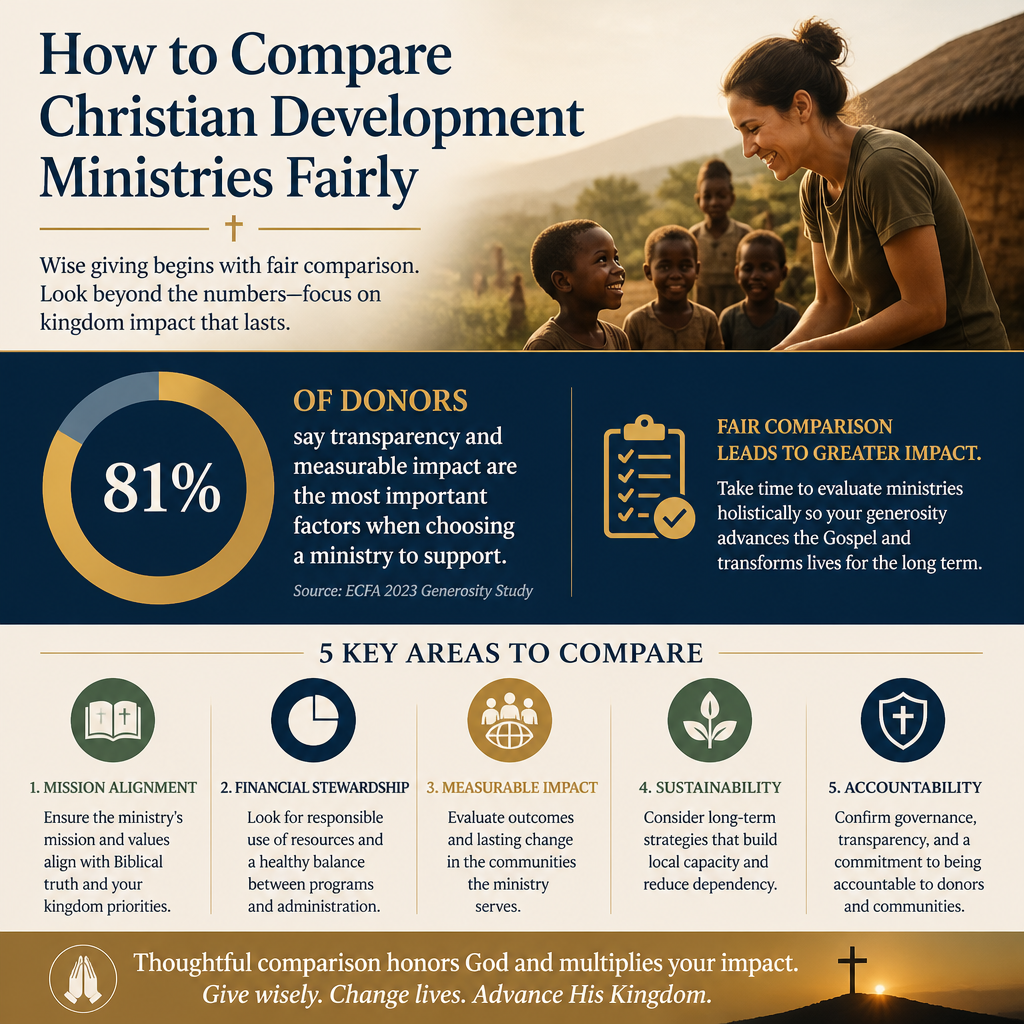
A fair comparison asks different questions: Are audits timely and credible? Are related-party transactions disclosed? Do financial statements align with public claims? Is restricted giving honored? Are there signs of chronic financial strain that could pressure leaders into exaggeration or corner-cutting?
Understand what sound controls make possible
Strong financial systems are not opposed to ministry; they protect it. In cross-border work, the risks include cash handling, vendor fraud, sanctions compliance, and weak documentation in remote contexts. Responsible ministries invest in controls, training, and monitoring. Donors should not punish that investment by equating it with waste.
Across our verification work at Most Trusted, the ministries that meet The Most Trusted Standard tend to show consistency between what they report and what their documents support: audited financials, clear accounting policies, and governance practices that reduce single-person control over spending decisions.
Evaluate governance and leadership as spiritual and operational accountability
Board independence and the discipline of oversight
Christian ministries often begin with a founder’s calling, and donors can rightly honor that. The harder question is whether the organization has grown into mature oversight. A fair comparison includes governance basics: a functioning board that meets regularly, minutes that document decisions, conflict-of-interest policies that are applied, and a compensation process that is not insulated from accountability.
Scripture’s concern for leadership integrity is unambiguous. When Paul lists qualifications for overseers, he includes character and household management because private integrity and public trust are linked (1 Timothy 3:1–7). Development ministries carry additional stewardship because they represent Christ in contexts where the Church’s credibility can be damaged by scandal or paternalism.
Local partnership and power
Many donors want to know whether a ministry is “indigenous.” The reality is more complex. Some international organizations have mature local leadership and deep partnership; some local entities replicate the same donor-driven distortions. Fair comparison asks about decision rights: Who defines needs? Who sets budgets? Who owns data? Who can stop a program if it is harming people?
Where a ministry claims partnership, donors should look for evidence that local churches and institutions are not merely implementers but meaningful participants in governance, strategy, and evaluation.
Demand transparency and honest evidence without pretending impact is simple
Transparency that can be verified
Transparency is not a vibe. It is the willingness to provide documentation that can be checked: audited statements, annual reports with program detail, governance disclosures, and clear descriptions of how donations are used. Some ministries tell excellent stories yet provide few verifiable documents; others publish extensive documents yet remain vague about program realities. A fair comparison includes both: narrative clarity and documentary integrity.
Donors who want a broader view of the field often begin with Christian Relief and Development Ministries, then narrow their focus based on the type of work and the regions they care about most.
Evidence that fits the work
Christians should not fear measurement, but we should fear false certainty. Outcomes are easier to measure in some domains than others. Vaccination coverage can be measured; discipleship formation is more difficult. Economic resilience takes time. A fair comparison asks whether the ministry’s evidence is appropriate, modest in its claims, and designed to protect beneficiaries as well as persuade donors.
- Clear, specific outcomes the program is accountable to deliver
- Baseline information that explains what changed and from what starting point
- Independent evaluation where the stakes justify it
- Safeguarding and complaints data handled with discretion and seriousness
- Public reporting that acknowledges limits and unintended consequences
Donors can also learn from the field’s broader correction on simplistic metrics. The letter commonly cited as the “Overhead Myth” was influential precisely because it challenged donors to reward transparency and results rather than cosmetic efficiency Charity Navigator on the Overhead Myth.
For donors who want to apply these questions consistently, How to Give Wisely to Christian Relief and Development Ministries provides a context for discerning between different models of Christian development work without collapsing everything into a single ranking.
FAQs for How to compare Christian development ministries fairly
Should donors prioritize ministries with the lowest administrative costs?
No. Administrative costs are not a reliable proxy for faithfulness or effectiveness. Sector leaders have documented how overhead fixation can incentivize underinvestment in finance controls, safeguarding, staff training, and evaluation, all of which protect beneficiaries and strengthen accountability BBB Wise Giving Alliance IssueLab copy of The Overhead Myth letter. A fair comparison weighs whether a ministry’s spending supports competent delivery and responsible governance.
How can donors compare spiritual faithfulness and measurable impact without forcing a false choice?
By requiring clarity in both domains. Faithfulness can be assessed through doctrinal commitments, leadership character, church relationships, and the integrity of witness. Impact can be assessed through appropriate outcomes, transparent reporting, and willingness to acknowledge limits. The Most Trusted Standard is designed to hold these together by examining faith foundation, financial integrity, governance and leadership, and transparency and effectiveness as mutually reinforcing responsibilities.
A fair comparison serves love, not suspicion
Christian development ministries should not be compared as consumer products, but they also should not be exempt from scrutiny because their work is sacred. Donors honor Christ when they give with informed confidence, seeking ministries that tell the truth, protect the vulnerable, handle resources with integrity, and pursue real good in real communities. Fair comparison is one way we practice love in deed and in truth, with our minds engaged and our hearts steady.



