

Why Christian relief ministries fund both aid and discipleship is not a marketing question. It is a theological question about what “help” is for, what human beings are for, and what the church is commissioned to do when suffering is urgent and faith is contested. Donors often feel the tension: if someone is hungry today, why spend anything on spiritual formation; if someone needs Christ, why spend anything on wells, clinics, and shelters.
Christian Scripture refuses that split. The prophets condemn those who “trample on the needy” while maintaining religious appearances (Amos 5), and Jesus both proclaimed the kingdom and fed the hungry (Mark 6). The Great Commission sends disciples to teach obedience to everything Christ commanded (Matthew 28), and the judgment scene in Matthew 25 treats works of mercy as a non-negotiable mark of fidelity. Mature relief ministries fund both because the gospel addresses the whole person, and because in real communities, aid without discipleship and discipleship without aid each tends to deform.
Relief and discipleship are not competing missions in Scripture
The Bible binds mercy and truth together
Christian donors sometimes assume a zero-sum trade-off: every dollar spent on preaching is a dollar not spent on food, and every dollar spent on food is a dollar not spent on evangelism. That framing owes more to modern institutional categories than to the Bible’s own moral imagination. The Old Testament repeatedly joins right worship to justice and neighbor-care; when that bond breaks, God rejects the worship (Isaiah 1). The New Testament joins proclamation to embodied love: “let us not love in word or talk but in deed and in truth” (1 John 3).
That unity does not eliminate prudential judgment. Christians genuinely disagree about what kinds of “spiritual programming” belong alongside humanitarian work, how explicit evangelism should be in a crisis setting, and how to ensure dignity and consent. Yet the underlying claim of Scripture is straightforward: mercy is not a diversion from faithfulness, and discipleship is not an abstraction from human need.
Jesus models integrated compassion under real constraints
The Gospels do not present Jesus as choosing between “meeting needs” and “ministry.” He heals bodies and forgives sins (Mark 2). He teaches and feeds (Mark 6). He refuses coercion while still calling people to repentance and faith. Christian relief ministries that fund both aid and discipleship are not adding a “faith layer” to a secular service model; they are working from a Christian account of what love requires in a fallen world.

Why aid alone can fail the people it intends to serve
Material help can become dependency without formation
One of the most important correctives in modern Christian development work is the insistence that poverty is not only a lack of goods. The When Helping Hurts framework, articulated by Steve Corbett and Brian Fikkert, argues that poverty is fundamentally about broken relationships with God, self, others, and creation, and that ill-designed aid can reinforce paternalism and dependency rather than restore agency. The core insight is not that relief is wrong, but that relief has a proper purpose and proper limits.
For donors, this matters because “aid” can be delivered efficiently and still fail morally. A distribution that treats people as passive recipients can weaken local initiative, undercut local markets, and reduce complex communities to a donor-facing story of rescue. Discipleship—when it is genuine formation rather than external control—can be one of the few program elements that explicitly names human dignity, calls forth responsibility, and builds the relational capital that sustains long-term change.
Development requires trust, and trust is spiritual as well as social
Many of the outcomes donors want—children staying in school, families resisting exploitation, communities organizing to protect the vulnerable—depend on trust. Trust is a social reality, but it is also deeply moral. Christian formation shapes honesty, sexual ethics, stewardship, reconciliation, and courage under pressure. Those are not peripheral to development; they are often the difference between a repaired well that stays repaired and a repaired well that becomes the next conflict.
At the same time, claims about “spiritual transformation” are easier to assert than to verify. This is where donors should press for clarity: What exactly does the ministry mean by discipleship? Who leads it? What safeguards exist against manipulation? What evidence suggests the ministry’s approach strengthens rather than fractures community life?
Why discipleship alone can fail the neighbor Christ commands us to love
Proclamation without mercy can become an unbiblical witness
In the epistle of James, the test case is painfully direct: if someone is poorly clothed and lacking daily food, and we offer religious words without material help, “what good is that?” (James 2). Christian donors usually do not need persuasion that the gospel must be spoken. The harder question is whether the manner of our speaking reflects the character of Christ.
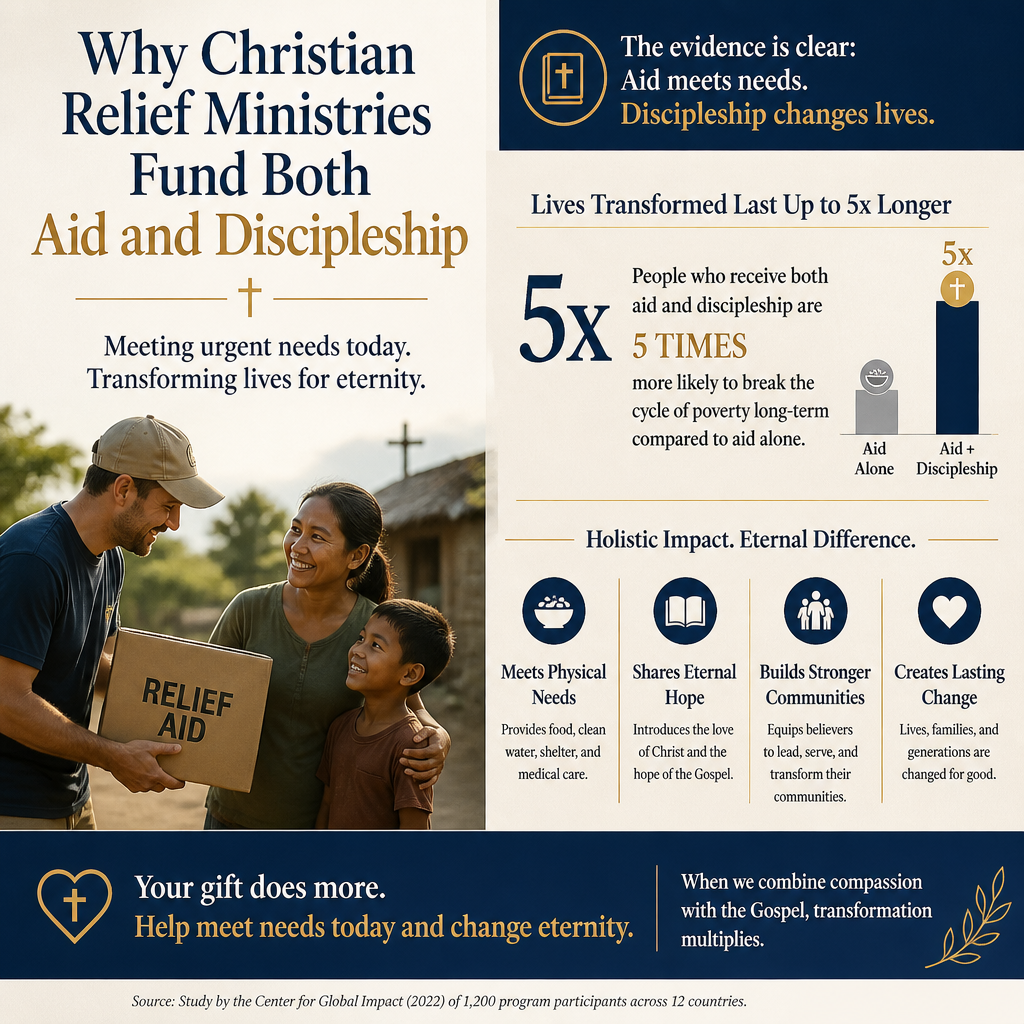
Relief work can protect the credibility of the church’s witness, not because we are managing “brand,” but because neighbors rightly measure the truthfulness of our love. When Christian ministries fund medical care, food security, clean water, trauma counseling, or emergency shelter, they are not purchasing a hearing; they are acting in a way that is consistent with what they proclaim about God’s compassion and human worth.
Crises expose what theology we really believe
Disaster and displacement reveal the difference between a faith that is merely private and a faith that is concretely responsible. A relief ministry that refuses to spend on material aid often signals—whether it intends to or not—that bodies matter less than souls. Scripture does not allow that separation. The resurrection of Jesus is bodily. The future hope of the church is not an escape from creation but a renewed creation. Christian relief that includes tangible care quietly testifies to that hope.
Donors can honor that integrated witness without excusing poor practice. In some contexts, overt religious activity can put vulnerable people at risk, especially religious minorities or those living under coercive power. Wise ministries adapt methods without surrendering convictions, and they are transparent about the constraints they face.
How donors should evaluate ministries that combine aid and discipleship
Integrity requires more than good intentions
Because this work carries moral weight, it also invites moral shortcuts: inflated spiritual reports, indistinct program budgets, and vague claims about “holistic impact.” Donors who want to give responsibly need more than inspiring stories. They need verifiable governance, financial integrity, and credible evidence that the ministry’s approach aligns with Christian ethics and with the realities of relief and development practice.
Across our verification work at Most Trusted, we see that ministries most worthy of confidence tend to define terms clearly, separate relief from development in their planning, and communicate limits as well as successes. They can describe when they provide immediate relief, when they shift to rehabilitation and development, and how discipleship is offered in ways that respect agency and avoid coercion. Those patterns align with The Most Trusted Standard, which examines a ministry’s faith commitments alongside financial and operational realities.
Practical markers donors can ask for
Donors do not need to be specialists to ask disciplined questions. A credible ministry should be able to explain its theological rationale, its safeguarding practices, and its measurement approach without evasiveness.
- Clarity on “relief” versus “development”: when is aid time-limited emergency relief, and when does it transition to long-term programming?
- Non-coercion and consent: how does the ministry ensure that receiving aid is not conditioned on religious participation?
- Local church partnership: what role do local congregations or indigenous leaders play, and how is power shared?
- Safeguarding and accountability: what child protection and beneficiary protection standards are in place, and how are complaints handled?
- Financial transparency: can the ministry provide audited financials and program-level explanations that match the story being told?
For donors exploring the wider landscape of programs and models, it is worth reviewing Christian Relief and Development Ministries with attention to how various organizations describe the relationship between evangelism, discipleship, and humanitarian practice.
Where the tensions are real and why mature ministries name them
Humanitarian principles and Christian conviction
Some donors worry that humanitarian standards require Christian ministries to mute the gospel. Others worry that explicit faith integration can compromise impartial care. The field has had to reckon with both concerns. Humanitarian practice commonly emphasizes impartiality—serving people on the basis of need—and “do no harm.” Those principles need not be enemies of Christian mission. Christians can serve impartially because every person bears God’s image, and Christians can avoid harm because love refuses to use people as means.
Yet application is not automatic. In some contexts, linking aid to religious activity can endanger recipients, damage interreligious coexistence, or fuel accusations that convert-seeking is the true motive. Responsible ministries establish clear boundaries: aid is given based on need; discipleship is offered, not imposed; staff are trained to avoid pressure; and public communication does not trade in spiritual spectacle.
Measuring discipleship without turning it into a metric
Donors appropriately ask what their giving accomplishes, but spiritual formation resists simplistic quantification. Counting “decisions” can become a fundraising tool rather than a truthful account of ministry. At the same time, refusing to measure anything invites obscurity and inflated claims.
A more credible posture is to report discipleship in ways that are concrete but restrained: participation levels, the content and cadence of teaching, leadership development pathways, and observable community outcomes that plausibly connect to formation (reconciliation practices, reductions in harmful behaviors, stronger family structures). Ministries should also be candid about what they cannot prove and should avoid implying that spiritual outcomes are mechanically produced by budgets.
Donors who want to understand how funding typically flows through these organizations can review How Christian Relief and Development Ministries Use Donations, paying attention to how ministries explain the staffing and partnership costs required for both immediate aid and long-term formation.
FAQs for Why Christian relief ministries fund both aid and discipleship
Is it ethical for a relief ministry to share the gospel while providing aid?
It can be ethical, but it depends on methods and safeguards. Ethical practice requires that aid is provided based on need, without conditioning assistance on participation in religious activity, and that recipients are not pressured in moments of vulnerability. Mature Christian ministries can hold clear convictions about Christ while practicing non-coercion, protecting dignity, and respecting the real power imbalance that often exists between giver and recipient.
Should donors prefer ministries that spend more on direct aid than on discipleship?
Not automatically. Some contexts require high material inputs (food, medicine, logistics), while others require sustained relational and community work (training, counseling, local leadership development) that will show up as staffing and program support. A healthier donor question is whether the ministry’s spending matches its stated theory of change, whether results claims are proportionate to evidence, and whether financial reporting is transparent enough to verify that aid and discipleship are carried out with integrity.
Giving that honors both the hungry and the hope of the gospel
Christian relief ministries fund both aid and discipleship because Scripture binds mercy and truth, and because communities do not heal through commodities alone. Donors serve the church and the vulnerable best when they refuse false alternatives and insist on integrity: clear theology, prudent humanitarian practice, transparent finances, and a discipleship vision that is offered with dignity rather than imposed. That combination is not easy, but it is closer to the shape of Christian love in the world.



