
Knowing how to spot red flags in Christian relief ministries is not a posture of suspicion; it is a discipline of stewardship. The New Testament assumes that Christians will give, but it also assumes discernment about who handles those gifts and how the vulnerable are treated (2 Corinthians 8:20–21).
Relief and development work often operates in complex environments: weak institutions, unstable security, and real urgency. Those conditions can hide genuine mismanagement, but they can also make responsible work appear messy to donors who are accustomed to clean narratives. Mature giving asks harder questions without hardening the heart.
1. When the story is stronger than the evidence
Some ministries are skilled at fundraising storytelling while remaining strangely thin on verifiable detail. In relief work, a compelling testimony is not the same thing as an accountable program model. A donor’s goal is not to punish emotion; it is to submit emotion to truth.
Red flag: claims that cannot be checked
Watch for ministries that regularly report sweeping impact without naming where the work occurs, what partners are involved, or what the outcomes actually mean. Responsible organizations can protect beneficiaries and still provide meaningful verification: third-party audits, program reports, and geographically specific descriptions that do not expose vulnerable people.
Red flag: constant urgency and permanent exception
Emergency appeals can be legitimate, but a permanent posture of crisis can become a way to avoid scrutiny. Relief does require speed; it does not require secrecy. A ministry that frames basic questions as disloyalty has likely confused spiritual loyalty with institutional protection.

2. When financial signals do not match the mission
In Scripture, financial integrity is never merely technical. The church in Jerusalem took pains to handle relief funds in a way that was not only honest, but also seen to be honest (2 Corinthians 8:20–21). Christian donors should expect the same seriousness today.
Red flag: unclear use of restricted gifts
Disaster relief giving is often restricted by donors for a specific purpose. Ministries should be able to explain, in plain terms, how restricted gifts are tracked, when they are spent, and what happens if needs change. If an organization cannot explain this, it may be poorly governed, or it may be using restricted gifts to plug general operating gaps.
Red flag: overhead talk that misleads rather than clarifies
Christians genuinely disagree about what “good overhead” looks like in practice, and the field has had to reckon with simplistic fundraising claims. The “Overhead Myth” was challenged publicly by charity evaluators and accountability bodies who warned that overhead alone is a poor measure of performance and can distort behavior; see the open letter hosted by BBB Wise Giving Alliance at BBB Wise Giving Alliance.
A ministry that promises an impossibly high percentage “goes straight to the field” may be describing something true but incomplete, or it may be signaling a refusal to invest in financial controls, staff training, monitoring, and safeguarding. In relief settings, those “unseen” capacities are often the difference between help and harm.
3. When governance is centered on a personality
Relief ministries can begin with a founder’s obedience and grow into a global operation. Growth is not the problem. The problem is when leadership structures do not grow alongside the mission, leaving donors dependent on personal trust rather than accountable oversight.
Red flag: a board that does not appear to govern
Healthy boards set policy, oversee finances, and hold senior leaders accountable. If a board seems to exist mainly to affirm the founder, or if the board is composed primarily of family members, close friends, or employees, donors should ask whether real oversight is possible.
Red flag: conflicts of interest treated as spiritual attacks
Conflicts of interest are not automatically scandalous; they are predictable in human institutions and must be managed. A mature ministry discloses related-party transactions, documents decision-making, and welcomes review. A ministry that frames conflict-of-interest questions as “touching the Lord’s anointed” has departed from New Testament patterns of shared leadership and mutual accountability.
4. When the work risks harming the people it claims to serve
Relief work can unintentionally displace local initiative, distort markets, or undermine dignity. The When Helping Hurts framework, articulated by Steve Corbett and Brian Fikkert, helped many Christian ministries name this pattern: help that is not appropriately calibrated can reinforce dependency and damage relationships (When Helping Hurts).
Red flag: no safeguarding and no clear complaints pathway
Any ministry working with children, refugees, or other vulnerable populations should be able to describe safeguarding policies, background screening, training, and a way for beneficiaries and staff to report concerns without retaliation. In relief contexts, power imbalances are real. Donors should treat safeguarding as a core ministry competency, not a bureaucratic add-on.
Red flag: projects that bypass local church and community leadership
Christian relief organizations vary in how they partner with local churches and civil society, and there are legitimate reasons some partnerships look indirect in high-risk settings. Still, a consistent pattern of bypassing local leadership can be a sign of a ministry that prefers control to collaboration. Sustainable development tends to require local ownership, not merely imported activity.
- Ask who requested the project and how needs were assessed with local input.
- Ask what happens after funding ends and what “exit” looks like.
- Ask how the ministry avoids market harm when distributing goods or cash.
- Ask how beneficiaries can give feedback and how complaints are handled.
- Ask how local believers are strengthened without being instrumentalized for fundraising.
5. When transparency is selective rather than disciplined
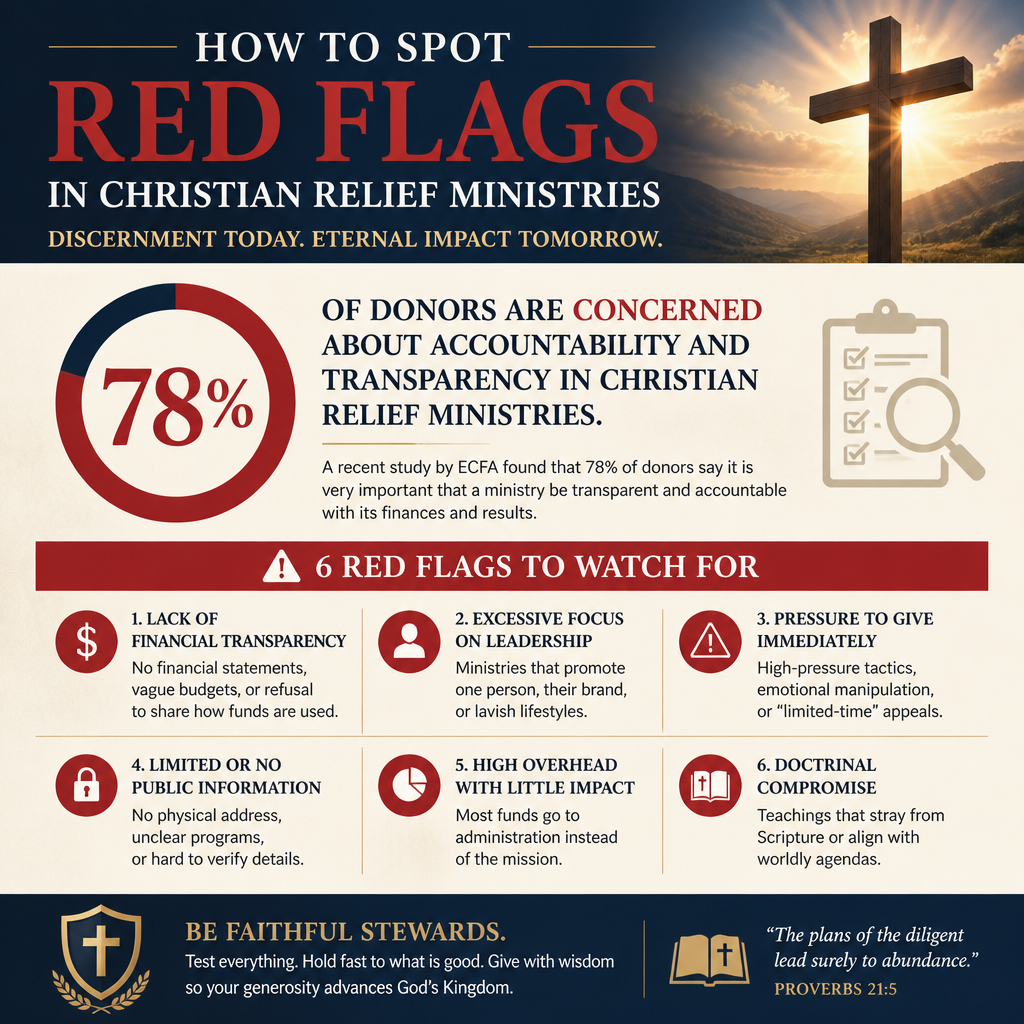
Transparency is not announcing everything; it is offering donors and stakeholders the information needed to evaluate faithfulness and effectiveness. Some ministries publish glossy reports while withholding the basic documents that allow real scrutiny.
Red flag: refusal to share standard documents
For U.S.-based nonprofits, the IRS expects public disclosure of Form 990, which is one reason donors have a baseline window into governance and finances. The IRS explains these public disclosure expectations at IRS. When a ministry refuses to share basic documents, or makes access unusually difficult, it is not being persecuted; it is likely avoiding accountability.
Red flag: metrics that are designed for fundraising rather than learning
Relief and development outcomes can be difficult to measure, and faithful work sometimes resists quantification. Yet a ministry should be able to show that it learns: it evaluates programs, identifies failures, and adjusts. If every report reads like a victory lap, donors should suspect that reality is being edited for appeal.
What this means in practice is that donors should look for disciplined transparency: audited financials when feasible, clear governance disclosures, safeguarding policies, and program reporting that names both progress and limitations. Across our verification work at Most Trusted, the ministries that meet The Most Trusted Standard tend to communicate this way because they have built systems that can withstand scrutiny, not merely messaging that can win attention.
FAQs for How to spot red flags in Christian relief ministries
Is it uncharitable to ask hard questions about a Christian relief ministry?
No. Scripture commends both generosity and prudence. Paul organized relief funds with multiple trusted handlers specifically to avoid any charge of misuse (2 Corinthians 8:20–21). Asking for clarity about governance, finances, and safeguarding is a form of love for beneficiaries, staff, and the donors whose gifts must be stewarded.
What should we do if we see a potential red flag but still respect the ministry’s spiritual fruit?
We recommend separating goodwill toward the people involved from confidence in the institution’s practices. Ask for documentation, not merely assurances. If the ministry responds with clarity and humility, that is often a positive signal. If it responds with deflection, spiritualized pressure, or hostility toward accountability, it may be wise to redirect giving to organizations with stronger safeguards. Many donors also find it helpful to compare ministries within Christian Relief and Development Ministries and to apply consistent criteria from How to Give Wisely to Christian Relief and Development Ministries.
Stewardship that protects the vulnerable
Relief giving is one of the clearest ways Christians can love neighbors in distress. It is also an arena where haste, emotion, and institutional weakness can produce preventable harm. Donors honor Christ when they refuse both cynicism and naivete, giving with compassion that is accountable, informed, and ordered toward the long-term good of those served.



