
How to give wisely to Christian relief and development ministries is ultimately a stewardship question before it is a tactical one. The need is real and urgent, but Christian donors are not asked to choose between compassion and discernment; Scripture binds them together, calling us to “do good… especially to those who are of the household of faith” while also requiring that “it is required of stewards that they be found faithful.”
The field itself has had to mature. Global relief can save lives within hours, yet the same interventions can unintentionally undermine local markets, weaken family systems, or concentrate power in ways that breed abuse. Development work can honor the dignity of communities over decades, yet it can also become indistinguishable from secular social service if Christian identity is treated as branding rather than confession. Wise giving does not avoid these tensions; it names them and funds ministries that show evidence of grappling with them honestly.
Start with a biblically serious definition of wise relief and development
Christian relief and development ministries operate where theology meets material vulnerability. When the Church provides food, shelter, medical care, and livelihood support, we are not merely “doing projects.” We are bearing witness that the God who reconciles all things in Christ also cares about bodies, households, and communities. Matthew 25 does not permit a gnostic spirituality that neglects hunger, displacement, imprisonment, or illness.
At the same time, wisdom in Scripture is not sentimental. Proverbs consistently treats wise action as disciplined action—measured, tested, and accountable. That matters because donors often encounter relief appeals at a moment of emotional intensity: a disaster, a war, a famine, a viral image of suffering. The question is not whether to respond; it is whether our response is aligned with truth, competence, and Christian love of neighbor.
Relief and development are related but not the same
Relief is the urgent provision of goods and services to preserve life and reduce immediate suffering. Development is the long work of restoring systems—agriculture, education, health, governance, household livelihoods—so communities can flourish without ongoing external subsidy. Many ministries do both, but the metrics, risks, and timelines differ. A ministry that is excellent at emergency logistics may not be competent in long-term economic strengthening, and a ministry built for patient community change may not be structured for rapid disaster response.
Harm reduction is part of Christian love
Christians genuinely disagree about how much weight to place on “do no harm” frameworks, especially when lives are at stake. Yet the field has learned that good intentions do not prevent negative outcomes. The When Helping Hurts framework, articulated by Steve Corbett and Brian Fikkert, has shaped a generation of Christian practitioners by arguing that poverty is not only a lack of material goods but also broken relationships with God, self, others, and creation, and that unwise aid can reinforce harmful dependency or paternalism. Wise donors look for ministries that can name these risks in plain terms and show how they mitigate them.
Integrity is part of Christian witness
Relief and development work often involves cash, procurement, cross-border operations, and partnerships in fragile contexts. That combination attracts fraud and amplifies the consequences of weak controls. A ministry’s theological fidelity and compassion are not substitutes for financial integrity and governance. In practice, giving wisely means treating accountability as a ministry value, not a donor preference.
Evaluate ministries by evidence, not only by appeal
Compelling storytelling is not proof of organizational health. Most Christian donors have learned this the hard way—through a ministry scandal, a vague financial report, or a program that sounded transformative but was never actually measured. The antidote is not cynicism. It is disciplined evaluation: looking for verifiable signals that a ministry is both spiritually grounded and operationally trustworthy.
Faith foundation that is more than a statement of beliefs
Many ministries can produce an orthodox doctrinal statement. Fewer demonstrate how faith shapes practice: how staff are formed, how local churches are respected, how evangelism and discipleship relate to mercy ministry, and how the ministry avoids coercion when serving vulnerable people. Wise donors ask whether the ministry’s Christian identity governs its decisions under pressure—especially in funding, partnerships, and safeguarding.
In some contexts, ministries downplay faith to maintain access or government partnerships. There can be legitimate security reasons for discretion, and Christians should not demand publicity that endangers local believers. But a mature ministry can explain the theological rationale for its posture and how it preserves Christian witness without putting beneficiaries at risk.
Financial integrity that can withstand scrutiny
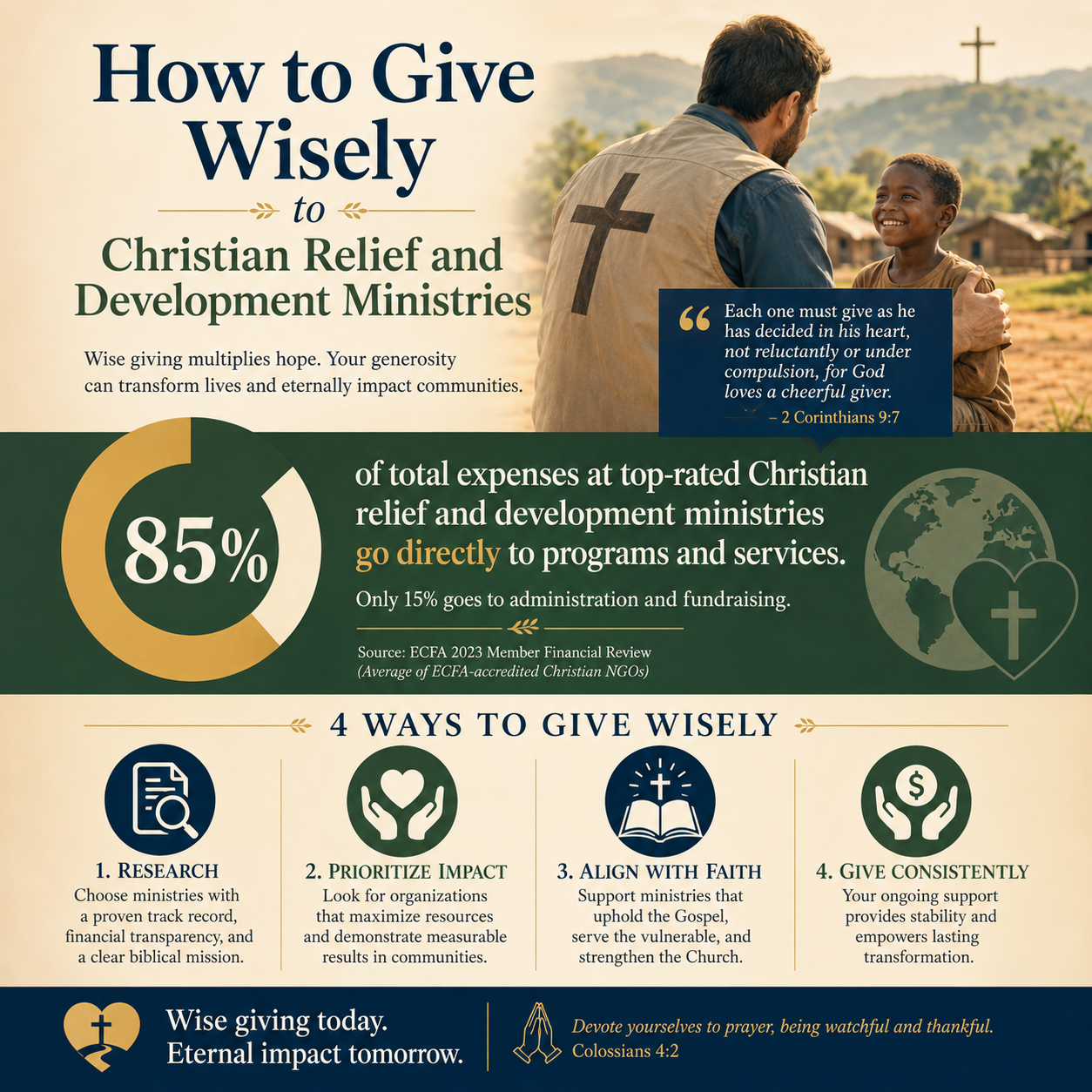
Audited financial statements, clear revenue concentration disclosures, conflict-of-interest policies, and transparent fundraising practices are not optional in a high-risk sector. In the United States, the IRS requires tax-exempt organizations to file Form 990, which provides a baseline view of governance, compensation practices, and program spending; donors can access these filings through the IRS Tax Exempt Organization Search https://apps.irs.gov/app/eos/.
We also recommend resisting simplistic rules about “overhead.” The leading charity evaluators have repeatedly argued that administrative and fundraising ratios can mislead and can even pressure organizations into underinvesting in controls and talent. Charity Navigator summarizes this position and the broader “Overhead Myth” critique on its site https://www.charitynavigator.org/. Wise donors ask a better question: does the ministry’s spending pattern fit its mission and risk profile, and is there evidence of disciplined stewardship over time?
Transparency that includes outcomes, not only activity
Counting outputs—meals served, wells drilled, shelters built—has value, especially in emergency response. But outputs can be achieved in ways that create long-term problems, and they often do not tell donors whether lives were sustainably improved. Mature ministries report outcomes where feasible: child nutrition status, household income changes, school attendance, reduced disease incidence, improved water functionality years after installation, or locally maintained supply chains.
Outcome measurement is not always clean. In conflict zones or post-disaster settings, rigorous evaluation may be unsafe or impossible. What we look for instead is intellectual honesty: does the ministry distinguish what it knows from what it hopes, and does it revise its approach when evidence points to weakness?
Ask governance questions that protect the vulnerable and the donor
Relief and development ministries often operate far from donors’ sight lines. That distance increases the moral importance of governance. Board oversight, leadership accountability, safeguarding systems, and partner due diligence are not bureaucratic add-ons; they are part of what it means to “provide things honest in the sight of all men.”
Board oversight and leadership accountability
Wise giving includes paying attention to who has authority. Is the board independent enough to oversee the CEO? Are there term limits or clear succession plans? Does the board have financial literacy and missional competence? A ministry that is effectively controlled by a founder with minimal oversight can accomplish much in early stages, but it carries outsized risk as budgets and staff expand.
Leadership accountability also includes candor in crisis. Donors should be wary of ministries that treat every criticism as persecution or every question as disloyalty. A Christian organization can defend its reputation without refusing legitimate scrutiny.
Safeguarding and the prevention of spiritual and physical abuse
Humanitarian contexts create conditions in which the vulnerable can be exploited: displaced families, unaccompanied minors, dependency on aid distribution, and power imbalances between expatriate staff and local communities. Wise donors ask whether safeguarding is formalized, resourced, and enforced. That includes background checks where possible, survivor-centered reporting pathways, training, restrictions on one-on-one access to minors, and clear consequences for violations.
Because Christian ministries also engage spiritual authority, safeguarding must include protection against coercion and manipulation. Beneficiaries should never feel that aid is conditional on conversion, church attendance, or public religious compliance. Ministries can proclaim Christ without trafficking in pressure.
Partnerships and local church respect
Many of the strongest Christian relief ministries work through local partners, including churches and indigenous NGOs. Done well, partnership honors local knowledge and strengthens civil society. Done poorly, it becomes a funding pipeline that imports foreign assumptions and weakens local legitimacy. Wise donors ask how partners are vetted, how funds are monitored, and whether local leaders have meaningful voice in program design.
Give in ways that match the ministry model and the moment
Even a strong ministry can be funded unwisely. The structure of the gift—restricted versus unrestricted, one-time versus recurring, designated to a crisis versus invested in capacity—shapes what a ministry can do and whether it can do it with integrity.
Emergency appeals require speed, but they still require verification
Disaster fundraising is where scammers and poorly governed organizations thrive. Wise donors move quickly but not impulsively: confirm the organization’s legal status, review recent financials, and look for evidence of credible field partnerships. In complex crises, it is also wise to ask what portion of funds will be used for immediate relief versus longer-term recovery, and how the ministry will report back when media attention fades.
Development usually requires patient capital
Long-term development is rarely suited to one-off gifts tied to a donor’s momentary attention. Agricultural training, microenterprise support, trauma-informed care, community health systems, and church-based discipleship initiatives require time and stability. Many ministries will do better work with a multi-year commitment that funds staff continuity, monitoring, and local capacity-building.
This is also where donors can do the most good by resisting “project fetish.” A well-run ministry needs accounting staff, compliance systems, cybersecurity, HR, field audits, and staff development to prevent failure and abuse. Funding that ignores these needs can force ministries into false economies that eventually harm beneficiaries.
Designations are not always the most faithful choice
Christians often prefer restricted gifts because restrictions feel like control and control feels like stewardship. Yet restrictions can also create distortions: oversupplying a popular program, underfunding safeguarding, or encouraging a ministry to chase donor preferences rather than field realities. Wise donors ask whether a designation helps the ministry do what it is actually equipped to do, and whether it introduces pressure to report success in ways that are not fully honest.
Where trust has been earned, unrestricted or lightly restricted giving is often the form of generosity that most strengthens integrity.
Where Most Trusted fits in wise Christian giving
Many donors do not have time to evaluate governance documents, financial audits, safeguarding policies, and outcome reporting across multiple ministries. Most Trusted exists to serve that need. We are an independent verification service for Christian nonprofits, evaluating ministries against The Most Trusted Standard, a 15-criteria framework spanning Faith Foundation, Financial Integrity, Governance and Leadership, and Transparency and Effectiveness.
What this means in practice is that we look for consistent evidence, not isolated signals: a ministry that teaches sound doctrine and also submits to meaningful oversight; a ministry that tells compelling stories and also publishes credible financial reporting; a ministry that pursues measurable good and also protects the vulnerable when no donor is watching. Donors seeking a broader view of the sector can also consult our coverage of Christian Relief and Development Ministries as they compare organizations and giving opportunities.
Wise giving is confidence disciplined by truth
Christian donors are not called to paralysis by analysis, nor to naive enthusiasm. We are called to love with wisdom: to fund work that is faithful to Christ, competent in practice, and accountable in governance. The ministries most worthy of support tend to welcome serious questions, publish meaningful evidence, and treat safeguarding and integrity as part of their discipleship before God.



