
Learning how to spot red flags in child sponsorship ministries is not a cynical exercise; it is a stewardship responsibility. Scripture binds God’s people to protect children and to pursue honesty in our dealings, because God himself “loves righteousness and justice” (Psalm 33:5). The Christian donor’s question is not whether to care, but how to ensure our care does not subsidize harm, manipulation, or half-truths.
Child sponsorship sits at the intersection of discipleship, development practice, and fundraising. Done well, it can stabilize a family, keep a child in school, and strengthen a local church’s long-term presence. Done poorly, it can commodify children, distort local incentives, and mislead donors who sincerely want to honor Christ with their giving.
1) Misrepresentation of the child and the program
Photographs and narratives that function as fundraising property
A first red flag is when the ministry’s communications treat a child’s image and story as fundraising property rather than as a neighbor’s dignity to be guarded. Some organizations publish full names, precise locations, or deeply personal details that would never be shared about a donor’s own child. Others circulate stock images while implying they represent specific sponsored children, or send letters that read as if written by the child but are heavily scripted or translated without disclosure.
Christians should not confuse emotional vividness with truth. The ninth commandment forbids false witness, and that includes the subtler forms of deception that can creep into donor communications: selective editing that changes the meaning, manufactured “before and after” contrasts, or claims that imply one donor’s monthly gift is the direct cause of outcomes that are actually funded by pooled revenue.
Ambiguous language about where money goes
Many reputable sponsorship programs pool funds for community-level impact while still facilitating personal connection through letters and prayer. That model can be legitimate. The red flag is evasive language: “100% goes to your child” without clear definitions, or promises that are impossible to audit in practice.
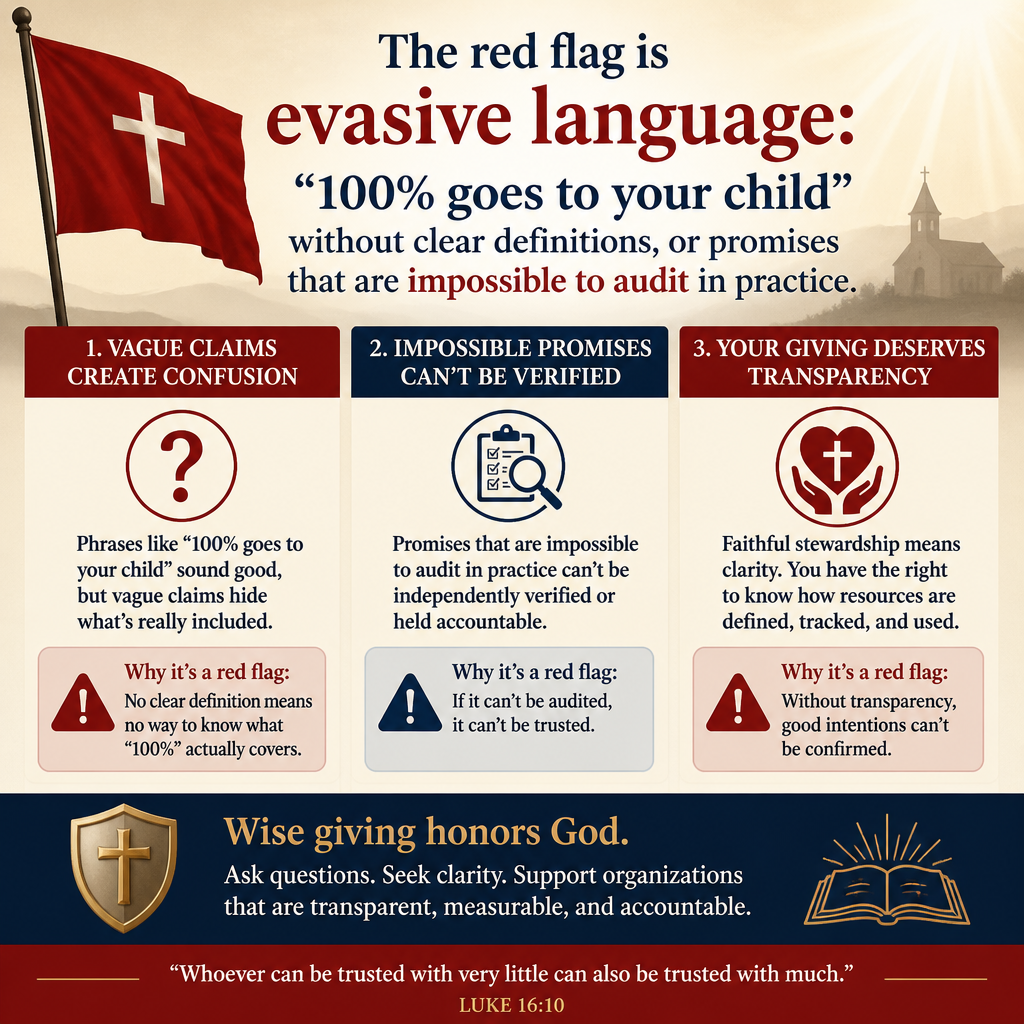
What this means in practice is that donors should expect plain statements such as: whether funds are restricted to a specific child, how pooled funds are allocated, and what portion supports administration and monitoring. Transparency is not a cosmetic virtue; it is the basis for meaningful consent.

2) Incentives that separate children from families
Institutional care promoted as the default solution
The global orphan care movement has had to reckon with a hard truth: many children labeled “orphans” still have a living parent or extended family. International agencies have urged a shift away from unnecessary institutionalization toward family-based care, kinship support, and reintegration where possible. UNICEF has repeatedly emphasized that poverty is often misread as abandonment and that residential care should be a last resort, not a fundraising centerpiece; see UNICEF’s global guidance at https://www.unicef.org/.
A child sponsorship ministry is not automatically disqualified if it partners with residential programs, especially in crisis settings. The red flag is when the ministry’s public messaging makes institutional placement sound like the normal or preferred pathway, or when it lacks clear reintegration goals and family-strengthening investments.
Recruitment practices that create perverse demand
Another red flag is when local staff are incentivized primarily by the number of “new sponsored children” rather than by measured improvements in child well-being and family stability. When the main performance metric is enrollment, programs can drift toward recruitment behavior that undermines the very families sponsorship is meant to strengthen.
Serious ministries name these risks and build safeguards: eligibility criteria, community verification, and periodic reassessments to ensure support does not unintentionally pull children away from kinship care. If an organization cannot describe such safeguards, donors should slow down.
3) Weak financial integrity and unclear use of restricted gifts
Missing audits and opaque financial reporting
Child sponsorship is a high-trust fundraising model. The ministry is asking donors to believe a personal story, month after month, across borders and languages. A corresponding level of financial clarity should follow. A red flag is the absence of audited financial statements for larger organizations, or reports that disclose broad totals but not program categories and geographic allocation.
In the United States, reputable nonprofits file Form 990, and it should be readily accessible. Donors can also look for whether the organization’s board is independent enough to provide oversight, and whether there is a clear conflict-of-interest policy.
Promises that cannot be reconciled with accounting reality
If the ministry promises donors that a fixed amount “goes directly to your child” while also maintaining large marketing budgets and extensive field operations, donors should ask how those costs are funded. Sometimes the answer is legitimate: separate unrestricted revenue, grants, or a different funding stream. The red flag is when the ministry cannot reconcile its promises with ordinary accounting categories, or discourages questions as “unspiritual.”
Across our verification work at Most Trusted, ministries that meet The Most Trusted Standard tend to treat financial reporting as part of discipleship: an honest accounting before God and neighbor, not a defensive posture before critics.
4) Governance and safeguarding that are asserted rather than demonstrated
Safeguarding policies without evidence of implementation
A child-focused ministry should be able to describe its child protection framework with specificity: staff screening, background checks where feasible, mandatory reporting, boundaries for communications, and protocols for visits. Vague statements such as “we care about child safety” are not enough, particularly when sponsorship includes direct donor-child correspondence or in-person trips.
Donors should also look for whether the organization aligns with recognized safeguarding expectations in the sector. Many ministries reference standards developed by groups such as Keeping Children Safe; see https://www.keepingchildrensafe.global/. The relevant question is not whether a badge appears on a website, but whether the ministry can show training cadence, incident reporting channels, and board-level oversight of safeguarding.
Board weakness and leadership concentration
Red flags in governance often appear as concentration of power: a founder-led board with minimal independence, related-party transactions, or a lack of documented oversight of field partners. Child sponsorship typically involves complex international subgrants and partnerships; weak governance increases the probability that problems go undetected until they become public failures.
Christians genuinely disagree about how to weigh charismatic leadership and entrepreneurial risk in mission work. Yet Scripture is not ambiguous that leaders are to be “above reproach” and that the church must exercise discernment (1 Timothy 3:2; 1 John 4:1). Accountability is not distrust; it is love of truth.
5) Transparency and effectiveness that do not match the claims
Outcomes talk without measurement discipline
A sponsorship ministry may speak movingly about hope, dignity, and transformation. Those are Christian realities, but they do not remove the need for evidence. A red flag is when the ministry claims broad impact—graduation increases, poverty reduction, spiritual renewal—without defining what is measured, how it is measured, and what the limits are.
Strong ministries can name practical indicators (school attendance, child health screenings, household economic stability, child protection referrals) and explain what is attributable to the program versus what is correlated. They can also acknowledge failures. The harder question is whether a ministry’s communications permit complexity, or whether every story is edited into predictable victory.
Donor experience designed to reduce questions
Some sponsorship models are built to create a frictionless donor experience: automatic updates, standardized letters, and emotional appeals that implicitly equate continued giving with continued love. The red flag is when a ministry makes it difficult to ask for documentation, policy details, or program evaluations, or when it treats donor discernment as disloyalty.
One useful test is whether the ministry can answer clear questions in writing and point to public documents. Donors should be able to locate consistent information across the website, annual report, and Form 990, without contradictions or missing categories.
- Can the ministry explain, plainly, whether funds are pooled or restricted to a specific child?
- Are audited financial statements or equivalent third-party financial reviews available for larger organizations?
- Does the ministry publish a child safeguarding policy and describe how it is implemented and overseen?
- Are board oversight and conflict-of-interest policies documented and credible?
- Do outcomes claims include definitions, methods, and limitations rather than only stories?
For donors who want a broader frame for discerning ministries in this space, our coverage of Child Sponsorship Ministries names common models, recurring risks, and what credibility tends to look like when it is earned over time.
FAQs for How to spot red flags in child sponsorship ministries
Is it a red flag if my sponsorship gift is not allocated only to my specific child?
Not necessarily. Many responsible programs pool sponsorship revenue to fund services that benefit the sponsored child and the wider community, such as school support, health screenings, or family economic strengthening. The red flag is not pooling; it is implying one-to-one allocation while operating a pooled model, or refusing to describe the allocation method. Donors should expect clear language and consistent financial reporting that matches the claim.
What documentation should a credible child sponsorship ministry provide?
At minimum, donors should be able to find governing documents and public reporting appropriate to the organization’s size and context: audited financial statements for larger organizations, Form 990 for U.S. nonprofits, a board list, conflict-of-interest policy, a child safeguarding policy with implementation details, and an annual report that describes activities and results with definable indicators. Where the ministry works through field partners, donors should also expect an explanation of partner vetting and monitoring.
Giving with both compassion and discernment
Child sponsorship can be a faithful expression of Christian mercy when it strengthens families, protects children, and tells the truth about what a donor’s gift does and does not do. When red flags appear, the appropriate response is not withdrawal from child-focused ministry, but a higher standard of evidence and accountability consistent with Christian stewardship.
Most Trusted exists to serve that discernment. We evaluate Christian nonprofits against The Most Trusted Standard, so donors can support ministries whose governance, finances, and child-centered practices bear the weight of the trust they request. Donors seeking practical guidance within this category can also consult How to Give Wisely to Child Sponsorship Ministries for additional decision points that separate compelling marketing from credible care.



