

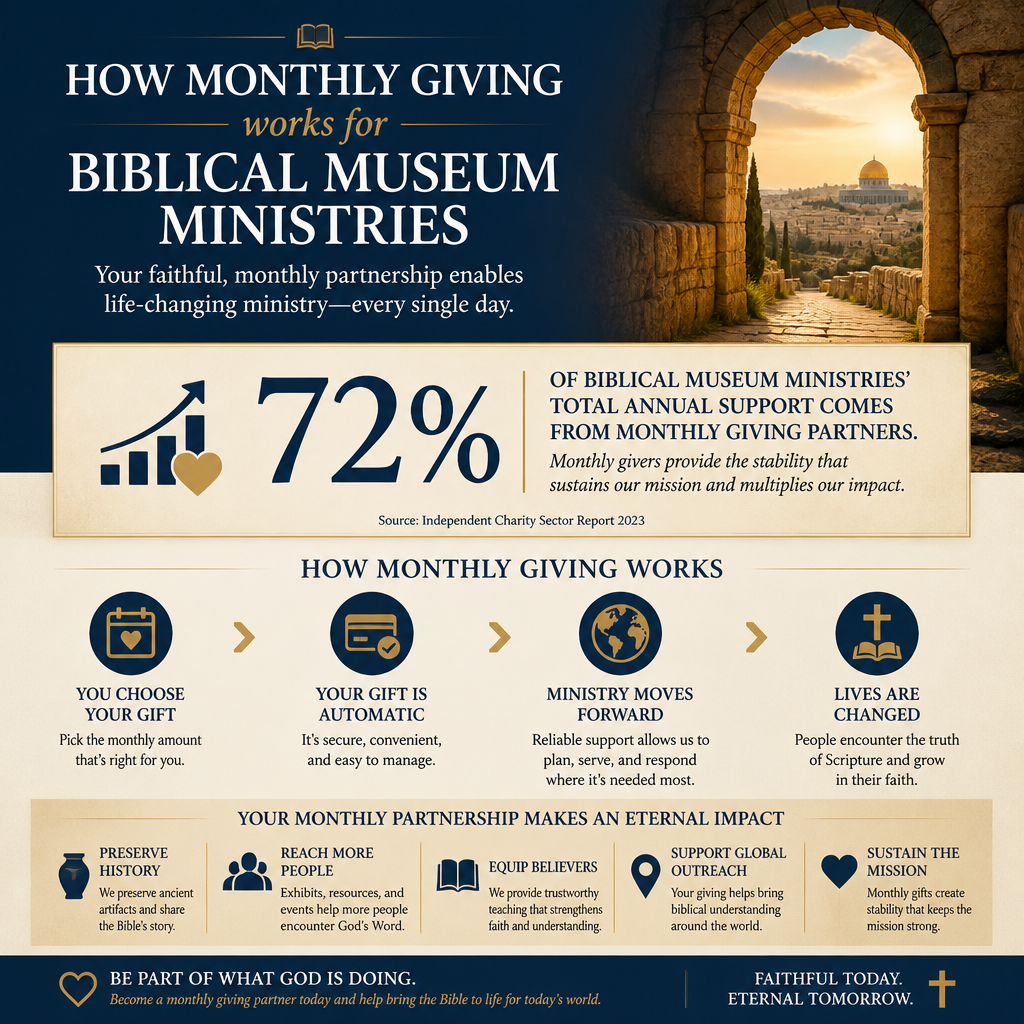
Monthly giving for biblical museum ministries is less about convenience than about sustaining long obedience in a work that is inherently long-range. Museums preserve artifacts, curate scholarship, build educational programs, and host public conversations that unfold over years, not weeks. Christian donors who care about the credibility of the biblical story in the public square often recognize the need for steady funding; the harder question is how monthly giving actually functions inside a museum ministry and what faithful stewardship should ask of it.
Done well, monthly giving becomes a disciplined partnership: donors provide predictable support, and ministries provide verifiable clarity about how that support advances a mission that serves the church and bears witness to the world. Done poorly, recurring revenue can quietly subsidize weak governance, unexamined assumptions about impact, or a marketing engine that grows faster than the ministry’s capacity to deliver truthful work. Christian donors have good reason to insist on both theological seriousness and operational credibility.
Monthly giving is a covenantal rhythm, not merely a payment method
Why recurring gifts fit museum work
Biblical museum ministries carry costs that do not map neatly to the church’s annual calendar. Collections care requires climate control, conservation planning, insurance, and specialist labor. Educational programming requires long lead times and stable staffing. Research and publication require patient investment. Monthly giving aligns with these realities by reducing volatility and allowing responsible planning.
Scripture frames faithful stewardship as steady, accountable management of resources entrusted by God. Jesus’ parable of the talents commends servants who act with diligence and foresight rather than fear or spectacle (Matthew 25:14–30). A recurring gift is not inherently more spiritual than a one-time gift, but it often reflects a donor’s willingness to fund the unglamorous, faithful work that makes public ministry credible.
What monthly giving changes inside the ministry
Predictable revenue can improve decision-making. When leadership can forecast a baseline of support, it can avoid reactionary fundraising tactics and reduce the pressure to chase attention. The result can be a calmer operating environment, better staff retention, and fewer compromises on scholarly and educational integrity.
There is a countervailing risk: recurring revenue can become “invisible money,” received with less scrutiny than project-based gifts. Mature donors do not confuse consistency with accountability. Ministries that deserve monthly support treat it as trust to be stewarded, not as an entitlement.
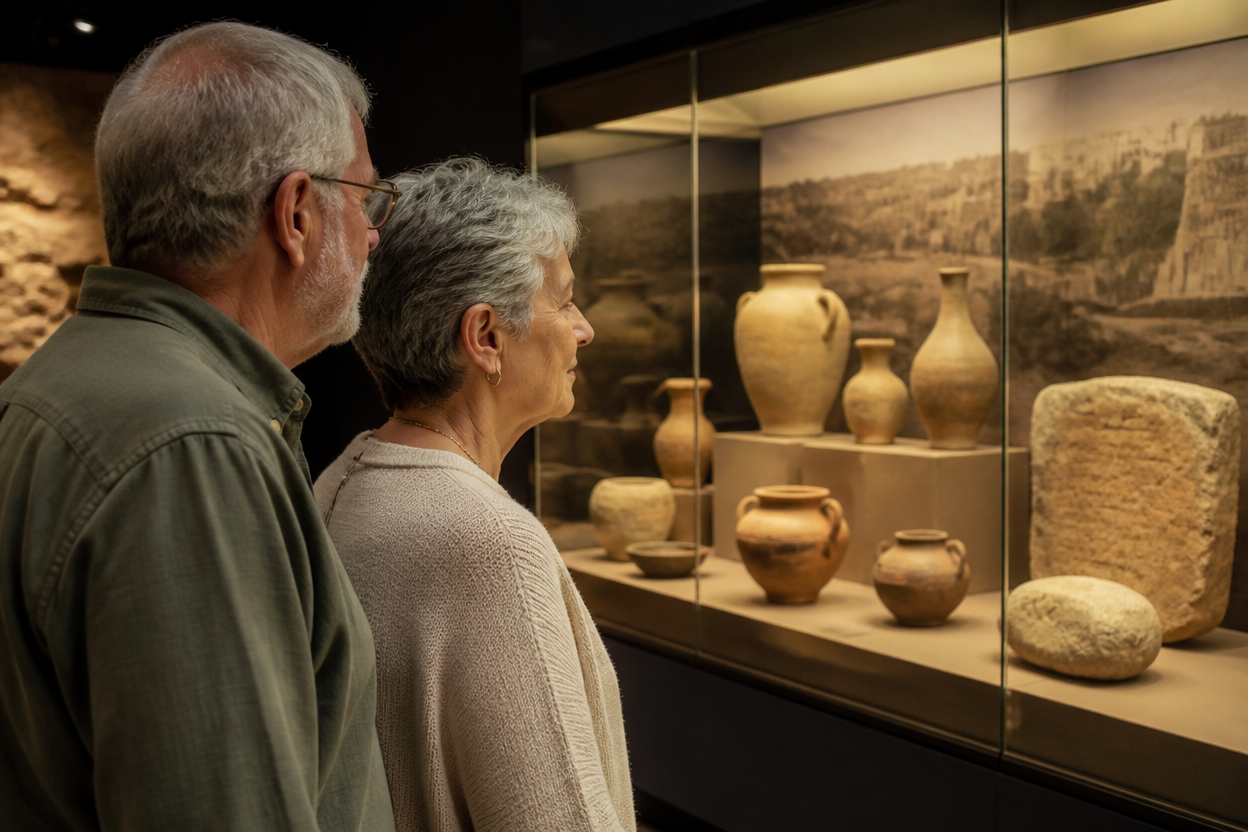
The best monthly programs connect recurring support to real costs and measurable work
General operating support is not the enemy of impact
Museums are often tempted to market only what feels tangible: an exhibit build, a new acquisition, a school program. Those are legitimate needs, but they rest on infrastructure donors rarely see. Effective monthly giving programs typically fund core operations—staffing, collections care, visitor services, educational delivery, and compliance—because those functions make mission delivery possible.
Christian donors sometimes worry that “overhead” is wasted. The modern nonprofit sector has had to correct that assumption. Charity Navigator, Candid (formerly GuideStar), and the BBB Wise Giving Alliance publicly argued that overhead ratios are a poor proxy for effectiveness in their joint statement on the “overhead myth” (Charity Navigator). A biblical museum that starves governance, compliance, and competent staff will eventually pay for it through errors, reputational damage, or mission drift.
But donors can still ask for clarity
The goal is not to demand artificial precision, as if every dollar can be traced to a single outcome. The goal is to require honest, intelligible allocation. Monthly donor communications should do more than celebrate attendance numbers; they should describe what was actually accomplished and what constraints remain. If a museum ministry claims it is “changing culture,” donors should expect a disciplined explanation of how exhibits, publications, school partnerships, or pastoral resources plausibly contribute to that claim.
For donors seeking a broader view of the field, we maintain editorial coverage of Biblical Museum Ministries so recurring support can be anchored in a realistic understanding of the ministry landscape, not only in a single organization’s messaging.
Monthly giving introduces governance and integrity questions donors should not ignore
Recurring revenue can either strengthen or weaken accountability
Stable income is a gift, but it can reduce healthy urgency. The ministries that remain trustworthy over time usually build governance practices that discipline leadership: independent boards, meaningful conflict-of-interest policies, audited or reviewed financials appropriate to scale, and transparent reporting that does not rely on curated stories alone.
Across our verification work at Most Trusted, we observe that recurring donor programs are most reliable when they sit inside a broader culture of institutional accountability—clear doctrinal commitments, careful financial controls, and transparent communication about both successes and setbacks. A monthly program cannot compensate for weak governance; it will eventually reveal it.
Key warning signs in museum ministries
Because biblical museums often operate in contested intellectual territory, reputational pressures can tempt ministries toward exaggeration. Donors should be especially attentive to how a museum describes evidence, scholarship, and uncertainty. Institutions that routinely overclaim may also overpromise in fundraising.
A few practical indicators tend to matter more than glossy donor materials:
- Independent board oversight that is visible and meaningful, not nominal
- Financial statements that show disciplined expense categories and reasonable reserves
- Publicly available leadership information and conflict-of-interest disclosures
- Clear policies for acquisitions, provenance, and ethical collections management
- Donor communications that avoid sensationalism and acknowledge limits
Donors should also consider what the wider nonprofit community has learned about impact claims. The “starvation cycle,” described by Gregory and Howard, explains how pressure to minimize overhead can lead nonprofits to underinvest in capacity and then underperform, reinforcing donor skepticism (Stanford Social Innovation Review). Museums are particularly vulnerable because high-quality curatorial and educational work is labor-intensive and rarely cheap.
How monthly giving should be structured to honor donors and protect mission
What a responsible monthly donor journey includes
A ministry that respects donors does not treat monthly giving as a one-time conversion event. It provides a clear path from invitation to informed partnership. That includes straightforward giving terms, transparent receipts, and the ability to change or stop a gift without friction. Christians should never feel trapped by a ministry’s recurring program.
Responsible programs also communicate at a pace that serves donors rather than exploiting them. A monthly gift does not require monthly emotional escalation. Donors can reasonably expect periodic reporting that is specific, truthful, and commensurate with the size of the organization.
Where The Most Trusted Standard fits
At Most Trusted, we evaluate Christian nonprofits against The Most Trusted Standard, a 15-criteria framework spanning faith commitments, financial integrity, governance, and transparency and effectiveness. For monthly givers, this kind of evaluation matters because recurring support increases relational and moral proximity. When a donor gives every month, the donor becomes a quiet co-sustainer of whatever is happening inside the institution—for good or for ill.
Verification is not a substitute for discernment, but it can strengthen it. The point is not to eliminate risk; it is to ensure that trust is warranted by evidence. Monthly giving is most fruitful when donors can name why the ministry is faithful to its convictions, competent in its operations, and candid with its supporters.
Discerning whether to give monthly to a biblical museum ministry
Questions that clarify fit and faithfulness
Christian donors genuinely disagree about the proper relationship between apologetics, scholarship, and evangelistic aims. Some want museums to argue; others want them to illuminate. Those differences are not merely strategic; they can reflect different instincts about how truth persuades in a secular age. Monthly giving should follow conviction, not impulse.
In practice, the most helpful questions are usually concrete. What does the museum claim its mission is, and is that mission consistent with orthodox Christian faith? How does it demonstrate intellectual honesty? What does it do with controversy—does it clarify, correct, and improve, or does it deflect? How does it treat scholars, pastors, and educators as stakeholders rather than as audiences to be impressed?
How donors can calibrate the size and purpose of a monthly gift
Not every donor must give monthly. Some donors are better positioned to fund time-bound projects or capital needs; others can underwrite scholarships for school groups, pastoral training events, or digitization initiatives. Monthly giving makes particular sense when a donor wants to strengthen the institution’s ongoing capacity: staffing stability, collections care, and educational continuity.
For donors considering recurring support across multiple organizations, we publish guidance within How to Give Wisely to Biblical Museum Ministries, since wise giving is often about portfolio discipline: aligning gifts with a coherent theology of stewardship and a realistic assessment of institutional health.
FAQs for How monthly giving works for biblical museum ministries
Is monthly giving better than a one-time gift for a biblical museum ministry?
Monthly giving is not morally superior, but it is often operationally valuable. Museums carry ongoing costs—collections care, staffing, education delivery, and facilities—that benefit from predictable support. A one-time gift can be decisive for a discrete need, while a monthly gift can strengthen long-term capacity. The wise choice depends on the ministry’s needs and the donor’s intent.
What should monthly donors expect from a trustworthy biblical museum ministry?
Monthly donors should expect transparent communication about mission and results, financial reporting appropriate to the organization’s scale, visible governance practices, and the ability to adjust or stop giving without friction. They should also expect intellectual honesty in how the ministry presents evidence and handles uncertainty, especially when operating in contested public conversations about the Bible.
Monthly giving is a form of sustained witness
Biblical museum ministries do not merely manage exhibits; at their best, they serve the church by preserving memory, cultivating understanding, and strengthening public confidence that Christian faith is not allergic to truth. Monthly giving works when it funds that patient work without distorting it. Christian donors can give consistently while still giving critically, insisting that trust be earned through verifiable integrity and faithful mission.



