
How prison ministry supports children of incarcerated parents is not a peripheral question for Christian donors. It sits at the intersection of Jesus’ command to visit those in prison and Scripture’s insistence that God is “Father of the fatherless” (Psalm 68:5), a title that rebukes any spiritualized compassion that never reaches families living with separation, stigma, and practical need.
The field is also morally complex. Incarceration can be the consequence of grave harm. Some children are safer with a parent absent; some caregivers are overwhelmed; some systems are predatory. Christian mercy does not deny these realities. It insists that children should not be made to bear a sentence they did not receive, and that the church has a concrete vocation to protect, stabilize, and disciple them while justice runs its course.
Children experience incarceration as a family crisis, not a legal event
Separation reshapes a child’s world overnight
When a parent is incarcerated, children often lose more than a relationship. They may lose housing, school continuity, routines, and community standing. The immediate crisis tends to be practical—who will pick them up, where they will sleep, whether a caregiver can absorb another mouth—but the lasting damage is frequently relational. Attachment fractures, shame hardens, and a child’s sense of safety becomes provisional.
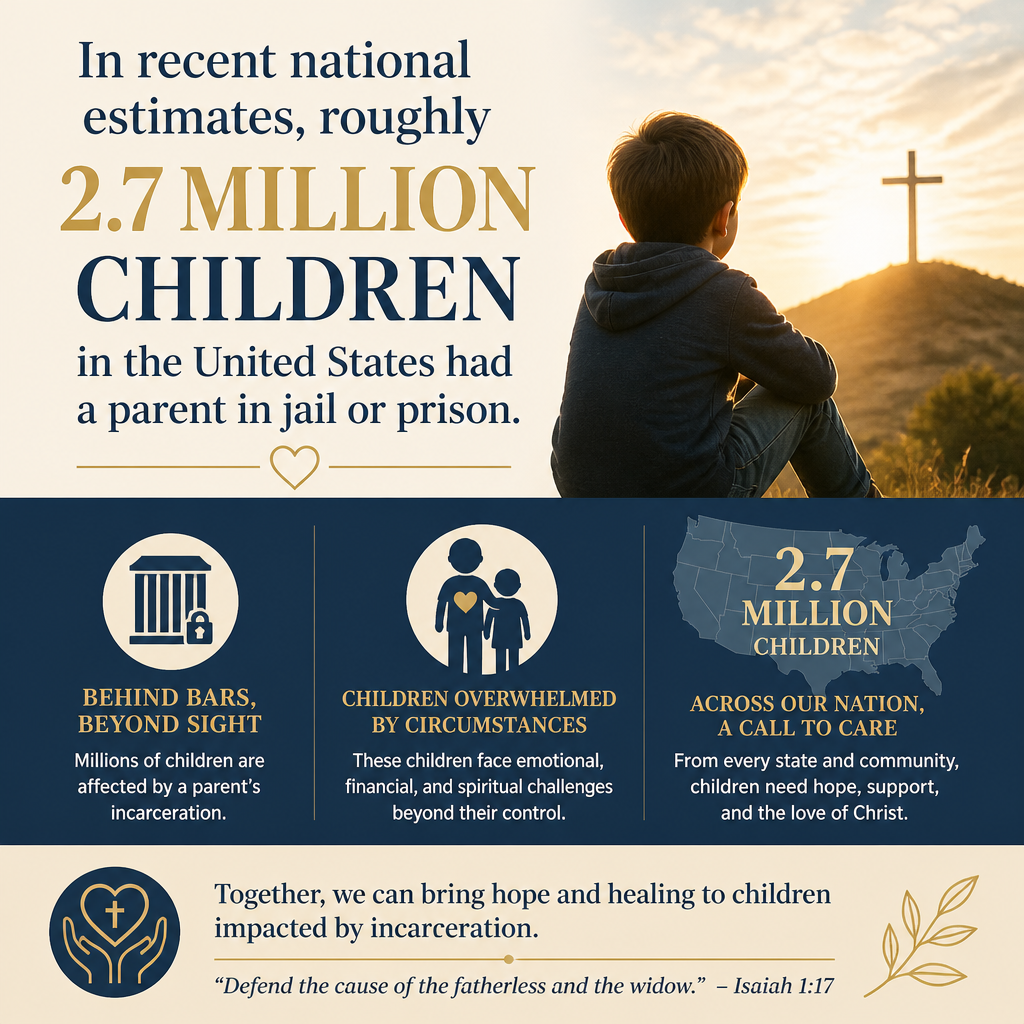
Verifiable evidence suggests this is not a rare pastoral edge case. In recent national estimates, roughly 2.7 million children in the United States had a parent in jail or prison. Bureau of Justice Statistics
Stigma turns children into invisible sufferers
Many children learn early that telling the truth carries social cost. Schools, churches, and extended family may respond with suspicion or avoidance rather than support. This is one reason prison ministry that focuses only on the incarcerated adult can miss a major locus of suffering. The child is still in the community, still sitting in classrooms, still trying to pray, still trying to form an identity. The question for donors is whether ministries are structured to see them.

Prison ministry becomes child ministry when it strengthens the caregiving network
Most children are being raised by someone else
For many families, incarceration shifts parenting responsibility to grandparents, aunts and uncles, or other kin. That transition can be loving and stabilizing, but it can also be financially and emotionally precarious. Child-focused prison ministries often start by serving the adults who show up every day: the caregiver who is suddenly managing trauma behaviors, court dates, school meetings, and a child’s questions about God.
Government data underscores how commonly grandparents carry this load. In 2021, about 2.3 million grandparents reported being responsible for their grandchildren under age 18 who lived with them. U.S. Census Bureau
Stability requires more than gifts and visits
Christians genuinely disagree about what a “good” program looks like here. Some emphasize material assistance; others emphasize counseling and spiritual formation; others prioritize advocacy in schools or systems. In practice, the ministries that serve children well tend to treat stability as an ecosystem: caregiver support, predictable rhythms, trustworthy adults, and clear pathways to professional help when trauma symptoms escalate beyond the capacity of volunteers.

This is where donors should apply discernment shaped by humility. Families are not projects. A child’s story is not a marketing asset. Serious prison ministries build safeguards around privacy, consent, and the dignity of the child and caregiver, even when that reduces the kind of content that performs well in fundraising.
Healthy contact with an incarcerated parent can be protective, but it must be wise
Connection can reduce harm when it is safe and supported
Not every parent-child relationship should be preserved in the same way. Some parents have perpetrated violence or abuse; some remain actively dangerous. Yet where contact is appropriate, the research literature generally treats stable family connection as a protective factor for both children and incarcerated parents. For example, the National Institute of Justice has summarized evidence that family contact is associated with improved post-release outcomes and can support reentry success. National Institute of Justice
The Christian claim beneath this work is not sentimentality; it is the doctrine of the imago Dei. Even where consequences are necessary, a human being is not reducible to his or her worst act. Children need language that can hold truth and hope together: wrongdoing is real; accountability is real; repentance is real; and God is able to rebuild what sin has shattered.
Programs must not romanticize reconciliation
Wise prison ministries do not pressure children to perform forgiveness, or caregivers to facilitate contact regardless of risk. They coordinate with legal requirements, mental-health guidance, and the child’s actual wellbeing. Some ministries support letter-writing programs that are supervised and age-appropriate. Others facilitate structured family days where volunteers, chaplains, or trained staff create a calmer environment for interaction. The moral test is not whether a photo opportunity exists, but whether the child leaves less burdened, more secure, and more truthfully seen.
Donors should fund ministries that pair compassion with verifiable integrity
Children-centered outcomes require disciplined stewardship
Because prison ministry touches vulnerable children, it carries elevated risks: boundary violations, spiritual manipulation, careless data practices, and programs built on charismatic personalities rather than accountable systems. Donors should not assume that passion guarantees protection. Serious compassion is structured compassion.
At Most Trusted, our verification work emphasizes that ministries serving high-vulnerability populations should demonstrate mature governance, clear safeguarding policies, and financial integrity that can be reviewed without defensiveness. The Most Trusted Standard evaluates ministries across faith commitments, stewardship, leadership accountability, and clear communication of results. Donors are not being cynical when they ask for evidence; they are practicing Christian stewardship.
What donor diligence looks like in practice
When evaluating programs that serve children of incarcerated parents—whether the ministry is centered on prison visitation, caregiver support, or reentry—clarity matters. The following questions tend to separate serious work from sentiment-driven work:
- Are child protection and background-check practices written, enforced, and reviewed?
- Does the ministry partner appropriately with churches, schools, and licensed clinicians when needed?
- Are spiritual goals articulated without coercion, and are services offered with respect for family dynamics?
- Is financial reporting accessible, consistent, and tied to program reality rather than vague aspiration?
- Are outcomes described in ways that protect privacy and avoid exploiting children’s stories?
For donors who want broader context on how incarceration and reentry ministries function across the ecosystem, our coverage of Prison and Post-Prison Ministries situates child-focused work within the wider Christian obligation to those behind bars and those returning home.
Programs that serve mothers and children face distinct pressures and opportunities
Maternal incarceration often destabilizes caregiving more abruptly
When mothers are incarcerated, children’s living arrangements can change quickly because mothers are more likely to have been primary caregivers. The resulting disruption can be severe even when extended family steps in. Ministries that work in women’s facilities frequently encounter acute needs around pregnancy, childbirth, breastfeeding decisions, and early childhood separation, all of which carry spiritual and psychological weight.
These realities shape what child support should look like. A ministry that serves incarcerated women well will often provide parenting classes grounded in both Scripture and evidence-informed practice, help mothers communicate appropriately with children, and coordinate with caregivers on the outside so that children are not caught in adult conflict.
Care must avoid both naïveté and contempt
Christian donors sometimes feel pulled between two moral instincts: compassion for children and anger at the adult whose choices helped create the crisis. Mature giving can hold both. We can insist on accountability for wrongdoing while also refusing to punish children through neglect. We can also resist the opposite error: treating incarceration as merely misfortune and bypassing the moral formation and restitution that repentance requires.
Because this work sits close to contested questions—sentencing, family courts, substance use, domestic violence—donors should favor ministries that demonstrate a capacity for case-by-case discernment rather than one-size-fits-all ideology. For donors focused specifically on women and mothers, Prison Ministry for Incarcerated Women and Mothers addresses the distinctive program models and safeguarding considerations in this subset of the field.
FAQs for How prison ministry supports children of incarcerated parents
Should Christian donors prioritize ministries that serve the incarcerated parent or the child?
Wise donors usually resist the forced choice. Children often need stable caregivers, pastoral care, and practical support in the community, while incarcerated parents may need discipleship, addiction recovery support, and preparation for reentry. The most credible ministries can explain how their work reduces harm for children without making children a fundraising instrument, and how they coordinate with caregivers and local churches so that care continues after release.
What red flags should donors watch for in ministries serving children affected by incarceration?
Common red flags include vague safeguarding policies, heavy reliance on unsupervised volunteers, pressure on children to share their stories publicly, unclear finances, and programs built around one charismatic leader with limited governance. Donors should also be cautious of ministries that promise quick reconciliation without addressing safety, trauma, and legal realities. The strongest organizations can show written policies, accountable leadership, and outcomes described with both humility and specificity.
Why this work belongs in serious Christian stewardship
Children of incarcerated parents are often present in our churches and neighborhoods, but their burdens are easy to miss because they are borne quietly. Prison ministry supports them best when it refuses sentimental shortcuts: it strengthens caregivers, protects children, and pursues wise connection to parents when appropriate. Donors who give with discernment—seeking ministries marked by theological seriousness and verifiable integrity—participate in a work of mercy that Scripture treats as neither optional nor abstract.



