
Prison ministry for incarcerated women and mothers sits at the intersection of justice, family fracture, trauma, and the credibility of the church. For Christian donors, the question is rarely whether women in prison deserve spiritual care; Scripture settles that. The harder question is whether our giving will strengthen what God intends—repentance, restoration, and the protection of children—or whether it will fund activity that is sincere but ineffective.
Jesus placed prison visitation among the defining works of mercy in Matthew 25. That does not exempt donors from discernment. Women’s incarceration is often accompanied by histories of abuse, addiction, and profound relational loss, and mothers face particular spiritual and practical pressures: separation from children, court deadlines, custody decisions, and the long shadow of reentry. Giving well requires understanding both the institutional realities of corrections and the pastoral realities of motherhood under confinement.
Why ministry to incarcerated women and mothers is not a niche concern
Ministry behind bars is not merely a charitable add-on to the church’s mission; it is an arena where the gospel confronts shame, power, and identity at close range. For incarcerated women, the presenting issues often include guilt and regret, but also coercion, exploitation, and complex trauma. A ministry that only addresses “bad decisions” may miss the deeper work of naming harm truthfully, calling sin what it is, and holding out the possibility of new creation without sentimentality.
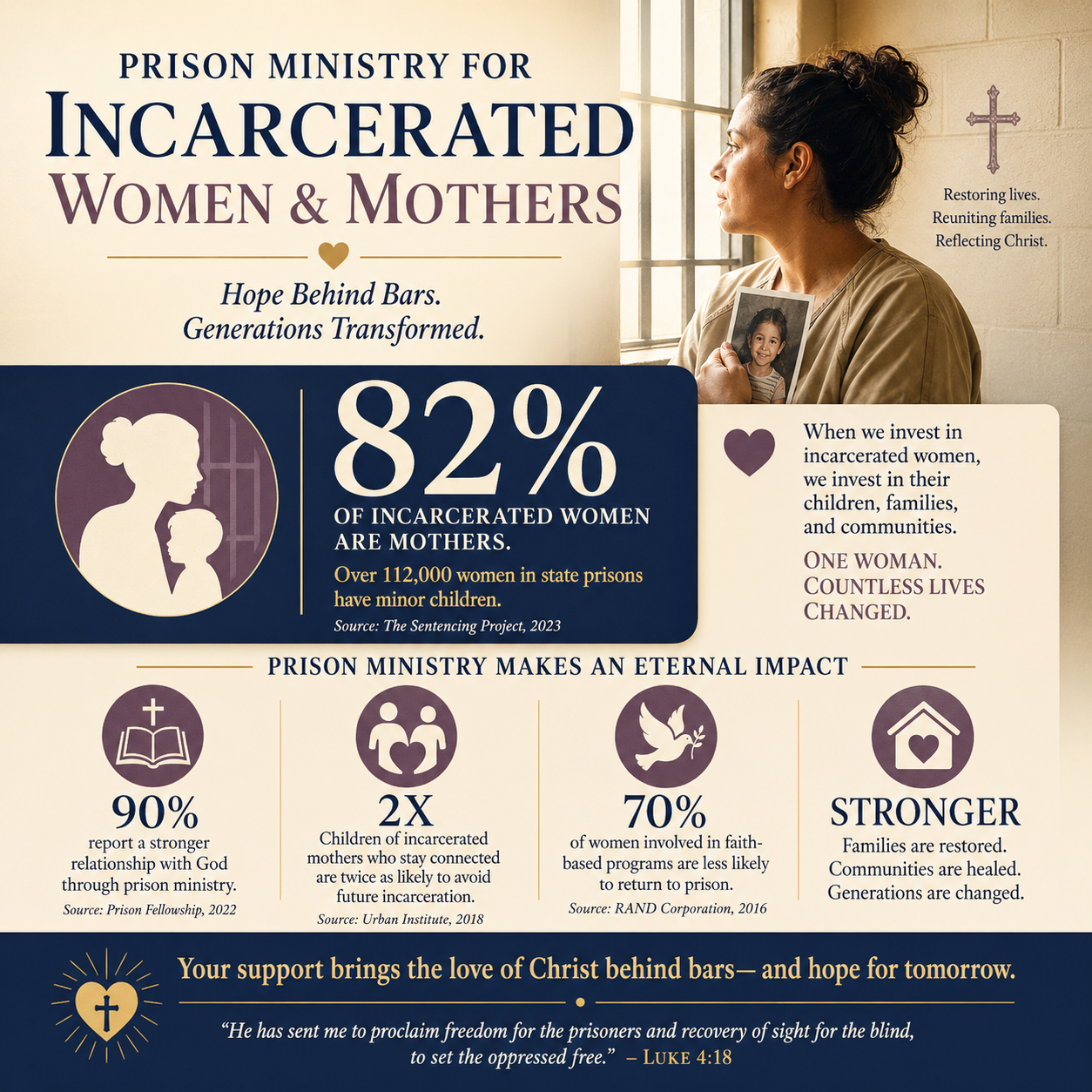
From a donor standpoint, women’s prisons and jails also represent a high-stakes leverage point for families. Many incarcerated women are mothers, and family separation has generational consequences. The U.S. Department of Justice’s Bureau of Justice Statistics has reported that a majority of women in state prisons are mothers of minor children Bureau of Justice Statistics. The spiritual care of a mother is never only about one person; it is often about what will become possible for her children, her extended family, and her local church when she returns.
What this means in practice is that fruitful women’s prison ministry tends to be both evangelistically clear and socially realistic. It proclaims Christ without confusion, and it prepares women for the long obedience of reentry: rebuilding trust, submitting to supervision requirements, working, parenting, and entering a church community where old patterns are neither excused nor endlessly rehearsed.
What effective women’s prison ministry actually does inside facilities
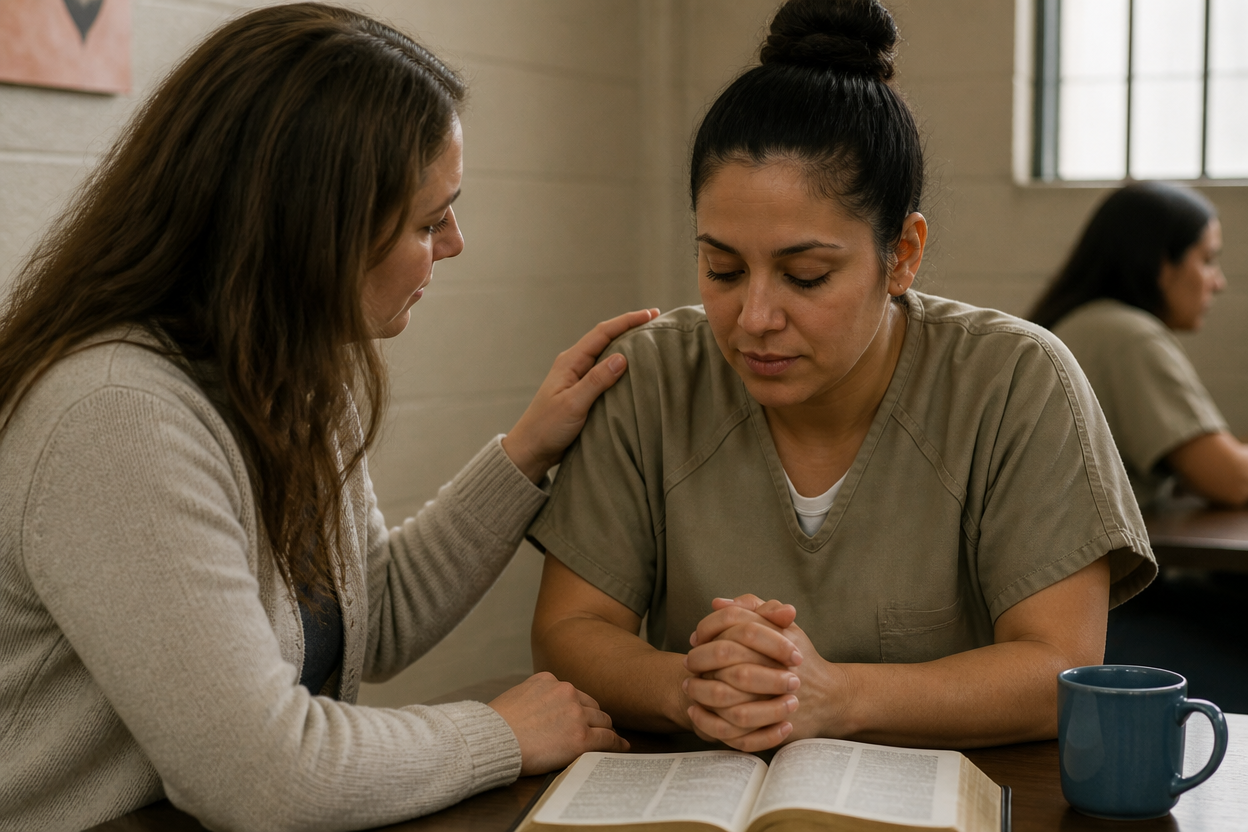
Corrections is a regulated environment, and ministries are guests inside a system designed for safety, not pastoral care. Donors should expect mature ministries to work respectfully with chaplains and staff, maintain clear volunteer boundaries, and comply with facility rules without becoming an arm of the institution. The goal is not access at any cost; it is faithful presence that does not compromise integrity or the dignity of incarcerated women.
Gospel proclamation with pastoral realism
Women in custody often carry layered stories: sexual violence, intimate partner control, substance use disorder, and participation in harm done to others. Effective ministries neither flatten these realities into therapeutic language nor weaponize moral language to increase shame. They teach Scripture carefully, call people to repentance, and provide concrete discipleship practices: prayer, confession, Scripture reading, church doctrine, and spiritual disciplines that can be sustained in a constrained setting.
Donors can reasonably ask ministries how they handle conversion claims, emotional highs during retreats, and the inevitable spiritual volatility of incarceration. The healthiest programs describe a pathway: consistent teaching, mentoring, and follow-up rather than one-time events that generate powerful testimonies but little formation.
Trauma-informed care without abandoning moral agency
The field has had to reckon with the prevalence of trauma among incarcerated women. Trauma-informed ministry is not a replacement for the gospel; it is a way of serving that avoids predictable harms—coercive spiritual pressure, unmanaged triggers, inappropriate disclosure in group settings, or volunteer savior dynamics. The Substance Abuse and Mental Health Services Administration’s trauma framework is widely cited across human services and offers a useful baseline for what “trauma-informed” means operationally SAMHSA.
Christians genuinely disagree about how much therapeutic language belongs in discipleship. A wise ministry does not treat that disagreement as a reason to avoid the subject. It trains volunteers to listen well, to avoid amateur counseling, to refer appropriately, and to hold together two biblical truths at once: people are morally accountable, and people are often wounded in ways that require patient, skilled care.

Volunteer formation and safeguarding
Inside women’s facilities, relational ministry is powerful and also inherently sensitive. Donors should expect strong screening and training, clear policies on contact and communication, and sober safeguards against manipulation or boundary violations—on both sides. Effective ministries treat volunteer formation as spiritual formation: humility, confidentiality, dependence on local leadership, and a refusal to center the volunteer’s experience.
Across our verification work at Most Trusted, we observe that ministries meeting The Most Trusted Standard tend to document their safeguarding practices, volunteer requirements, and lines of accountability in ways donors can review. Clear governance and transparent policies are not bureaucratic; they are forms of neighbor love in high-vulnerability settings.
Programs that serve incarcerated mothers and protect children
Serving incarcerated mothers is not synonymous with advocating for every desired outcome a parent may want. Courts, child welfare agencies, and caregivers have legitimate responsibilities, and children are not props in an adult redemption story. Donors can honor mothers while prioritizing child safety and stability.
Parenting classes that are more than curriculum
Parenting education in custody can be transformative, but only when it is integrated with accountability, emotional regulation skills, and realistic planning for reunification. Many facilities offer some form of parenting program; the best faith-based partners add consistent mentoring, coordination with chaplains, and practical preparation for supervised visits, letter writing, and co-parenting with caregivers.
Donors should ask whether a parenting program is designed for the constraints mothers face: limited phone access, visitation rules, and the fact that children may be fearful or angry. A curriculum that assumes daily parenting contact can inadvertently deepen shame. A sound program teaches mothers to pursue repair patiently, to respect caregivers, and to accept that reconciliation may take time.
Pregnancy, postpartum needs, and the dignity of mother and child
Pregnancy in custody raises acute ethical and medical questions. Ministries sometimes provide material support—maternity clothing, hygiene supplies, transportation assistance for family visits when appropriate, or coordination with community clinics upon release. Those supports matter, but donors should also look for ministries that advocate for dignity without turning complex policy questions into slogans.
Some donors will also want to understand the legal context of restraints, prenatal care access, and nursery programs, which vary widely by state and facility. The National Institute of Corrections provides an entry point into correctional standards and practices that affect women, including pregnant women National Institute of Corrections. The most credible ministries speak carefully here: they know what is true in their context, what is not, and what they can responsibly influence.
Support for children and caregivers on the outside
Ministry to incarcerated mothers is incomplete if it ignores the children and caregivers carrying the daily burden. Some programs serve children directly through mentoring, church partnerships, transportation assistance for visits, or caregiver support groups. These efforts require excellent safeguarding, clear consent procedures, and coordination with guardians—not informal arrangements driven by good intentions.
Donors should also recognize a tension: child-focused work often requires longer time horizons than prison-based programming. It can be harder to measure, slower to show visible “wins,” and more dependent on local churches. Yet it is often where the long-term fruit of a mother’s discipleship is tested and sustained.
How donors can evaluate women’s prison ministry with confidence
Because prison ministry carries heightened vulnerability and public scrutiny, donors should evaluate it with the same seriousness they bring to missions, pastoral formation, or child-serving organizations. The goal is not to demand perfection. It is to identify ministries that are faithful, competent, and accountable.
Faith commitments that shape practice
Many organizations can deliver services; Christian ministries should be clear about the gospel they proclaim and the ecclesial relationships they maintain. Donors can ask: Is the ministry’s statement of faith public? Does it maintain meaningful ties to local churches? Does it treat discipleship as more than religious programming?
For donors who want a broader frame for related work, we have seen that women’s prison ministry is strongest when it is integrated into the wider ecosystem of Prison and Post-Prison Ministries rather than operating as an isolated initiative. Reentry, family support, housing, employment, and church belonging are not separable problems in the lives of most returning mothers.
Financial integrity without simplistic overhead tests
Correctional ministry can be relatively low-cost in some forms and resource-intensive in others, especially when it includes reentry support, case management, or caregiver services. Donors should resist simplistic judgments based solely on overhead ratios. Charity Navigator, GuideStar (Candid), and BBB Wise Giving Alliance have urged donors not to use overhead as the primary measure of effectiveness, emphasizing outcomes, transparency, and governance Charity Navigator.
A stronger set of questions includes: Are audited financials available when appropriate for size? Does the organization show clear spending categories? Are restricted gifts honored? Are related-party transactions disclosed? The point is to confirm that compassion is being stewarded with discipline.
Governance, safeguarding, and evidence of effectiveness
Effective ministry in women’s facilities is not proved by moving stories alone. Donors can look for evidence that the organization tracks outputs and outcomes appropriate to its scope: consistent participation, mentor retention, post-release follow-up rates, connections to churches, referrals to trauma counseling, reunification steps, or reductions in disciplinary incidents within programs when data is available. Not every ministry will have access to recidivism data, and the research is mixed on how directly any single intervention can move those numbers. Serious organizations will say so plainly and still show what they can responsibly measure.
Most Trusted exists to help donors give with confidence by evaluating Christian nonprofits against The Most Trusted Standard, a 15-criteria framework spanning faith foundation, financial integrity, governance and leadership, and transparency and effectiveness. In women’s prison ministry, that framework helps donors see whether a program’s spiritual claims are matched by operational maturity: trained volunteers, documented policies, accountable leadership, and transparent reporting.
Giving that honors mothers, protects children, and strengthens the church
Women’s prison ministry asks donors to hold together truths that are often separated: mercy and moral clarity, compassion and safeguarding, hope and realism about systems. The gospel is never threatened by honesty about trauma, relapse risk, or family complexity. It is threatened by ministry models that refuse accountability or promise outcomes no one can control.
The most trustworthy opportunities are often those that sound less dramatic and more durable: consistent Bible teaching, careful mentoring, parenting formation tied to real-world constraints, support for caregivers, and disciplined reentry partnerships with churches. When donors fund that kind of work, we are not only visiting those in prison; we are strengthening families and congregations that will bear the long work of restoration.



