

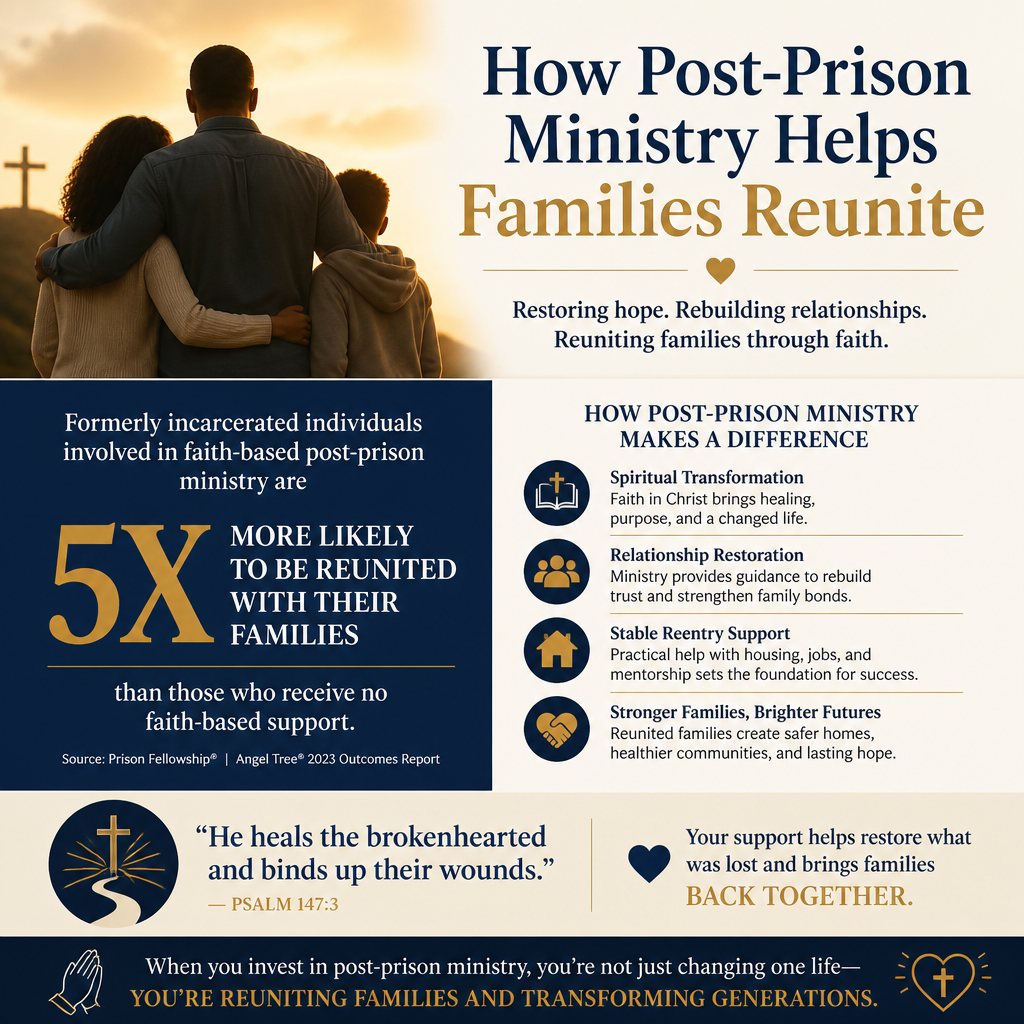
How post-prison ministry helps families reunite is not a sentimental question; it is a test of whether Christian mercy can hold together truth, justice, and restoration over months and years. When a mother or father comes home from incarceration, the family does not simply “pick up where it left off.” Trust has been strained, finances are often fragile, children have adapted to absence, and the returning citizen may be stepping into sobriety, supervision requirements, and stigma all at once.
Scripture treats this complexity with clear-eyed realism. The gospel announces forgiveness and new creation, yet it never denies the cost of sin or the slow work of rebuilding what has been broken. The church’s calling to “remember those in prison, as though in prison with them” (Heb. 13:3) includes remembering the family members who served an unchosen sentence outside the walls.
Reentry is a family event, not an individual milestone
Reentry conversations often focus on housing, employment, and compliance. Those matter. But family systems absorb incarceration in ways that shape whether a homecoming becomes a durable reunification or another cycle of separation.
Children and caregivers have formed survival patterns
During incarceration, spouses and caregivers develop routines to keep the household functioning: childcare logistics, emotional boundaries, and sometimes a guarded posture meant to prevent further disappointment. Children may experience loyalty conflicts, anger, grief, and shame that they cannot articulate. A returning parent can interpret this guardedness as rejection, while the family experiences it as self-protection.
The data confirms the breadth of the disruption
Family disruption is widespread in the U.S. criminal justice system. The Bureau of Justice Statistics reports that a large majority of people in state prison are parents of minor children, meaning reentry frequently includes parenting and co-parenting dynamics, not only individual rehabilitation (Bureau of Justice Statistics).
Post-prison ministries that serve families well generally resist the assumption that reunification is automatic. They treat reunification as a process requiring pastoral wisdom, practical support, and accountability strong enough to protect the vulnerable.

What effective post-prison ministry actually does for reunification
Not every ministry that welcomes returning citizens is positioned to support a family’s restoration. Some programs focus appropriately on evangelism and discipleship inside facilities. Others center on reentry logistics. Family reunification requires a distinct set of competencies and safeguards.
They rebuild trust through structured, supervised steps
Families often need “re-entry agreements” that name expectations about sobriety, employment, communication, finances, and parenting roles. The most responsible ministries do not pressure a spouse or caregiver to “forgive and forget” on demand. They create structured pathways for trust to be rebuilt with observable fruit over time.
They connect spiritual formation with practical repair
Repentance has concrete implications. Zacchaeus did not only confess; he made restitution (Luke 19:8). In a reentry context, that may mean learning to show up consistently, pay child support, tell the truth, submit to counsel, and accept the limits a family may need for safety. Post-prison ministry becomes credible when discipleship is not abstracted from the hard disciplines of daily faithfulness.

Donors who want a wider view of ministry to incarceration and restoration can begin with Prison and Post-Prison Ministries. Reunification work is one expression of a broader biblical mandate, but it also requires distinct care for those most likely to be harmed when restoration is rushed.
The tensions donors should name without flinching
Christian donors often carry two competing impulses: an urgency to extend grace to returning citizens and a desire to protect spouses, children, and congregations from preventable harm. Both concerns are legitimate. Ministries earn trust when they refuse to choose between them.
Reconciliation is not identical to reunification
Scripture calls believers toward reconciliation, but reconciliation does not always mean immediate proximity. Particularly where there has been domestic violence, sexual abuse, repeated infidelity, or persistent substance misuse, a ministry must avoid spiritualizing risk. Wise leaders coordinate with professional counselors, comply with mandatory reporting laws, and honor court orders and protective measures.
Accountability and mercy are not enemies
Some donors worry that strong accountability sounds “ungracious.” Yet grace in the New Testament is not permissiveness; it is power for new obedience. A ministry that tolerates deceit, manipulative appeals, or boundary violations is not practicing grace. It is leaving families to absorb the cost.
National reentry work has also faced hard questions about what actually reduces recidivism and improves family stability. The National Institute of Justice notes that recidivism measurement varies by state and study design, which should temper simplistic claims and push ministries toward transparent outcome definitions (National Institute of Justice).
What to look for when funding family-focused reentry work
Post-prison ministries can be deeply faithful and still underdeveloped in governance, financial controls, safeguarding, or outcome reporting. Because family reunification involves children and vulnerable adults, donors should hold ministries to standards that match the stakes.
Signals of readiness to handle complex family cases
Across our verification work at Most Trusted, the ministries that meet The Most Trusted Standard tend to show more than compassion. They demonstrate operational maturity: clear policies, trained staff and volunteers, and transparent reporting that a serious donor can interrogate.
- Safeguarding policies for child protection, background checks, supervision, and mandatory reporting.
- Defined reunification pathways that include staged expectations rather than instant restoration.
- Partnerships with counselors, legal aid, workforce programs, and housing support when appropriate.
- Boundary discipline that protects spouses and children from coercion or spiritual pressure.
- Financial clarity that shows how donor funds are allocated and who approves expenditures.
Transparency that respects donors and families
Family stories can be powerful, but ethical storytelling matters. Responsible ministries obtain informed consent, avoid exposing children, and do not use a family’s trauma as fundraising currency. They also resist overstating results. The best reporting names both fruit and limitations: what is improving, what is still fragile, and what support is realistically required.
Donors evaluating reentry programs specifically can also review Post-Prison Reentry Support for Returning Citizens to understand common program models and the accountability questions that naturally follow.
How post-prison ministry strengthens the household over time
Reunification is sustained less by a single “homecoming moment” and more by a year of ordinary faithfulness: keeping appointments, making amends, earning income legally, maintaining sobriety, and learning to parent with humility. Ministries that stay present through that long arc often become a stabilizing third party for families who have learned to distrust promises.
Mentoring and peer communities reduce isolation
Returning citizens can feel watched by institutions and doubted by relatives. Spouses and caregivers can feel equally isolated, carrying resentment and exhaustion while trying to remain open to change. Carefully trained mentors and peer groups can create a non-anxious environment where honesty is expected and shame is not allowed to rule the household.
Practical support becomes a form of neighbor-love
Material pressures are not the whole story, but they do strain relationships. The Bureau of Labor Statistics continues to show that unemployment is correlated with lower educational attainment, and many returning citizens are trying to re-enter the labor market with limited credentials and a record (U.S. Bureau of Labor Statistics). Effective ministries respond by pairing job readiness with character formation, helping families avoid the false choice between “any income” and “faithful living.”
When the church treats employment, housing, and parenting as spiritual matters—not because they are easy, but because Christ claims the whole of life—families often gain the conditions needed for reconciliation to become durable.
FAQs for How post-prison ministry helps families reunite
Should Christian donors prioritize family reunification programs over prison evangelism?
We should resist treating these callings as competitors. Prison evangelism bears fruit that may later sustain reentry, and family-focused reentry work often depends on spiritual renewal that began inside. The wiser donor question is whether a ministry is clear about its scope and competent for that scope. A program that claims to reunite families should be able to describe safeguarding practices, staged reunification steps, and partnerships that protect spouses and children.
What outcomes should donors expect a credible reunification ministry to report?
Outcome reporting should match the ministry’s actual activities and avoid inflated claims. Credible measures may include consistent program participation, employment stability, sobriety milestones verified through appropriate accountability, compliance with supervision requirements, and family-related indicators such as attendance at parenting classes or mediated family sessions. Ministries should also name what they cannot control—court decisions, housing markets, relapse risk—and report outcomes with definitions a donor can evaluate.
Giving that protects the vulnerable and honors redemption
How post-prison ministry helps families reunite ultimately turns on whether a ministry can hold two biblical commitments together: the reality of redemption in Christ and the responsibility to protect those most easily harmed. Donors serve families well when they fund ministries that pair compassion with competence, and that submit their claims, finances, and governance to transparent scrutiny. That is not cynicism; it is stewardship worthy of the families whose restoration is at stake.



