
Why sentencing reform matters to prison ministry is not a political slogan. It is a practical question of whether our ministry to incarcerated men and women is ordered toward restoration or toward a revolving door that neither protects communities well nor honors the biblical seriousness of justice and mercy.
Donors who support prison ministry often carry two convictions at once: that wrongdoing is real and must be named, and that no human being is finally reducible to his worst act. Scripture holds those together without embarrassment. God “loves righteousness and justice” (Psalm 33:5), and yet the gospel announces reconciliation for sinners. Sentencing reform is one arena where those convictions must be translated into policy, practice, and measurable outcomes.
Justice in Scripture is accountable and restorative
Sentencing is part of how a society tells the truth
Christian ministry inside prisons does not require naivete about crime. Violence, exploitation, and addiction fracture lives and destabilize neighborhoods. A just society names evil and restrains it; Romans 13 acknowledges the state’s coercive authority as a limited instrument to uphold order. Sentencing communicates what a society believes about culpability, the dignity of victims, and the moral seriousness of harm.
But biblical justice is more than retribution. The Hebrew concept of mishpat is not simply punishment; it is right order. The prophets condemn systems that “turn aside the needy from justice” (Isaiah 10:2). A sentencing regime that predictably produces destabilization, family fracture, and perpetual exclusion may satisfy a desire to punish while failing the harder work of restoring what was broken.
Mercy is not the opposite of justice
Christians genuinely disagree about how much mercy should be expressed through sentencing versus through parole, reentry support, or clemency. Yet Scripture does not treat mercy as sentimental leniency. Mercy is covenantal; it aims at repair, repentance, and reintegration. Zacchaeus’s repentance in Luke 19 includes concrete restitution. Forgiveness does not erase consequences, but it does reopen the future.
When prison ministry is faithful, it calls incarcerated people to repentance and new obedience, and it calls the church to a sober hope that the Spirit can make men and women new. Sentencing policy either makes room for that work to bear fruit over time or it can render that hope structurally irrelevant.

Sentencing policy shapes the ministry field inside prison walls
Overcrowding and churn limit what ministry can actually do
Prison ministry is not only a matter of chaplains and volunteers; it is also a matter of institutional conditions. Overcrowded facilities, staffing shortages, and rapid turnover can restrict access to programming, reduce meaningful discipleship time, and increase violence. When sentence structures produce extreme volume or constant churn, prison systems struggle to provide stable environments where transformation can be mentored and observed.
Nationally, the United States held roughly 1.2 million people in state and federal prisons in 2022, not counting local jails, according to the Bureau of Justice Statistics at the U.S. Department of Justice (BJS). The scale matters for donors because it is a reminder that even excellent ministries operate within capacity constraints they did not create. Sentencing reform is one of the few levers that affects those constraints upstream.
Long sentences change the pastoral questions
A sentence measured in decades reshapes what discipleship looks like. The spiritual tasks remain: confession, forgiveness, vocation, reconciliation, perseverance. Yet the pastoral terrain includes grief that is not quickly relieved: children growing up without a parent, marriages strained or ended, the loss of earning years, and a constant sense of being “outside” ordinary life.
Some crimes warrant incapacitation for extended periods. The tension is that broad sentencing practices often sweep in many who do not present the same level of risk. Where sentencing is poorly calibrated, prisons become warehouses for people whose primary needs are treatment, education, or structured accountability in the community. That misalignment is not only inefficient; it can distort a prison ministry’s mission into triage rather than formation.
Reform is not a single policy but a set of moral questions
Proportionality and discretion are theological concerns
Sentencing reform is frequently reduced to a binary: “tough on crime” versus “soft on crime.” Mature Christian engagement does not accept that framing. The real questions are moral and practical: Is the sentence proportional to the harm and culpability? Does it protect the public? Does it leave any plausible path toward restoration? Does it treat similar cases similarly, or does it produce arbitrary outcomes based on jurisdiction, income, or access to counsel?
Many reform efforts center on mandatory minimums and sentencing enhancements that restrict judicial discretion. Christians can differ on which offenses should carry mandatory floors. Yet the theological concern is recognizable: when a system cannot distinguish well between the violent and the nonviolent, the predatory and the addicted, the hardened and the immature, it risks becoming unjust in the precise biblical sense—unable to judge rightly.
Victims and communities must not be treated as afterthoughts
Some reform rhetoric has minimized victims, as if compassion for the incarcerated requires silence about the injured. That is not a Christian option. The biblical demand for justice includes the vulnerable who have been harmed, and many victims are themselves poor, isolated, or disbelieved. Churches that fund prison ministry should also be willing to support trauma care, restitution pathways, and community-based violence interruption where appropriate.
At the same time, many victims also want change because they know prison alone rarely repairs what was taken. Restorative justice models are contested and must be handled with care; they are not suitable for every case and can be mishandled in ways that pressure victims. Where they are pursued, they must be voluntary, survivor-centered, and honest about power and safety. Done well, they can align with a biblical vision in which truth-telling and accountability are paired with the possibility of moral repair.
Donor discernment requires more than good intentions
Effective ministries work across the prison and reentry continuum
Prison ministry that ignores sentencing realities often finds its work undone at the moment of release. A man may leave prison converted and eager to live faithfully, then face housing bans, employment barriers, and supervision conditions that set him up to fail. Reform is therefore inseparable from reentry. Donors who care about lasting fruit should understand the broader ecosystem of Prison and Post-Prison Ministries and how policy choices influence what ministries can sustain.
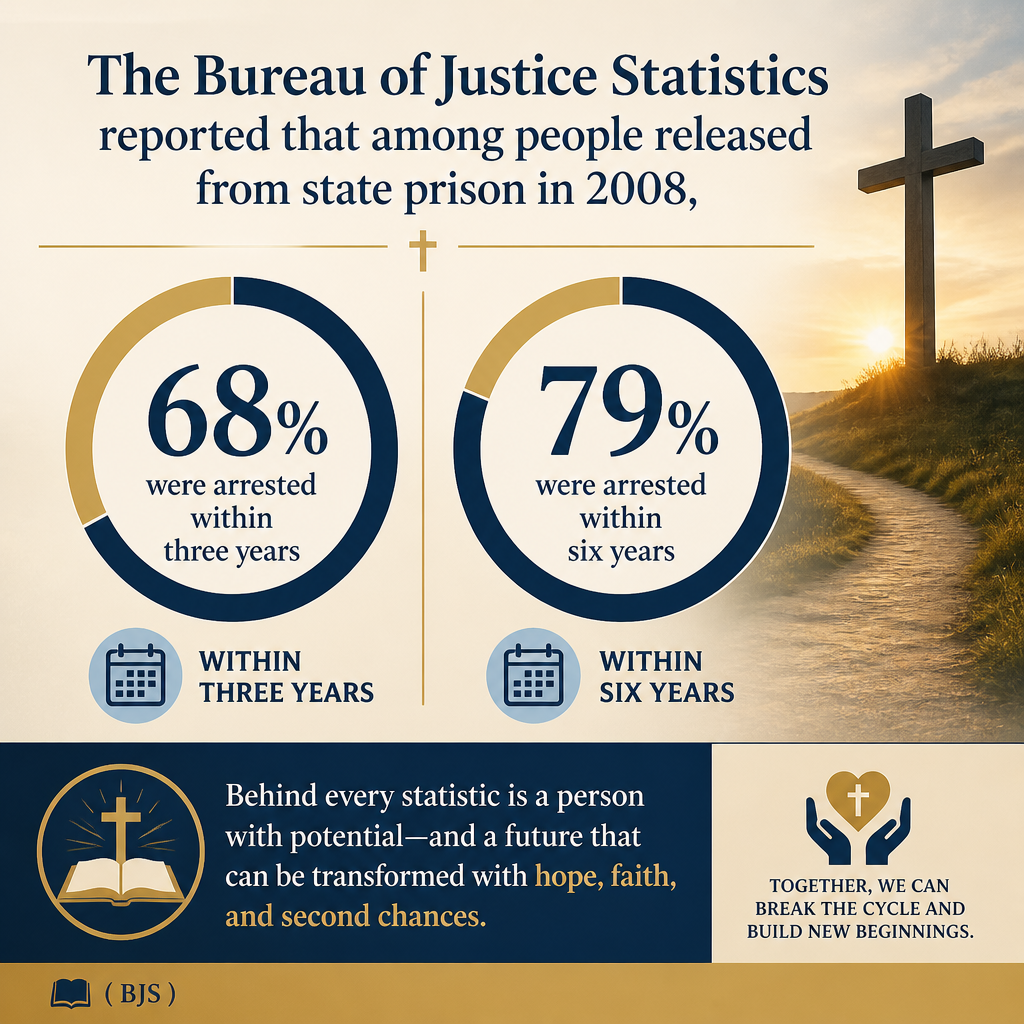
Recidivism remains a central concern for both public safety and credible ministry outcomes. The Bureau of Justice Statistics reported that among people released from state prison in 2008, about 68% were arrested within three years, and about 79% within six years (BJS). Those figures are sobering, and they underscore why donors should resist simplistic promises. Reform that improves treatment access, supervision quality, and reentry stability may do more for public safety than longer sentences applied indiscriminately.
What we look for when donors ask which work to fund
Most Trusted exists to help donors give with confidence by evaluating ministries against The Most Trusted Standard, a 15-criteria framework across Faith Foundation, Financial Integrity, Governance and Leadership, and Transparency and Effectiveness. Across our verification work, we observe that strong prison and sentencing-adjacent ministries tend to take measurable outcomes seriously without reducing people to metrics. They can articulate a theory of change, name what they can and cannot claim, and show how they steward restricted and unrestricted gifts.
In the specific arena of Legal Advocacy and Prison Ministry Reform, donor risk increases because policy work can become personality-driven, ideologically captured, or opaque in its use of funds. We recommend funding organizations that can document their advocacy goals, disclose coalition relationships and major funding sources, and show how they protect mission integrity when political incentives shift.
- Clear scope: the ministry can define which sentencing issues it addresses and why.
- Victim-aware posture: reforms are pursued with explicit concern for those harmed and for community safety.
- Evidence-informed claims: the organization cites credible research and avoids overstated promises.
- Local partnership: the work is coordinated with churches, reentry providers, and where feasible, corrections staff.
- Transparent reporting: donors can see how funds are allocated and what progress looks like over time.
Reform serves discipleship by making restoration plausible
Hope is strengthened when a future can be built
Prison ministry proclaims that no one is beyond the reach of grace. Yet discipleship is ordinarily lived in communities: a church that knows one’s name, work that disciplines the will, family responsibilities that mature a man, friendships that reinforce repentance. When sentencing policy routinely imposes barriers that last long after a debt is paid, it becomes harder for churches to practice reintegration as a normal Christian duty.
This is not an argument for minimizing sin or removing consequences. It is an argument for aligning consequences with the ends of justice: protection, accountability, and the possibility of restored membership in society when repentance is credible and risk is managed. A system that cannot recognize change may train people to despair, and despair is not a neutral spiritual condition.
The church’s credibility is at stake
Many incarcerated men and women will listen carefully to what Christians say about forgiveness, repentance, and new life. They will also watch what Christians fund and advocate. If the church speaks of restoration while supporting systems that functionally deny restoration in all but rhetoric, our witness becomes thin.
Sentencing reform matters to prison ministry because it is one of the places where the church can insist that justice be both truthful and humane. The goal is not to baptize a partisan program. The goal is to pursue public policy that better fits a biblical account of human dignity: sinners who are accountable, image-bearers who can change, and neighbors whose safety and flourishing are not competing goods.
FAQs for Why sentencing reform matters to prison ministry
Does sentencing reform mean being soft on crime?
No. Sentencing reform can include measures that increase accountability for serious violence while reducing overly broad penalties that do not improve public safety. The Christian question is whether sentencing is proportionate, protects the vulnerable, and leaves room for credible restoration where appropriate, without trivializing harm or sidelining victims.
What should Christian donors ask before funding sentencing reform work?
Donors should ask for clarity on the specific reforms pursued, the evidence base for expected outcomes, and how the organization safeguards its mission from partisan capture. It is also prudent to ask how victims are considered, how coalitions are disclosed, and whether the organization can report transparently on both financial stewardship and real-world results.
Sentencing reform as a Christian stewardship concern
Sentencing reform matters to prison ministry because it shapes who enters prison, how long they remain, what formation is feasible while they are there, and whether reentry has a credible chance of stability. Donors who fund prison ministry are not only supporting services inside institutions; they are supporting a moral vision of justice that can tell the truth about sin while refusing to deny the possibility of transformation. The most responsible giving will fund ministries that hold those truths together with measurable integrity and transparent stewardship.



