
How orphan care ministries help with adoption expenses is a question Christian donors should approach with equal parts compassion and clarity. Adoption is often financially daunting, and the church has a legitimate role in bearing burdens; yet money can also distort incentives, pressure families, and unintentionally fund practices that do not serve a child’s long-term good.
Scripture names God as “Father of the fatherless” (Psalm 68:5), and James calls care for orphans and widows “pure and undefiled religion” (James 1:27). That mandate does not suspend the need for due diligence. It heightens it, because the children at the center of adoption and foster care cannot protect their own interests, and because donors are stewards, not merely givers.
Why adoption costs are real and why ministries step in
Adoption expenses often cluster where families have the least flexibility
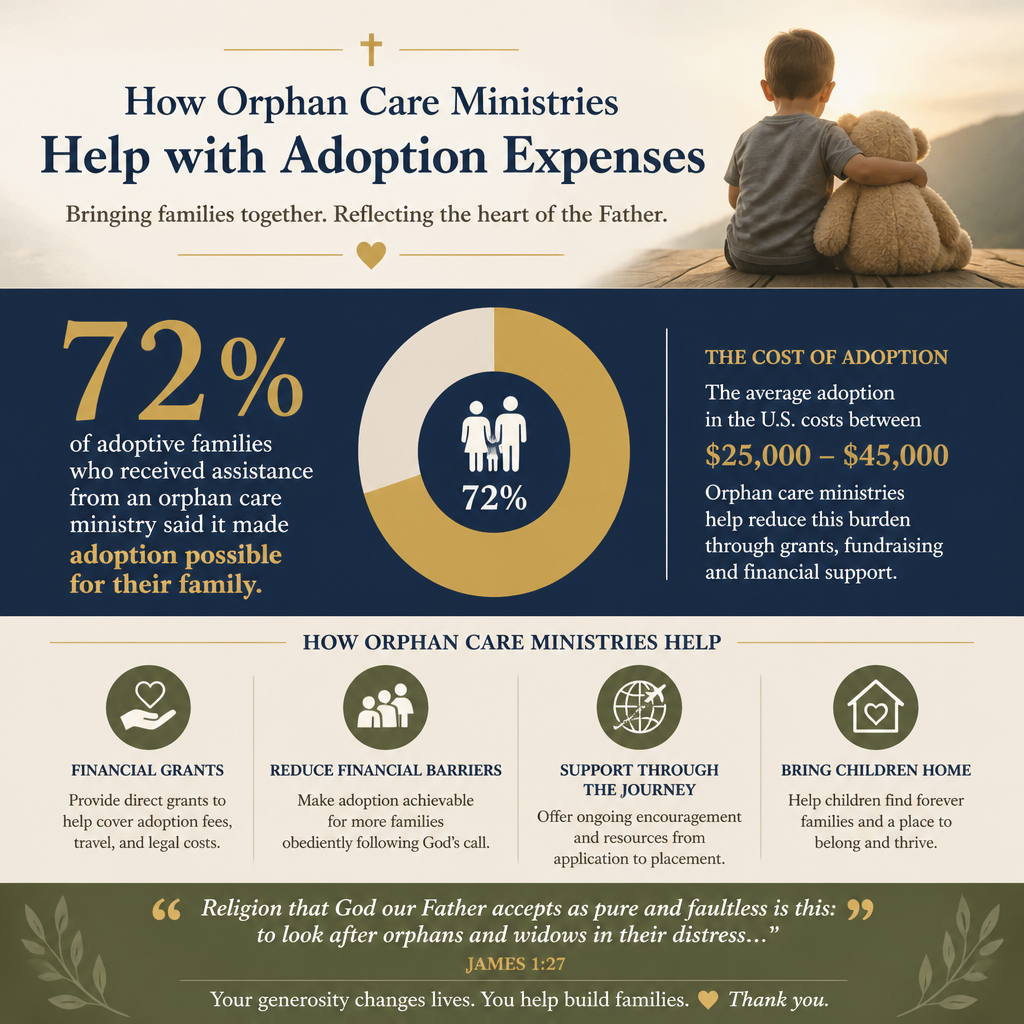
Even families with stable incomes can be stretched by the timing and bundling of adoption expenses: home studies, background checks, required training, legal fees, travel, immigration processing for some intercountry adoptions, and post-placement reporting. The cost profile differs by pathway, but the burden is often concentrated into short windows when families have limited options besides debt or postponement.
When ministries help, they rarely make adoption “easy.” Rather, they can keep a family from choosing between obedience and insolvency. Many Christian donors recognize that dynamic from other areas of discipleship: the call is clear, but the practical obstacles are not imaginary.
The public policy baseline helps donors understand the gap
In the United States, the Adoption Tax Credit is one of the most concrete tools that can offset qualified expenses for some families, but it functions as a tax mechanism rather than upfront cash. For many adoptive parents, the challenge is less “Will we eventually recoup some costs?” and more “How will we pay what is due now?” The IRS details eligibility and limitations for the credit, including income thresholds and documentation expectations (Internal Revenue Service).
What this means in practice is that ministry assistance is often most effective when it addresses cash-flow realities, not only total cost.

What responsible financial assistance actually looks like
Healthy models prioritize the child, protect the family, and respect the process
Across the landscape, the most credible orphan care ministries tend to treat financial help as one piece of a wider, disciplined approach: preparing parents, honoring legal requirements, and maintaining the integrity of child-welfare decisions. Donors should expect assistance programs to be structured, documented, and accountable.
In practice, help with adoption expenses commonly includes grants, matching campaigns, no-interest loans administered with safeguards, employer-partnership facilitation, and practical support that reduces indirect costs such as travel logistics or required training fees.
Grants and matching can be powerful when they are designed with guardrails
Adoption grants are often the most straightforward form of assistance. They can be administered directly to vendors (agencies, attorneys, immigration service providers) rather than as unrestricted cash to families. This protects donors and families alike, and it reduces the risk of misuse.
Matching grants can also strengthen congregational ownership: a ministry commits funds contingent on a local church raising a portion. The good versions of this model avoid turning a child into a fundraising object. They place dignity first, and they require appropriate counseling and pastoral support for the family’s broader readiness, not only their ability to raise money.
- Direct-to-provider payment rather than cash disbursement, where feasible
- Clear eligibility criteria tied to ethical adoption practice and legal compliance
- Required preparation such as trauma-informed training for parents
- Documented financial review to prevent unsustainable debt assumptions
- Post-placement follow-through that supports family stability, not only placement
The tensions donors should name rather than ignore
Money can distort incentives in child welfare systems
Christians genuinely disagree about how much of adoption’s financial burden should be addressed through private charity versus public policy. There is also a harder debate that mature donors should not evade: when money moves through fragile child-welfare systems, it can create perverse incentives. The global orphan care movement has had to reckon with cases where institutional care is maintained because it attracts donors, or where children are separated from families unnecessarily. The best ministries acknowledge this history and build anti-corruption safeguards rather than dismissing the concern as cynical.
The research consensus is strong that children do better in family-based care than in institutional settings. A major statement from UNICEF summarizes evidence that institutionalization is associated with poorer outcomes and that family strengthening and family-based alternatives should be prioritized (UNICEF). Donors do not need to become child-welfare experts, but we should recognize what the evidence implies: funding structures should support family preservation and family-based care, not the long-term expansion of institutions.
Adoption is not a substitute for family preservation and kinship care
Not every vulnerable child needs adoption. Some need time, economic stability, protection from abuse, or support for a parent facing crisis. Others need kinship placement. Ethical orphan care takes seriously the principle of subsidiarity: whenever safe and possible, children should remain with their family of origin, then with extended family, before unrelated adoption is considered.
That principle does not diminish adoption’s beauty. It locates adoption properly within a continuum of care that prioritizes the child’s attachments and identity. Donors can support ministries that treat adoption as one response among several, rather than the default answer to poverty.
How donors can evaluate an orphan care ministry before funding adoption aid
Seek evidence of integrity, not just moving stories
Adoption is emotionally potent, which means it can be vulnerable to selective storytelling and pressure-driven fundraising. Serious donors ask: What safeguards exist to ensure a child is truly eligible for adoption? How does the ministry document consent? What relationships exist with licensed agencies and qualified legal professionals? How does the ministry support families after placement when the difficult work of attachment and trauma care often intensifies?
Across our verification work at Most Trusted, we observe that ministries meeting The Most Trusted Standard tend to be explicit about governance, financial controls, and program outcomes, not merely program intentions. They can explain how funds flow, who authorizes disbursements, how conflicts of interest are prevented, and what oversight is in place when working across borders or across multiple agencies.
Use a structured framework to evaluate adoption-expense programs
Because donors often fund “front-end” costs, it is easy to overlook whether the ministry’s internal systems are mature enough to handle designated funds and sensitive family information. The Most Trusted Standard provides a disciplined lens across faith commitments, financial integrity, governance practices, and transparency. In adoption-related giving, those criteria translate into concrete questions about restricted-fund handling, board accountability, leader oversight, and honest reporting on what assistance does and does not accomplish.
For donors seeking to place adoption assistance in its broader ministry context, it is often helpful to compare an organization’s adoption-expense program to its wider approach to vulnerable children and families. Our coverage of Orphan Care Ministries reflects that wider frame: a child’s long-term welfare is rarely served by one-time financial transactions detached from durable family support.
Where adoption-expense giving fits within a wise orphan care strategy
Adoption aid is strongest when paired with formation and long-term support
Paying fees can remove a barrier, but it cannot create a secure attachment, repair early trauma, or sustain a marriage under stress. Healthy ministries prepare families with training that reflects mainstream child-welfare learning on trauma and attachment, and they connect parents to qualified counseling and community support. Donors should expect ministries to take post-placement stability seriously, even when that work is quieter and harder to fund.
Many in the field have been shaped by the “When Helping Hurts” framework articulated by Steve Corbett and Brian Fikkert, which warns that assistance can unintentionally harm when it displaces responsibility, undermines dignity, or creates dependency (When Helping Hurts). Applied to adoption expenses, the principle is not “never help.” It is “help in a way that strengthens families and institutions toward long-term health.”
Donors can balance adoption support with prevention and family strengthening
Some donors prefer to fund direct adoption grants; others are persuaded that the highest impact is upstream in family preservation. A mature giving portfolio can hold both convictions: helping a particular child join a stable family while also supporting economic strengthening, parenting support, and community-based child protection that reduces unnecessary separation.
Within Orphan Care Ministries in Adoption and Foster Care, the strongest organizations tend to speak plainly about this balance. They resist simplistic narratives and instead show donors how different interventions serve different children at different points of vulnerability.
FAQs for How orphan care ministries help with adoption expenses
Should Christian donors prioritize adoption grants or foster care support?
Both can be faithful, but they serve different needs. Adoption grants typically address upfront costs that prevent a family from proceeding, while foster care support often funds ongoing needs such as respite care, trauma-informed services, and wraparound support that stabilizes placements. Donors should align their giving with the child-welfare gap they are best positioned to address, and favor ministries that can document ethical practice and measurable follow-through.
What are red flags when a ministry fundraises for adoption expenses?
Red flags include pressure-based timelines, vague descriptions of where funds go, refusal to explain legal and ethical safeguards, and an overreliance on emotionally charged imagery that compromises a child’s privacy. Donors should also be cautious when a ministry frames adoption as the default solution to poverty rather than one pathway within a continuum that includes family preservation and kinship care.
A sober, hopeful place for donors to stand
Orphan care ministries can help with adoption expenses in ways that are both compassionate and disciplined: reducing upfront barriers, protecting families from destructive debt, and honoring the child’s dignity through careful safeguards. Christian donors serve the vulnerable most faithfully when we fund not only the moment of placement, but the long obedience of preparation, ethical process, and long-term family stability.



