
How orphan care ministry adoption grants work is a stewardship question before it is a fundraising question. Christian donors want to honor the biblical mandate to protect the vulnerable while also resisting the patterns that have historically harmed children and families when money flows without accountability.
Adoption grants can be one of the most direct ways a donor helps a child move into a stable family. They can also, if poorly designed, create incentives that pressure families, distort local child welfare systems, or substitute sentiment for due diligence. Mature giving holds compassion and verification together.
What adoption grants are and what they are not
Grantmaking that reduces barriers to a permanent family
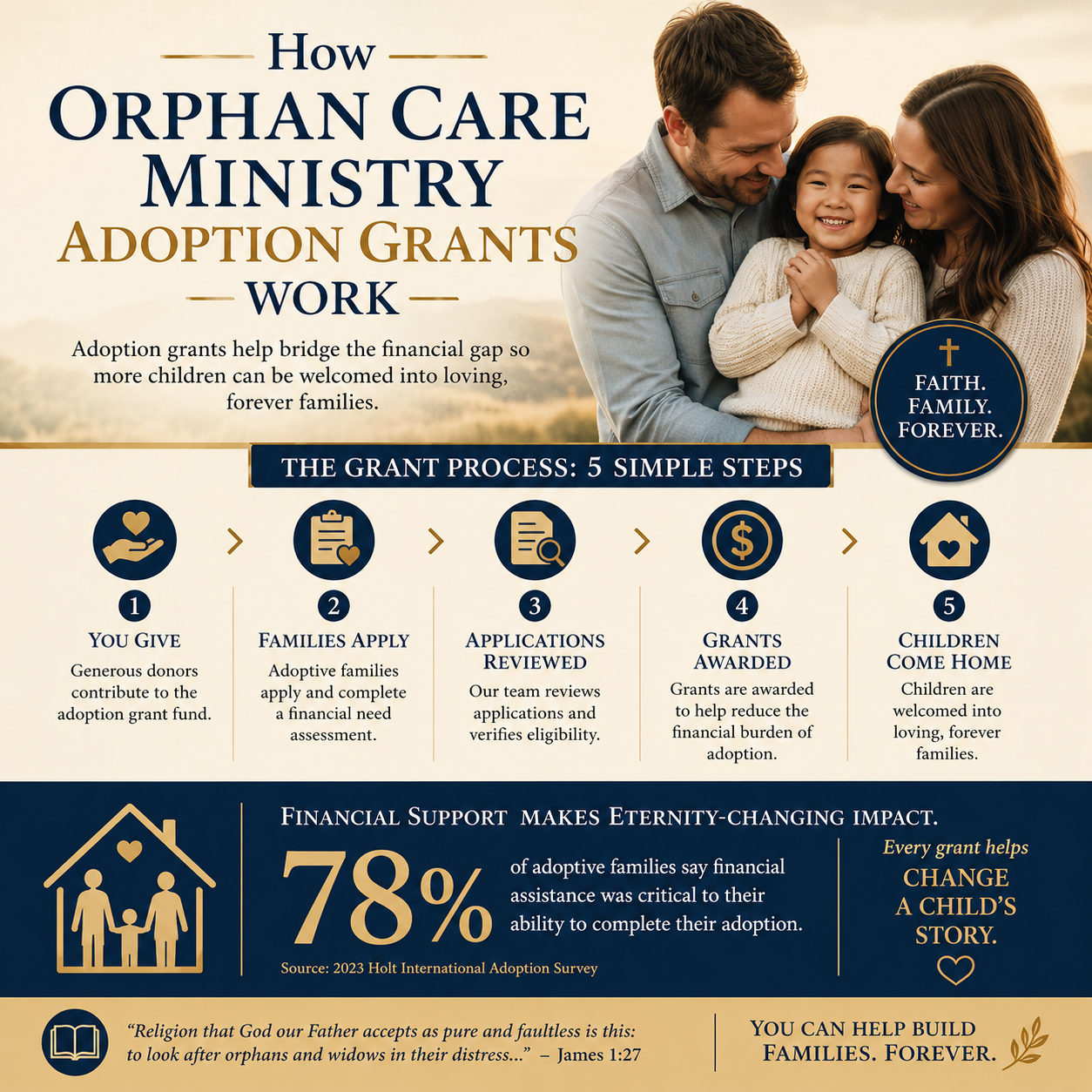
In most Christian orphan care ministries, an adoption grant is a restricted gift used to offset eligible, documented costs connected to a specific adoption. Those costs may include home study fees, agency fees, legal and court costs, translation and document processing, travel, post-placement reporting, and counseling supports. The grant is typically paid to a vendor or agency, or reimbursed against receipts, rather than deposited directly into a family’s personal bank account.
When grants are structured well, they function like targeted assistance in a complex process. They acknowledge a basic tension: adoption is not a consumer transaction, but it does carry real administrative and legal costs. Donors are often willing to help with those costs precisely because they want families to say yes to a child without being immobilized by financial strain.
A tool that must not become a substitute for ethics
Adoption grants do not “create” orphans, and they are not meant to reward demand for children. In responsible practice, grant programs are paired with safeguards against child trafficking, coercion, and document fraud. Christians genuinely disagree about international adoption policy in particular, but there is wide agreement on one point: if a system pays the wrong parties for the wrong outcomes, children are put at risk.
The more significant the donor’s heart for orphan care, the more important it is to refuse simplistic narratives. “Care for the fatherless” in Scripture is inseparable from God’s demand for justice, honest weights and measures, and protection of the poor from exploitation.

How funds typically flow from donor to child and family
Common program models donors will encounter
Across the field, our team sees several recurring grant models. None is universally best; each carries trade-offs that should be named explicitly.
- Family-directed applications: families apply directly to the ministry, often after a home study approval.
- Agency-partnered grants: the ministry coordinates with a licensed adoption agency and pays documented fees.
- Matching grants: the ministry matches a portion of funds the family raises, reinforcing shared sacrifice.
- Need-tiered awards: awards are scaled to verified financial need rather than distributed evenly.
- Bridge grants: short-term assistance helps a family complete time-sensitive steps, later replenished through designated fundraising.
In each model, the decisive question is not creativity but control: who verifies need, who verifies legitimacy of the adoption pathway, and who verifies that funds paid were necessary and appropriate.
Controls that separate assistance from improvised cash transfers
The strongest programs maintain clear documentation standards: award letters that specify restrictions, invoices or receipts for each disbursement, and a consistent policy for exceptions. They also maintain separation of duties so that no single staff member solicits, approves, and disburses funds without oversight. That kind of internal discipline can feel “administrative” to donors, but it is part of Christian honesty.
For donors who want to understand the broader landscape of this work, it is worth reading within Orphan Care Ministries, where the range of approaches and risks becomes more visible over time.
Eligibility, underwriting, and the moral logic behind them
What responsible ministries usually require
Grant programs commonly require a current home study, proof that the family is working with a properly licensed agency or attorney, a budget of anticipated adoption expenses, and evidence of financial need. Many also require pastoral reference, participation in adoption education, and agreement to post-placement supports.
These requirements can feel intrusive. Yet adoption is inherently a child-protection arena. A grant is not a donor’s private gift to a family; it is a ministry’s public act with fiduciary responsibility. Mature ministries will say plainly that compassion without underwriting can become negligence.
Why financial need is assessed even when donors want to help everyone
Donors sometimes ask why grants are not simply distributed evenly. The underlying logic is stewardship and equity. If funds are limited, a ministry has to decide whether its purpose is symbolic encouragement or real barrier removal for families who otherwise cannot proceed. Need-tiered awards are one way to keep the assistance aligned with the claim that the money exists for the sake of the child’s placement stability, not for donor satisfaction.
At the same time, responsible programs avoid practices that turn need assessment into humiliation. The point is not to make families perform desperation; it is to verify that limited charitable dollars are doing what donors intend.
Risks, controversies, and the safeguards donors should expect
Adoption grants in a world of mixed incentives
The orphan care movement has had to reckon with documented failures in international adoption systems: coercion of birth families, falsified paperwork, and illicit payments that effectively purchase children. These abuses are not theoretical. They are part of the historical record, which is why donors should be cautious of ministries that treat adoption as a sentimental storyline rather than a regulated child welfare process.
For donors who want a credible overview of global child protection standards, the Hague Convention on Protection of Children and Co-operation in Respect of Intercountry Adoption is a central reference point, and it is administered through the Hague Conference on Private International Law at hcch.net.
Safeguards that should be visible in policy and reporting
In our verification work at Most Trusted, the ministries that meet The Most Trusted Standard tend to treat safeguarding as a governance issue, not a public relations issue. Donors should expect to see clear policies, not vague assurances. Several safeguards are particularly relevant to grant programs:
First, a ministry should define what it will and will not fund, including an explicit prohibition on any payments that resemble inducements to child placement intermediaries. Second, it should articulate how it selects partners, especially across borders, and how it evaluates compliance with relevant laws and ethical norms. Third, it should publish a conflict-of-interest policy and show that it is enforced.
The harder question is effectiveness. Adoption grants are often evaluated in terms of “families helped,” but durability matters. Donors should ask whether the ministry invests in post-placement supports, trauma-informed counseling, and practical care for families when the early months of attachment are difficult. Christian love is patient, and adoption support should not end when a photo is taken at the airport.
How donors can evaluate an adoption grant ministry with confidence
Questions that correspond to verifiable evidence
Donors do not need to become adoption lawyers to give wisely. They do need to insist on evidence that matches the moral weight of the work. The following lines of inquiry tend to separate serious ministries from well-branded ones.
Faith and formation: Does the ministry speak about adoption with theological clarity, distinguishing Christian adoption as a gospel-shaped act from adoption as personal fulfillment? Governance: Is there an independent board with meaningful oversight, and are conflicts of interest disclosed and managed? Financial integrity: Are audited financial statements available where appropriate, and are restricted gifts handled with discipline? Transparency and effectiveness: Does the ministry report what it funds, how it decides, and what it learns from outcomes?
Our purpose at Most Trusted is to help donors evaluate Christian nonprofits against The Most Trusted Standard so that giving can be confident rather than anxious. For donors focusing specifically on adoption and foster care contexts, Orphan Care Ministries in Adoption and Foster Care is often where the relevant distinctions become clearest.
Grounding expectations in the realities of U S adoption costs
Adoption grant programs exist because the costs can be substantial. A common donor mistake is to assume that high costs always indicate profiteering. Some costs reflect real legal and social work requirements meant to protect children; other costs reflect market inefficiencies and uneven regulation. Donors can acknowledge both realities without cynicism.
For a sober, non-ministry-specific snapshot of typical domestic adoption expenses, the Child Welfare Information Gateway (a U.S. Department of Health and Human Services service) summarizes domestic adoption costs and considerations at childwelfare.gov.
FAQs for How orphan care ministry adoption grants work
Do adoption grants usually go to the family or to the agency?
Responsible programs commonly pay qualified expenses directly to a licensed agency, attorney, or other vendor, or they reimburse a family against clear documentation. Direct cash transfers without receipts and restrictions are less common in well-governed ministries because they are harder to justify as restricted charitable assistance and harder to safeguard against misuse.
Are adoption grants tax deductible for the donor and taxable for the family?
For donors, gifts to a qualified nonprofit are generally treated as charitable contributions, subject to IRS rules and the donor’s tax circumstances. For families, whether a grant is treated as taxable income can depend on how it is structured and paid, and families should seek guidance from a qualified tax professional. The IRS resource hub at irs.gov is the appropriate starting point for donors who want primary-source information.
Giving that protects children and honors the church
Adoption grants can be an instrument of mercy when they are designed to reduce genuine barriers, administered with careful controls, and paired with ethical safeguards that protect children and birth families. Donors should not be asked to choose between compassion and accountability. In orphan care, accountability is part of compassion, because children live with the consequences of our decisions long after our generosity has been spent.



