
How long does a Bible translation project take? For most language communities that do not yet have Scripture in their heart language, the answer is measured in years, not months, and the timeline depends as much on people and process as on linguistics.
Christian donors often ask this question because translation feels like a straightforward production problem: fund the work, hire the experts, publish the book. Yet Bible translation is closer to church planting than to printing. It requires patient collaboration with a language community, rigorous checking for accuracy, and long-term formation of local leaders who will sustain Scripture use after the launch.
Typical timelines depend on what is being translated
The first determinant is scope. A New Testament, a full Bible, and a set of oral Bible stories are not interchangeable outcomes, and they should not be evaluated with the same expectations. Ministries sometimes publish timelines in broad ranges because the work is iterative and the community context can shift midstream.
Common ranges donors will encounter
Across the translation ecosystem, donors most often see the following planning ranges:
- Scripture engagement and language development preparation: often 1–3 years, especially where orthography, literacy materials, or basic linguistic analysis is still emerging
- New Testament translation: often 8–12 years for a first translation in a language community
- Full Bible translation: often 12–20+ years, depending on capacity, checking processes, and stability
- Revision of an existing translation: often shorter, but still multi-year when the revision is comprehensive and community-tested
These ranges are widely referenced by major translation organizations and training institutions. For example, Wycliffe Bible Translators notes that a New Testament typically takes about a decade, with full Bible translation often extending beyond that timeline, depending on context and capacity. Wycliffe Bible Translators
Why comparing projects can mislead
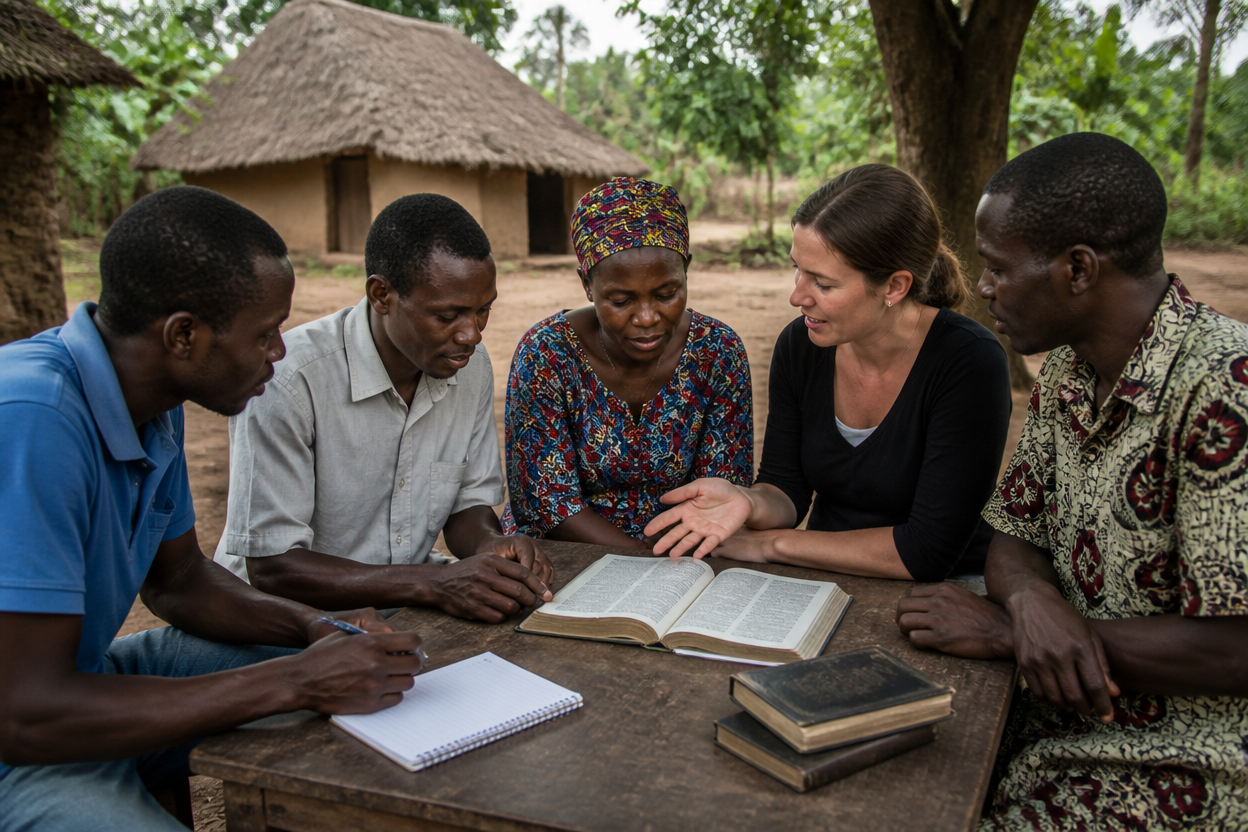
A translation timeline in one country may not generalize to another. Some languages have established writing systems and strong literacy, while others are primarily oral. Some communities have stable churches and trained local translators ready to lead; others are receiving Scripture in the context of first-generation discipleship. The same number of books can represent very different levels of complexity.
This is one reason we counsel donors to resist a single metric for “speed.” Faithful translation is not slow because ministries lack ambition. It is slow because accuracy, acceptance, and local ownership cannot be rushed without consequences for the church that will inherit the text.
Why the work takes time even when funding is available
Funding matters, but it is rarely the only constraint. Even well-funded projects can stall if a community loses key personnel, if conflict displaces leaders, or if checking systems cannot keep pace with drafts. Mature ministries build timelines around bottlenecks that money alone does not remove.
Translation is a chain of dependencies
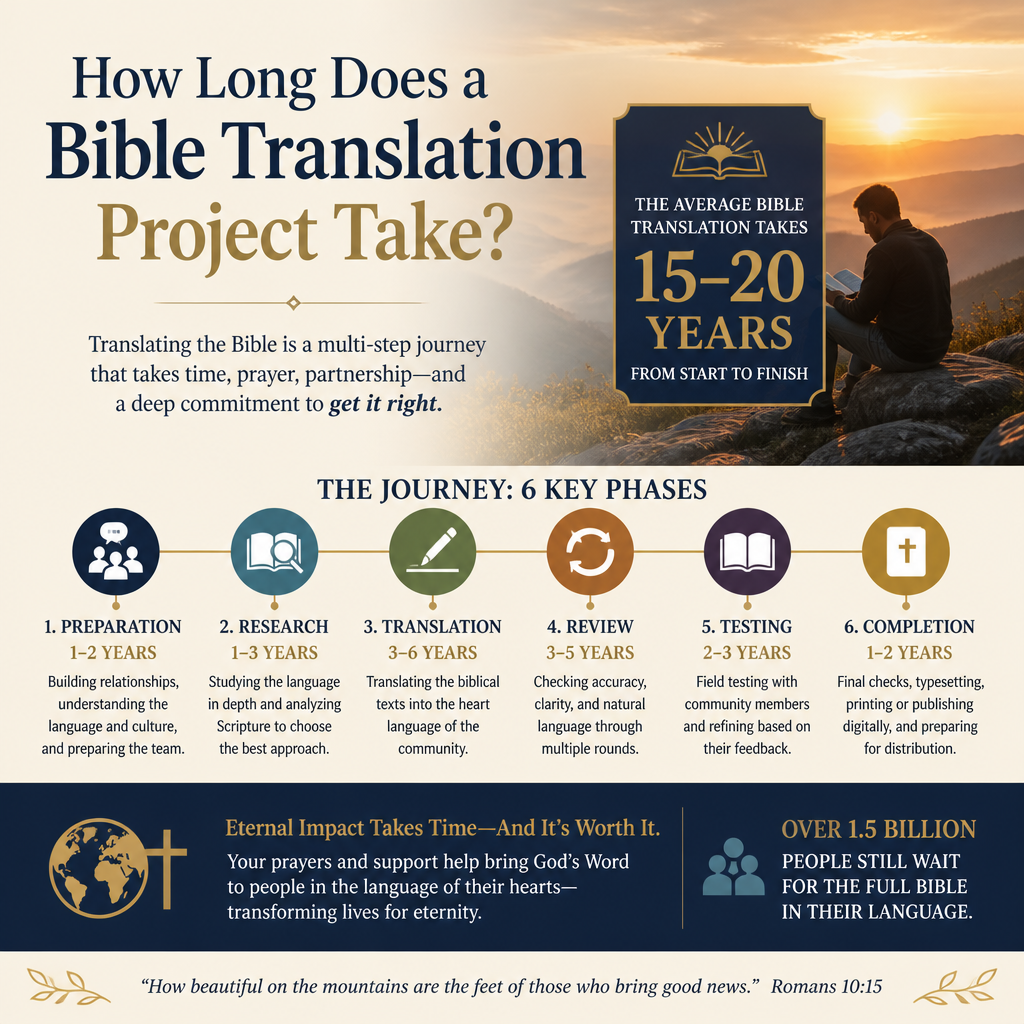
Most projects move through a sequence: exegesis and drafting, team review, community testing, consultant checking, and finalization for publication and distribution. Each stage depends on trust, skill, and availability. Consultant checking, in particular, can be a limiting factor because qualified translation consultants are relatively few and typically serve multiple projects.
The donor implication is straightforward: a ministry’s calendar is only as realistic as its staffing plan and its checking capacity. When a ministry promises a short timeline without describing how consultant checking, community testing, and local leadership development will be sustained, donors should ask harder questions.
Language development and literacy can be inseparable
Some communities have a language, but not a widely used written form. In those settings, translation may require orthography decisions, dictionary work, literacy materials, and teacher training before Scripture can be read broadly. That is not a detour from the mission; it is part of what it means to give Scripture to a people in a form they can receive and pass on.
Donors sometimes hesitate here, concerned that literacy work “dilutes” translation. Yet the biblical aim is not only the existence of a text but the formation of a Scripture-shaped people. Nehemiah 8 presents a picture of public reading, explanation, and communal understanding, not merely the production of scrolls. The ministry of the Word is always a ministry to people.
Quality controls protect the church from avoidable harm
Christians sometimes speak about Bible translation as if the primary risk is delay. The more sobering risk is error that becomes institutionalized in a young church. Translators must be accountable not only for sincerity but for fidelity—rendering the meaning of the original languages faithfully and clearly in the receptor language.
Accuracy and naturalness must be tested, not assumed
Teams generally check for several layers of quality: exegetical accuracy, consistency of key terms, clarity, and naturalness of expression. Community testing is not a token step. It reveals where phrasing miscommunicates, where terms carry unintended connotations, and where theology is distorted by ordinary misunderstandings rather than by malice.
These controls are one reason timelines extend. They are not bureaucratic hurdles; they are safeguards for the church’s long-term health. James warns that teachers will be judged with greater strictness (James 3:1). Translation work participates in the church’s teaching ministry at scale. Precision is a moral duty.
Orthodoxy and local ownership must be held together
A project can fail in two opposite ways. It can prioritize speed and produce an untrusted translation that local churches do not use. Or it can prioritize community acceptance in a way that yields theological vagueness, avoiding necessary doctrinal terms to reduce controversy. Faithful ministries aim for both: a translation the church embraces and a text that bears the weight of apostolic teaching.
Donors serve this work well by funding the “invisible” parts: training for local translators, consultant checking, and the repeated cycles of revision that make a translation dependable. The aim is not merely a launch event; it is decades of Scripture use in worship, preaching, and discipleship.
What donors should look for in a ministry timeline
Christian donors are not obligated to become linguists. Yet donors can assess whether a ministry’s timeline reflects reality and whether the organization is accountable for stewardship. Across our verification work at Most Trusted, we see that the ministries that meet The Most Trusted Standard tend to describe their process plainly, name constraints honestly, and report progress with enough specificity that supporters can understand what has been completed and what remains.
Markers of a credible plan
A responsible timeline is usually accompanied by several features: clear phases, measurable milestones, and a coherent explanation of risks. It should also clarify the intended product: first translation versus revision, print versus oral, and the relationship between translation and Scripture engagement.
We also recommend paying attention to governance and financial integrity signals. Translation projects are long-duration commitments; donors deserve assurance that reserves, budgeting discipline, and leadership oversight are strong enough to weather disruptions. The “Overhead Myth” conversation has helped donors resist simplistic ratios, but it also clarified that transparency and outcome reporting are essential to trust. Stanford Social Innovation Review
Questions that clarify stewardship
The following questions tend to produce substantive answers from mature ministries:
How is progress measured? Chapters drafted, checked, and approved are not the same. A trustworthy report distinguishes them.
Who provides consultant checking? If checking depends on scarce external consultants, a timeline should reflect that constraint.
What is the plan for local leadership development? A project that cannot retain trained translators will repeatedly reset.
How will the church use the translation? Scripture engagement, literacy, audio distribution, and pastoral training are not optional accessories in many contexts.
Donors who want a broader view of how ministries in this space operate can consult our coverage of Bible Translation Ministries, where we evaluate organizations with consistent criteria rather than marketing claims.
How to think about urgency without turning translation into a race
Christians rightly feel urgency for the nations to hear God’s Word. Paul’s missionary ambition to proclaim Christ where he was not named (Romans 15:20) still shapes the church’s imagination. Yet urgency can become a subtle temptation: to measure faithfulness by speed rather than by integrity.
Faster is not always more faithful
Technology has changed parts of the workflow. Digital tools, remote collaboration, and improved linguistic resources can reduce friction. Oral Bible story sets and audio distribution can also bring Scripture content to communities sooner than a full print Bible.
At the same time, some pressures are structural. Community trust takes time. Training competent local translators takes time. Theological precision takes time. When a ministry shortens its timeline, donors should ask what has been removed: community testing, checking rigor, or leadership formation. The church that receives the translation will live with those trade-offs.
Different models serve different contexts
Christians genuinely disagree about optimal models: whether to prioritize speed through internal drafts and centralized checking, or to prioritize slower community processes that build deeper ownership. These are not merely technical disputes; they reflect different theological judgments about the relationship between text, church, and authority.
In our view, donors should fund what they can verify. That includes a ministry’s stated doctrine, its accountability structures, and its track record of producing translations that churches actually use. For donors wanting a deeper sense of processes and variations across organizations, our work on How Bible Translation Ministries Work is designed to make those differences legible without reducing them to slogans.
FAQs for How long does a Bible translation project take
Can a Bible translation be finished faster with more money?
Additional funding can remove real constraints: paying local translators fairly, supporting training, providing software and equipment, and sustaining teams through disruptions. Yet the critical path often includes factors money cannot instantly solve, such as consultant checking capacity, community testing cycles, and the time it takes to form competent local leaders. A ministry that treats money as the primary determinant of speed may be underestimating the human and ecclesial dimensions of the work.
Why do some projects produce Scripture portions quickly but take much longer to complete the full Bible?
Portions can be produced earlier to meet urgent discipleship needs, to support evangelism, or to begin Scripture engagement while longer-term work continues. Completing the full Bible requires sustained consistency across genres, careful terminology decisions that remain stable over time, and extensive checking. The early portions are often the beginning of a long commitment rather than evidence that the remaining work will be equally fast.
What faithful expectations look like for Christian donors
How long a Bible translation project takes is ultimately a question about what donors are funding: not merely a text, but the church’s reception of God’s Word in a language community. The most credible timelines are those that name the real work—drafting, checking, community testing, and leadership formation—without embarrassment.
Christian donors serve this mission best by giving with patience and discernment: funding the long obedience of translation work, asking for transparent milestones, and supporting ministries whose governance and reporting can bear the weight of multi-year promises. That posture honors the God who gives his Word, and it protects the church that will live by it.



