
How Bible translation ministries choose languages to translate is not a neutral technical question. It is a set of moral decisions about people, time, and scarce resources placed in the service of the Great Commission. Donors rightly ask whether a ministry’s language priorities reflect love of neighbor, respect for the local church, and sober stewardship rather than institutional momentum.
Scripture gives the theological frame. Pentecost was not a retreat from language difference but God’s public declaration that the gospel addresses people in their own tongues (Acts 2:6–11). And Paul’s ambition to preach “where Christ was not known” (Romans 15:20) presses ministries toward those still unreached, while the pastoral mandate to build up the church presses ministries toward depth, accuracy, and long-term usefulness. Mature translation work holds those together.
Language choice is a stewardship decision before it is a technical one
Translation is not only access but formation
A Bible in a language people do not actually use, trust, or read does not meaningfully serve the church. Many ministries therefore weigh “access” in more than one dimension: mother-tongue comprehension, literacy realities, and whether Scripture will be heard through audio, sung through Scripture songs, or read in print. What counts as a “language” also varies by context; the difference between a language and a dialect can be linguistically complex and politically charged.
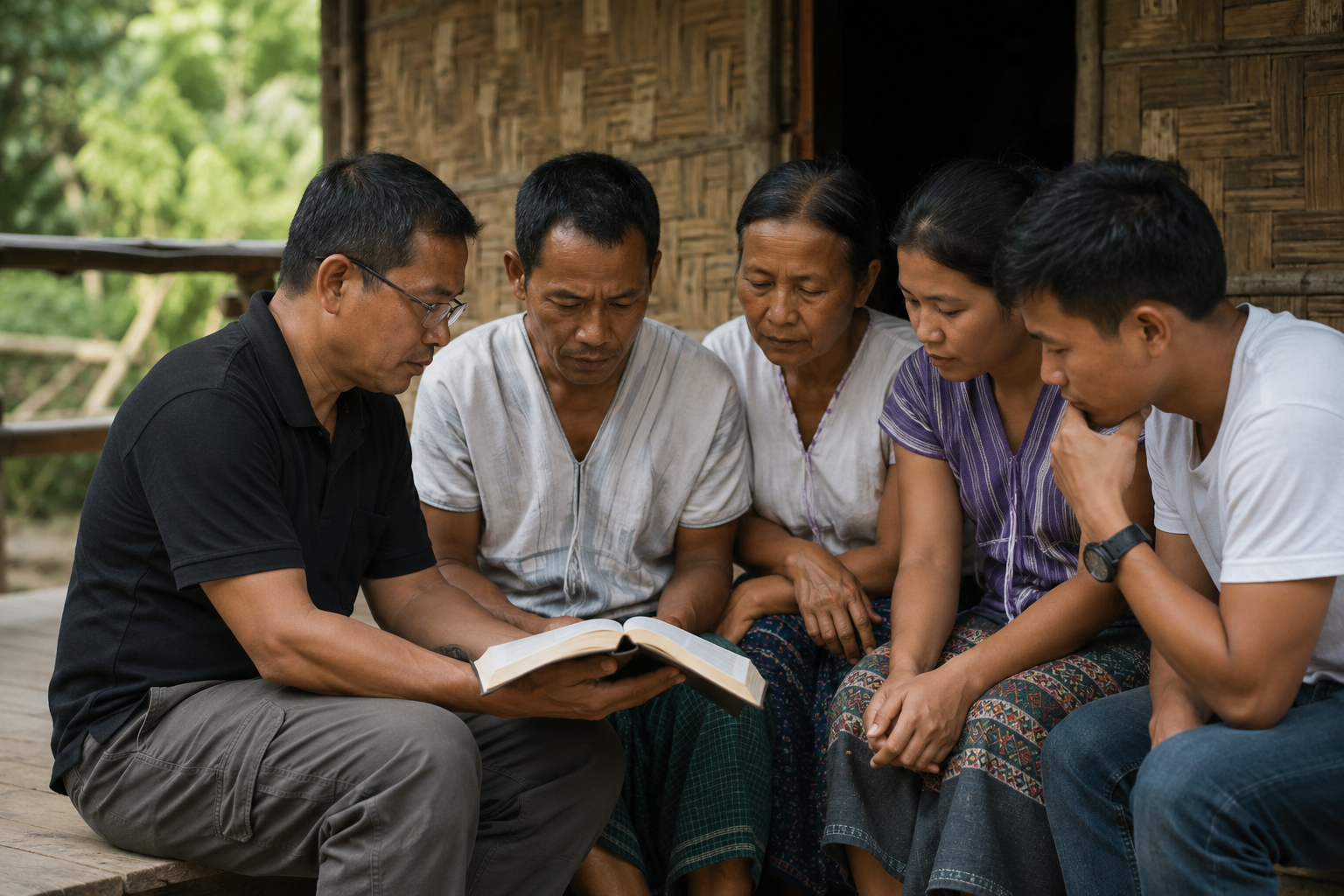
These decisions are also ecclesial. A translation that becomes the shared text for preaching, catechesis, and discipleship can shape doctrine and church health for generations. That is why ministries often prioritize communities where there are credible local church partners ready to receive, test, and use the translation, rather than treating translation as a standalone product that can be “delivered” from the outside.
Why urgency and excellence compete with each other
Christians genuinely disagree about the right balance between speed and precision. Some argue for rapid first translations to reduce the spiritual isolation of unreached peoples; others emphasize that a poor translation can introduce lasting confusion, fracture church unity, or weaken confidence in Scripture. In practice, serious ministries build decision systems that make trade-offs explicit rather than denying them.
Across How Bible Translation Ministries Work, the recurring pattern is that language selection is never only about need. It is also about feasibility, sustainability, and the long obedience of training local believers to carry Scripture into the life of the church.
Most ministries begin with global need, then narrow to local viability
The “Bibleless” category is real but not simple
Many ministries start with global mapping of languages that lack a full Bible or lack any Scripture at all. Those maps are often built using established field datasets that track language status, church presence, and translation progress. One widely used benchmark is the number of languages that still lack a complete Bible; as of 2024, the number reported by Wycliffe Global Alliance was 3,526 languages without a full Bible translation (Wycliffe Global Alliance).
That number, while sobering, does not settle priorities. A single language may have multiple partial translations of varying quality, or it may be close enough to a neighboring trade language that some leaders prefer investing in distribution and literacy rather than beginning a new translation. In other cases, mutual intelligibility is overstated by outsiders, and local believers insist on mother-tongue Scripture because comprehension and dignity both matter.
Viability includes church presence, not only linguistic data
Translation ministries often ask whether there is a credible community of believers who will own the work. This is not a denial that Scripture can precede revival; it is a recognition that translation is normally a multi-decade process requiring local leadership, review, and sustained use. Ministries that treat the local church as an afterthought tend to produce translations that struggle to be adopted.
Viability also includes security and access constraints. In restricted contexts, translation may need to be done with heightened discretion, with special attention to safeguarding local believers. Donors sometimes interpret the resulting lack of public detail as evasiveness; sometimes it is prudent protection. The harder question is whether a ministry can still offer meaningful accountability without exposing partners to risk.
Language prioritization depends on how ministries define impact
First Scripture versus full Bible versus durable use
Some organizations prioritize “first Scripture”—a Gospel, key passages, or a New Testament—as the fastest path toward Scripture engagement and evangelism. Others prioritize a full Bible, arguing that the whole counsel of God is necessary for mature discipleship and for guarding the church from distortion. Many pursue a staged strategy: initial portions to seed use, followed by a longer path to a full canon.
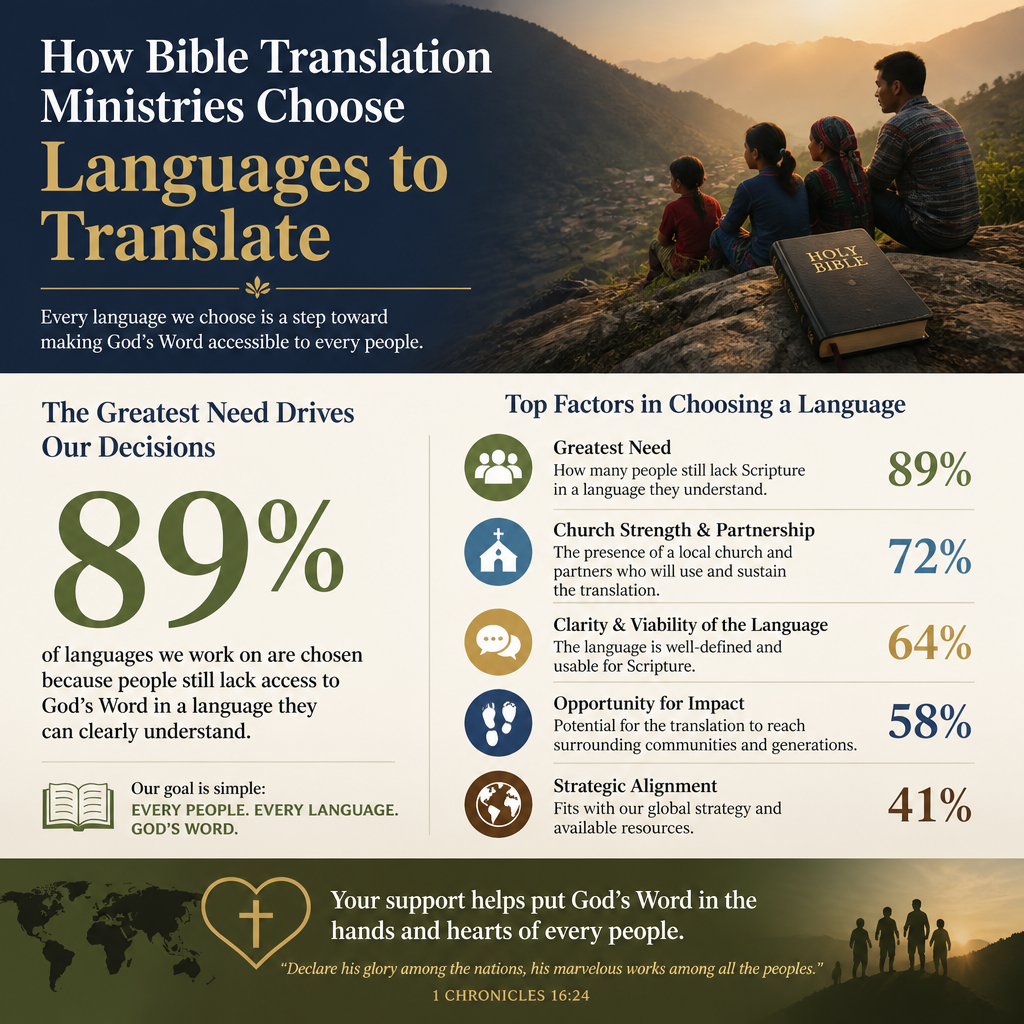
Impact, in mature translation programs, is measured not merely by completion milestones but by adoption: whether churches read it publicly, whether pastors preach from it, whether families use it at home, and whether it shapes prayer and song. Ministries may therefore prioritize a smaller language community with high likelihood of deep use over a larger community where adoption barriers are severe.
Literacy and orality are not secondary concerns
Language choice can change when literacy is low or when the community’s dominant learning patterns are oral. A print-only strategy in an oral context can unintentionally restrict Scripture to a narrow educated class. Increasingly, ministries integrate audio Scripture, story-based engagement, and local media pathways as part of the translation plan, not as an afterthought.
Here donors should press for clarity. A ministry’s claims about “impact” should be anchored in a plausible theory of how Scripture will actually be received and used in that language community, and how translation will connect to teaching, discipleship, and church strengthening.
Wise language selection includes governance, ethics, and local ownership
Who decides matters as much as what is decided
Language choices can become distorted when decisions are driven primarily by donor visibility, institutional expansion, or the preferences of outside advocates. A theologically serious ministry will have governance that resists those pressures: clear criteria, documented processes, and decision-making that meaningfully includes local Christian leaders, not merely as endorsers but as participants.
This is one place where donor due diligence can move beyond sentiment to accountability. At Most Trusted, our verification work evaluates ministries against The Most Trusted Standard, with attention to Faith Foundation, Financial Integrity, Governance and Leadership, and Transparency and Effectiveness. A credible language-selection process usually leaves a paper trail: published criteria, clear partner roles, and a willingness to explain trade-offs without defensiveness.
Ethical tensions in naming, counting, and claiming outcomes
Even basic reporting can raise ethical questions. What counts as “a translation project”? How do ministries count languages when one language has multiple regional varieties, or when standardization is contested? How do they report progress when security constraints limit public updates? The field has had to reckon with the temptation to overclaim, especially when fundraising depends on simple narratives.
Donors should not punish ministries for complexity, but we should require honesty. The ministries most worthy of trust tend to describe limitations plainly: what they know, what they do not know, and what would need to be true for a new language project to be responsible.
- Stated criteria for selecting languages, not only inspirational stories
- Local church involvement in planning, review, and adoption
- Realistic timelines and staged goals that fit the context
- Safeguarding practices appropriate for restricted environments
- Evidence of use after completion, not only completion metrics
What donors should ask before funding a new language project
Questions that reveal whether priorities are disciplined
Donor intent often centers on reaching the unreached, but disciplined compassion asks more. A new language project can be a faithful use of funds, and it can also be a high-risk undertaking if governance is weak, local partnership is thin, or feasibility is overstated. Strong ministries welcome careful questions because they share the premise that the work belongs to Christ and must be handled reverently.
We recommend asking for specificity that can be verified without requiring the ministry to endanger partners. Where public reporting must be limited, a trustworthy organization usually has alternative accountability practices: third-party review, board oversight documentation, or restricted reporting to qualified donors under appropriate confidentiality.
Connecting language choice to broader credibility
A language-selection story can be compelling while the institution behind it is fragile. Translation is long-term work: staffing, training, review cycles, community testing, and ongoing revisions require financial stability and governance depth. Donors who want to give with confidence should therefore evaluate not only the need but the organization’s capacity to finish well and to serve the church after launch.
For donors comparing ministries working in this space, Bible Translation Ministries is a helpful place to situate language choices within the wider set of institutional questions that shape outcomes over decades.
FAQs for How Bible translation ministries choose languages to translate
Do ministries prioritize the largest languages first?
Not always. Some prioritize larger languages because a translation may serve millions and can accelerate Scripture engagement at scale. Others prioritize smaller languages because the need is acute, the community may be more isolated, and the likelihood of mother-tongue adoption may be higher. Mature prioritization usually weighs both: scale of potential access and the plausibility of durable use through the local church.
Why not translate into a regional trade language everyone already uses?
Trade languages can be crucial for evangelism, education, and broader communication, and many ministries do invest heavily in them. The limitation is that “everyone uses it” can mean “everyone uses it for commerce,” not for prayer, confession of sin, grief, or the most intimate forms of understanding. Mother-tongue Scripture often strengthens comprehension and dignity, and it can deepen the church’s worship and discipleship in ways a second language cannot. The responsible question is not trade language versus mother tongue as a principle, but which approach will best serve the church in that specific community.
A faithful language strategy serves the church for generations
Language selection is where theology, missiology, and institutional integrity meet. The ministries that choose well tend to be both ambitious and restrained: ambitious about reaching those without Scripture, restrained about what they can responsibly promise, and committed to local ownership as a matter of Christian ethics. Donors who fund translation with discernment participate in a work that is larger than any organization, trusting that God delights to make his Word known in the languages of real people, in real places, for the building up of Christ’s church.



