

How donors pray for Bible distribution ministries effectively is not a question about religious sentiment; it is a question about spiritual stewardship. Bible distribution sits near the center of Christian mission because “faith comes from hearing, and hearing through the word of Christ” (Romans 10:17). When donors pray, we are not trying to add spiritual atmosphere to a transactional gift. We are asking the Lord to accomplish what only the Spirit can do through the Word.
The harder question is what we should pray for when the work involves translation timelines, shipping lanes, hostile governments, digital security, and real organizational risk. Bible distribution can be faithful and still be ineffective; it can be efficient and still be spiritually thin; it can scale fast and still lose accountability. Serious prayer names those tensions instead of denying them.
Pray for the Word to be received, not merely delivered
Ask for comprehension, repentance, and endurance
The New Testament does not treat Scripture as a neutral object that becomes powerful when it arrives. Scripture is living and active (Hebrews 4:12), and yet Jesus’ parable of the sower shows that the same seed can be choked, scorched, or stolen (Matthew 13:1–23). Donors pray effectively when we ask God to prepare hearts and communities for the Word’s true work: conviction of sin, faith in Christ, durable obedience, and love for neighbor.
This changes the tone of our prayers. We pray for new readers to understand what they read, for pastors and lay leaders to teach with integrity, and for churches to form around Scripture rather than around personality or politics. And we pray for endurance, because in many settings the first open reading of Scripture creates relational strain, not immediate social stability.
Pray for churches, not only individual readers
Bible distribution ministries often describe “access” as the primary obstacle. Access matters, but Scripture itself points beyond access toward embodiment. The Word gathers a people; it forms worship, discipline, mercy, and mission. Donors can pray for Bible distribution ministries to serve local churches rather than replace them, to strengthen pastors rather than bypass them, and to resist a consumer model of discipleship where the Bible is treated as a private spiritual product.

Pray for integrity where money and mission meet
Ask God to protect ministries from measurable temptations
Whenever donors fund a tangible unit—Bibles printed, devices delivered, languages completed—ministries face the temptation to chase the easiest numbers. The incentive pressures are not imaginary. The more closely fundraising is tied to countable outputs, the more leaders must guard against inflated reporting, selective storytelling, and “success” metrics that ignore long-term spiritual fruit.
Prayer should be specific: for honest reporting, for leaders who fear God more than they fear donor disappointment, and for boards that ask hard questions early. Donors can also pray for ministries to resist the “Overhead Myth” instinct that starves operational capacity and increases risk. The sector has formally warned against using overhead ratios as a proxy for trustworthiness in an open letter signed by GuideStar, Charity Navigator, and the BBB Wise Giving Alliance (GuideStar).
Pray for wise stewardship decisions, not just lower costs
Cost control is not the same as stewardship. A ministry may cut “overhead” and quietly increase errors in distribution, compliance, or security. The biblical category is faithfulness: “it is required of stewards that they be found faithful” (1 Corinthians 4:2). Pray for finance teams, auditors, and operations leaders to have clarity; for leaders to fund internal controls; and for donors to have the humility to support what is boring but essential.
Across our verification work at Most Trusted, we see a consistent pattern: ministries that meet The Most Trusted Standard tend to name their risks plainly and build governance to match the scale of their work. That posture is not cynicism; it is moral seriousness about handling resources given for God’s purposes.

Pray for the realities on the ground that donors rarely see
Ask for protection, wisdom, and cultural clarity
Bible distribution happens in environments that range from mildly inconvenient to actively dangerous. Some teams operate under surveillance; some must secure devices and user data; some rely on local partners who bear the highest personal cost. Donors can pray for protection without romanticizing risk, and for wisdom without demanding recklessness as proof of faith.
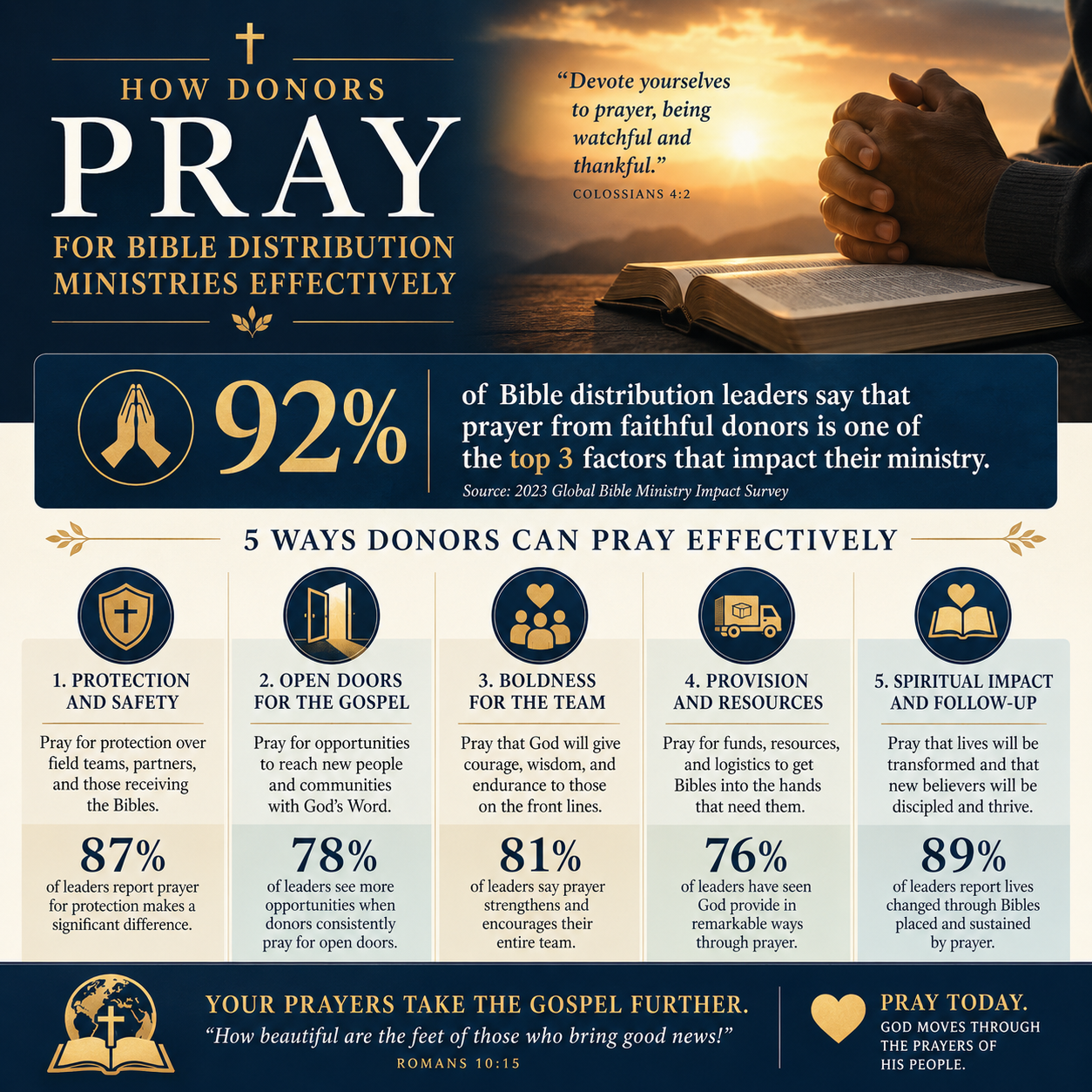
We also pray for cultural clarity. Translation and distribution are not merely technical. They require discerning local meanings, avoiding avoidable offense, and refusing paternalism. A ministry can introduce Scripture and still export foreign assumptions about leadership, gender, wealth, or spiritual authority that confuse rather than clarify the gospel.
Pray for partnership that honors local leadership
The field has had to reckon with the limits of outsider-driven strategy. The When Helping Hurts framework, articulated by Steve Corbett and Brian Fikkert, has shaped many Christian organizations’ thinking about unintended harm, dependency, and dignity in poverty-related work (When Helping Hurts). Bible distribution is not identical to poverty relief, but the same moral principle applies: help that diminishes agency is not Christian help.
Donors pray effectively when we ask that local pastors and believers would set direction, that foreign organizations would listen well, and that resources would flow in ways that strengthen long-term indigenous capacity.
Pray with discernment about models of distribution and impact
Print, audio, digital, and hybrid models each carry trade-offs
The question is not whether “a Bible” is good. It is whether a given model serves the people it targets, under the conditions they live in, with reasonable confidence that the ministry can deliver what it promises. Print Bibles can be durable and sharable; they can also be seized at borders. Audio Scripture can serve oral learners; it can also attract surveillance if devices are conspicuous. Digital access can multiply reach; it can also expose users to data risk and to a flood of unvetted teaching.
Donors can pray for ministry leaders to choose models aligned with local realities, not donor preferences. We can also pray for sober measurement—enough to learn and improve, not so much that the ministry reduces discipleship to dashboards.
Pray for transparency that deepens trust rather than performs it
Christians genuinely disagree about how much detail a ministry should publish in hostile contexts. Some information can endanger partners. Yet secrecy can also shelter poor governance. The mature posture is principled transparency: sharing what can be shared, explaining what cannot be shared, and submitting to accountable oversight.
As donors, we should pray for ministries to communicate with candor and restraint, and to welcome third-party scrutiny where appropriate. For readers who want to frame this within the broader work of Bible Distribution Ministries, we refer to Bible Distribution Ministries as a context for the kinds of organizations, approaches, and accountability questions donors routinely encounter.
Pray as donors who act, not as donors who outsource obedience
Intercession should shape how we give and how we ask questions
Prayer does not replace diligence. In Scripture, petition and prudence belong together. Nehemiah “prayed to the God of heaven” and also posted guards and organized labor (Nehemiah 4:9). Donors pray effectively when intercession leads to concrete, appropriate actions: asking better questions, funding what is necessary, and refusing to demand unrealistic results.
One place to be concrete is to pray through a short set of ministry-specific requests that align with how Bible distribution actually works:
- For faithful translation and review processes that protect doctrinal clarity and linguistic accuracy.
- For secure, lawful, and ethically sound distribution channels that do not expose local believers unnecessarily.
- For governance strong enough to resist exaggeration, financial mismanagement, and spiritual celebrity.
- For local churches and leaders to have authority, training, and long-term support around Scripture engagement.
- For donors to give with humility, consistency, and patience rather than episodic urgency.
Pray for verification, accountability, and the courage to be examined
Donors often feel the strain between trust and skepticism. The call is not naïveté, but neither is it cynicism. The church is a body, and the body needs truthful speech (Ephesians 4:25). Prayer for Bible distribution ministries should include a request that organizations welcome examination, correct course when needed, and tell the truth when outcomes fall short.
Most Trusted exists to serve donors at precisely this point: helping givers evaluate ministries against The Most Trusted Standard, a 15-criteria framework spanning faith foundation, financial integrity, governance and leadership, and transparency and effectiveness. When donors pray for verification work to be done well—in ministries and in independent evaluators—we are praying for a healthier ecosystem where gospel work is strengthened by truth.
For those specifically seeking a prayerful posture that also supports responsible giving and long-term partnership, we connect this discussion to Praying for and Supporting Bible Distribution Ministries as the broader category of donor practices that join intercession, discernment, and material support.
FAQs for How donors pray for Bible distribution ministries effectively
Should donors pray for specific numbers, like Bibles printed or languages completed?
It is appropriate to pray for tangible milestones, because Scripture treats material provision and human planning as real instruments in God’s providence. But numeric goals should be prayed in submission to deeper ends: faithfulness, safety, truthful reporting, and lasting Scripture engagement in local churches. When donors pray only for higher numbers, we can unintentionally reward pressure that leads to exaggeration or poor risk decisions.
How can donors pray when ministries cannot share details for security reasons?
Donors can pray at the level of moral and operational realities: for protection of local partners, for wisdom in communications, for strong governance, and for accountable oversight behind the scenes. It is also reasonable to ask whether the ministry can explain its security constraints clearly and whether it submits to credible external accountability, even when it cannot publish sensitive details.
Praying that matches the weight of the work
Bible distribution ministries handle a holy trust: placing the Scriptures into the hands and homes of people who may never have had them, and doing so amid pressure that is spiritual, financial, political, and organizational. Donors pray effectively when we ask God for fruit that only he can give, and when we pray in ways that discipline our own giving—toward truth, accountability, and long obedience. The Word is not fragile, but those who carry it still need wisdom, protection, and integrity.



