

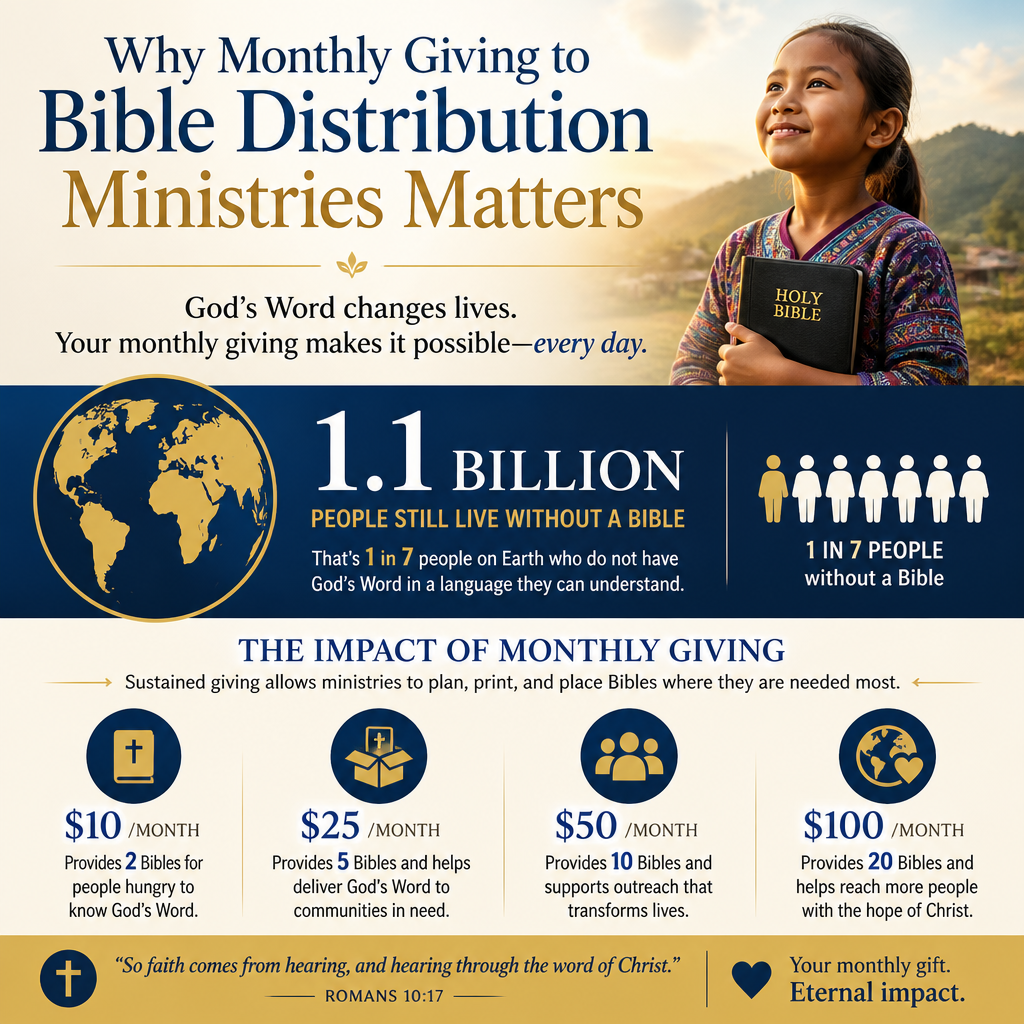
Monthly giving to Bible distribution ministries matters because the work is rarely episodic. Translating, printing, shipping, and placing Scripture where it can be read with understanding is a long obedience in the same direction, with costs and constraints that do not arrive on a donor calendar. When the church funds Bible access primarily through one-time gifts, ministries often have to plan as if the next season of provision might not come, even when the spiritual need is steady.
Scripture itself normalizes both the urgency of proclamation and the patience of formation. Paul’s ambition to preach where Christ was not named required logistics, companions, and sustained support from churches that understood partnership as more than occasional generosity (Philippians 4:15–17). Monthly giving is not a superior class of faithfulness, but it is a disciplined form of participation that aligns donor practice with how distribution actually happens.
Monthly giving underwrites the unglamorous work that makes distribution possible
Bibles do not distribute themselves
Many donors picture Bible distribution as a simple transaction: print a Bible, put it in a hand. In practice, the ministry is usually a chain of interdependent steps—translation review, Scripture engagement planning, printing schedules, freight, customs compliance, warehousing, last-mile delivery, and local partnership. Disrupt one link and the whole effort slows or collapses.
Recurring support is especially material for ministries that carry fixed commitments. Printing and freight often require deposits and contracted timelines, and translation work is labor-intensive and multi-year. A predictable base of monthly partners allows a ministry to commit responsibly rather than operate with chronic contingency.
Cash flow shapes ethical decisions
Financial pressure can create quiet ethical compromises in any charitable field, and Bible work is no exception. When a ministry’s revenue spikes around campaigns and collapses afterward, leaders are tempted to promise more than they can deliver, or to chase the most photogenic distribution opportunities rather than the most strategic ones.
Christians genuinely disagree about which distribution models are best in every context—mass distribution events, church-based placement, literacy-linked programs, digital-first approaches, or combinations. But across our verification work at Most Trusted, we observe that stable, recurring revenue tends to reduce reactive decision-making and increase a ministry’s ability to explain its choices with clarity and accountability.

Monthly giving strengthens both reach and staying power
Access requires endurance
The mission is not only to place Bibles, but to sustain access over time. Some regions experience recurring crises—conflict, inflation, disrupted shipping lanes, or sudden policy changes. Those shocks can turn “successful distribution” into “stalled inventory” overnight. Monthly giving provides the resilience to absorb volatility without abandoning local partners or cutting corners.
There is also a spiritual realism to this. The word of God does not return void (Isaiah 55:11), but distribution ministries are not exempt from the ordinary constraints of the world we live in. Donors who commit monthly help keep the work faithful when it is slow, contested, or administratively costly.
A broader donor base can mean less dependence risk
One concentrated major gift can be an extraordinary blessing. It can also create fragility if a ministry becomes dependent on a few donors whose priorities may shift. A healthy monthly program can diversify revenue and steady governance, because leaders are less pressured to orient the organization around a small set of expectations.

For donors, this is a form of prudence. If a ministry can articulate a coherent monthly giving strategy, it often signals that leadership is thinking about sustainability rather than only the next mailing cycle. That does not guarantee effectiveness, but it is one indicator we consider as we evaluate ministries against The Most Trusted Standard.
Monthly giving can protect ministry integrity and donor confidence
Recurring support invites measurable planning
Donors often ask for “impact,” but the more demanding question is whether a ministry can plan and report in a way that is actually verifiable. A recurring revenue base makes it easier to set realistic targets—how many languages can be advanced through defined translation stages, what print runs can be responsibly scheduled, which partnerships can be supported with training and follow-up.
This is where Christian donors benefit from independent verification. Most Trusted exists to help donors give with confidence by evaluating ministries against The Most Trusted Standard, a 15-criteria framework that examines faith commitments, financial integrity, governance, and transparency. Monthly giving is not an end in itself; it is one way a ministry can fund disciplined execution and honest reporting.
Accountability is not opposed to faith
Some Christians fear that emphasizing governance, controls, and reporting reflects a lack of trust in God. Scripture does not share that fear. Paul took pains to administer gifts honorably, “not only in the Lord’s sight but also in the sight of man” (2 Corinthians 8:20–21). Donors should not feel guilt for asking whether recurring gifts are stewarded with competence.
Monthly giving also gives donors a consistent vantage point. Over time, it becomes easier to notice whether a ministry communicates with integrity, reports results without exaggeration, and responds to scrutiny without defensiveness. Stewardship is formed through practice, and recurring giving forms both the donor and the organization.
Monthly giving clarifies what kind of partnership a donor is actually offering
Not every donor is called to the same pattern
Some donors can make large, decisive gifts that move translation or printing forward dramatically. Others are more able to give modest amounts consistently. We should not romanticize one pattern and disparage the other. The question is faithfulness under providence: what can be sustained with joy and without hidden resentment?
Monthly giving is particularly fitting for donors who want to fund the “middle layers” of ministry—administration that serves mission, partner training, compliance work, and the steady back-end labor that rarely appears in a newsletter photo. Mature donors often recognize that these layers are not distractions from ministry; they are a form of love for neighbor when done with discipline.
Practical marks of a healthy monthly giving invitation
Monthly giving programs vary widely. Some are built for long-term partnership; others are built for short-term acquisition and donor churn. As donors consider Bible distribution ministries, the following signs tend to indicate seriousness:
- Clear explanation of how recurring gifts support specific ongoing work, not vague “general ministry needs.”
- Restraint in promises, especially around rapid “reach” claims that cannot be verified.
- Evidence of local partnership and contextual humility rather than one-directional exporting.
- Financial reporting that is accessible and consistent year to year.
- Leadership willingness to name constraints and trade-offs without spin.
For donors who want a broader view of how this sector operates and how ministries differ, our coverage of Bible Distribution Ministries places monthly giving in context alongside translation, engagement, and access strategies.
Monthly giving should follow discernment, not sentiment
Distribution without engagement can become mere placement
The field has had to reckon with a hard truth: distribution is not automatically discipleship. Placing Bibles where literacy is low, where no church presence exists, or where follow-up is impossible can yield weaker outcomes than donors assume. Some ministries address this through oral Bible storying, literacy programs, or church-anchored Scripture engagement; others focus on digital tools where print is impractical.
Christians will weigh these approaches differently. The point is not to demand a single model, but to insist on coherence: a ministry should be able to explain why its method fits the context, what partnerships make it viable, and how it avoids superficial counting.
How donors can test whether monthly support is warranted
Monthly giving is most fruitful when it is attached to a ministry that can bear the weight of recurring trust. Before committing, donors should ask questions that go beyond the emotional appeal:
Does the ministry have audited or professionally reviewed financial statements, and are they accessible? Is governance credible, with meaningful oversight rather than a symbolic board? Does leadership communicate theologically with clarity, avoiding both prosperity logic and marketing-driven urgency? Does reporting distinguish between Bibles printed, shipped, distributed, and actually used in Scripture engagement settings?
These are the kinds of questions addressed in our analysis of How to Give Wisely to Bible Distribution Ministries, where we encourage donors to pair generosity with evidence-based discernment.
FAQs for Why monthly giving to Bible distribution ministries matters
Is monthly giving always better than a one-time gift?
No. One-time gifts can fund major translation milestones, strategic print runs, or urgent replacement after conflict or disaster. Monthly giving is valuable because it funds continuity and reduces volatility, but it should be chosen because it is sustainable for the donor and genuinely useful for the ministry, not because it signals spiritual maturity.
What should we look for before starting a monthly gift to a Bible distribution ministry?
We recommend confirming baseline transparency and governance first: clear doctrinal commitments, credible leadership oversight, accessible financial reporting, and candid explanation of distribution methods and partners. Monthly giving creates an ongoing relationship, so the ministry’s communication practices and willingness to be accountable matter as much as the initial appeal.
A form of steadiness that matches the work
Bible distribution ministries operate at the intersection of spiritual urgency and operational patience. Monthly giving matters because it funds the long arcs—translation progress, print planning, partner training, and follow-up—that make access durable rather than momentary. For donors who want their generosity to be both faithful and responsible, recurring support is often one of the simplest ways to align giving with the reality of the mission.



