
How donors can support foster care ministries is not a question of sentiment; it is a question of faithful stewardship under complexity. Scripture’s concern for children without stable family protection is unmistakable, yet modern child welfare systems, trauma science, and congregational capacity all introduce trade-offs that serious Christian donors must face directly.
Foster care is also structurally different from many causes that donors understand instinctively. The state holds legal custody. Case plans change. Reunification is often the stated goal. Outcomes rarely fit a clean narrative. What this means for Christian giving is that the most effective support often looks less like “sponsoring a child” and more like strengthening the people and institutions that surround a child for years.
Begin with a theology of neighbor love and authority
Foster care ministry sits at the intersection of mercy and public mandate
Christian donors rightly begin with God’s self-description as “Father of the fatherless” and with the New Testament’s insistence that “religion that is pure and undefiled” includes practical care for vulnerable children. Yet foster care is not only a private work of mercy; it is a public legal arrangement. The state is charged with protecting children when safety has broken down, and the church’s role is often to stand alongside a system we do not control, serving children and families without pretending we can replace lawful authority.
That posture guards donors from two errors. One is cynicism that dismisses child welfare agencies as irredeemable. The other is idealism that assumes good intentions can override legal constraints, family bonds, or clinical realities. The ministries that endure are usually those that can honor a child’s story, respect court processes, and still embody the church’s calling to sacrificial love.
Reunification and adoption are not interchangeable ends
Christians genuinely disagree about the relative emphasis foster care ministries should place on reunification, kinship care, and adoption. Donors should not avoid that disagreement; it should shape due diligence. In the United States, federal policy has long prioritized family preservation and reunification when safely possible, while also setting timelines intended to prevent children from languishing without permanency. Those are hard objectives to hold together.
One practical implication is that donors should ask ministries to articulate a coherent theology and practice of permanency that does not treat birth families as obstacles. In many cases, supporting a foster care ministry means supporting supervised visitation, parent coaching, substance-use recovery partnerships, and concrete assistance that can make reunification safer, not only underwriting foster parent recruitment.

Fund what actually stabilizes placements and reduces harm
Prioritize trauma-informed, relationship-based support
Placement instability compounds trauma. When children are moved repeatedly, they lose schools, friends, routines, and adults they had begun to trust. A large national study of children in foster care found that many experienced multiple placements during their time in care, with instability associated with poorer outcomes; the details are nuanced by age and circumstance, but the central pattern is consistent across the literature. Donors who want to do tangible good should fund the supports that keep stable, safe placements from collapsing under predictable pressure.
Effective foster care ministries often fund or coordinate respite care, 24/7 crisis lines, clinically informed coaching, transportation help, and support groups that reduce isolation. These are not glamorous line items, but they are often the difference between a child sleeping in the same bed next month or being moved again.
Support kinship caregivers who are often under-resourced
In many jurisdictions, kinship care is a major feature of the foster care landscape. Grandparents, aunts, uncles, and close family friends take in children with little notice, often while juggling fixed incomes, health limitations, or housing constraints. Donors can fund practical supports that child welfare systems frequently struggle to provide quickly: beds, car seats, school uniforms, legal aid for guardianship proceedings, and short-term rental assistance.
For donors seeking a reliable overview of ministries working across this breadth, we maintain coverage of Orphan Care Ministries in Adoption and Foster Care with attention to how organizations approach family-based care, safeguarding, and measurable support for caregivers.
Ask verification-grade questions before you give
Foster care invites generous giving and also demands accountability
Because foster care involves vulnerable children, mandated reporting environments, and complex power dynamics, Christian donors should treat governance and safeguarding as first-order concerns. Across our verification work at Most Trusted, we observe that strong ministries do not merely state values; they document practices. They can show evidence of background checks, child-safety policies, incident reporting procedures, and partnerships with licensed professionals when clinical issues arise.
Most Trusted evaluates ministries against The Most Trusted Standard, a 15-criteria framework spanning Faith Foundation, Financial Integrity, Governance and Leadership, and Transparency and Effectiveness. For foster care ministries, this framework helps donors move beyond storytelling to verifiable signals of maturity: board oversight, conflict-of-interest controls, audited or professionally reviewed financials where appropriate, and program metrics that are honest about limits.
Healthy ministries resist the overhead fallacy
Foster care support is people-intensive. Training, supervision, counseling partnerships, case coordination, and compliance require skilled staff. Donors should be wary of simplistic pressure to minimize “overhead” in ways that hollow out capacity and increase risk. The broader charitable sector has repeatedly warned that the overhead ratio is a poor proxy for effectiveness; major evaluators have emphasized that governance, transparency, and outcomes matter more than chasing an artificially low administrative percentage. See the public statement commonly referred to as the “overhead myth,” signed by leading charity information organizations and BBB Wise Giving Alliance. BBB Wise Giving Alliance
The harder question is whether staffing and administration are appropriately disciplined and clearly connected to child safety, caregiver support, and measurable service delivery. Donors should ask for budgets that tell that story with clarity.
- What safeguards protect children from inappropriate access, including volunteers and short-term visitors?
- How are foster parents and kinship caregivers trained, coached, and supported in crisis?
- What partnerships exist with licensed clinicians, schools, and child welfare agencies?
- How does the ministry handle reunification and birth-family engagement in practice?
- What evidence of impact is tracked, and what outcomes are acknowledged as outside the ministry’s control?
Give in ways that match the system children are actually in
Understand the scale and constraints of the U.S. foster care system
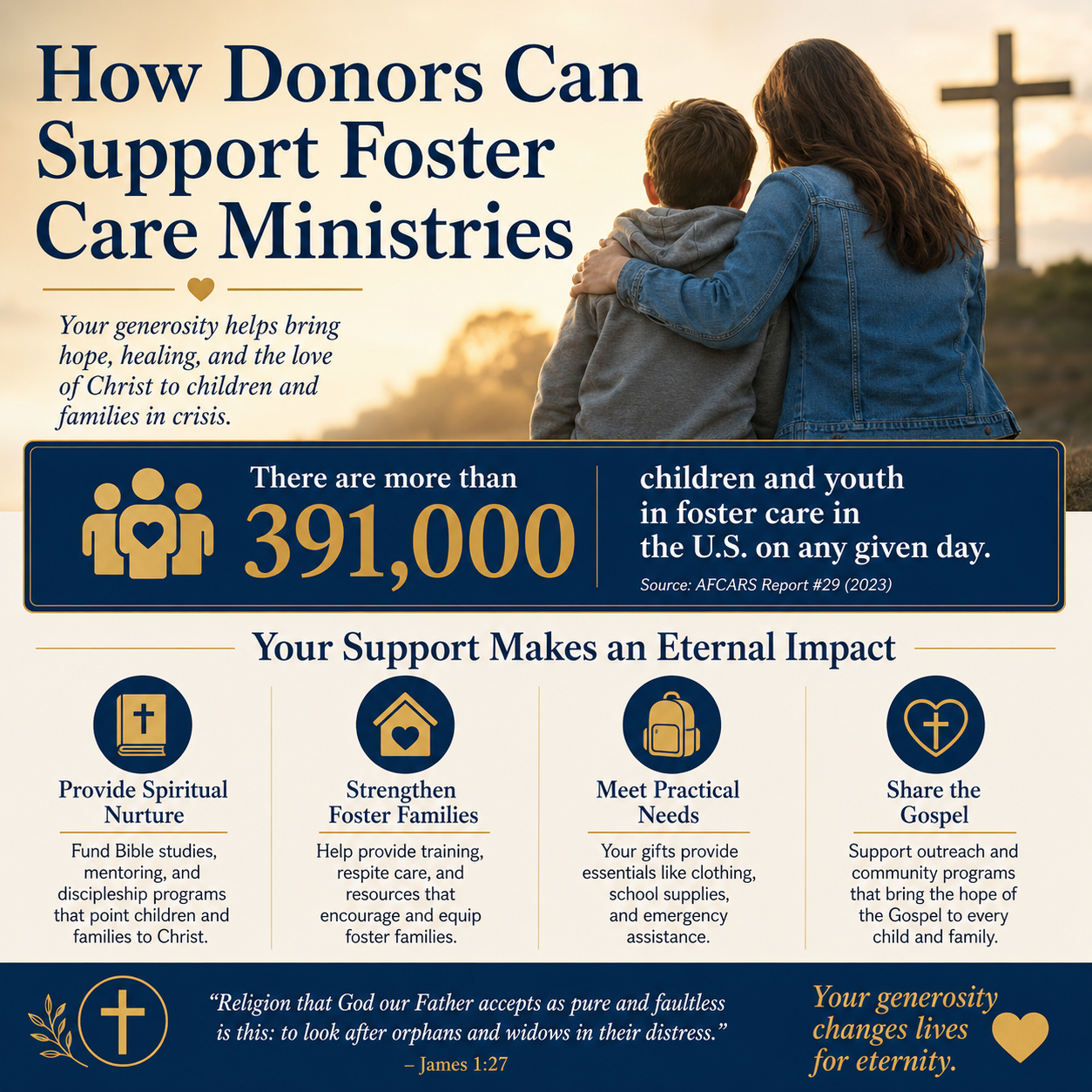
Donors sometimes assume foster care is a marginal issue. It is not. The U.S. Department of Health and Human Services reports that hundreds of thousands of children are in foster care in the United States in a given year, with entries and exits driven by a range of safety concerns and family crises. Those numbers fluctuate year to year, but the scale is consistently large enough that localized, church-based responses must be connected to wider systems to be durable. Administration for Children and Families
What this means in practice is that donors should fund ministries that can operate within state and county constraints, communicate well with agencies, and avoid incentives that unintentionally compete with reunification or kin placements. Coordination is not a sign of compromise; it is often a sign of realism.
Favor long-term capacity over one-time gestures
Short-term giving can meet real needs, but foster care ministries usually require long-term donor maturity. Recruiting foster families without retaining them is an expensive churn cycle that can harm children. Funding a one-time event without funding the case management that follows can create false expectations. Donors who want to reduce harm should consider multi-year support, especially for leadership development, caregiver retention, and clinical partnerships.
For donors who want a broader theological and practical lens on this work, we also address the wider landscape of Orphan Care Ministries, including debates the movement has had to face around institutional care, family preservation, and the unintended consequences of well-meant charity.
Support the people who carry the daily weight
Strengthen foster parents and kinship caregivers as a ministry to the child
Children experience foster care through the stability, presence, and competence of the adults who care for them. Donors can support ministries that treat foster parents and kinship caregivers not as heroic mascots but as neighbors in need of sustained support. That includes mental health resources, marriage and family counseling access, peer communities, and respite rhythms that keep households intact.
Donors should also watch for ministries that understand secondary trauma. Caregivers and ministry staff can absorb the weight of children’s stories over time. Programs that normalize supervision, counseling referrals, and healthy limits tend to be more durable than programs that depend on perpetual emergency-mode sacrifice.
Invest in birth-family support without naïveté
Birth families are often living with addiction, mental illness, domestic violence, housing instability, or generational trauma. Supporting birth families does not mean ignoring safety; it means acknowledging that many removals are symptoms of wider brokenness. Ministries that help parents complete case plans, secure employment, access treatment, and build safe support networks can contribute to reunification when it is appropriate and to safer permanency when it is not.
This is also where donors should expect careful boundaries. A ministry can honor birth parents’ dignity while still holding firm lines around child protection, supervision requirements, and truthful communication about risk.
FAQs for How donors can support foster care ministries
Should donors prioritize adoption funding over foster care support?
Donors should prioritize the child’s best interest and the ministry’s demonstrated competence, not a single pathway. Adoption can be a faithful and necessary outcome for children who cannot safely return home, but foster care ministries often create impact earlier in the timeline by stabilizing placements, supporting kinship caregivers, and helping families address the conditions that led to removal. The most responsible giving asks which interventions reduce harm and increase safe permanency in the specific community being served.
What are the clearest signs a foster care ministry is trustworthy?
Trustworthiness shows up in governance, safeguarding, and transparent evidence of practice. Donors should look for documented child-safety policies, clear volunteer access limits, staff and foster parent training expectations, financial statements that are understandable and appropriately reviewed, and outcome reporting that is honest about complexity. Ministries that meet The Most Trusted Standard tend to communicate with clarity, submit to oversight, and resist fundraising narratives that oversimplify children’s stories.
Faithful support is measured in stability, not spectacle
Foster care ministries serve children whose lives have already been disrupted, and donors should not add instability through impulsive or poorly vetted giving. The most constructive support funds the unglamorous work: training, crisis response, clinical partnerships, and long-term caregiver retention. When donors pair biblical conviction with verification-grade diligence, the result is not merely generosity, but neighbor love with staying power.



